


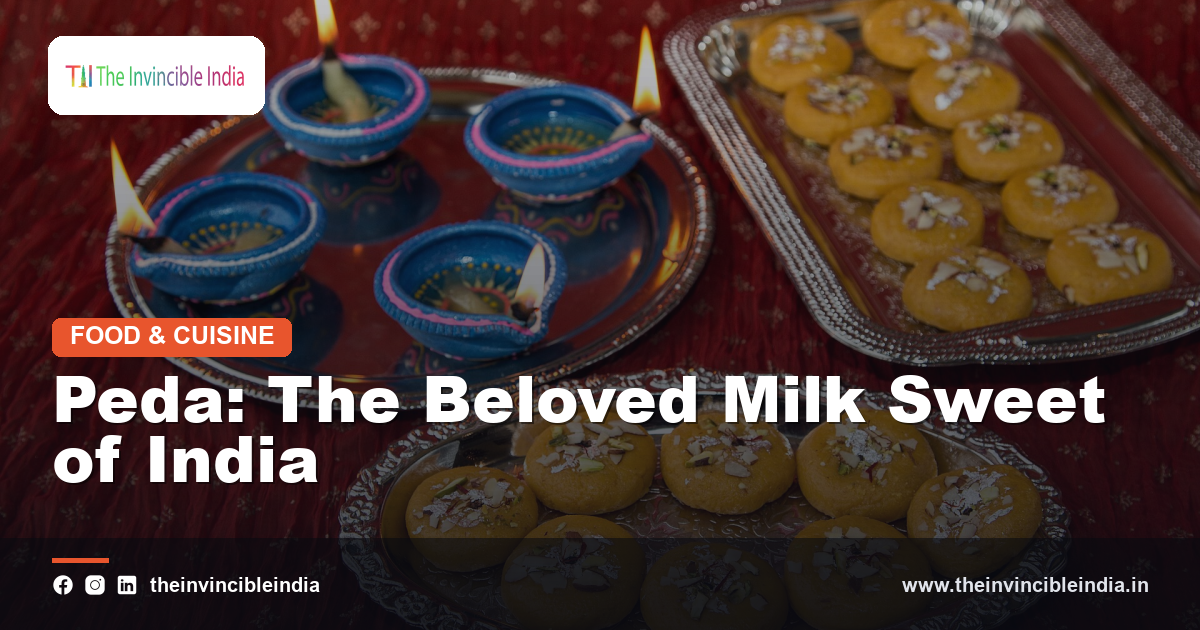
Peda is a soft, fragrant milk sweet made by slowly cooking milk solids with sugar and cardamom until the mixture thickens into a fudge-like dough that is then shaped into small discs. Simple in its ingredients yet rich in taste, it is offered at temples, exchanged at celebrations and given as a token of good news in homes across the country. Like many of the famous sweets of India, peda reflects the deep cultural importance of milk and the patience of the traditional halwai. This guide explores peda, its ingredients, its regional styles and its lasting place in India’s culinary heritage.
Quick Facts
| Detail | Information |
|---|---|
| Type | Milk-based fudge-like sweet |
| Main ingredients | Khoa (milk solids), sugar and cardamom |
| Shape | Small round or oval flattened discs |
| Famous styles | Mathura peda and Dharwad peda |
| Occasions | Festivals, weddings, births and temple offerings |
| Character | Soft, rich and gently sweet |
What Peda Is
Peda is a traditional Indian sweet made from khoa, the thickened milk solids that remain when milk is simmered slowly until most of its water evaporates. The khoa is cooked with sugar and flavoured with cardamom, then shaped into small round or oval discs that are often pressed with a pattern on top. Its texture is soft and slightly grainy, melting easily on the tongue, and its flavour is mellow, milky and warmly fragrant. Peda is among the most widely recognised sweets in the country and is made in every region in one form or another. As a straightforward union of milk, sugar and spice, peda captures the essence of the Indian mithai tradition.
The Place of Milk in Indian Sweets
Milk holds a special place in Indian culture, valued as a pure and nourishing food and offered in worship, and this respect shapes a vast family of milk-based sweets. Rasgulla, barfi, kalakand, rabri and peda all depend on the transformation of milk through slow heating, curdling or reduction. Dairy farming has long been part of rural life, and cattle occupy a respected position in many traditions. Turning surplus milk into sweets also served a practical purpose, allowing its richness to be preserved and enjoyed. Peda belongs firmly within this heritage, and its very existence testifies to the central role that milk has played in the food and belief of the subcontinent.
Origins and Early Traditions
The precise origin of peda is not documented, yet it is widely regarded as a very old sweet of northern India, long associated with the milk-rich regions of the Braj area and the Gangetic plains. Sweet-makers in temple towns are believed to have perfected the craft over many generations, preparing large quantities for pilgrims and worshippers. Over time, the sweet spread outward through trade, pilgrimage and migration, acquiring local characteristics wherever it settled. Because such histories are largely passed down through community memory rather than written record, exact dates are best left unstated. What remains certain is that peda has been a treasured sweet for a very long time, deeply woven into everyday and ritual life.
Khoa: The Foundation of the Sweet
Khoa, also called mawa, is the heart of peda and the key to its character. It is made by simmering full-cream milk in a wide vessel, stirring constantly, until the water evaporates and the milk solids gather into a thick, pale mass. The quality of the khoa depends on the milk, the heat and the patience of the cook, and skilled sweet-makers can judge readiness by touch and smell. Freshly made khoa gives peda its creamy, faintly caramelised flavour. Because it is so central, the choice of khoa often distinguishes one maker from another. A peda is, above all else, a celebration of well-made khoa, and this humble ingredient carries the whole sweet.
Sugar, Cardamom and Other Flavours
Sugar is added to the warm khoa in measured quantity to sweeten it and to help the mixture bind and set into shape. Cardamom is the classic flavouring, its sweet, floral aroma lifting the milk and lending peda its unmistakable fragrance. Some makers add saffron for colour and depth, a few strands of which give a golden tone, while others use nutmeg, rose water or a touch of ghee. Chopped pistachios or almonds are often pressed onto the surface as decoration. The balance among sweetness, spice and milk is subtle, and each sweet-maker guards a preferred proportion. Together these gentle additions give peda a warm, comforting profile that appeals across generations.
How Peda Is Made
Making peda begins with cooking khoa in a heavy pan over low heat, adding sugar and cardamom, and stirring steadily until the mixture leaves the sides of the pan and forms a soft dough. It is then allowed to cool slightly so that it can be handled. Small portions are rolled into balls, flattened between the palms and often pressed with a thumb or a mould to create the familiar rounded disc, sometimes with a shallow dent in the centre. Skilled makers work quickly and evenly, producing pedas of consistent size. The process demands patience rather than complicated technique, and it is this careful, unhurried handling that gives good peda its smooth texture and gentle flavour.
Mathura Peda and the Braj Tradition
Among the best-known regional styles is Mathura peda, associated with the town of Mathura in Uttar Pradesh, which is revered as the birthplace of Krishna and lies at the heart of the Braj region famed for its dairy tradition. This peda is typically deeper in colour, with a granular texture and a rich, slightly caramelised flavour achieved by cooking the khoa until it turns a warm brown. It is a customary offering at temples in the area and a favourite souvenir for pilgrims. Its reputation is tied closely to the town’s religious character. In this context, Mathura peda serves as both a sweet and a symbol, linking food to devotion in one of India’s most sacred landscapes.
Dharwad Peda and Southern Traditions
In Karnataka, the city of Dharwad has become famous for its own distinctive peda, which is known for a dark brown colour, a firm yet soft texture and a deep caramelised flavour. It is generally associated with a family of sweet-makers who settled in the town and developed a specialised technique, and it has earned wide recognition as a regional speciality. Travellers passing through the region often carry boxes of it home. Its character differs noticeably from the northern style, showing how a shared idea can evolve into something regionally unique. The example of Dharwad illustrates how peda has taken root in the south and become a cherished local identity.
Other Regional Styles
Peda is prepared in many other parts of India, with each region adjusting the recipe to local taste. In Gujarat and Maharashtra, pedas are commonly made for festivals and are sometimes flavoured with saffron or nutmeg, while Bengali sweet-makers work with chhena-based confections that share a family resemblance. Some regions produce a lighter, paler peda, while others favour a darker, more intensely cooked version. Sweet shops in almost every town have a house recipe. This variety shows that peda is less a single fixed sweet than a broad tradition, one that has adapted gracefully to local ingredients, climates and preferences across the vast and diverse geography of the subcontinent.
Peda as Prasad and Temple Offering
One of the most important roles of peda is as prasad, a sweet offering first presented to a deity and then distributed to devotees. Temples across India use it in this way, and pilgrims often purchase boxes of peda to offer and to carry home. Because it keeps reasonably well and is easy to portion, it suits the practical needs of large gatherings. Receiving a peda as prasad is understood as receiving a blessing, and the sweetness carries symbolic meaning of goodwill and grace. This spiritual dimension is central to peda’s identity, elevating it from simple confectionery to a food that connects everyday pleasure with devotion and faith.
Peda at Festivals and Celebrations
Peda is a fixture of Indian celebration, appearing at festivals such as Diwali, Raksha Bandhan, Janmashtami and Ganesh Chaturthi, and at family milestones including weddings, engagements, births and academic successes. Sharing sweets is an essential gesture of joy in India, and a box of peda is among the most common ways of announcing good news. Guests are welcomed with it, neighbours exchange it, and children eagerly await it. Its sweetness and universal appeal make it suitable for people of different communities and regions. In this way, peda functions as a small social bond, a sweet that marks moments of happiness and strengthens the ties of family and community.
Peda and the Halwai Craft
The making of peda is part of the wider craft of the halwai, the traditional Indian sweet-maker whose skill is passed from generation to generation. Such craftsmen learn to judge the readiness of khoa, the right sweetness and the proper shaping through years of practice rather than written instruction. Many sweet shops are family businesses that have operated for decades and take pride in the consistency of their recipes. Customers often remain loyal to a particular shop for its peda. This tradition of apprenticeship and reputation gives the sweet a human dimension, reminding us that behind every well-made peda lies a lineage of patient handwork and cultivated judgement.
Peda Compared with Other Milk Sweets
Peda shares its milk-based foundation with barfi, kalakand, milk cake and gulab jamun, yet it has features of its own. Barfi is usually set in a slab and cut into squares, kalakand has a moist, granular texture from curdled milk, and gulab jamun is fried and soaked in syrup. Peda, by contrast, is shaped by hand into small discs and has a soft, dense, melting quality without any syrup. It is also comparatively simple, relying on only a few ingredients. These differences allow each sweet to occupy its own niche in the mithai repertoire, and peda’s modest, unfussy character has helped it remain a perennial favourite among them.
Storage, Serving and Etiquette
Peda is usually served at room temperature, often arranged on a plate and garnished with slivers of pistachio or almond. Because it is rich in milk solids, it is best eaten within a reasonable period, though its low moisture allows it to keep longer than many fresh sweets. Sweet shops pack it in boxes so that it can be carried as a gift, and offering a box is a customary courtesy when visiting a home. It is polite to accept a peda when offered, especially at celebrations. These simple habits reflect the etiquette of Indian hospitality, in which food is given and received with warmth, and peda serves as a graceful way of expressing goodwill.
Making Peda at Home
Many home cooks prepare peda for festivals, often using shortcuts such as milk powder, condensed milk or ready-made khoa to save time. The mixture is cooked gently with sugar and cardamom until it thickens, then cooled, shaped and decorated. Although these methods differ from the slow traditional approach, they produce a pleasing sweet that many families enjoy. Traditionalists still prefer to simmer milk for hours to develop the fuller flavour. The important habits remain the same, namely low heat, constant stirring and careful shaping. Home preparation keeps the sweet-making tradition alive within families, allowing children to learn the craft and ensuring that peda remains a personal, cherished part of celebration.
Cultural Symbolism of Sweetness
In Indian culture, sweetness carries symbolic weight beyond taste, representing auspiciousness, prosperity and goodwill. Beginning a new venture or marking success with something sweet is a widely observed custom, and peda is one of the most common choices for this purpose. Its pale, gentle appearance and milky flavour also associate it with purity. Literature, film and everyday speech frequently refer to the sharing of sweets as a sign of happiness. The simple act of offering peda thus communicates far more than hospitality, conveying hope, gratitude and affection. This symbolic richness is a major reason why the sweet has retained such an honoured place in social and religious life for so long.
Peda Today
Today peda remains one of India’s most beloved sweets, made by traditional halwais, by large confectioners and by families in their own kitchens. Modern versions include chocolate, mango, saffron and dry-fruit flavours, while packaged pedas travel easily to gift markets abroad. Despite such innovations, the classic milk peda scented with cardamom continues to hold first place in popular affection. As interest in regional foods and heritage sweets grows, styles such as Mathura and Dharwad peda receive renewed appreciation. Peda endures because it joins simplicity, devotion and celebration in a single small bite, carrying the sweet traditions of India confidently into the present day.
Sources & Further Reading
- Ministry of Culture, Government of India (indiaculture.gov.in).
- Food Safety and Standards Authority of India (fssai.gov.in).
Frequently Asked Questions
What is peda made of?
Peda is made from khoa, which is milk cooked down to a thick solid mass, along with sugar and cardamom. Some makers add saffron, nutmeg or nuts. The mixture is cooked, cooled and shaped into small discs.
What is the difference between Mathura peda and Dharwad peda?
Mathura peda comes from Uttar Pradesh and is usually granular and richly caramelised, associated with temple offerings in the Braj region. Dharwad peda comes from Karnataka and is known for its dark brown colour and firm yet soft texture. Both are milk-based but differ in style and technique.
Why is peda offered as prasad?
Milk is regarded as pure and nourishing in Indian tradition, and milk sweets are commonly offered to deities. Peda keeps reasonably well and is easy to distribute, so it suits temple use. Receiving it is understood as receiving a blessing.
How long does peda stay fresh?
Because peda is made from thickened milk solids with low moisture, it keeps longer than many fresh sweets, though it is best eaten within a few days. Storage conditions and the recipe affect freshness, so sweet shops usually advise consuming it promptly.
Can peda be made at home?
Yes, many home cooks make peda using khoa, milk powder or condensed milk with sugar and cardamom. The mixture is cooked gently, cooled and shaped by hand. The slow traditional method gives a deeper flavour, while shortcuts save time.