


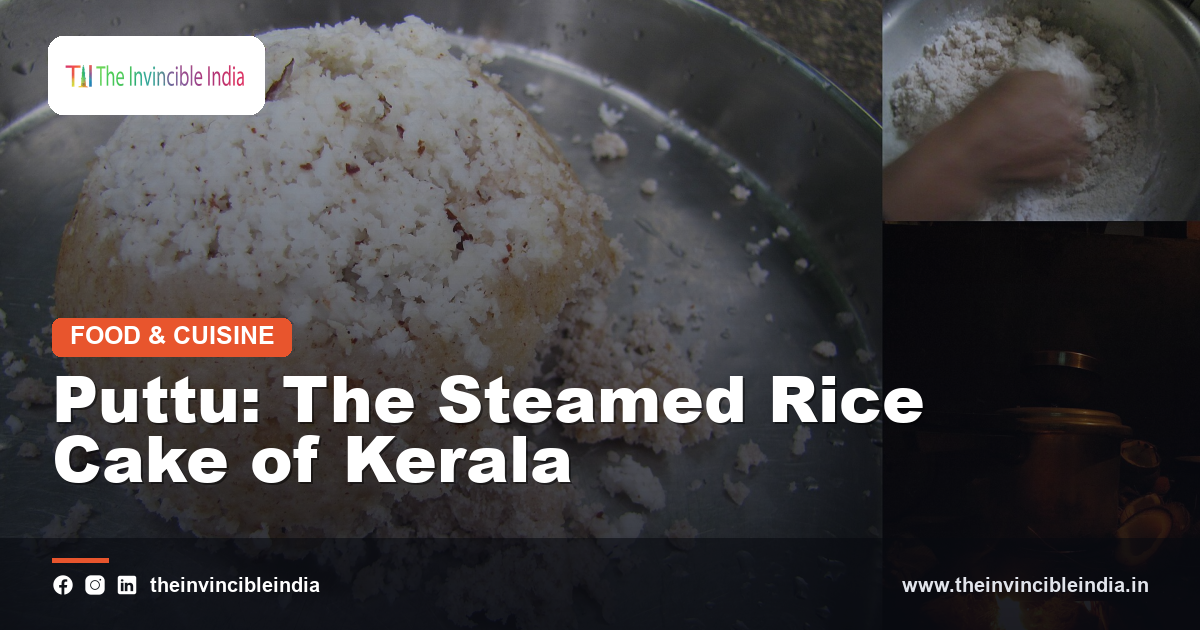
Puttu is the steamed cylinder of coarsely ground rice flour and freshly grated coconut that has anchored the Kerala breakfast table for generations. Cooked in a slender vessel over a rush of steam, it emerges as a soft, crumbly column that is broken apart and eaten with a spiced curry, ripe banana or crisp pappadam. Much as the wider Kerala cuisine reveals a coastal land devoted to rice and coconut, puttu shows how two humble ingredients and one clever technique can produce a dish of lasting appeal. This guide explores puttu, its method, its many pairings and its enduring place in Indian culinary heritage.
Quick Facts
| Detail | Information |
|---|---|
| Type | Steamed rice flour and coconut cake |
| Region | Kerala and neighbouring coastal areas |
| Main ingredients | Rice flour, grated coconut, salt and water |
| Classic partner | Kadala curry, banana or pappadam |
| Cooking method | Layered and steamed in a cylindrical vessel |
| Usually eaten | At breakfast or as a light evening meal |
What Puttu Is
Puttu is a steamed savoury cake made by layering lightly moistened rice flour with grated coconut inside a cylindrical mould and cooking it in the steam of boiling water. The result is a tall, soft cylinder that crumbles readily when broken, its texture somewhere between a fluffy cake and a moist crumb. It is neither fried nor baked, which gives it a light, clean quality that suits an early meal. Puttu is closely identified with Kerala, where it appears in homes, tea shops and restaurants across the state. As a simple steamed preparation of just a few ingredients, puttu remains one of the clearest expressions of how Kerala treats rice and coconut as the twin foundations of its food.
Origins and Regional Roots
Puttu has long been part of the culinary landscape of the southern coast, and the very word is commonly linked to a Tamil term connected with the idea of a portion or a crumbled mass. Steamed rice preparations are an old and widespread tradition across southern India, and puttu belongs to that family alongside idli and various steamed dumplings. It is popular in Kerala, in parts of Tamil Nadu and in Sri Lanka, where each region has developed its own preferences. Precise origins cannot be traced with certainty, but its deep local roots are unmistakable. As a dish with an ancient steaming tradition behind it, puttu carries the shared culinary memory of the southern coastal belt.
Rice Flour and the Right Texture
The character of puttu depends heavily on the rice flour, which is traditionally prepared by soaking rice, drying it and pounding or grinding it to a coarse, sandy consistency rather than a fine powder. This coarseness allows steam to pass between the grains and gives the finished cake its characteristic crumbly softness. Many households buy ready-made puttu podi, a flour prepared specially for this purpose, while others roast and grind it at home. The flour is then sprinkled with lightly salted water and rubbed gently until it holds together when pressed but falls apart when released. This careful attention to texture is what separates a light, airy puttu from a dense, heavy one, and it forms the heart of the craft.
The Role of Coconut
Coconut is the second pillar of puttu, and freshly grated coconut is layered alternately with the moistened flour inside the mould. Kerala takes its very name from the coconut palm in popular understanding, and the fruit appears in nearly every dish of the state, so its presence here feels entirely natural. The coconut adds moisture, gentle sweetness and a rich aroma that permeate the steamed cylinder as it cooks. It also creates small pockets that help steam circulate through the column. Puttu without coconut would be a much plainer thing, and this generous use of the fruit shows why coconut sits at the centre of Kerala cooking as a whole.
The Puttu Kutti and Steaming Method
Traditional puttu is cooked in a puttu kutti, a cylindrical steamer that fits over a small pot of boiling water and has a perforated disc near the base. The cook places the disc, adds a layer of coconut, then a layer of moistened flour, and repeats until the vessel is filled, finishing with coconut on top. Steam rising from the pot passes upward through the layers and cooks them in a few minutes. The cylinder is then pushed out gently with a stick or ladle handle. Bamboo, brass, aluminium and steel versions exist, and modern pressure-cooker adaptations are common. This distinctive vessel gives puttu its recognisable shape and remains the essential tool of the dish.
Kadala Curry, the Classic Companion
The most celebrated partner for puttu is kadala curry, a robust gravy made from black chickpeas cooked with onions, spices and often a coconut-based masala. Its earthy, slightly hot character contrasts pleasingly with the mild, soft puttu, and the gravy soaks into the crumbly cylinder as it is mixed together on the plate. Kadala curry is usually served hot, and its protein-rich chickpeas make the pairing filling and balanced. Households guard their own versions of the spice blend, and the aroma of roasting coconut and spices is a familiar morning scent in many Kerala kitchens. Together, puttu and kadala curry form one of the most recognised breakfast combinations in India, a pairing that feels inseparable in the regional imagination.
Banana, Pappadam and Sweet Pairings
Puttu is remarkably adaptable in its accompaniments, and one of the most beloved traditional pairings is simply ripe banana, mashed or eaten alongside the crumbled cake, sometimes with a sprinkle of sugar. Crisp pappadam, broken over the plate, adds a savoury crunch, while a spoonful of ghee or a little jaggery gives a different kind of richness. Some families eat puttu with green gram curry, egg curry, fish curry or meat stew, depending on the occasion. This flexibility means that puttu can shift easily between a sweet, simple meal and a hearty savoury one. Such adaptability, achieved without altering the dish itself, explains why puttu has remained a fixture of Kerala eating for so long.
Varieties: Ragi, Wheat and Beyond
Although rice puttu is the standard form, cooks have long explored other flours and fillings within the same steaming principle. Ragi puttu, made from finger millet flour, is valued for its dark colour and earthy flavour, while wheat puttu offers a more everyday alternative. Tapioca and cassava are also used in some households, reflecting the importance of tubers in the region. Stuffed versions, where a filling such as jaggery and coconut, or a savoury mixture, is placed inside, appear on festive tables and in modern restaurants. Bamboo-steamed puttu, known for its faint woody aroma, holds a special place among enthusiasts. This range of variations shows how a single basic method can support a wide and creative family of steamed dishes.
Puttu in the Kerala Breakfast Tradition
Breakfast in Kerala is a serious and varied affair, and puttu takes its place beside appam, idiyappam, dosa and idli in a rotation that families follow through the week. Puttu is prized because it is quick to steam, easy to digest and filling without being heavy, making it well suited to a working morning. Tea shops and small hotels serve it hot from the steamer, often with kadala curry or a simple accompaniment. It also serves as a light evening meal in some homes. Within this broader breakfast culture, puttu holds a particularly steady and dependable place, a dish that many Malayalis associate with comfort and with the ordinary rhythm of home life.
Puttu in Festivals and Family Life
Puttu is not restricted to any single festival, yet it appears on many tables during gatherings, holidays and family visits across Kerala, valued for the ease with which large quantities can be prepared. Communities of different faiths eat it, and its adaptability allows it to sit comfortably alongside both vegetarian and non-vegetarian dishes. The sight of a family gathered around freshly steamed puttu on a quiet morning, or of guests being served it with a special curry, is a familiar image of Kerala hospitality. It is a food shared rather than showcased. This ordinary yet meaningful role in daily and festive life is central to puttu’s standing as a genuinely cherished regional dish.
Puttu Beyond Kerala
Puttu is enjoyed beyond Kerala’s borders, particularly in neighbouring Tamil Nadu, where it appears in home cooking and in many restaurants, and in Sri Lanka, where a related steamed cylinder of rice flour and coconut is a familiar breakfast dish. Each region tends to favour its own accompaniments and slightly different flour preparations, yet the essential structure of layered flour and coconut remains the same. Communities of the Kerala diaspora have also carried puttu across the world, and many households abroad keep a puttu steamer in the kitchen. This wide reach demonstrates how a simple regional dish can travel and endure, remaining recognisable wherever coastal southern traditions have settled and taken root.
Nutrition and Everyday Value
Puttu is valued as a wholesome and easily digested meal, since it is steamed rather than fried and uses very little added fat. Rice supplies carbohydrate for energy, coconut contributes richness, and the accompanying chickpea or lentil curry adds protein and fibre, so that a plate of puttu and kadala curry forms a fairly balanced breakfast. Versions made with ragi or other millets add further fibre and minerals. As with any traditional food, portion and accompaniment matter, and preparations differ from home to home. Without making precise nutritional claims, it is fair to say that the steamed, low-oil nature of puttu has long made it a trusted everyday food, favoured by people of all ages for its gentleness and satisfying simplicity.
Regional Styles and Home Variations
Within Kerala itself, puttu is prepared with subtle differences from one region and household to the next. Some cooks prefer a slightly coarser flour, others a finer one, and the proportion of coconut varies according to taste. Coastal households may pair the dish with fish curry, while inland or plantation communities might serve it with different gravies. Cooks in some homes add a pinch of cumin or a few curry leaves to the coconut, while others keep it strictly plain. These small personal touches reflect the fact that puttu is a living home tradition rather than a fixed recipe. The result is a dish with a clear identity yet with generous room for family preference and local character.
Tools, Tradition and the Modern Kitchen
The traditional puttu kutti has been joined in recent times by electric steamers, pressure-cooker attachments and even instant puttu mixes, all designed to save time in busy households. Ready-to-use puttu flour is widely sold in shops, and many urban families rely on it for convenience. Some cooks feel that the older bamboo or brass vessels give a better aroma, and they continue to use them by choice. Restaurants have also experimented with presentation, shaping puttu in creative ways and pairing it with new fillings. Yet the underlying technique of layered flour and coconut steamed over boiling water has changed very little. This balance between convenience and tradition shows how a heritage dish adapts while keeping its essential character intact.
Making Puttu at Home
Home cooks approach puttu with a few consistent principles rather than rigid measurements. The flour should be moistened just enough to form loose crumbs that hold together when squeezed lightly, without becoming sticky or pasty. The coconut should be fresh and gently packed between layers, and the vessel should not be pressed too firmly, since steam must flow freely through the column. Steaming for a short time, until vapour escapes from the top, is usually sufficient. Serving puttu immediately, while it is still warm, gives the best texture. These modest guidelines, learnt through practice and passed down within families, explain why puttu is regarded as easy to prepare yet rewarding to perfect, a dish where small habits make a visible difference.
Cultural Meaning of a Simple Dish
Puttu carries meaning far beyond its modest ingredients, standing for the Kerala way of turning available produce into food that is nourishing, sociable and quietly elegant. It appears in memories of childhood mornings, in the conversation of tea shops and in the packed meals of travellers. Malayalam literature and film often use the dish as a marker of home and belonging. The rhythm of steam rising from the puttu kutti is, for many people, the sound of a household waking up. Such associations elevate puttu from mere sustenance to a cultural symbol. In this sense, the dish acts as a small but powerful emblem of Kerala identity and of the comfort of familiar food.
Puttu Today
Today puttu remains a treasured and widely eaten dish, prepared daily in Kerala homes and increasingly appreciated by food lovers elsewhere in India and abroad. Restaurants present it in traditional and inventive forms, while packaged flours and modern steamers keep it accessible for busy families. Interest in millets and lighter cooking has drawn fresh attention to its ragi and wheat versions. Even so, the essential pleasure of puttu, a warm cylinder of steamed rice and coconut broken over a fragrant curry, has not changed. As Kerala cuisine continues to gain recognition, puttu stands as one of its most approachable ambassadors, a humble steamed cake that carries the region’s culinary heritage into the present with quiet confidence.
Sources & Further Reading
- Ministry of Culture, Government of India (indiaculture.gov.in).
- Food Safety and Standards Authority of India (fssai.gov.in).
Frequently Asked Questions
What is puttu made of?
Puttu is made from coarsely ground rice flour layered with freshly grated coconut and steamed in a cylindrical vessel. A little salt and water are used to moisten the flour. Variations use ragi, wheat or tapioca flour.
What is puttu traditionally eaten with?
The classic accompaniment is kadala curry, a spiced black chickpea gravy. Puttu is also eaten with ripe banana, pappadam, ghee and sugar, green gram curry, or egg and fish curries. The choice often depends on the household and the occasion.
Is puttu healthy?
Puttu is steamed rather than fried and uses very little added fat, so it is generally considered a light and easily digested food. Paired with a chickpea or lentil curry, it makes a fairly balanced meal. Millet-based versions add extra fibre.
What is a puttu kutti?
A puttu kutti is the traditional cylindrical steamer used to cook puttu. It fits over a pot of boiling water and has a perforated disc at the base, allowing steam to rise through the layers of flour and coconut. It may be made of bamboo, brass, steel or aluminium.
Is puttu eaten only in Kerala?
Puttu is most closely associated with Kerala, but it is also popular in parts of Tamil Nadu and in Sri Lanka. Kerala communities living elsewhere in India and abroad also prepare it regularly, so it is widely recognised beyond the state.