


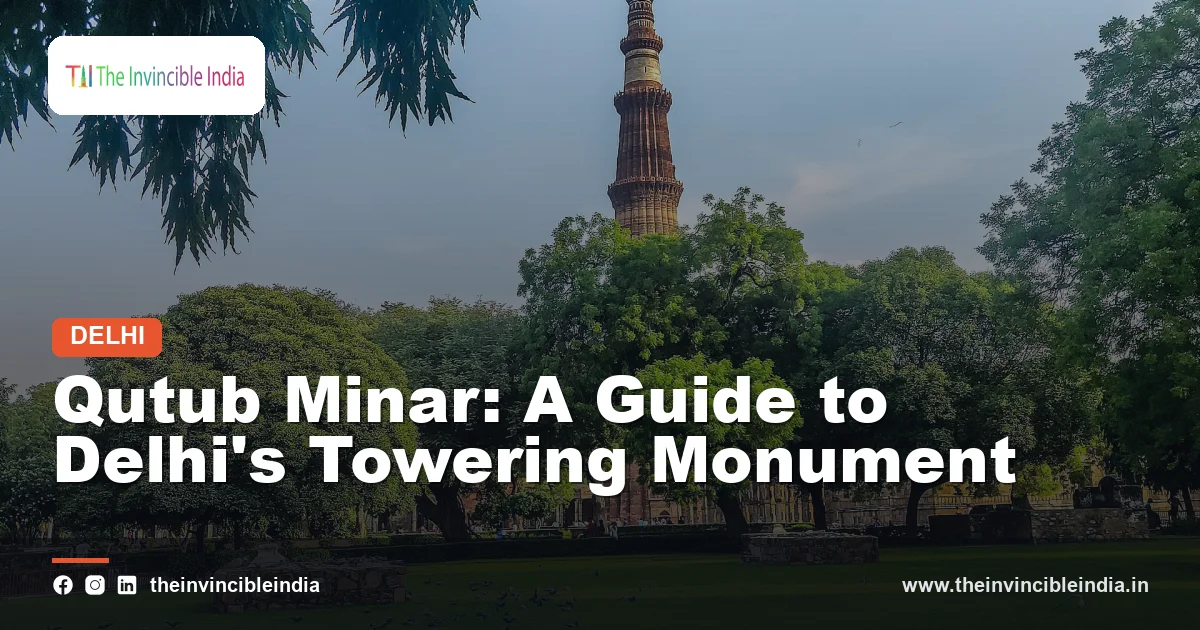
Soaring above the historic landscape of Delhi, the Qutub Minar is one of India’s most iconic monuments and the tallest brick minaret in the world. Built more than eight centuries ago, this magnificent tower of red sandstone and marble marks the beginning of Islamic rule in India and stands as a masterpiece of early Indo-Islamic architecture. A UNESCO World Heritage Site, the Qutub Minar and the fascinating complex of monuments around it draw millions of visitors each year. This guide explores the history, architecture and enduring wonder of this towering symbol of Delhi.
Quick Facts: Qutub Minar
| Detail | Information |
|---|---|
| Location | Mehrauli, Delhi |
| Height | About 73 metres (the tallest brick minaret in the world) |
| Begun by | Qutb-ud-din Aibak, around 1192 |
| Completed by | Iltutmish and later rulers |
| Material | Red sandstone and marble |
| UNESCO status | World Heritage Site (1993) |
The History of the Qutub Minar
The construction of the Qutub Minar began around 1192 under Qutb-ud-din Aibak, the founder of the Delhi Sultanate and the first of the so-called Slave dynasty, following his conquest of Delhi. Aibak built only the first storey; the tower was continued by his successor and son-in-law Iltutmish, who added three more storeys, and was later repaired and modified by subsequent rulers, including Firoz Shah Tughlaq, who rebuilt the upper sections after they were damaged by lightning. The minaret’s construction across several reigns is reflected in the subtle differences in style and material between its storeys.
An Architectural Masterpiece
The Qutub Minar is a triumph of early Indo-Islamic architecture, rising in five distinct storeys to a height of around 73 metres, tapering gracefully from a broad base to a narrow summit. The lower storeys are built of red sandstone, while the upper sections incorporate marble and sandstone, added during later repairs. The tower is encircled by projecting balconies supported on elaborately carved brackets, and its fluted, ribbed surface is covered with bands of intricate carving and inscriptions. A spiral staircase of many steps winds up the interior, though it is no longer open to the public.
The Inscriptions and Calligraphy
One of the most beautiful features of the Qutub Minar is the exquisite calligraphy that adorns its surface. Bands of inscriptions in Arabic and Persian, carved in elegant scripts, wind around the tower, containing verses from the Quran as well as historical details about its construction and the rulers who built and repaired it. Interspersed with the calligraphy are decorative geometric and floral patterns, reflecting a fusion of Islamic artistic traditions with the skills of local Indian craftsmen. These inscriptions are not only beautiful but also serve as valuable historical records of the monument’s long and complex history.
The Iron Pillar of Delhi
Within the Qutub complex stands one of the most remarkable objects in India, the famous Iron Pillar of Delhi. Dating back over 1,600 years to the Gupta period, this pillar of nearly pure wrought iron has stood exposed to the elements for centuries yet has famously resisted rust, a fact that has long puzzled and impressed metallurgists and testifies to the extraordinary skill of ancient Indian ironworkers. Bearing an ancient Sanskrit inscription, the pillar was brought to the site and has become one of the most intriguing attractions of the complex, a mystery of ancient science and craftsmanship.
The Quwwat-ul-Islam Mosque
Adjacent to the Qutub Minar are the remains of the Quwwat-ul-Islam Mosque, one of the earliest mosques built in India, whose construction began under Qutb-ud-din Aibak. The mosque is notable for having been built using materials from earlier temples that once stood on the site, and many of its pillars and carvings display Hindu and Jain motifs, reused and adapted in a striking blend of styles. This fascinating fusion of architectural traditions makes the mosque an important monument in its own right and a vivid illustration of the cultural encounters of the period.
The Alai Darwaza and Alai Minar
The Qutub complex contains several other notable structures, including the Alai Darwaza, a magnificent gateway built in the early 14th century by the Sultan Alauddin Khalji. Considered a gem of Indo-Islamic architecture, it is famed for its beautiful proportions, red sandstone and marble decoration, and elegant arches. Nearby stands the Alai Minar, the incomplete base of a tower that Alauddin Khalji intended to build twice the height of the Qutub Minar, but which was abandoned after his death, its massive stump remaining as a monument to imperial ambition that was never fulfilled.
The Qutub Complex Today
Together, the Qutub Minar and the monuments surrounding it form the Qutub complex, a UNESCO World Heritage Site and one of Delhi’s most popular and rewarding destinations. Set amid landscaped gardens in the Mehrauli area, the complex allows visitors to wander among centuries of history, from the towering minaret and ancient mosque to the mysterious Iron Pillar and elegant gateways, as well as the tombs and ruins that dot the grounds. The site is beautifully maintained and offers a peaceful and atmospheric escape from the bustle of the modern city.
Planning Your Visit
The Qutub Minar is located in the Mehrauli area of South Delhi and is easily reached by the Delhi Metro, with the Qutub Minar station nearby, as well as by road. The complex is open throughout the week, and the best time to visit is during the cooler months from October to March, ideally in the morning or late afternoon to enjoy the soft light and avoid the midday heat. Allow an hour or two to explore the complex fully. The monument is especially beautiful at sunset, and an annual cultural festival is sometimes held against its magnificent backdrop.
The Legends and Mysteries
Like many ancient monuments, the Qutub Minar and its complex are surrounded by legends and intriguing stories. The famous Iron Pillar, in particular, has inspired much wonder, and a popular tradition once held that anyone who could encircle it with their arms while standing with their back to it would have their wish granted, a practice now prevented by a protective fence to preserve the pillar. The very purpose of the great tower has also been debated, whether it was built primarily as a victory tower proclaiming the advent of a new rule, or as a minaret from which the call to prayer was sounded for the adjacent mosque. Such questions add to the monument’s enduring fascination.
Restoration and Preservation
Over its long history of more than eight centuries, the Qutub Minar has weathered earthquakes and lightning strikes, and has been repaired and restored several times by successive rulers and, in later centuries, by conservation authorities. These repairs are visible in the different materials and styles of its upper storeys. Today, the monument is carefully protected and maintained by the Archaeological Survey of India, which works to preserve the structure and its intricate carvings for future generations. Its designation as a UNESCO World Heritage Site has further helped to ensure its ongoing conservation and international recognition.
Mehrauli and the Surrounding Area
The Qutub Minar stands in Mehrauli, one of the oldest continuously inhabited areas of Delhi, steeped in history and dotted with monuments from many eras. Close to the Qutub complex lies the Mehrauli Archaeological Park, a sprawling area containing the ruins of tombs, mosques, stepwells and other structures spanning centuries of the city’s past. Exploring this area allows visitors to appreciate the deep layers of history embedded in this part of Delhi, from the time of the early sultans through the Mughal period and beyond, making the whole neighbourhood a rewarding destination for those interested in the city’s rich heritage.
A Symbol of Delhi’s History
The Qutub Minar occupies a special place in the long and layered history of Delhi, a city that has risen and fallen many times over the centuries. As the monument that marked the establishment of the Delhi Sultanate, it stands at a pivotal moment in Indian history, the beginning of centuries of Islamic rule that would profoundly shape the culture, architecture and society of the subcontinent. Rising above the ruins of earlier ages and surrounded by the relics of those that followed, the Qutub Minar has become an enduring emblem of Delhi itself, a witness to the ebb and flow of empires across time.
Tips for Visitors
To make the most of a visit to the Qutub Minar, it is best to arrive early in the day to enjoy the monument in soft light and before the crowds arrive. Comfortable footwear is useful for walking around the complex and its gardens, and carrying water and sun protection is advisable, especially in the warmer months. Hiring a guide or using an audio guide greatly enriches the experience by bringing the history and details of the monuments to life. The complex is well maintained, with pathways and gardens, and offers plenty of beautiful spots for photography, particularly of the towering minaret itself.
The Enduring Wonder of the Qutub Minar
More than eight centuries after the first stone was laid, the Qutub Minar continues to inspire awe in all who stand beneath it. Its soaring height, the elegance of its tapering form, the beauty of its carved inscriptions, and the fascinating complex of ancient monuments that surround it combine to make it one of the great treasures of India. As a masterpiece of early Indo-Islamic architecture, a UNESCO World Heritage Site and an enduring emblem of Delhi, the Qutub Minar stands as a magnificent witness to the city’s long and layered history, drawing visitors from across the country and around the world to marvel at its timeless grandeur.
A Must-See in Delhi
For anyone visiting Delhi, the Qutub Minar is an absolute must-see, offering a powerful sense of the city’s ancient roots and its rich, multi-layered history. Easily accessible, beautifully maintained and endlessly photogenic, it rewards visitors with both the grandeur of its towering minaret and the fascination of the historic complex around it. Whether you come for the architecture, the history, or simply the pleasure of wandering among centuries-old monuments in a peaceful garden setting, the Qutub Minar offers an experience that captures the enduring spirit and heritage of one of the world’s great historic cities.
Frequently Asked Questions
Who built the Qutub Minar?
The Qutub Minar was begun around 1192 by Qutb-ud-din Aibak, founder of the Delhi Sultanate, and completed by his successor Iltutmish and later rulers over the following decades and centuries.
How tall is the Qutub Minar?
The Qutub Minar stands about 73 metres tall, making it the tallest brick minaret in the world.
What is the Iron Pillar of Delhi?
The Iron Pillar is an ancient pillar of nearly pure iron, over 1,600 years old, located in the Qutub complex, famous for having resisted rust for centuries, a testament to ancient Indian metallurgy.
What is the best time to visit the Qutub Minar?
The best time to visit is during the cooler months from October to March, ideally in the morning or late afternoon to enjoy pleasant weather and beautiful light.