


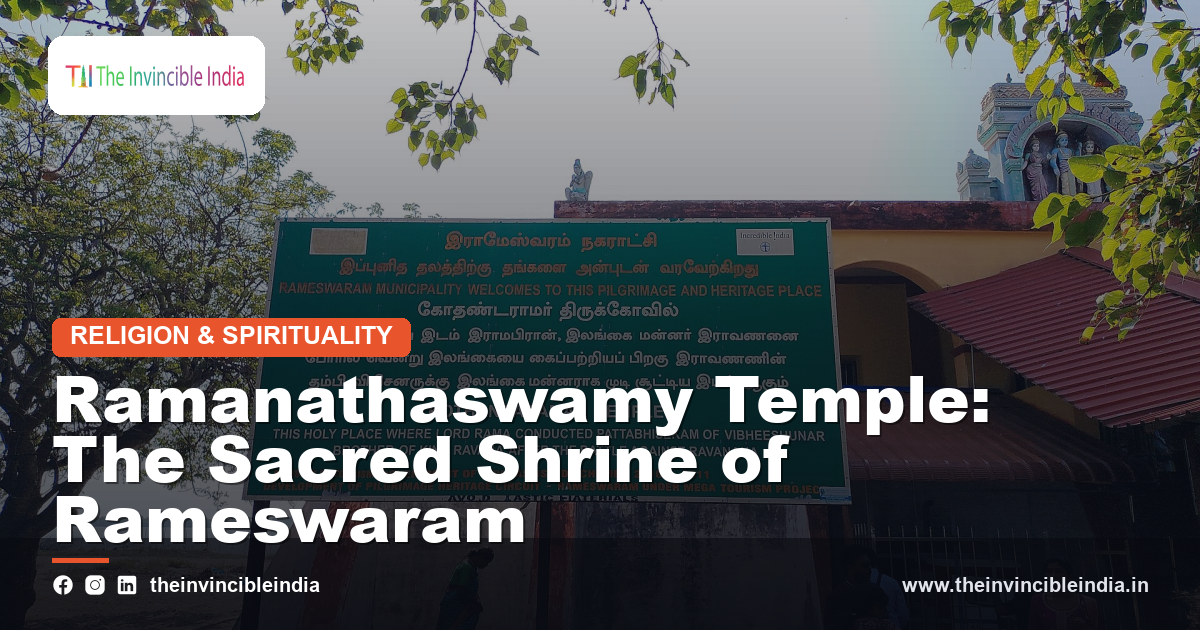
The Rameswaram temple, formally known as the Ramanathaswamy Temple, stands on an island at the south-eastern tip of the Indian peninsula, where pilgrims have come for centuries to bathe in the sea and worship Shiva. The shrine is counted among the twelve Jyotirlingas and is also one of the four Char Dham destinations, which gives it a rare place in both Shaiva and pan-Indian devotional geography. Its long pillared corridors, towering gateways and sacred water tanks draw devotees from every region. To understand its place in the wider tradition, it helps to read about the twelve Jyotirlingas, of which Rameswaram is the southernmost.
Quick Facts
| Detail | Information |
|---|---|
| Deity | Shiva as Ramanathaswamy |
| Location | Rameswaram island, Tamil Nadu |
| Tradition | Shaiva, with strong Vaishnava reverence |
| Status | One of the twelve Jyotirlingas |
| Pilgrimage | Part of the Char Dham circuit |
| Famed for | Pillared corridors and sacred theerthams |
Rameswaram: An Island of Pilgrimage
Rameswaram is an island town that has been a destination for pilgrims for many centuries, and its identity is inseparable from the temple at its heart. The name itself is traditionally understood to mean the lord of Rama, a phrase that carries both devotional and narrative meaning. Visitors arrive in every season to bathe in the waters that surround the island and to offer prayers at the shrine.
The atmosphere of the town reflects this constant flow of devotion. Lodgings, small shops, and ritual services cluster around the temple streets, while the sea remains close at hand in almost every direction. Rameswaram therefore stands as a place where geography, myth, and worship meet, and the Ramanathaswamy Temple remains the anchor around which the entire pilgrim economy and sacred identity of the island are organised.
Geography of the Sacred Island
The island lies in the stretch of sea between the Indian mainland and Sri Lanka, in the state of Tamil Nadu. It is reached from the mainland across a long bridge, which has itself become part of the pilgrim experience, since crossing the water is regarded by many as a prelude to darshan. The surrounding waters are shallow and open, and the coastline gives the town a distinctive, breezy character.
This coastal setting shapes the rituals as well as the landscape. Sea bathing is considered an essential first step for many devotees, and the nearby shoreline is dotted with places of worship and quiet spots for contemplation. The geography of Rameswaram thus explains much about its religious practice, because the meeting of land and sea is woven directly into the way pilgrims approach the temple.
The Ramayana Connection
The sanctity of Rameswaram is rooted in the Ramayana, the ancient epic that narrates the life of Rama. According to tradition, Rama came to this shore on his journey toward Lanka and worshipped Shiva here, seeking blessings and expressing gratitude. This account ties the island to one of the most beloved stories in Indian culture and gives the shrine its enduring association with Rama.
What makes this narrative distinctive is that it presents an incarnation of Vishnu honouring Shiva, a theme that resonates with the broader spirit of harmony in Indian religious life. Devotees of both traditions find meaning in the story, and the temple is therefore remembered not only as a Shaiva centre but also as a site where the epic and the worship of Shiva are joined in a single act of devotion.
A Jyotirlinga of the South
Rameswaram is revered as one of the twelve Jyotirlingas, the sacred sites where Shiva is worshipped as a radiant pillar of light. These shrines are spread across the subcontinent, and together they form a circuit of pilgrimage that many devotees hope to complete in a lifetime. Within this group, Rameswaram is regarded as the southern anchor, balancing shrines found in the north, west, and centre of the country.
The Jyotirlinga tradition emphasises the formless and infinite nature of Shiva, which is represented in the shrine by the lingam. Worship at Rameswaram follows this understanding, with offerings of water, flowers, and leaves made in a spirit of humility. The temple therefore carries a double significance, being a local centre of devotion and a recognised member of one of the most important pilgrimage networks in Hinduism.
The Tradition of Two Lingams
A well-known tradition associated with the temple speaks of two lingams. One is said to have been fashioned from sand by Sita, while the other is said to have been brought by Hanuman from the Himalayan region. Devotees remember this account as a reminder of the careful attention given to ritual timing and the devotion shown by figures of the epic.
Whatever the historical layers behind such accounts, the tradition expresses how communities have understood the shrine across generations. The story gives pilgrims a narrative to accompany their worship, linking the sanctum to Sita and Hanuman as well as to Rama. The memory of these two lingams continues to shape the way the temple is explained to visitors, and it remains a cherished part of the sacred lore of Rameswaram.
Dravidian Temple Architecture
The Ramanathaswamy Temple is a striking example of the Dravidian style of temple building, which developed in the southern part of the subcontinent. Features of this tradition include tall gateway towers, large enclosed courtyards, richly carved pillars, and a layout that leads the worshipper inward through successive spaces toward the sanctum. The temple displays these elements on a generous scale.
The architecture is not merely decorative but purposeful. Each courtyard and hall is designed to support processions, rituals, and gatherings, and the stone carving carries devotional imagery that teaches through form. As an architectural achievement, the temple reflects the skill of generations of builders and craftspeople, and its design continues to express the religious ideals that the structure was created to serve.
The Celebrated Corridors
The most admired feature of the temple is its system of long corridors lined with rows of carved pillars. These covered walkways run around the inner precincts and create a dramatic sense of depth, with columns receding into the distance on either side. They are widely regarded among the finest examples of this type of architecture in India, and they are a highlight for visitors who come to photograph or simply walk through them.
Beyond their beauty, the corridors serve a practical and spiritual function. They provide shade and shelter for pilgrims moving between the sacred wells and the sanctum, and they create a rhythm of movement that suits circumambulation and ritual. The corridors of Rameswaram therefore combine grandeur and usefulness, and they remain the defining image of the temple in the minds of those who have visited.
Gopurams and Sacred Gateways
Entrances to the temple are marked by monumental gateway towers known as gopurams, which rise above the surrounding town and serve as landmarks visible from a distance. Their surfaces are covered with sculpted figures of deities, guardians, and celestial beings, arranged in tiers that draw the eye upward. Passing beneath a gopuram is understood as a symbolic threshold between everyday life and sacred space.
These towers also express the continuity of a craft tradition, in which sculptors and masons have worked with stone, plaster, and colour over many generations. Periodic renewal and ceremonial consecration keep the gateways in active religious use. The gopurams of Rameswaram therefore serve as both artistic monuments and living thresholds, welcoming pilgrims into an environment shaped entirely by devotion.
The Sacred Theerthams
A distinctive feature of the temple is its collection of sacred water sources, known as theerthams, located within the precincts. Pilgrims traditionally move from one to the next, bathing in the water as an act of purification before worshipping at the sanctum. The number of these wells is commonly counted as a set of twenty-two, and each is associated with its own sacred name and tradition.
The practice of bathing in these waters is a central element of the pilgrim experience at Rameswaram. It expresses the belief that physical cleansing supports inner renewal, and it gives the visit a structured, participatory character. The theerthams thus make the temple not only a place to see but a place to take part in a prescribed journey of purification that has been followed by countless devotees over the centuries.
Agni Theertham and the Sea
Near the temple, the shoreline known as Agni Theertham is regarded as the traditional place for a pilgrim to begin. Devotees enter the sea here to bathe, often accompanied by priests who guide them through the prayers. The act of bathing in the ocean before visiting the sanctum is widely considered an essential preparation for darshan.
The seashore also serves as a site for rites in memory of ancestors, which many families perform when they visit Rameswaram. These observances reflect the belief that the island is an especially auspicious place to honour departed relatives. By joining the ocean, the ancestors, and the temple in one pilgrimage, Agni Theertham gives the visit a dimension of family remembrance as well as personal devotion.
Daily Worship and Ritual Life
Worship at the Ramanathaswamy Temple follows a daily cycle of rituals conducted by temple priests, beginning early in the day and continuing through the evening. These include the bathing of the deity, the offering of flowers and lamps, recitation of sacred hymns, and ceremonial closing of the sanctum at night. Devotees may attend these services or make their own offerings according to tradition.
The ritual calendar reflects the broader practices of South Indian Shaiva temples, in which precise procedures and trained priestly lineages preserve continuity. This discipline gives the temple a steady, reliable rhythm that pilgrims can depend upon. The daily worship at Rameswaram thereby sustains the sanctity of the shrine, offering every visitor an opportunity to join a devotional practice that has been handed down with care.
Festivals of the Temple
Several festivals are celebrated at the temple throughout the year, with the major observances attracting large gatherings of devotees. Among these, Maha Shivaratri holds special importance, since it honours Shiva and is observed with night-long worship and devotion. Other festivals include processions in which the deity is carried through the streets, accompanied by music and the participation of the local community.
These celebrations bring the temple into the life of the town and link the island to wider traditions of festival worship in Tamil Nadu. They also show how sacred time is structured around annual cycles of remembrance and joy. The festivals of Rameswaram therefore renew the bond between the deity, the priests, and the people, and they remain among the most vivid expressions of living faith at the shrine.
The Kashi and Rameswaram Link
One of the best-known pilgrimage traditions in India connects Rameswaram with Kashi, the sacred city on the Ganga. Devotees have long regarded a journey that joins these two sites as especially meritorious, often carrying water from the Ganga to offer at Rameswaram and returning with sand or water from the southern shore. This exchange binds the far south to the north in a single devotional circuit.
The link illustrates how pilgrimage has long worked as a unifying force across the subcontinent, carrying people, languages, and customs between distant regions. It echoes the broader idea that sacred geography spans the whole of India. The Kashi and Rameswaram tradition thus remains a powerful symbol of national cultural unity, and it is one of the main reasons Rameswaram is considered a pan-Indian destination.
Rameswaram in the Char Dham Tradition
Rameswaram is commonly listed as one of the four Char Dham sites, the great pilgrimage destinations that are said to mark the four directions of the country. Together with the other three, it is seen as completing a sacred circuit that a devotee aspires to undertake. This gives the shrine a place of honour in the religious imagination far beyond the borders of Tamil Nadu.
The Char Dham idea reflects a vision of India as a unified sacred landscape, and Rameswaram represents the southern pole of that landscape. Pilgrims who reach the island often speak of a sense of completing a long journey. The temple thus serves as a symbol of the aspiration to see the whole of the sacred land, and its association with the Char Dham adds depth to its already considerable significance.
Patronage and Temple History
The temple as it stands today reflects centuries of patronage, expansion, and care by rulers, local chieftains, and devotees. Regional dynasties contributed to its construction and upkeep, and in later periods the chieftains who governed the surrounding area are remembered as important supporters. Successive additions gave the complex its present scale and its elaborate corridors.
Such patronage was a common feature of major South Indian temples, which functioned as centres of religion, learning, art, and community life. Endowments supported rituals, festivals, and the work of craftspeople. The history of the Ramanathaswamy Temple therefore shows how sacred architecture grew through collective generosity, and it reminds visitors that the shrine is the product of many hands working across many generations.
Dhanushkodi and the Surrounding Landscape
Beyond the temple, the island offers other places of interest that enrich the pilgrim journey. Dhanushkodi, at the eastern tip, is a stark and quiet coastal area associated in tradition with Rama and the crossing toward Lanka. Nearby waters are linked in popular belief with the chain of shoals known as Rama Setu, a name that recalls the bridge described in the epic.
These locations extend the narrative of Rameswaram beyond the walls of the temple and into the open landscape. Visitors often include them in their itinerary to gain a fuller sense of how the story and the place relate to each other. The wider landscape of the island therefore deepens the meaning of the temple visit, presenting the shrine as part of a larger sacred geography.
Harmony of Shaiva and Vaishnava Devotion
One of the most appealing qualities of Rameswaram is the way it brings together devotees of different traditions. Shaiva worshippers come to honour Shiva in the form of the Jyotirlinga, while followers of Rama and Vishnu come because of the epic connection. Both groups find the temple meaningful, and their presence side by side gives the shrine a spirit of inclusiveness.
This harmony reflects the pluralism that has long characterised Indian religious life, in which different paths of devotion coexist and enrich one another. The story of Rama worshipping Shiva offers a natural symbol for that coexistence. Rameswaram thus stands as a living example of how a single sacred place can welcome many expressions of faith, and it continues to teach respect for diversity through the simple act of shared worship.
Rameswaram Temple Today
Today the Ramanathaswamy Temple remains an active centre of worship and one of the most visited pilgrimage sites in southern India. Devotees arrive throughout the year, joined by travellers and students of architecture who come to appreciate its corridors and sculpture. The temple is maintained through the efforts of its priests, administrators, and the wider community.
Modern facilities have made the journey more accessible, yet the essential character of the visit has not changed: a bath in the sea, a walk through the sacred wells, and darshan in the sanctum. The temple continues to serve as a bridge between epic memory and daily devotion. Rameswaram therefore endures as a place where heritage is lived rather than merely preserved, and where the faith of past generations is carried forward by the pilgrims of the present.
Sources & Further Reading
- Ministry of Culture, Government of India (indiaculture.gov.in).
- Archaeological Survey of India (asi.nic.in).
Frequently Asked Questions
Why is the Rameswaram temple important?
The Ramanathaswamy Temple is revered as one of the twelve Jyotirlingas and as one of the Char Dham pilgrimage sites. It is also linked by tradition to the Ramayana, which makes it significant for both Shaiva and Vaishnava devotees.
What is special about the corridors of the temple?
The temple is famous for its long corridors lined with rows of carved pillars. They are widely counted among the finest examples of Dravidian temple architecture and give pilgrims shaded passage through the inner precincts.
What are the theerthams at Rameswaram?
Theerthams are sacred water sources within and around the temple where pilgrims traditionally bathe before worship. They are commonly counted as a set of twenty-two wells, each with its own sacred name.
Why do pilgrims bathe in the sea at Rameswaram?
Bathing at the shoreline near Agni Theertham is regarded as a traditional act of purification before visiting the sanctum. Many families also perform rites for ancestors at the shore.
What is the link between Rameswaram and Kashi?
A long-standing pilgrimage tradition joins Kashi and Rameswaram, with devotees carrying Ganga water south and bringing sand or sea water back. The practice unites the north and south of India in a single devotional circuit.