


Sikhism is one of the world’s major religions, a faith founded in the Punjab region of India by Guru Nanak more than five centuries ago and shaped by a line of ten Gurus. It teaches devotion to one formless God, the equality of all human beings, honest living, selfless service and remembrance of the divine, rejecting ritualism and the barriers of caste. At its heart is the Guru Granth Sahib, the sacred scripture revered as the eternal living Guru, and its holiest shrine is the Golden Temple at Amritsar. A young religion by the standards of India yet now among the largest in the world, Sikhism is a vibrant faith of devotion, equality and service. This guide explores its founder, beliefs, Gurus, scripture, symbols and living traditions, a distinctive strand of Indian spiritual life.
Quick Facts
| Detail | Information |
|---|---|
| Type | A major world religion, founded in India |
| Founder | Guru Nanak, in the Punjab |
| Gurus | A line of ten Gurus |
| Scripture | The Guru Granth Sahib, revered as the eternal Guru |
| Core beliefs | One God, equality, honest living and selfless service |
| Holiest shrine | The Golden Temple at Amritsar |
The Faith of the Gurus
Sikhism is the faith of the Gurus, a religion founded and shaped by a line of ten spiritual teachers, the Gurus, beginning with Guru Nanak. The word Sikh means a disciple or learner, and Sikhs are the disciples of the Gurus and their teachings. Founded in the Punjab region some five centuries ago, Sikhism grew into a distinct and vibrant religion with its own scripture, beliefs, practices and community. Today it is one of the major religions of the world, with a large following in India, especially in the Punjab, and among Sikh communities across the globe. As the faith of the Gurus, teaching devotion, equality and service, Sikhism holds an important place among the religions of India and the world.
Guru Nanak, the Founder
Sikhism was founded by Guru Nanak, the first of the Gurus, who was born in the Punjab in the fifteenth century and became a great spiritual teacher. Guru Nanak taught devotion to one God, the equality of all people, and a life of honesty, service and remembrance of the divine, rejecting empty ritual and the divisions of caste and creed. He travelled widely, spreading his message, and gathered a community of followers. His teachings, expressed in beautiful devotional poetry, laid the foundations of the Sikh faith. Revered as the founder and first Guru, Guru Nanak is one of the most beloved and influential spiritual figures of India, and his birth is celebrated as a great festival by Sikhs across the world.
The Ten Gurus
Sikhism was shaped by a succession of ten Gurus, spiritual teachers who led and developed the community over some two centuries, each building on the work of those before. Beginning with Guru Nanak and ending with the tenth Guru, this line of Gurus guided the growth of the faith, developing its teachings, institutions and community, and giving it its scripture and its distinctive identity. Each Guru made his own contribution to the tradition, and together they shaped Sikhism into the religion it became. The line of the ten Gurus is central to Sikhism, and the Gurus are revered as the great teachers who established and nurtured the faith and passed on the divine light from one to the next.
One Formless God
At the heart of Sikh belief is devotion to one God, a single, formless, eternal and universal divine reality, the creator of all. Sikhism teaches that there is one God for all humanity, beyond form and image, to be remembered, loved and served. This belief in one formless God is expressed at the very opening of the Sikh scripture and is fundamental to the faith. Sikhs seek to keep God ever in mind through the remembrance and repetition of the divine name and through devotion. This teaching of devotion to one formless, universal God, the same for all people, is the foundation of Sikhism and shapes its whole vision of the spiritual life and of human unity.
Equality of All People
A central and defining teaching of Sikhism is the equality of all human beings, regardless of caste, creed, gender or station. The Gurus taught that all people are equal before God and rejected the divisions and hierarchies of caste and the discrimination against women that they saw around them. This teaching of equality was radical in its time and remains central to the Sikh faith and community. It is expressed powerfully in Sikh institutions and practices designed to affirm the equal dignity of all. This strong and consistent commitment to human equality is one of the most important and admirable features of Sikhism, flowing from its belief in one God who is the God of all people alike.
Honest Living and Service
Sikhism teaches a practical spirituality centred on three key principles: honest living and work, remembrance of God, and selfless service to others. Sikhs are taught to earn their living by honest means, to keep God in their hearts through devotion and the remembrance of the divine name, and to share with and serve others selflessly. Selfless service, or seva, is a cherished value, expressed in service to the community and to all in need. This emphasis on ethical living, devotion and service, rather than on withdrawal from the world, gives Sikhism a practical and active character. Its teaching that the spiritual life is lived through honest work, remembrance of God and service to humanity is one of its defining features.
The Langar
One of the most beautiful and distinctive institutions of Sikhism is the langar, the free community kitchen attached to Sikh places of worship, where all are welcomed and fed together, without distinction. In the langar, food is prepared and served by volunteers and offered freely to all who come, of any religion, caste or background, who sit together as equals to share the meal. The langar embodies the Sikh values of equality, service and generosity, breaking down social barriers and expressing the belief that all people are one family. Instituted by the Gurus, the langar remains a cherished and defining practice of Sikhism, feeding countless people every day and expressing in action the faith’s ideals of equality and selfless service.
The Guru Granth Sahib
The sacred scripture of Sikhism is the Guru Granth Sahib, a vast collection of devotional hymns and teachings, which holds a place of supreme reverence as the eternal, living Guru. Compiled by the Gurus, the scripture contains the writings of the Sikh Gurus along with those of other saints and holy figures, including revered Hindu and Muslim saints, reflecting the universal spirit of the faith. The tenth Guru declared that after him the scripture itself would be the Guru, and so the Guru Granth Sahib is revered not merely as a book but as the living embodiment of the Gurus’ teaching and guidance. It is treated with the greatest honour and is central to all Sikh worship and life.
The Gurdwara
The Sikh place of worship is the gurdwara, meaning the doorway to the Guru, where the Guru Granth Sahib is enshrined and where the community gathers for worship, prayer and the singing of hymns. In the gurdwara, the scripture is honoured, devotional hymns are sung, prayers are offered, and the community comes together, and attached to it is the langar where all are fed. Gurdwaras are open to all, of any faith, and are centres not only of worship but of community life and service. The gurdwara, with its enshrined scripture, its devotional singing and its open doors, is the heart of Sikh religious and community life and a place of worship, learning and service for the community.
The Golden Temple
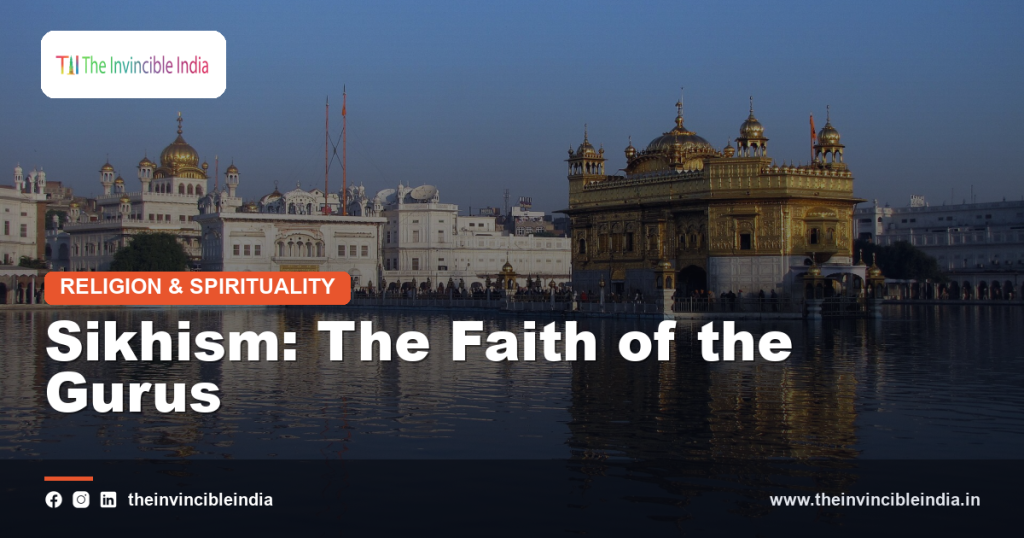
The holiest and most beloved shrine of Sikhism is the Golden Temple, at Amritsar in the Punjab, one of the most beautiful and revered religious sites in the world. Set amid a sacred pool from which the city takes its name, and gleaming with gold, the temple is a place of extraordinary beauty and profound spiritual atmosphere, drawing pilgrims and visitors from across the world. With its four doors open to all directions, symbolising its welcome to people of every background, and its great langar feeding countless visitors, the Golden Temple embodies the Sikh values of devotion, equality and service. As the holiest shrine of Sikhism and a place of great beauty and peace, it holds a cherished place in the hearts of Sikhs everywhere.
The Khalsa
A momentous event in the history of Sikhism was the founding of the Khalsa by the tenth Guru, the creation of a community of committed, initiated Sikhs dedicated to the faith and to upholding righteousness. In founding the Khalsa, the Guru gave initiated Sikhs a distinct identity, a code of conduct and a set of outward symbols of their faith, calling them to lives of devotion, courage, discipline and service, and to stand up for justice and the defence of the weak. The founding of the Khalsa gave Sikhism a strong and distinct community identity and a spirit of courage and commitment. The Khalsa remains central to Sikh identity, embodying the ideals of the devoted and righteous Sikh.
The Five Symbols
Initiated Sikhs of the Khalsa are traditionally distinguished by five outward symbols of their faith, articles that each carry spiritual meaning and mark the wearer as a committed Sikh. These include uncut hair, kept as a mark of respect for the natural form given by God and usually covered by a turban, along with other articles each with its own significance relating to discipline, readiness and commitment. These symbols give initiated Sikhs a distinctive appearance and serve as constant reminders of their faith and its values. The five symbols, adopted at the founding of the Khalsa, are an important and visible part of Sikh identity, expressing the commitment, discipline and devotion of the initiated Sikh.
Rejection of Ritual and Caste
From its founding, Sikhism rejected empty ritualism, superstition and the divisions of caste that the Gurus saw around them, teaching instead a direct devotion to one God and the equality of all. The Gurus criticised meaningless ceremony, idol worship and the claims of priestly and caste hierarchy, insisting that what mattered was sincere devotion, honest living and service, not outward ritual or social status. This rejection of ritualism and caste, and the affirmation of a direct, egalitarian faith, was central to the message of the Gurus and to the distinct identity of Sikhism. It reflects the reforming spirit of the faith and its vision of a religion of devotion, ethics and equality rather than of ritual and division.
A History of Courage
The history of Sikhism is marked by a spirit of courage and sacrifice in the defence of faith, justice and the oppressed. During times of persecution, several of the Gurus and many Sikhs made great sacrifices, and the faith developed a strong tradition of standing up against injustice and defending the freedom of conscience of all. This spirit of courage, of readiness to sacrifice for righteousness and to protect the weak and the persecuted, became an important part of Sikh identity and is deeply honoured in the community. The history of Sikh courage and sacrifice in the cause of justice and freedom is a proud and defining part of the tradition, expressing its call to uphold righteousness even at great cost.
Festivals and Traditions
Sikhism has a rich tradition of festivals and observances that mark the great events of the faith and the lives of the Gurus. The birthdays of the Gurus, especially of Guru Nanak, and the founding of the Khalsa are celebrated with devotion, the singing of hymns, processions and the sharing of langar, and other important days commemorate key events and sacrifices in Sikh history. These festivals bring the community together in devotion and joy and keep alive the memory of the Gurus and the history of the faith. The festivals and traditions of Sikhism are a vibrant expression of its devotion and community spirit and are celebrated with love by Sikhs across India and the world.
Sikhism Today
Today Sikhism is one of the major religions of the world, with a large and vibrant community in India, especially in the Punjab, and among Sikhs settled across the globe. Its followers continue to live by the teachings of the Gurus, worshipping in gurdwaras, revering the Guru Granth Sahib, serving through the langar and seva, and upholding the values of devotion, equality, honesty and service. Sikhs are known for their spirit of enterprise, courage and generosity wherever they live. As the faith of the Gurus, teaching devotion to one God, the equality of all people and selfless service to humanity, Sikhism remains a vibrant and distinctive religion and a proud part of the heritage of India.
Sources & Further Reading
- Ministry of Culture, Government of India, on the religious traditions of India (indiaculture.gov.in).
- The Guru Granth Sahib, the sacred scripture of Sikhism.
Frequently Asked Questions
What is Sikhism?
Sikhism is a major world religion founded in the Punjab by Guru Nanak more than five centuries ago and shaped by a line of ten Gurus. It teaches devotion to one formless God, the equality of all people, honest living and selfless service, and reveres the Guru Granth Sahib as its eternal Guru.
Who founded Sikhism?
Sikhism was founded by Guru Nanak, the first of the ten Gurus, who was born in the Punjab in the fifteenth century. He taught devotion to one God, the equality of all people and a life of honesty and service, laying the foundations of the faith.
What is the Guru Granth Sahib?
The Guru Granth Sahib is the sacred scripture of Sikhism, a vast collection of devotional hymns compiled by the Gurus, including the writings of the Sikh Gurus and other saints. It is revered as the eternal, living Guru and is central to all Sikh worship and life.
What is the langar?
The langar is the free community kitchen attached to Sikh places of worship, where all are welcomed and fed together without distinction of religion, caste or background. It embodies the Sikh values of equality, service and generosity.
What is the Golden Temple?
The Golden Temple at Amritsar is the holiest and most beloved shrine of Sikhism, a place of great beauty set amid a sacred pool and gleaming with gold. With its doors open to all and its great langar, it embodies the Sikh values of devotion, equality and service.