


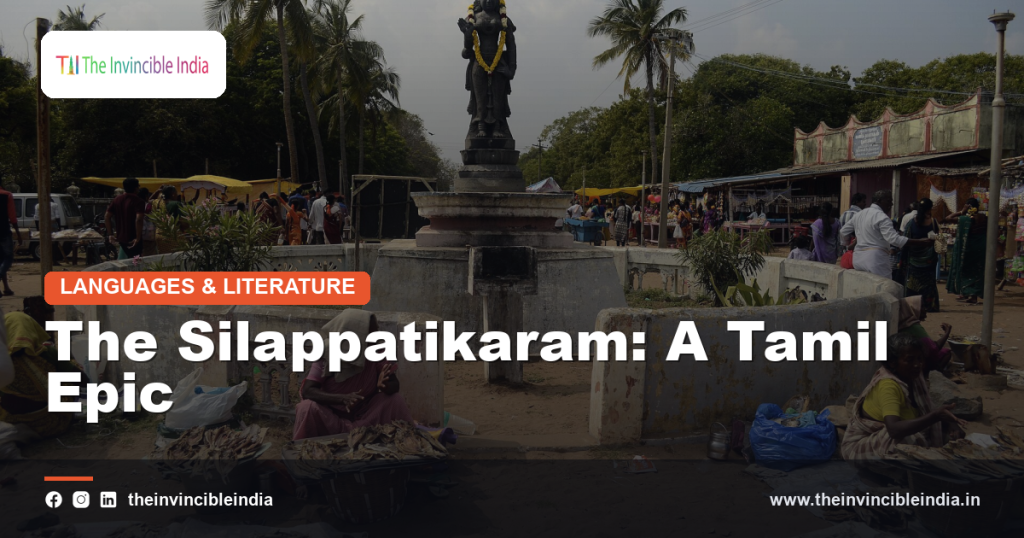
The Silappatikaram is one of the great epic poems of classical Tamil literature, composed in the tradition examined in our Tamil language guide. Traditionally attributed to the poet-prince Ilango Adigal, it tells the story of Kannagi and her husband Kovalan, a narrative of love, betrayal and the pursuit of justice that culminates in one of Tamil literature’s most memorable acts of righteous anger. Structured around three ancient Tamil kingdoms and rich in detail about music, dance and social life, the epic occupies a central place among the Five Great Epics of Tamil tradition. Its portrayal of virtue, fate and justice continues to shape Tamil cultural memory. This guide explores its story, structure and enduring legacy.
Quick Facts
| Detail | Information |
|---|---|
| Category | Classical Tamil epic poem |
| Traditional Author | Ilango Adigal |
| Language | Tamil |
| Position | One of the Five Great Epics of Tamil literature |
| Central Story | Kannagi and Kovalan |
| Legacy | Veneration of Kannagi and lasting influence on Tamil culture |
What Is the Silappatikaram
The Silappatikaram is a classical Tamil epic poem that narrates the tragic story of Kovalan and his devoted wife Kannagi, culminating in a dramatic act of justice that has resonated within Tamil culture for centuries. Composed in verse, it combines narrative storytelling with detailed descriptions of music, dance and social custom.
Regarded as one of the foundational works of Tamil literature, the epic is valued both for its narrative power and for the rich cultural detail it preserves about the society in which it was composed. Its enduring fame rests on the moral force of its central story as much as on its considerable literary craftsmanship.
Meaning of the Title
The title Silappatikaram translates broadly as the tale of the anklet, referring directly to the anklet at the centre of the epic’s pivotal dramatic episode. This title reflects the object’s crucial narrative role, since a dispute over an anklet ultimately triggers the central tragedy around which the entire poem revolves.
By naming the work after this single object, the title signals from the outset the importance of material evidence, mistaken judgment and eventual vindication within the unfolding story. The anklet thus functions as both a literal plot device and a powerful symbol of truth and justice within the epic’s moral framework.
Authorship: Ilango Adigal
The Silappatikaram is traditionally attributed to Ilango Adigal, remembered in Tamil literary tradition as a prince who renounced royal life to become an ascetic. This traditional account of his background lends the epic an added dimension of moral authority, associating its composition with a figure who had personally turned away from worldly power.
While details of his life remain a matter of literary tradition rather than firmly documented history, Ilango Adigal’s association with the Silappatikaram has secured him lasting recognition as one of the great figures of classical Tamil literature. His authorship is closely tied to the epic’s distinctive blend of narrative drama and ethical reflection.
Place Among the Five Great Epics
The Silappatikaram is traditionally counted among the Five Great Epics of Tamil literature, a group of major narrative poems recognised for their length, literary ambition and cultural significance. Within this group, it is often regarded as the most celebrated and widely read, admired for both its story and its poetic execution.
Its inclusion among these foundational epics reflects the esteem in which Tamil literary tradition has long held the work, treating it as a benchmark of narrative and poetic achievement. This standing has ensured its continued study and appreciation alongside the other major epics of the classical Tamil canon.
Historical and Literary Context
The Silappatikaram emerged in the period following the classical Sangam age of Tamil poetry, marking a shift toward longer, more elaborate narrative composition. This transition reflects broader developments within Tamil literary culture, as poets moved from shorter lyrical forms toward sustained epic storytelling.
Set against a richly imagined depiction of three ancient Tamil kingdoms, the epic draws on this historical and cultural backdrop to lend its narrative a strong sense of place and social texture. This grounding in a recognisable, if idealised, historical setting contributes significantly to the work’s lasting resonance within Tamil cultural memory.
Structure: Three Books
The Silappatikaram is organised into three books, each named after one of the great ancient Tamil kingdoms and corresponding to a distinct stage in the unfolding narrative. This structure allows the story to move geographically and thematically as the central characters travel between different regions and circumstances.
Each book contributes its own atmosphere and emphasis, ranging from scenes of courtly and domestic life to the dramatic climax of injustice and its aftermath. This tripartite structure gives the epic a clear narrative architecture while allowing for considerable variety in tone, setting and thematic focus across its three sections.
The Story of Kovalan and Kannagi
At the heart of the Silappatikaram is the story of Kovalan, a merchant, and his devoted wife Kannagi, whose married life is disrupted after Kovalan becomes involved with another woman before eventually returning to Kannagi. The couple then travels together to a new city in search of a fresh beginning.
It is in this new setting that the central tragedy of the epic unfolds, as Kovalan becomes caught up in a case of mistaken accusation that leads to dire consequences. Kannagi’s response to this injustice forms the emotional and moral centre of the entire narrative, transforming a personal tragedy into a broader meditation on justice and virtue.
The Anklet and the Central Conflict
The pivotal conflict of the Silappatikaram arises when Kovalan is wrongly accused of theft in connection with an anklet, a mistaken judgment that leads to severe and irreversible consequences. This dramatic turn hinges on a case of mistaken identity involving similar anklets, underscoring the fragility of justice when built on incomplete evidence.
Kannagi’s determined efforts to prove her husband’s innocence after this injustice drive the epic’s most memorable scenes, culminating in a public demonstration that exposes the error and affirms Kovalan’s innocence. This episode gives the poem its title and stands as its dramatic and moral centrepiece.
Themes of Justice and Fate
Justice and fate stand as two of the most prominent themes running throughout the Silappatikaram, explored through the unjust punishment suffered by Kovalan and Kannagi’s subsequent pursuit of vindication. The epic presents a world in which human institutions can err gravely, yet in which truth ultimately asserts itself through determined moral action.
Alongside this concern with justice, the poem also reflects on the workings of fate, suggesting that individual lives are shaped by forces beyond simple human control even as personal virtue and determination remain significant. This interplay between justice, fate and moral agency gives the epic much of its enduring philosophical depth.
The Concept of Karpu
Central to the Silappatikaram is the Tamil concept of karpu, broadly understood as chastity, fidelity and moral virtue, embodied most fully in the character of Kannagi. Her unwavering devotion to her husband, even after his own lapses, is presented as the foundation of her moral authority and eventual vindication.
This emphasis on karpu reflects broader values within classical Tamil society regarding marital devotion and personal integrity, values that the epic elevates through Kannagi’s example into a powerful ideal of virtuous conduct. Her characterisation as a paragon of karpu has remained central to her lasting cultural significance.
Kannagi's Deification
Following the dramatic events of the epic, Kannagi comes to be honoured as a goddess associated with chastity and righteous justice, a transformation that reflects the profound moral impact of her story on Tamil cultural imagination. Temples and shrines dedicated to her veneration developed in various parts of the Tamil-speaking world.
This process of deification illustrates how the Silappatikaram moved beyond the realm of literature to shape actual religious and cultural practice, with Kannagi’s story continuing to inform devotional traditions associated with virtue and justice. Her veneration remains one of the most striking examples of literature directly influencing lived religious culture.
Portrayal of Ancient Tamil Kingdoms
The Silappatikaram offers a vivid literary portrayal of three major ancient Tamil kingdoms, depicting their cities, courts and social customs with considerable descriptive detail. Each kingdom is associated with a distinct setting and atmosphere, contributing to the epic’s rich sense of geographic and cultural variety.
This detailed portrayal has made the epic a valuable literary source for understanding the imagined social and political landscape of ancient Tamil civilisation, even as scholars treat its depictions as literary rather than strictly historical record. The epic’s attention to courtly life, trade and urban culture adds considerable texture to its central narrative.
Music, Dance and Performing Arts
The Silappatikaram is notable for its detailed descriptions of music, dance and performance, making it an important source for understanding the performing arts traditions of ancient Tamil society. Passages describing musical instruments, dance forms and performance occasions appear throughout the text, reflecting their significant place in contemporary cultural life.
This attention to the performing arts extends the epic’s significance beyond narrative literature into the history of Tamil music and dance, with scholars drawing on its descriptions to reconstruct aspects of classical performance practice. This dimension has secured the Silappatikaram a lasting place in the study of Tamil performing arts.
Language and Poetic Style
Composed in classical Tamil verse, the Silappatikaram employs a poetic style suited to sustained narrative, balancing vivid description with emotional intensity at key dramatic moments. Its verse form allows for both extended scene-setting and concentrated dramatic expression during the epic’s central episodes of conflict and grief.
The poem’s language reflects the literary sophistication of its period, drawing on established Tamil poetic conventions while adapting them to the demands of long-form epic narrative. This stylistic achievement contributes significantly to the work’s standing as one of the masterpieces of classical Tamil literature.
Influence on Tamil Literature and Culture
The Silappatikaram exerted a profound influence on subsequent Tamil literature, establishing narrative and thematic patterns that later poets and writers continued to draw upon in their own work. Its treatment of justice, virtue and tragedy provided a lasting model for morally serious narrative composition within the Tamil tradition.
Beyond literature, the epic’s themes and characters became embedded in broader Tamil cultural consciousness, informing popular storytelling, religious devotion and artistic representation across generations. This deep and continuing cultural resonance distinguishes the Silappatikaram from many other classical texts, securing its place as a living element of Tamil identity.
Influence Beyond Tamil Nadu
The story and themes of the Silappatikaram extended their influence beyond the Tamil-speaking regions of India, reaching communities in Sri Lanka and parts of Kerala where veneration of Kannagi and related traditions took root. This wider geographic reach reflects historical connections and shared cultural currents across the region.
The presence of Kannagi-related worship and cultural memory in these areas illustrates how a literary work rooted in a specific Tamil context could travel across regional and even national boundaries, adapting to local settings while retaining its core themes. This broader legacy underscores the epic’s significance within a wider South Asian cultural sphere.
The Silappatikaram Today
Today, the Silappatikaram remains one of the most widely read and celebrated works of classical Tamil literature, studied for its narrative power, cultural detail and moral seriousness. Its story continues to be retold through literature, performance and popular culture across Tamil-speaking communities.
The enduring appeal of the epic lies in its combination of compelling human drama and profound ethical reflection, qualities that continue to resonate with readers many centuries after its composition. As a touchstone of Tamil literary and cultural heritage, the Silappatikaram retains a vital and continuing significance.
Sources & Further Reading
- Sahitya Akademi.
- Ministry of Culture, Government of India (indiaculture.gov.in).
Frequently Asked Questions
What is the Silappatikaram about?
The Silappatikaram tells the story of Kovalan and his wife Kannagi, culminating in a dramatic pursuit of justice after Kovalan is wrongly accused and executed, and Kannagi proves his innocence.
Who wrote the Silappatikaram?
The epic is traditionally attributed to Ilango Adigal, a poet remembered in Tamil literary tradition as a prince who became an ascetic.
What does the title Silappatikaram mean?
The title translates broadly as the tale of the anklet, referring to the object at the centre of the epic’s central conflict and its resolution.
Why is Kannagi worshipped as a goddess?
Following the events of the epic, Kannagi came to be venerated as a goddess associated with chastity and righteous justice, reflecting the deep moral impact of her story.
What are the three books of the Silappatikaram?
The epic is divided into three books, each named after one of the ancient Tamil kingdoms and corresponding to a different stage of the story.