


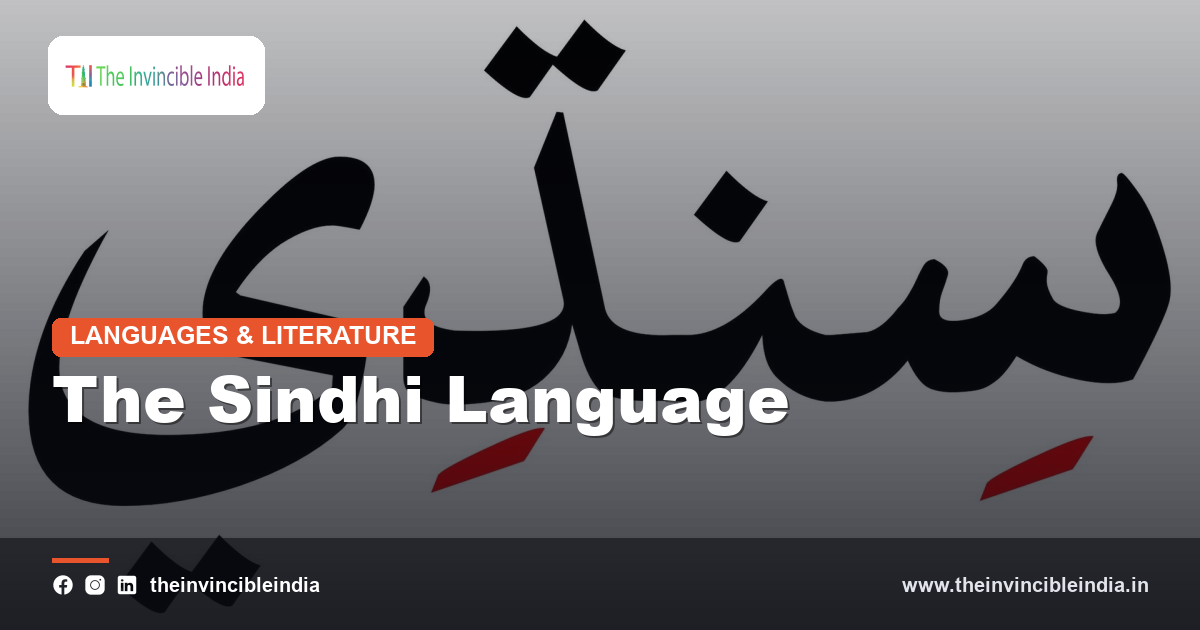
Sindhi is an Indo-Aryan language historically associated with the Sindh region, today divided between Pakistan and a substantial diaspora community living across India. Unlike most languages discussed in guides to the languages of India, Sindhi in India is not tied to a single dedicated state, yet it remains an officially recognised scheduled language, sustained by close-knit communities that carry forward its literature, script, and oral heritage. The language is notable for a set of distinctive implosive consonant sounds not shared by many of its Indo-Aryan relatives, and for a literary tradition deeply shaped by centuries of Sufi devotional poetry. Sindhi’s story of migration, adaptation, and cultural preservation makes it one of the more distinctive chapters within India’s broader linguistic landscape.
Quick Facts
| Detail | Information |
|---|---|
| Language Family | Indo-Aryan (Indo-European) |
| Historic Homeland | Sindh region (now in Pakistan) |
| Scripts Used | Perso-Arabic (Pakistan), Devanagari (India) |
| Distinctive Sounds | Implosive consonants |
| Notable Poet | Shah Abdul Latif Bhittai |
| Status in India | Scheduled language without a dedicated state |
Origins in the Indus Valley Region
Sindhi traces its roots to Prakrit and Apabhramsha speech current in the lower Indus valley, an area with an exceptionally long history of settlement and cultural exchange stretching back to some of the earliest urban civilisations of the subcontinent. Over many centuries this regional speech evolved into a distinct language with its own grammar and vocabulary.
Centuries of trade and contact with Persian, Arabic, and later Baloch and Turkic speaking communities left a visible mark on Sindhi vocabulary, giving the language a layered character that reflects the Sindh region’s long-standing role as a crossroads between South Asia and the wider Islamic world.
Place Within the Indo-Aryan Family
Sindhi belongs to the northwestern group of Indo-Aryan languages, a branch that also includes languages spoken across parts of present-day Pakistan and the northwestern reaches of the Indian subcontinent. Its grammar and core vocabulary place it firmly within this larger Indo-Aryan family.
At the same time, Sindhi has developed several features, including its distinctive consonant sounds, that set it apart from many of its closest linguistic relatives, leading scholars to treat it as an unusually independent member of the northwestern Indo-Aryan group rather than a close variant of any single neighbouring tongue.
Geographic Spread and Communities
Sindhi remains the majority language of the Sindh province in present-day Pakistan, where it continues to serve as the everyday language of a large population alongside its role in regional administration and education. It carries deep historical and cultural roots throughout the province.
In India, Sindhi speakers form a dispersed community rather than a regionally concentrated one, having resettled across cities such as Ahmedabad, Mumbai, Pune, and the specially established township of Ulhasnagar following the displacement that accompanied the Partition of India. This dispersed settlement pattern shapes how the language is maintained today.
A Language Without a Dedicated State
Sindhi holds a distinctive position among India’s officially recognised scheduled languages because, unlike most others, it is not linked to any single state within the Indian union. Its historic homeland lies entirely across the border in Pakistan.
This unusual status means that Sindhi’s preservation in India depends heavily on community associations, cultural organisations, and family transmission rather than on state-level administrative support, giving the language’s continuity in India a particularly community-driven character.
The Perso-Arabic Sindhi Script
In Pakistan, Sindhi is most commonly written using a modified form of the Perso-Arabic script, adapted with additional letters and diacritical marks to represent sounds not found in Persian or Arabic, including the language’s characteristic implosive consonants. This script is used throughout Sindh in education, publishing, and administration.
The adaptation of the Arabic script for Sindhi required careful development by scholars and writers over time, resulting in a writing system capable of representing the language’s full range of sounds while remaining visually related to other Perso-Arabic scripts used across the region.
Devanagari and Sindhi in India
In India, Sindhi is frequently written in the Devanagari script, the same script used for Hindi and several other Indian languages, allowing it to be taught and published using widely available typefaces and educational materials. This choice reflects the practical realities of the community’s dispersed settlement across Devanagari-using regions.
The use of two quite different scripts for the same spoken language, one rooted in the Arabic writing tradition and the other in the Brahmic tradition shared with Hindi, is one of the more distinctive features of Sindhi’s modern linguistic situation.
Historical Scripts and Trade Notations
Before the standardisation of the modern Perso-Arabic Sindhi script, the region used a variety of local trade scripts, sometimes grouped under names such as Khudabadi, developed and used mainly by merchant communities for record keeping and correspondence. These scripts were practical rather than literary in purpose.
Such trade scripts illustrate how Sindhi’s writing traditions developed along multiple parallel paths, shaped by the needs of commerce, religion, and administration, before later standardisation efforts consolidated the language’s more formal literary and educational writing systems.
Phonology and Distinctive Sounds
Sindhi is particularly noted among Indo-Aryan languages for its set of implosive consonants, produced with an inward flow of air, a feature shared by only a small number of languages in the region. These sounds give spoken Sindhi a recognisable auditory character.
Alongside these implosives, Sindhi phonology includes a broad range of aspirated and unaspirated consonants and a full set of vowel sounds, combining to produce a rich and distinctive sound system that has long attracted the interest of linguists studying sound change in Indo-Aryan languages.
Grammar and Sentence Structure
Sindhi generally follows a subject-object-verb sentence order and relies on postpositions rather than prepositions, a pattern consistent with the broader Indo-Aryan family. Nouns are marked for gender, number, and case through a system of suffixes attached to word stems.
Verb conjugation in Sindhi reflects tense, aspect, and degrees of formality, allowing speakers to express nuanced social relationships through grammatical structure alone. This combination of features gives Sindhi both grammatical richness and considerable expressive flexibility.
Regional and Community Dialects
Sindhi includes a number of recognised dialects associated with different parts of the historic Sindh region, each carrying its own shades of pronunciation and vocabulary while remaining broadly mutually intelligible with the standard literary language.
Among diaspora communities in India, generational and regional variation in Sindhi usage has also emerged, shaped by contact with Hindi, Gujarati, Marathi, and other languages spoken in the cities where Sindhi families settled after Partition. This contact has left its own mark on everyday spoken Sindhi in India.
Sufi Poetry and Devotional Verse
Sindhi literature is especially renowned for its tradition of Sufi devotional poetry, which expresses themes of divine love, longing, and spiritual surrender through richly symbolic verse often set to melody and performed aloud. This devotional strand forms the heart of classical Sindhi literary achievement.
Such poetry drew on local folk tales, mystical imagery, and the rhythms of everyday speech, creating a literary style that could reach audiences well beyond formally educated readers and that continues to be recited and sung in Sindhi communities today.
Shah Abdul Latif Bhittai
Shah Abdul Latif Bhittai is remembered as the most celebrated figure in classical Sindhi literature, renowned for a substantial body of mystical poetry that wove together spiritual devotion, regional folklore, and vivid natural imagery. His verse remains central to Sindhi cultural identity.
His compositions, still widely sung and recited, are credited with shaping the emotional and lyrical character long associated with Sindhi poetry, and his legacy continues to be honoured by Sindhi speakers across both Pakistan and the Indian diaspora.
Folk Tales and Oral Storytelling
Beyond its formal poetic tradition, Sindhi sustains a rich body of folk tales and legendary romances that have been retold across generations through both spoken storytelling and devotional song. These narratives often carry moral and spiritual themes.
Many of these folk stories draw on shared regional legends also found in neighbouring language traditions, reflecting the long history of cultural exchange across the wider Indus valley and Sindh region, and they remain an important part of how Sindhi identity is passed down informally within families.
Partition, Displacement, and Cultural Continuity
The Partition of India brought profound disruption to the Sindhi-speaking community, as a large population relocated from Sindh to India without a dedicated territorial homeland to settle into. This experience shaped a distinctive and resilient sense of communal identity.
In the decades that followed, Sindhi communities in India worked to preserve their language, cuisine, and customs through community associations, religious institutions, and cultural gatherings, ensuring that Sindhi identity endured despite the loss of a single geographic centre.
Sindhi Language Organisations and Preservation
Sindhi cultural and literary associations in India have played an important role in supporting the teaching, publishing, and public celebration of the language, organising literary gatherings, award programmes, and community education efforts. These organisations help sustain formal engagement with Sindhi literature.
Universities and academic departments in both India and Pakistan continue to support research into Sindhi language, literature, and linguistics, contributing to ongoing efforts to document and preserve the language’s classical and folk literary heritage for future generations.
Sindhi in Media and Modern Life
Sindhi continues to appear in print publications, radio broadcasts, and community media in both India and Pakistan, helping keep the language present in everyday public life alongside its historic literary and devotional traditions. Community networks reinforce this ongoing visibility.
Digital platforms and social media have also given Sindhi speakers new spaces to share language content, music, and cultural discussion, helping connect diaspora communities with each other and with the language’s traditional heartland across generational and geographic distance.
Sindhi Cuisine, Customs, and Community Identity
Language for the Sindhi community in India is closely bound up with a broader set of cultural markers, including distinctive cuisine, festival customs, and religious practice, all of which reinforce a shared sense of identity even where spoken fluency has weakened across generations. These customs are often celebrated together at community gatherings.
Festivals such as Cheti Chand, marking the community’s new year, provide occasions for public celebration of Sindhi language, music, and tradition, helping sustain interest in the language among younger members of the community who may otherwise have limited daily exposure to it. Such events keep Sindhi heritage visible within wider Indian civic life.
The Sindhi Language Today
Sindhi today remains a living language sustained by strong community identity, a distinguished classical poetic heritage, and continued institutional and cultural support across India and Pakistan. Its speakers take particular pride in the language’s Sufi literary legacy.
As Sindhi communities in India continue to balance integration with the wider society around them against the preservation of a distinct linguistic and cultural identity, the language endures as an important marker of heritage, carried forward through poetry, community life, and family tradition.
Sources & Further Reading
- Sahitya Akademi.
- Ministry of Culture, Government of India (indiaculture.gov.in).
Frequently Asked Questions
What language family does Sindhi belong to?
Sindhi belongs to the northwestern branch of the Indo-Aryan language family, itself part of the larger Indo-European family, though it has developed several distinctive features of its own.
What scripts are used to write Sindhi?
Sindhi is written using a modified Perso-Arabic script in Pakistan, while in India it is commonly written in the Devanagari script, the same script used for Hindi.
Why does Sindhi not have a dedicated state in India?
Sindhi’s historic homeland, the Sindh region, became part of Pakistan after Partition, so Sindhi speakers in India settled across many cities rather than a single designated state.
Who is Shah Abdul Latif Bhittai?
Shah Abdul Latif Bhittai is the most celebrated poet in classical Sindhi literature, known for mystical verse blending spiritual devotion with regional folklore and imagery.
What sounds make Sindhi phonology distinctive?
Sindhi is notable for its implosive consonants, produced with an inward airflow, a feature shared by only a small number of languages in the region.