


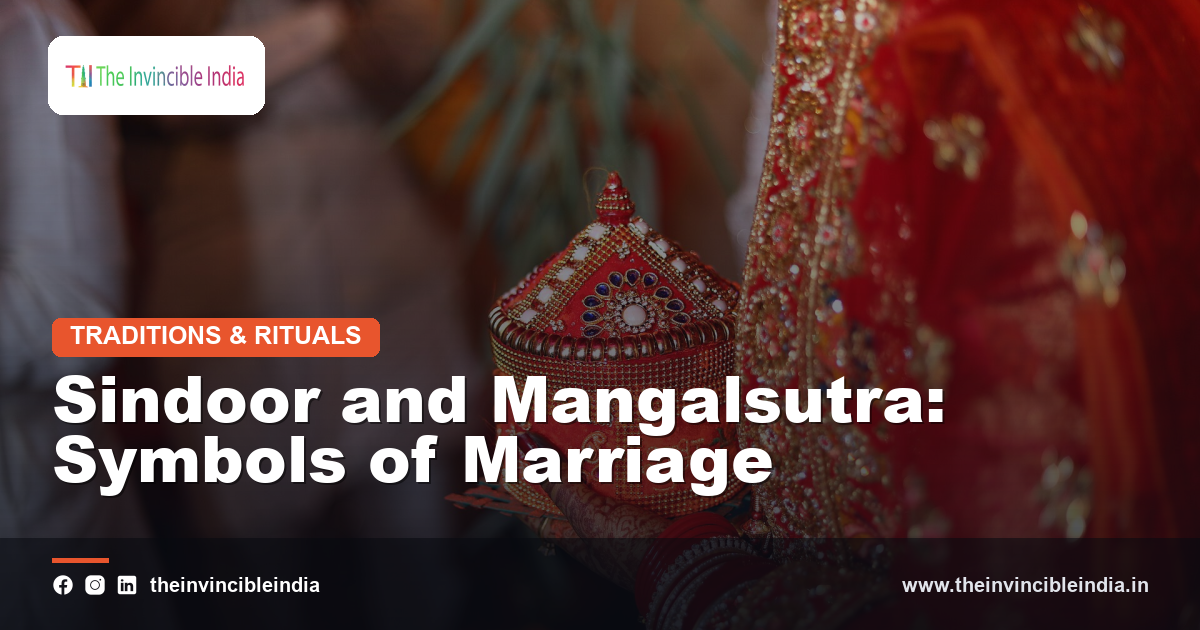
Sindoor and the mangalsutra are two of the most recognisable symbols of marriage within Hindu tradition, worn by married women as visible markers of their marital status. Sindoor refers to the vermillion powder traditionally applied along the parting of the hair, while the mangalsutra is a sacred necklace tied by the groom during the wedding ceremony. Both symbols are closely associated with the broader sequence of Indian wedding traditions, carrying meanings of commitment, protection and social recognition. This guide examines the history, significance and continuing practice surrounding these two enduring symbols.
Quick Facts
| Detail | Information |
|---|---|
| Also Known As | Sindoor (vermillion), Mangalsutra (sacred necklace) |
| Worn By | Married Hindu women |
| Type of Symbol | Traditional markers of marital status |
| General Occasion | Applied or tied during the wedding, worn ongoing |
| Key Materials | Vermillion powder; black and gold beads |
| Region of Prominence | Observed across Hindu communities in India |
Meaning and Significance
Sindoor and the mangalsutra together stand among the most widely recognised symbols of marriage within Hindu tradition, worn by married women as visible signs of their marital status. Sindoor refers to the vermillion powder applied along the parting of the hair, while the mangalsutra is a necklace tied by the groom during the wedding ceremony itself.
Both symbols carry meanings that extend beyond simple identification, traditionally understood to represent the wellbeing and protection of the husband as well as the formal recognition of the marital bond within family and community life.
Sindoor: Origins and Meaning
Sindoor, a red or vermillion-coloured powder, has long been associated with marriage in Hindu tradition, applied by a married woman along the parting of her hair following her wedding ceremony. The application is generally performed for the first time by the groom, marking the formal beginning of this ongoing practice.
The colour red carries broader symbolic associations within Hindu tradition, often linked to auspiciousness, vitality and marital wellbeing, giving sindoor a significance that extends beyond its function as a mere visual marker of marital status.
Application and Daily Practice
Following the wedding ceremony, sindoor is traditionally applied daily by married women as part of their regular routine, generally continuing throughout the course of the marriage. The specific style and amount applied can vary according to regional and personal custom.
This daily practice reflects sindoor’s role as an ongoing rather than one-time marker, distinguishing it from other wedding symbols applied only during the ceremony itself, and embedding the symbol within the routine of everyday married life for many women.
Mangalsutra: Origins and Meaning
The mangalsutra, meaning ‘sacred thread’ or ‘auspicious thread,’ is a necklace traditionally tied by the groom around the bride’s neck during the wedding ceremony, generally featuring black and gold beads along with a pendant. Its tying marks a significant ritual moment within the broader wedding proceedings.
Like sindoor, the mangalsutra is understood to symbolise the marital bond and the husband’s commitment to his wife’s wellbeing, functioning as a continuously worn marker of marriage rather than a symbol confined to the wedding day alone.
The Ritual of Tying the Mangalsutra
The tying of the mangalsutra is performed as a specific ritual moment within the wedding ceremony, generally accompanied by prayers recited by the officiating priest and witnessed by family members gathered for the occasion. The groom typically ties the necklace in three knots, according to widely followed convention.
This ritual moment is regarded as one of the ceremony’s most significant, formally marking the establishment of the marital bond in a manner comparable in importance to other central rites such as kanyadaan and the saptapadi.
Design and Regional Variations of the Mangalsutra
The design of the mangalsutra varies considerably across India’s regions, with differences in bead colour, pendant style and overall design reflecting local custom and community tradition. Despite these variations, black beads generally remain a consistent element across most regional forms.
This diversity of design illustrates the broader pattern of regional adaptation found within Hindu wedding customs generally, in which a shared symbolic object, the mangalsutra, takes on distinct local forms while retaining its core significance as a marker of marriage.
Sindoor in Regional Traditions
The style and manner of applying sindoor also varies across India’s regions, with differences in the amount applied, the specific occasions for reapplication and accompanying customs observed in different communities. In some regions, sindoor application is accompanied by additional related rituals during festivals.
These regional variations reflect the broader diversity of Hindu marital customs across the country, in which a shared underlying symbol is expressed through locally specific practices while retaining its recognised association with marriage nationally.
Symbolism of Protection and Wellbeing
Both sindoor and the mangalsutra are traditionally understood to carry a symbolic association with the protection and long life of the husband, with their continued wearing regarded by many as connected to his ongoing wellbeing. This protective symbolism adds a further layer of meaning beyond simple marital identification.
This association reflects a broader pattern within Hindu tradition of linking visible symbols to underlying beliefs about wellbeing and protection, giving everyday items such as sindoor and the mangalsutra a significance that extends well beyond their immediate visual function.
Social Recognition of Marital Status
Historically, sindoor and the mangalsutra have served an important social function, allowing a woman’s marital status to be readily recognised within her community without requiring explicit statement. This visible signalling played a practical role in social interaction across many traditional Hindu communities.
While social norms have evolved considerably over time, this function of visible recognition remains part of the cultural understanding surrounding both symbols, even as their significance today is often framed more in personal and familial terms than purely social ones.
Sindoor and Mangalsutra in Festivals
Certain festivals and occasions place particular emphasis on sindoor, with married women applying it with special attention during specific celebrations, sometimes as part of rituals performed for the husband’s long life and wellbeing. The mangalsutra is similarly worn with particular prominence during festive occasions.
This heightened festival attention reflects the broader integration of these marital symbols into the wider calendar of Hindu religious and cultural observance, extending their significance beyond daily wear into specific ritual contexts throughout the year.
Materials and Craftsmanship
The mangalsutra is traditionally crafted using gold, along with black beads that are generally understood to hold a protective significance, with the specific design often reflecting family or regional jewellery traditions passed down across generations. Sindoor, meanwhile, is traditionally made from natural pigments, though modern versions vary.
The craftsmanship involved in creating a mangalsutra often reflects broader family and cultural values, with pieces sometimes passed down or specifically commissioned for a wedding, giving the object both a personal and an artisanal significance beyond its symbolic role.
Changing Practices Among Younger Generations
Contemporary attitudes toward sindoor and the mangalsutra vary among younger generations, with some women continuing traditional daily wear and others choosing to wear these symbols more selectively, particularly on formal or ceremonial occasions. Such choices often reflect personal preference within evolving social contexts.
This variation reflects broader ongoing conversations about tradition and personal choice within contemporary Hindu households, in which established marital symbols are increasingly approached with flexibility rather than treated as strictly obligatory in all settings.
Sindoor and Mangalsutra in Popular Culture
Sindoor and the mangalsutra frequently appear in Indian popular culture, including film and television, often used as visual shorthand to indicate a woman’s marital status or to mark significant narrative moments related to marriage. This visibility has reinforced their recognition as widely understood cultural symbols.
Such portrayals have contributed to the broader cultural familiarity of both symbols across India, extending their recognition even among audiences and communities where these specific customs may not be traditionally practiced in daily life.
Comparisons with Other Marital Symbols
Sindoor and the mangalsutra exist alongside other traditional markers of marriage observed in different Indian communities, such as specific bangles or toe rings associated with particular regions, each carrying comparable symbolic weight within its own local tradition. Together, these varied symbols reflect a broader pattern across Indian culture.
This diversity of marital symbols across different communities illustrates how the underlying purpose, visibly marking marital status and invoking blessings for the couple, is expressed through a range of specific traditional forms depending on region and community.
Continuity and Personal Meaning
For many women, sindoor and the mangalsutra continue to carry deep personal significance beyond their traditional symbolic function, understood as meaningful expressions of their marriage and connection to their husband and family. This personal dimension exists alongside the symbols’ broader cultural and social meanings.
This blending of personal sentiment and inherited tradition reflects a common pattern in how long-standing cultural symbols are experienced by individuals, who often bring their own meaning to practices passed down through family and community custom.
Sindoor Daan: The First Application
The first application of sindoor, generally performed by the groom during the wedding ceremony itself, is regarded as a distinct ritual moment known as sindoor daan, marking the formal beginning of the bride’s practice of wearing it. This moment is often considered among the most significant of the entire ceremony.
Sindoor daan is typically accompanied by specific prayers, and its performance is treated with particular solemnity, reflecting the weight traditionally placed on this specific ritual act within the broader sequence of the wedding.
Everyday Care of the Mangalsutra
Married women typically wear the mangalsutra continuously following the wedding, with many treating it with particular care given its symbolic and often sentimental value. Some choose simpler versions for daily wear and reserve more elaborate pieces for special occasions.
This practical approach to everyday wear reflects how a symbol of considerable ritual significance is nonetheless integrated into ordinary daily life, balancing its traditional meaning with the practicalities of wearing valuable jewellery on a continuous basis.
Sindoor and Mangalsutra as Cherished Keepsakes
In some families, elements of the mangalsutra or associated jewellery are passed down from earlier generations, treated as heirlooms carrying both sentimental and symbolic value alongside their function as marital markers. Sindoor containers themselves are sometimes kept as cherished personal items as well.
This practice of treasuring heirloom jewellery connected to marriage reflects a broader Indian cultural pattern of linking personal keepsakes to significant family rituals, adding a further layer of continuity between generations through these enduring symbols.
Sindoor and Mangalsutra Today
Sindoor and the mangalsutra remain widely recognised symbols of marriage across Hindu communities today, continuing to be applied and worn according to a mixture of traditional practice and personal preference. Their significance persists even as specific customs surrounding their use continue to evolve gradually.
The continued prominence of both symbols, alongside changing attitudes among younger generations, reflects the broader pattern of Hindu marital traditions adapting over time while retaining their core symbolic association with marriage, commitment and family life.
Sources & Further Reading
- Ministry of Culture, Government of India (indiaculture.gov.in).
- Sahitya Akademi.
Frequently Asked Questions
What is sindoor?
Sindoor is a red or vermillion-coloured powder traditionally applied by married Hindu women along the parting of their hair, generally beginning with the wedding ceremony.
What is a mangalsutra?
A mangalsutra is a sacred necklace, typically featuring black and gold beads, tied by the groom around the bride’s neck during the wedding ceremony.
Why are sindoor and mangalsutra worn?
Both are traditional symbols of marital status, understood to represent the marital bond and the husband’s wellbeing, and are worn on an ongoing basis after the wedding.
Does the mangalsutra design vary across India?
Yes, the design varies by region and community, though black beads generally remain a consistent element across most traditional forms.
Do all married Hindu women wear these symbols the same way?
No, practices vary by region, family tradition and personal choice, with some women observing daily wear and others reserving the symbols for formal occasions.