


The Thirukkural, also spelled Tirukkural, is one of the most revered works of classical Tamil literature, a compact collection of couplets addressing ethics, statecraft and love, traditionally attributed to the poet-sage Thiruvalluvar. Composed in the flowing, precise idiom of classical Tamil, it is widely admired both within India and internationally for the breadth and clarity of its ethical vision, offered largely without reference to any single religious tradition. Organised into short, memorable verses grouped by theme, the work has been read, quoted and studied continuously for many centuries, and continues to hold an almost unparalleled place of reverence in Tamil culture. This guide explores its structure, content, authorship tradition and enduring influence.
Quick Facts
| Detail | Information |
|---|---|
| Also Known As | Tirukkural, Kural |
| Traditional Author | Thiruvalluvar |
| Language | Classical Tamil |
| Structure | 1,330 couplets organised into 133 chapters |
| Three Books | Aram (virtue), Porul (wealth and polity), Inbam (love) |
| Notable Feature | Widely admired for its largely non-sectarian ethical teachings |
What Is the Thirukkural
The Thirukkural is a celebrated work of classical Tamil literature composed as a collection of short couplets, known as kurals, each offering a compact statement on some aspect of ethical, social or personal life. Traditionally attributed to the poet-sage Thiruvalluvar, the work is organised into a large number of short chapters, each grouping together several couplets addressing a single theme.
Because of its concise, aphoristic style and its wide-ranging subject matter, the Thirukkural has come to be regarded not merely as a literary work but as a broad guide to ethical and practical living, cherished across generations. It occupies a position of deep reverence in Tamil culture, frequently described as a work without equal in its combination of brevity and wisdom.
Thiruvalluvar: The Poet-Sage
Thiruvalluvar, the traditional author of the Thirukkural, is revered as one of the great figures of Tamil literary and moral tradition, though relatively little can be said with certainty about the details of his life. Various traditions and legends have grown up around him over the centuries, reflecting the depth of regard in which he is held, though these should be understood as tradition rather than verified biography.
What is generally agreed upon is that Thiruvalluvar composed a work of remarkable ethical breadth and literary precision, one that transcends any single sect, caste or regional identity. This universality is often cited as central to his enduring stature as a moral and literary figure honoured across Tamil society regardless of background.
Structure of the Text: Three Books
The Thirukkural is organised into three major sections, traditionally referred to as Aram, Porul and Inbam, addressing virtue, wealth and material life, and love, respectively. Each of these three books is further divided into numerous short chapters, with each chapter comprising ten couplets exploring a specific theme within its broader section.
This tripartite structure, moving from personal and social ethics through practical governance and economic life to the emotional realm of love, is often noted for its comprehensive scope, addressing nearly every dimension of human experience within a single unified work. The careful, systematic organisation of the text is itself considered a notable literary achievement.
Book One: Aram (Virtue)
The first book of the Thirukkural, Aram, addresses questions of virtue, ethics and righteous conduct, covering themes such as domestic life, hospitality, gratitude, honesty and compassion. Its couplets offer guidance applicable to individuals across all walks of life, emphasising qualities such as integrity and kindness as foundations for a well-lived life.
This section is often regarded as the philosophical heart of the work, articulating a vision of ethical conduct that draws on general moral reasoning rather than specific religious doctrine. Its teachings on virtue continue to be quoted widely in Tamil culture, both in formal educational contexts and in everyday speech and writing.
Book Two: Porul (Wealth and Polity)
The second book, Porul, turns to matters of wealth, governance, statecraft and public life, offering guidance addressed variously to rulers, officials and ordinary citizens on subjects including justice, diligence, friendship and the proper conduct of public affairs. This section reflects considerable practical wisdom concerning administration and social organisation.
Porul is frequently cited for its perceptive observations on leadership and governance, considered relevant well beyond the specific historical context in which it was composed. Its practical, worldly focus complements the more purely ethical concerns of the first book, giving the overall work a balance between moral idealism and pragmatic realism.
Book Three: Inbam (Love)
The third and final book, Inbam, addresses the theme of love, particularly the emotional experience of romantic love between partners, expressed through short, evocative couplets exploring longing, union, separation and devotion. This section differs markedly in tone from the more didactic first two books, adopting a more lyrical and personal register.
Despite its focus on romantic love, Inbam retains the same economy of expression found throughout the Thirukkural, conveying deep emotional insight within the brief compass of a couplet. This section is often admired for demonstrating that the same disciplined verse form used for ethical instruction can also convey tenderness and emotional nuance with equal skill.
The Kural Verse Form
Each couplet of the Thirukkural follows a specific classical Tamil metre known as the kural venba, a compact two-line verse form prized for its economy and precision. This tight metrical structure demands considerable skill from the poet, requiring complex ideas to be compressed into a small number of words without sacrificing clarity or depth.
The discipline imposed by this verse form is often cited as part of what gives the Thirukkural its distinctive, quotable character, with individual couplets frequently standing alone as self-contained statements of insight. This combination of formal constraint and expressive richness is considered one of the great technical achievements of classical Tamil poetry.
Language and Style
The Thirukkural is composed in a refined register of classical Tamil, marked by precision, restraint and a notable absence of ornamental excess, in keeping with its aim of conveying clear ethical and practical guidance. Its language, while classical, has remained largely comprehensible to Tamil readers across the centuries, contributing to its continued accessibility.
This clarity of style stands in contrast to some more elaborately ornamented forms of classical literature, and is often highlighted by scholars as a deliberate authorial choice suited to the work’s didactic purpose. The enduring readability of the text, even after many centuries, is frequently cited as a testament to its careful and economical use of language.
Themes of Universal Ethics
A defining feature of the Thirukkural is its emphasis on universal ethical principles, such as honesty, compassion, self-discipline and justice, articulated in terms accessible to people of any background rather than tied to a specific religious framework. This universal orientation has allowed the text to be embraced widely across Tamil society, regardless of religious or communal affiliation.
Scholars and readers frequently note that many of the ethical positions found in the Thirukkural resonate with themes found in other major world ethical and philosophical traditions, without the text explicitly aligning itself with any one of them. This broad ethical appeal is central to its reputation as a work of enduring, cross-cultural relevance.
Thirukkural and Religious Neutrality
Although composed within a broadly Indian cultural and philosophical context, the Thirukkural is notable for avoiding explicit endorsement of any single religious tradition, a quality that has allowed it to be claimed and admired across different religious communities within Tamil society. This has contributed significantly to its status as a shared cultural and ethical text rather than a sectarian religious scripture.
This religious neutrality is often highlighted as a distinguishing feature when the Thirukkural is compared with other classical ethical or didactic texts from the same broader era, many of which are more closely tied to specific religious traditions. Its accessibility across communities has helped secure its place as a widely shared cultural touchstone.
Place in Tamil Literary Tradition
The Thirukkural occupies an especially prominent place within the broader tradition of classical Tamil literature, which includes a substantial body of poetry and didactic works composed over an extended early period. Within this wider literary landscape, the Thirukkural is frequently singled out for its combination of ethical seriousness, formal discipline and lasting popular appeal.
Its influence can be traced in the work of numerous later Tamil poets and scholars, who have engaged with its ideas through commentary, adaptation and continued study. This sustained scholarly and popular engagement across many centuries situates the Thirukkural as a central pillar of the Tamil literary canon.
Translations and Global Reach
The Thirukkural has been translated into numerous languages, both Indian and international, reflecting a long-standing interest in its ethical teachings well beyond the Tamil-speaking world. These translations have introduced the text to global readers interested in classical Indian thought and comparative ethics, extending its reach far beyond its original linguistic and cultural context.
Scholarly interest in the text also continues internationally, with academic study examining its structure, philosophy and place within world literature on ethics. This sustained global attention reflects the broad, cross-cultural appeal of a text originally composed for a specific regional and linguistic audience many centuries ago.
Thiruvalluvar Statue and Valluvar Kottam
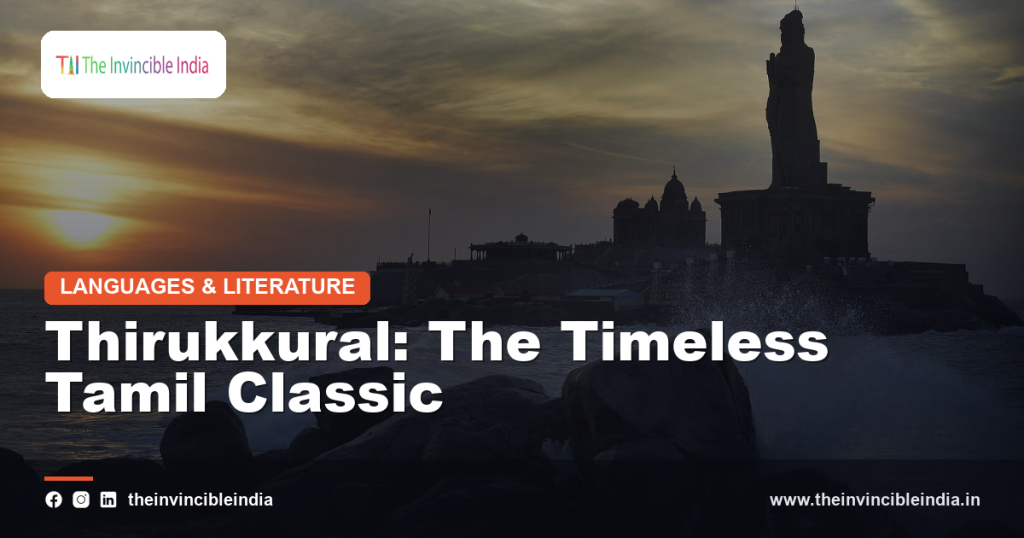
Thiruvalluvar is commemorated through several notable monuments across Tamil Nadu, most prominently a large statue erected at Kanniyakumari, at the southern tip of the Indian peninsula, visible from a considerable distance and symbolically positioned at land’s end. This statue has become an iconic representation of Tamil literary and cultural pride.
In Chennai, the Valluvar Kottam monument, designed in the form of a temple chariot, is dedicated to Thiruvalluvar and displays the full text of the Thirukkural inscribed on stone panels within its complex. Together, these monuments reflect the exceptional reverence accorded to Thiruvalluvar and his work within Tamil public and cultural life.
Thirukkural in Education and Public Life
The Thirukkural holds a prominent place in the educational curriculum across Tamil Nadu, with its couplets commonly taught in schools and frequently memorised by students as part of their study of Tamil language and literature. Public recitation and quotation of its verses remain common in formal speeches, ceremonies and everyday discourse across the state.
Government and cultural institutions in Tamil Nadu have also promoted the text through publications, public inscriptions and commemorative events, reflecting its status as a shared cultural touchstone that transcends the boundaries of literature alone. This sustained public and institutional engagement ensures the continued transmission of the text to new generations.
Influence on Tamil Culture and Identity
Beyond its literary and educational significance, the Thirukkural plays an important role in Tamil cultural identity, frequently invoked as an expression of Tamil intellectual and ethical achievement of great antiquity. Its couplets are commonly cited in public discourse, political rhetoric and everyday conversation, reflecting a deep and continuing familiarity with the text among Tamil speakers.
This broad cultural presence, spanning literature, education, public monuments and everyday speech, illustrates the unusual degree to which a single classical text can remain woven into the fabric of a living linguistic and cultural community many centuries after its composition.
Thirukkural Today
Today, the Thirukkural continues to be read, quoted, translated and studied both within Tamil Nadu and around the world, retaining its reputation as one of the great works of classical world literature on ethics. Its couplets remain in active circulation in education, public life and popular culture, a testament to the lasting relevance of its concise ethical vision.
As interest in classical Indian thought continues to grow internationally, the Thirukkural is increasingly studied alongside other major works of world ethical literature, introducing new generations of readers to its distinctive blend of brevity, wisdom and universal appeal. Its enduring presence across so many centuries secures its place as a timeless classic of Tamil literature.
Sources & Further Reading
- Sahitya Akademi.
- Ministry of Culture, Government of India (indiaculture.gov.in).
Frequently Asked Questions
What is the Thirukkural?
The Thirukkural is a classical Tamil work of ethical couplets traditionally attributed to the poet-sage Thiruvalluvar, addressing virtue, wealth and love across 1,330 short verses.
Who wrote the Thirukkural?
The Thirukkural is traditionally attributed to Thiruvalluvar, a revered Tamil poet-sage about whom relatively little is known beyond his authorship of this celebrated work.
How is the Thirukkural structured?
The text is divided into three books, Aram (virtue), Porul (wealth and polity) and Inbam (love), each containing chapters of ten couplets on a shared theme.
Why is the Thirukkural considered non-sectarian?
The work offers ethical guidance in general, widely applicable terms without explicitly endorsing any single religious tradition, allowing it to be embraced across different communities.
Where can Thiruvalluvar's legacy be seen today?
Thiruvalluvar is commemorated through prominent monuments including a large statue at Kanniyakumari and the Valluvar Kottam monument in Chennai, which displays the full text of the Thirukkural.