


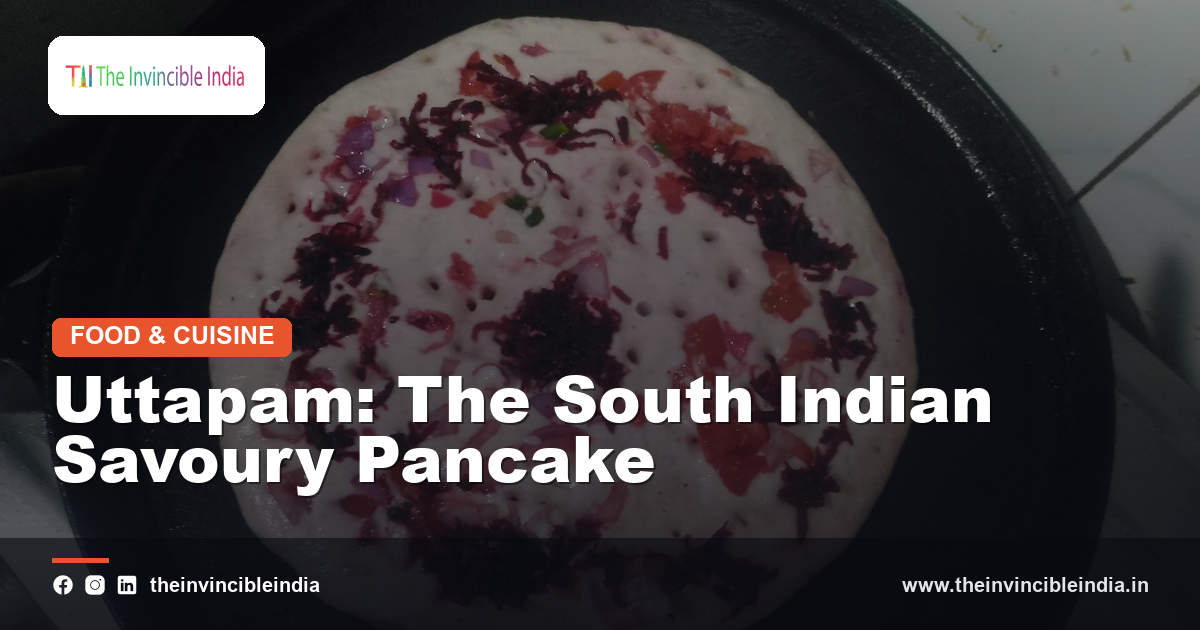
Uttapam is a thick, savoury pancake from South India, made from the same fermented rice and lentil batter used for dosa but cooked thicker and generously topped with onion, tomato, chilli and other vegetables pressed directly into its surface. Softer and more forgiving than the crisp, paper-thin dosa, uttapam occupies its own comfortable place within the South Indian tiffin table, closer in texture to a savoury griddle cake than to a crepe. Much like the wider family of South Indian breakfast dishes, it draws its character from a fermented batter and a handful of simple, well-chosen toppings. This guide explores uttapam, its origins, its preparation and its enduring popularity across Indian households and restaurants.
Quick Facts
| Detail | Information |
|---|---|
| Type | A thick South Indian savoury pancake |
| Rooted in | South Indian rice-and-lentil batter cooking |
| Main batter | Fermented rice and urad dal |
| Famous variety | Onion uttapam |
| Served with | Coconut chutney and sambar |
| Character | Soft, thick and mildly spiced |
What Is Uttapam
Uttapam is a thick, savoury pancake native to South India, prepared from the same fermented rice and lentil batter that gives dosa and idli their characteristic tang, but poured thicker onto the griddle and left to cook slowly rather than being spread thin and crisped quickly. Where dosa is prized for its delicate crunch, uttapam is valued for its soft, almost spongy texture, closer in feel to a savoury pancake than to a crepe. Vegetables such as onion, tomato and green chilli are pressed into the batter as it cooks, becoming part of the pancake itself rather than a separate topping. As a thick, soft and generously topped member of the South Indian pancake family, uttapam offers a distinct and satisfying alternative to its thinner, crisper relatives.
Origins in South Indian Cooking
Uttapam belongs to the long tradition of fermented rice-and-lentil cooking that defines much of South Indian cuisine, a tradition built around batters that are soaked, ground and left to rise naturally before being cooked into dishes such as idli, dosa and uttapam itself. This style of cooking developed over many generations in the kitchens of South India, where rice and lentils were abundant and fermentation offered both flavour and improved digestibility without any need for chemical leavening agents. Uttapam is generally understood as a simpler, more rustic cousin of the dosa, requiring less skill in spreading and more forgiving of an imperfect batter. Rooted firmly in this shared tradition of fermented South Indian batters, uttapam reflects the same patient, time-tested techniques that shaped the region’s wider tiffin culture.
The Fermented Batter
At the heart of every uttapam lies a fermented batter, made by soaking rice and urad dal separately, grinding each into a smooth paste, and combining them before leaving the mixture to ferment for several hours or overnight. This resting period allows naturally occurring wild yeasts and bacteria to act on the batter, producing the gentle sourness and light airiness that distinguishes South Indian pancakes from unleavened flatbreads elsewhere in India. A well-fermented batter rises visibly and develops small bubbles throughout its surface, a sign that it is ready for the griddle. This careful fermentation process, patient and reliant on natural microbial activity rather than any added raising agent, gives uttapam its characteristic flavour and texture before a single vegetable is even added.
Rice and Urad Dal Base
The base ingredients of uttapam, rice and urad dal, are soaked and ground in careful proportion, with slightly more rice than lentil generally used to achieve a batter that cooks up thick yet tender rather than dense or gummy. Some cooks add a small portion of cooked rice or poha to the mix, believed to lend extra softness to the finished pancake. This same base batter, adjusted slightly in consistency, also serves as the foundation for dosa and idli, making uttapam part of a closely related family of dishes sharing a single versatile preparation. This simple rice-and-lentil base, refined through generations of home cooking, remains the essential starting point from which every variety of uttapam is made.
Onion Uttapam
Onion uttapam is the most widely recognised and popular version of the dish, made by scattering finely chopped onion, along with green chilli and sometimes coriander leaves, over the batter as soon as it is poured onto the hot griddle. As the pancake cooks, the onion softens and lightly caramelises at its edges, adding a mild sweetness that balances the batter’s natural tang. This combination of soft pancake and gently cooked onion has made onion uttapam a standard offering on tiffin menus across South India and in restaurants throughout the country. As the signature and most requested variety of the dish, onion uttapam has become almost synonymous with uttapam itself in popular understanding, admired for its simple, comforting appeal.
Tomato and Vegetable Toppings
Beyond onion, uttapam welcomes a wide range of vegetable toppings, with chopped tomato, grated carrot, capsicum and coriander leaves all commonly pressed into the batter to create colourful, nutritious variations on the basic dish. Tomato uttapam, in particular, offers a tangy, slightly juicy contrast to the softer texture of the pancake, while mixed vegetable versions allow home cooks to make use of whatever produce is on hand. These toppings are added raw and cook gently as the pancake sets, retaining some of their own texture and flavour. This flexibility with vegetable toppings, welcoming whatever is fresh and available, makes uttapam a practical and adaptable dish well suited to everyday home cooking.
Cooking Technique on the Tawa
Uttapam is cooked on a flat griddle, or tawa, lightly greased with oil and heated to a moderate temperature rather than the high heat used for a crisp dosa. A ladleful of batter is poured and only gently spread, thicker than a dosa, before the chosen toppings are scattered evenly across its surface and pressed in lightly with the back of a spoon. The pancake is cooked slowly on one side until small bubbles appear and the base turns golden, then flipped briefly to finish the toppings without over-browning the batter. This deliberate, moderate cooking technique on the tawa is essential to achieving uttapam’s characteristic soft, evenly cooked texture, quite different from the fast, high-heat method used for dosa.
Difference Between Uttapam and Dosa
Although uttapam and dosa share the very same fermented batter, they differ considerably in thickness, texture and cooking method, with dosa spread thin and cooked quickly over high heat to achieve a crisp, lacy finish, while uttapam is poured thicker and cooked more slowly to remain soft throughout. Uttapam also carries its vegetable toppings within the body of the pancake itself, whereas dosa is more often filled or served plain alongside its toppings. These differences give the two dishes distinct identities despite their shared origin. This clear contrast between uttapam and dosa, one soft and topped, the other crisp and thin, shows how a single batter can yield two very different and equally beloved dishes.
Regional Variations
Uttapam varies subtly from region to region and household to household across South India, with some cooks favouring a purely rice-based batter for extra softness, while others add a portion of semolina or poha to achieve a slightly different texture. In some coastal areas, uttapam is topped with grated coconut alongside onion and chilli, while other versions include a thin layer of chutney spread beneath the toppings before cooking. These small variations reflect local taste and available ingredients rather than any single fixed recipe. This gentle regional variation across uttapam preparations demonstrates the flexibility of the dish within the wider, shared tradition of South Indian batter cooking.
Accompaniments: Chutney and Sambar
Uttapam is traditionally served with coconut chutney and sambar, the same pairing that accompanies dosa and idli across South Indian tiffin tables, with the chutney offering a cool, creamy contrast and the sambar contributing warmth and substance to the meal. A tomato-based or coconut chutney is especially popular alongside onion uttapam, its tang complementing the pancake’s mild sweetness. Some households also serve uttapam with a simple podi, or spiced dry chutney powder, mixed with ghee. These essential accompaniments of chutney and sambar, prepared fresh alongside the pancake, complete the uttapam meal and reflect the same careful balance of flavour found throughout South Indian tiffin cuisine.
Nutritional Character
Uttapam is generally considered a wholesome and balanced dish, combining the carbohydrates of rice with the protein of urad dal, and gaining further nutrition from the vegetables pressed into its surface during cooking. The fermentation process that produces its batter is also credited with improving the digestibility of the grains and lentils involved, a quality shared with other fermented South Indian foods. Cooked with only a modest amount of oil on the griddle, uttapam remains relatively light compared to many fried snacks. This wholesome nutritional character, built on fermented grains, lentils and fresh vegetables, has helped uttapam remain a trusted and popular choice for breakfast and light meals across generations.
Uttapam as Tiffin Food
Within the South Indian tiffin tradition, uttapam holds a comfortable and well-established place alongside idli, dosa and vada, offered as a slightly heartier alternative for those who prefer a softer, more substantial pancake to a crisp dosa. It is commonly available at tiffin counters, small eateries and family restaurants throughout South India, prepared fresh to order and served hot off the griddle. Its combination of ease of preparation and satisfying texture suits it well to the fast pace of a morning meal. As an established and much-loved part of the tiffin repertoire, uttapam continues to be ordered and enjoyed as a reliable, comforting choice at any time of day.
Street Food and Restaurant Popularity
Uttapam has found a firm place not only in traditional tiffin rooms but also in modern restaurants and food stalls across India, where it is often listed alongside dosa on menus catering to a wide range of tastes. Restaurants have introduced creative versions topped with paneer, cheese or a wider mix of vegetables, extending the dish well beyond its traditional onion and tomato toppings while retaining its essential soft, thick character. Its approachable flavour makes it popular with diners less accustomed to South Indian food. This growing restaurant popularity of uttapam, adapted with new toppings while keeping its core identity intact, reflects the dish’s broad and enduring appeal across different tastes and regions.
Home Cooking Traditions
Uttapam remains a familiar and frequently prepared dish in South Indian homes, valued for making good use of leftover dosa batter that has fermented a little further and become slightly sourer, a stage at which it suits uttapam particularly well. Home cooks often personalise their uttapam with whatever vegetables are on hand, treating the dish as both a practical way to use up ingredients and a comforting family favourite. Children are frequently introduced to uttapam as a gentler alternative to spicier tiffin dishes. This enduring place of uttapam within home cooking traditions, practical and endlessly adaptable, ensures that the dish remains a familiar and welcome sight at breakfast tables across South India.
Uttapam Beyond South India
Although rooted firmly in South Indian cuisine, uttapam has travelled well beyond its home region, appearing on menus in restaurants across northern and western India and in Indian eateries around the world. Its soft texture and mild, adaptable flavour have made it approachable to diners unfamiliar with South Indian food, often serving as an accessible entry point before trying crisper dosa varieties. Frozen and instant uttapam mixes have also made the dish easier to prepare at home outside its traditional region. This spread of uttapam well beyond South India, carried by restaurants and home cooks alike, reflects its broad and growing popularity across the wider landscape of Indian cuisine.
Uttapam Today
Today uttapam continues to be prepared and enjoyed much as it always has been, its fermented batter and vegetable toppings a familiar sight on tiffin tables, restaurant menus and home kitchens across South India and beyond. Modern variations continue to appear alongside the classic onion and tomato versions, yet the essential character of the dish, soft, thick and generously topped, remains unchanged. It continues to be served alongside chutney and sambar as a complete, satisfying meal. As a thick, comforting member of the great South Indian pancake family, uttapam stands as a simple yet enduring dish within India’s rich and varied culinary heritage.
Sources & Further Reading
- Ministry of Tourism, Government of India, on the cuisines of India (tourism.gov.in).
- Culinary references on South Indian tiffin and breakfast traditions.
Frequently Asked Questions
What is uttapam made of?
Uttapam is made from a fermented batter of rice and urad dal, the same batter used for dosa and idli, poured thicker onto a griddle and topped with onion, tomato or other vegetables while it cooks.
What is the difference between uttapam and dosa?
Uttapam is thicker and softer than dosa, with vegetables pressed into the batter itself, while dosa is spread thin and cooked over higher heat to achieve a crisp, lacy texture.
What is onion uttapam?
Onion uttapam is the most popular version of the dish, made by scattering chopped onion and green chilli over the batter as it cooks, giving the finished pancake a mild sweetness at its edges.
What is uttapam served with?
Uttapam is traditionally served with coconut chutney and sambar, the same accompaniments used with dosa and idli across South Indian tiffin meals.
Is uttapam a healthy dish?
Uttapam is generally considered wholesome, combining fermented rice and lentils with fresh vegetables and only a modest amount of oil, making it a balanced choice for breakfast or a light meal.