

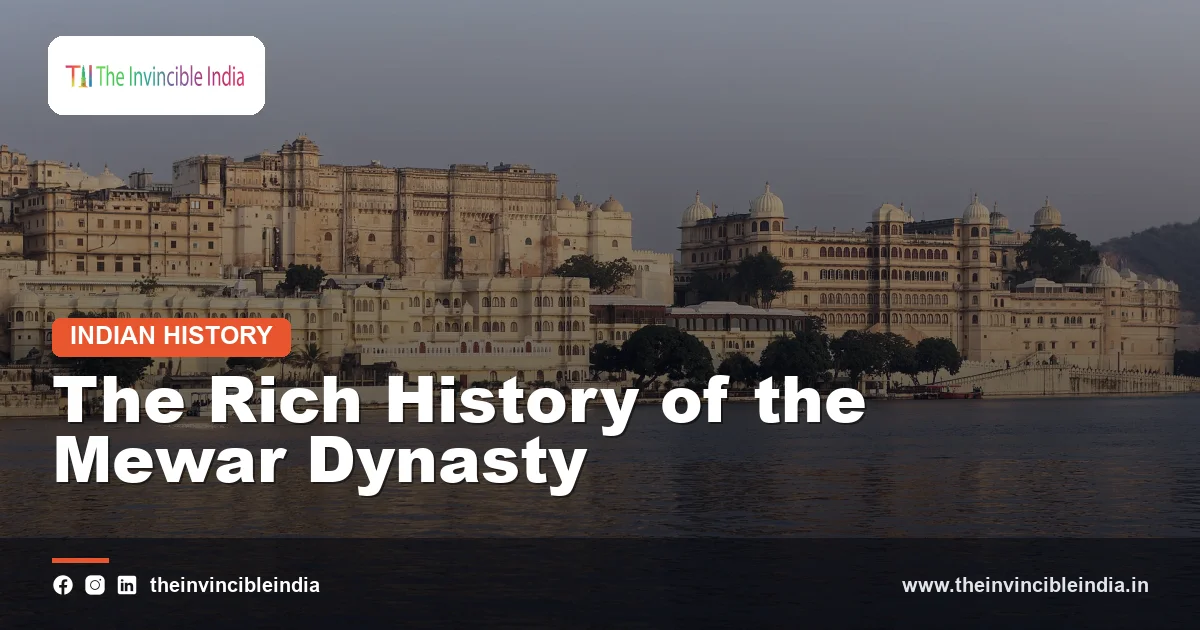
The Mewar dynasty is one of the most storied and revered royal lineages in Indian history, celebrated for its unyielding spirit of independence, its profound sense of honour, and its rich patronage of art and architecture. Ruling from the region around Chittorgarh and later Udaipur in what is now Rajasthan, the Sisodia rulers of Mewar are regarded as one of the oldest surviving royal dynasties in the world, tracing an unbroken line across more than a thousand years. This detailed guide explores the rich history of the Mewar dynasty, its greatest rulers, its legendary battles and its living legacy.
Quick Facts About Mewar
| Dynasty | Guhila, later the Sisodia branch of Rajputs |
| Early capital | Chittorgarh |
| Later capital | Udaipur (founded 1559) |
| Most famous ruler | Maharana Pratap |
| Region | Southern Rajasthan (Mewar) |
The Origins of Mewar
The kingdom of Mewar traces its roots to the Guhila dynasty, traditionally founded around the 7th century, with the semi-legendary figure of Bappa Rawal credited as an early hero who established the clan’s fortunes at Chittorgarh. Over the centuries, the Guhilas evolved into the Sisodia branch of the Rajputs, who would come to define Mewar’s identity. Unlike many other Rajput houses that eventually allied closely with the Mughals through marriage, the Sisodias cultivated a fierce reputation for resisting foreign domination, a stance that became central to their legend and their pride.
Chittorgarh: The Soul of Mewar
For much of its early history, the mighty hill fort of Chittorgarh served as the capital and the very soul of Mewar. The largest fort in India by area, it was both a symbol of Rajput power and the stage for some of the most dramatic and tragic events in Indian history. Its towers, palaces and temples bore witness to prosperity and to devastating sieges, and the fort remains, to this day, the emotional heart of Mewar’s story of valour and sacrifice.
The Three Great Sieges and Jauhar
Chittorgarh endured three legendary sieges, each ending in the terrible ritual of jauhar — the mass self-immolation of the women — followed by saka, the final suicidal charge of the men into battle rather than surrender. The first siege, by Alauddin Khalji of Delhi in 1303, is bound to the legend of the beautiful Rani Padmini. The second, by Bahadur Shah of Gujarat in 1535, saw the sacrifice of thousands under Rani Karnavati. The third, by the Mughal emperor Akbar in 1568, prompted Maharana Udai Singh II to seek a safer capital. These acts of collective sacrifice became enduring symbols of Rajput honour.
Rana Kumbha: Builder and Patron
Among Mewar’s greatest rulers was Rana Kumbha, who reigned from 1433 to 1468. A brilliant military strategist, he expanded the kingdom and is said to have built or repaired dozens of forts, most famously Kumbhalgarh, with its wall stretching some 36 kilometres. He also raised the magnificent nine-storey Vijay Stambh (Tower of Victory) at Chittorgarh to commemorate a great triumph. Beyond warfare, Rana Kumbha was a scholar and a generous patron of music, literature and architecture, and his reign is remembered as a golden age of Mewar.
Rana Sanga and the Struggle for North India
Rana Sanga (Sangram Singh I), who ruled in the early 16th century, was one of the most powerful Rajput kings of his time. He united several Rajput clans and fought numerous battles against the sultans of Delhi, Gujarat and Malwa. His confrontation with Babur, the founder of the Mughal Empire, at the Battle of Khanwa in 1527 was a pivotal moment; though Sanga was defeated, his resistance underscored Mewar’s determination to remain free.
Maharana Pratap: The Legend of Haldighati
The most celebrated of all Mewar rulers is undoubtedly Maharana Pratap, who reigned from 1572 to 1597. Refusing to submit to the Mughal emperor Akbar despite immense pressure, he became the very embodiment of resistance and self-respect. At the Battle of Haldighati in 1576, fought against a large Mughal army, Pratap and his loyal horse Chetak displayed extraordinary courage. Though the battle was inconclusive and forced Pratap into years of hardship in the hills, he never surrendered, waging guerrilla warfare and, with the help of his devoted minister Bhamashah, gradually recovering much of his lost territory before his death.
The Founding of Udaipur
With Chittorgarh increasingly vulnerable, Maharana Udai Singh II founded the city of Udaipur in 1559, choosing a beautiful, well-watered valley shielded by the Aravalli hills. The new capital, built around a series of lakes, proved far more defensible and grew into one of the most enchanting cities in India. Udaipur has remained the seat of the Mewar legacy ever since, and its palaces and lakes continue to draw travellers from around the world.
Later Rulers and the Mughal Settlement
After decades of conflict, Pratap’s successors eventually reached an accommodation with the Mughals in the early 17th century, one that notably preserved Mewar’s dignity and did not require the marriage alliances that other Rajput houses had accepted. The later Maharanas focused on rebuilding, and adorned Udaipur with grand palaces, gardens and temples, ushering in a long period of cultural flourishing even as the political landscape of India shifted around them.
Art, Architecture and the Mewar School of Painting
The Mewar rulers were extraordinary patrons of the arts. They built magnificent palaces, temples, gardens and lakeside pavilions, blending Rajput and later Mughal influences into a distinctive style. Mewar also gave rise to a celebrated school of miniature painting, known for its bold colours and vivid depictions of court life, religious themes, festivals and epics such as the Ramayana. These paintings are treasured today in museums and collections around the world as a high point of Indian art.
The Living Legacy of Mewar
The legacy of Mewar is very much alive today. The descendants of the royal family continue to preserve its heritage, maintaining palaces, museums and charitable foundations, and the annual Mewar Festival and other traditions keep the culture vibrant. Sites such as the City Palace, Chittorgarh Fort, Kumbhalgarh and the cenotaphs at Ahar draw countless visitors, while the stories of Maharana Pratap and the defenders of Chittorgarh remain a powerful source of pride and inspiration across India.
The Sacred Sites and Cenotaphs of Mewar
The Mewar rulers left behind not only forts and palaces but also a landscape rich in sacred and memorial architecture. At Ahar, near Udaipur, stand the royal cenotaphs (chhatris) of the Maharanas, elegant domed memorials marking the cremation sites of generations of rulers. The nearby temple town of Eklingji, dedicated to Lord Shiva as the family deity of the Mewar rulers, has been worshipped by the Maharanas for over a thousand years; by tradition, the Maharana ruled Mewar only as the earthly regent (Dewan) of Eklingji. The ruins of Nagda and the exquisite Jain temple of Ranakpur, with its 1,444 carved marble pillars, further enrich the spiritual heritage of the region.
Mewar and the Bhil Community
An important and often overlooked chapter of Mewar’s story is its deep bond with the Bhil tribal community. During Maharana Pratap’s long years of struggle against the Mughals, the Bhils were his most loyal allies, providing warriors, guides and sustenance in the forests and hills. Their contribution is honoured in the very emblem of Mewar, which depicts a Rajput and a Bhil warrior standing together, symbolising a partnership of mutual respect that endured through the kingdom’s most difficult times.
A Timeline of Mewar
The sweep of Mewar’s history can be traced through key moments: the legendary founding by Bappa Rawal around the 8th century; the establishment of the Sisodia line; the first siege of Chittorgarh in 1303; the reign of the builder-king Rana Kumbha in the 15th century; the Battle of Khanwa in 1527 under Rana Sanga; the third and final sack of Chittorgarh in 1568; the founding of Udaipur in 1559; the epic resistance of Maharana Pratap culminating in the Battle of Haldighati in 1576; and the eventual settlement with the Mughals in the 17th century, followed by centuries of cultural flourishing. This long arc makes Mewar one of history’s most remarkable dynasties.
Mewar in Art, Literature and Popular Culture
The heroism of Mewar has inspired poets, painters and storytellers for centuries, and continues to do so today. The valour of Maharana Pratap and the sacrifice of the defenders of Chittorgarh feature in folk ballads, school textbooks, television serials and films, keeping the dynasty’s memory vividly alive in the national imagination. The Mewar school of miniature painting, with its glowing colours and dramatic compositions, remains one of the most admired traditions of Indian art and a visual record of the kingdom’s courtly life.
Visiting the Mewar Heartland
For travellers, the Mewar region offers an immersive journey into this history. Udaipur, with its City Palace and lakes, is the ideal base. From there, day trips lead to the mighty Chittorgarh Fort, the vast ramparts of Kumbhalgarh, the temples of Eklingji, Nagda and Ranakpur, and the battlefield of Haldighati with its memorials to Maharana Pratap and his horse Chetak. Together they allow visitors to walk in the footsteps of one of India’s greatest dynasties and to feel the enduring pride of Mewar.
The Values Mewar Represents
More than territory or wealth, Mewar has come to symbolise a set of enduring values — independence, honour, sacrifice, loyalty and resilience in the face of overwhelming odds. The refusal of its greatest rulers to trade their self-respect for comfort or safety, and their readiness to endure hardship rather than submit, have made Mewar a byword for courage and dignity. It is this spirit, as much as its monuments, that keeps the story of the dynasty alive and cherished across generations.
Mewar’s Place in the Indian Imagination
Few dynasties occupy as cherished a place in the Indian imagination as Mewar. The refusal of Maharana Pratap to bow to a mightier empire, the sacrifices at Chittorgarh, and the loyalty of allies like the Bhils have become part of the moral vocabulary of the nation, invoked as examples of courage, self-respect and steadfastness. Generations of Indian children grow up learning these stories, and leaders across the centuries have drawn inspiration from Mewar’s example of resistance against overwhelming odds. In this sense, the legacy of Mewar belongs not only to Rajasthan but to the whole of India, a shared inheritance of pride and principle that continues to resonate far beyond the borders of the old kingdom.
Frequently Asked Questions
Who was the most famous ruler of Mewar?
Maharana Pratap is the most celebrated Mewar ruler, renowned for resisting the Mughal Empire at the Battle of Haldighati in 1576.
What was the capital of Mewar?
Chittorgarh was the early capital of Mewar; Udaipur was founded as the new capital in 1559.
What is jauhar?
Jauhar was the practice of mass self-immolation by Rajput women to avoid capture when defeat in a siege was certain.
Which dynasty ruled Mewar?
Mewar was ruled by the Guhila dynasty and later its Sisodia branch of Rajputs.
Why is Mewar considered special among Rajput kingdoms?
Mewar is celebrated for its long, unbroken lineage and its fierce tradition of resisting foreign domination rather than forming marriage alliances with the Mughals.


