

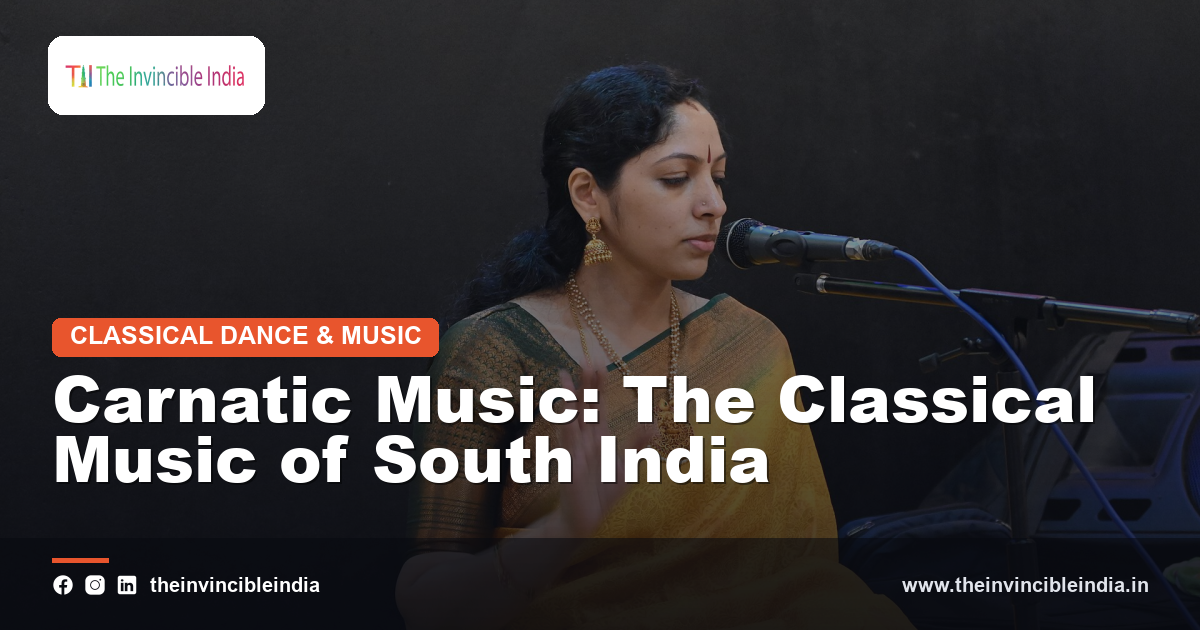
Carnatic music is the classical music tradition of South India, one of the two great streams of Indian classical music alongside the Hindustani tradition of the North. Like its northern counterpart it is built on the raga, the melodic framework, and the tala, the rhythmic cycle, but it is distinguished by its rich body of composed songs, its devotional character and its own instruments and style. Shaped above all by a great tradition of composers, most famously the revered Trinity of Carnatic music, it is an art of extraordinary structure, subtlety and spiritual depth. This guide explores its history, its ragas and talas, its great composers, its main forms, its instruments and the celebrated Chennai music season.
Quick Facts
| Detail | Information |
|---|---|
| Type | The classical music tradition of South India |
| Foundations | The raga (melody) and the tala (rhythmic cycle) |
| Character | Rich in composed songs (kritis); largely devotional |
| Great composers | The Trinity: Tyagaraja, Muthuswami Dikshitar and Syama Sastri |
| Key instruments | Veena, violin, mridangam, flute, ghatam |
| Famous season | The Chennai (Madras) music season each December |
The Classical Music of the South
Carnatic music is the classical music of South India, embracing the traditions of Tamil Nadu, Karnataka, Andhra Pradesh, Telangana and Kerala. It shares with Hindustani music the fundamental concepts of the raga and the tala and a common ancient root, but developed into a distinct tradition with its own repertoire, forms, instruments and aesthetic. Carnatic music is especially rich in composed songs and devotional in spirit, and it places great emphasis on the works of its revered composers. Deeply woven into the cultural and religious life of the South, it is a sophisticated and living art, cherished by musicians and audiences alike across the region and beyond.
Ancient and Devotional Roots
Carnatic music grows from the same ancient foundations as all Indian classical music, drawing on the melodic chanting of the Vedas and the theory of music set out in ancient Sanskrit treatises. In the South, this heritage combined with a rich tradition of devotional poetry and temple worship, and much of Carnatic music is deeply religious in character, its songs expressing devotion to the deities. The tradition of devotional singing, including the songs of the medieval saint-poets, fed into the classical music of the region. This deep devotional root gives Carnatic music its spiritual seriousness and its enduring bond with the temples and religious life of South India.
The Raga in Carnatic Music
As in all Indian classical music, the raga is the melodic foundation of Carnatic music, a framework of notes, phrases and rules that carries a particular mood. Carnatic music has an elaborate and systematic theory of ragas, organised into families derived from a set of fundamental parent scales, from which a vast number of ragas are generated. Within a raga, the musician both performs composed songs and improvises, exploring its character through various techniques. This systematic organisation of ragas is one of the distinctive features of the Carnatic tradition, giving it a remarkable range and structure while preserving the expressive individuality of each raga.
The Tala System
Rhythm in Carnatic music is governed by the tala, the cyclic framework of beats, and the tradition has a particularly sophisticated and well-developed system of talas. Performers and audiences keep the tala visibly, with a set pattern of hand gestures, claps and finger counts, so that the rhythmic cycle is followed throughout a performance. The interplay of melody and rhythm, and the dialogue between the main performer and the percussionist, especially in the dedicated rhythmic solo, is a source of great excitement. The precise and intricate handling of tala is a hallmark of Carnatic music and a skill in which its musicians take great pride.
The Trinity of Carnatic Music
The tradition of Carnatic music is dominated by the legacy of its great composers, above all the revered Trinity who lived in the eighteenth and nineteenth centuries: Tyagaraja, Muthuswami Dikshitar and Syama Sastri. Working in the same era in the Tamil country, these three saint-composers created a vast body of devotional songs of extraordinary musical and spiritual richness, which form the core of the Carnatic repertoire performed to this day. Their compositions, in various languages and set in many ragas, are treasured as the summit of the tradition. The Trinity gave Carnatic music much of its repertoire and character, and their works remain central to every concert.
Purandara Dasa and Earlier Masters
Before the Trinity, the tradition was shaped by earlier masters, most notably Purandara Dasa, the sixteenth-century saint-composer of Karnataka who is honoured as a founding figure of Carnatic music. He is credited with systematising the teaching of the music, devising the graded exercises through which students still begin their training, and composing a great many devotional songs. For his foundational contributions he is often called the grandfather of Carnatic music. The work of Purandara Dasa and other early composers laid the groundwork on which the Trinity and later musicians built, and his teaching method remains the foundation of Carnatic musical education.
The Kriti
The central form of Carnatic music is the kriti, a devotional song in a particular raga and tala, with a structured form of several sections. The great composers cast their finest works in this form, and the kriti is the heart of the Carnatic concert repertoire. In performance, a kriti is not merely sung as written but is elaborated and adorned with improvisation, so that the fixed composition becomes the basis for creative interpretation. The balance between the composed song and the improvisation around it is characteristic of Carnatic music, which, more than the Hindustani tradition, is built around a rich body of cherished compositions.
Improvisation in Carnatic Music
Although Carnatic music is rich in composition, improvisation remains central to it, and a concert offers several forms of it. The musician may explore a raga freely and without rhythm in the alapana, improvise rhythmic melodic passages, and engage in the elaborate ragam-tanam-pallavi, the grand improvisatory centrepiece of a concert that displays the fullest command of melody and rhythm. There is also the exciting exchange of improvised phrases between performers. This blend of cherished composition and creative improvisation gives Carnatic music both its structure and its spontaneity, and the skill of a musician is judged as much by the imagination of the improvisation as by the rendering of the songs.
The Veena
The veena is the ancient and revered string instrument of South India and one of the most important instruments of Carnatic music. A large plucked instrument with a deep, resonant and mellow tone, it is capable of the subtle slides and ornaments that are essential to Indian music, and it has a special place in the tradition, associated with learning and with the goddess of knowledge. Playing the veena is a refined art, and its rich, contemplative sound is well suited to the devotional character of Carnatic music. Long central to the tradition, the veena remains a cherished and dignified voice of South Indian classical music.
Violin, Mridangam and Other Instruments
The violin, adopted from the West and adapted to Indian music, has become central to Carnatic performance, both as the main accompaniment to a vocalist and as a solo instrument, prized for its ability to follow the voice closely. The mridangam, a double-headed barrel drum, is the principal percussion instrument, providing the rhythmic foundation and the exciting percussion solo. Other instruments include the ghatam, a clay pot played as a drum, the flute, and the nagaswaram, a wind instrument used in temple music. Together these instruments give Carnatic music its distinctive ensemble sound, in which the melodic lead is closely supported by melody and rhythm.
The Carnatic Concert
A Carnatic concert, known as a kutcheri, follows a broadly established structure that has developed over the past century. It typically opens with a brisk composition to set the mood, followed by a sequence of kritis in various ragas and talas, interspersed with improvisation, building towards the elaborate ragam-tanam-pallavi that forms the centrepiece. Lighter and devotional pieces follow, and the concert closes with auspicious final items. A vocal concert features the singer supported by the violin and mridangam, with perhaps the ghatam, and the interplay among the performers is central to the experience. This well-shaped concert form is a distinctive and cherished part of the tradition.
The Chennai Music Season
One of the most remarkable features of Carnatic music is the great music season held in Chennai each December and January, a festival of extraordinary scale and intensity. Over several weeks, hundreds of concerts are held across the city in numerous venues and cultural organisations, drawing performers and audiences from across the region and around the world. The season is a celebration of the tradition, a gathering of its community, and an occasion for both established masters and rising talents to perform. This vibrant annual festival, unmatched in its concentration of classical music, is a testament to the living vitality of Carnatic music and its central place in the culture of the South.
Training and Transmission
Carnatic music is learned through long and disciplined training, traditionally under the close guidance of a guru. Students begin with the graded exercises attributed to Purandara Dasa, mastering the basics of note, raga and tala, before progressing to the great compositions and the arts of improvisation. The relationship between teacher and student is central, and much of the subtle knowledge of the tradition passes through this personal transmission. Alongside the traditional method, the music is also taught in schools and academies. This dedicated training, grounded in a vast repertoire and a systematic method, preserves the depth of Carnatic music and hands it on faithfully to each new generation.
Carnatic Music Today
Carnatic music flourishes today as a vibrant living tradition, performed across South India and by communities and admirers around the world. Its great composers’ works remain at the heart of every concert, while musicians continue to bring fresh imagination to the tradition through their improvisation and interpretation. The Chennai season and countless concerts elsewhere sustain a thriving musical culture, and the Indian diaspora has carried the tradition abroad. Rooted in devotion and refined over centuries, yet alive with creativity, Carnatic music remains one of the great classical traditions of the world, cherished for its structure, its spiritual depth and its endless beauty.
Sources & Further Reading
- Sangeet Natak Akademi, national academy for music, dance and drama, on the classical music traditions of India (sangeetnatak.gov.in).
- Ministry of Culture, Government of India, on Carnatic music (indiaculture.gov.in).
Frequently Asked Questions
What is Carnatic music?
Carnatic music is the classical music tradition of South India, one of the two great branches of Indian classical music alongside the Hindustani tradition of the North. It is built on the raga and the tala, is rich in composed devotional songs called kritis, and is largely devotional in character.
Who are the Trinity of Carnatic music?
The Trinity of Carnatic music are the three great saint-composers of the eighteenth and nineteenth centuries — Tyagaraja, Muthuswami Dikshitar and Syama Sastri — whose devotional compositions form the core of the Carnatic repertoire performed today.
What is a kriti?
A kriti is the central form of Carnatic music, a structured devotional song in a particular raga and tala. In performance it is elaborated with improvisation, so the composed song becomes the basis for creative interpretation.
What is the difference between Carnatic and Hindustani music?
Both are classical traditions built on the raga and tala, but Carnatic music of the South is richer in composed songs and devotional in character with its own instruments, while Hindustani music of the North, shaped partly by Persian influence, emphasises improvisation and the gradual unfolding of a raga.
What is the Chennai music season?
The Chennai music season is a great festival of Carnatic music held each December and January, when hundreds of concerts are staged across the city in numerous venues, drawing performers and audiences from around the world.


