

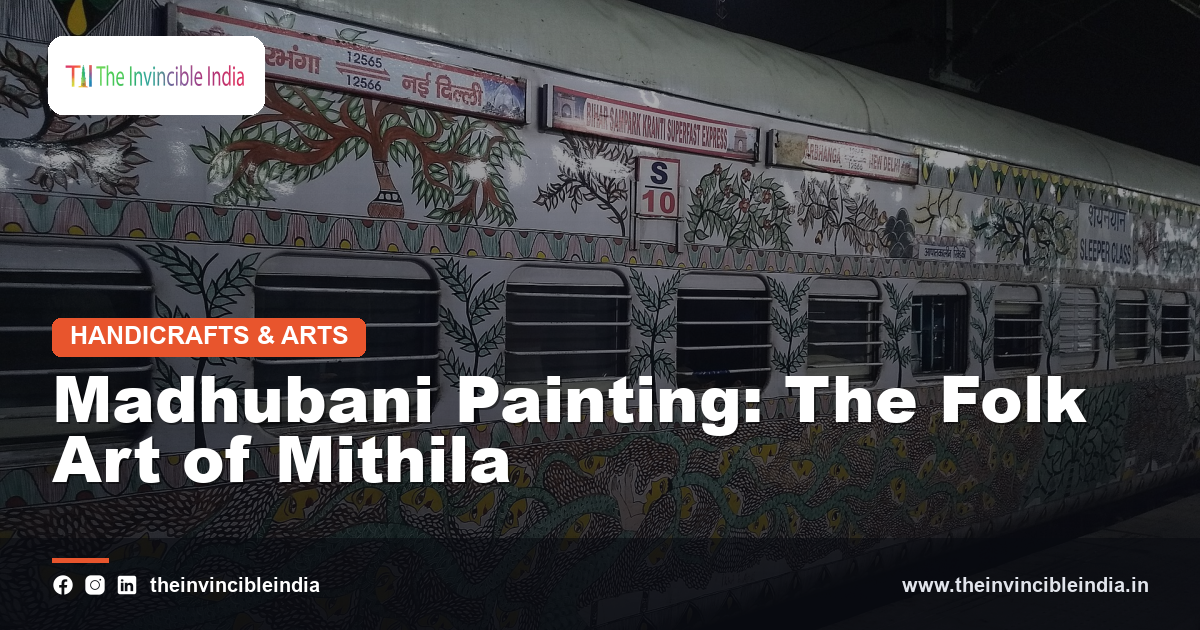
Madhubani painting, also known as Mithila painting, is one of the most celebrated folk art traditions of India, born in the Mithila region of Bihar. Famous for its bold outlines, vivid natural colours, intricate patterns and richly symbolic imagery, it depicts gods and goddesses, scenes from mythology, the natural world and the rituals of village life. Traditionally created by women on the walls and floors of their homes, especially for weddings and festivals, the art has in recent decades moved onto paper and cloth and won admirers around the world. Rooted in centuries of tradition and carrying deep cultural and ritual meaning, Madhubani painting is a treasured strand of India’s handicraft heritage. This guide explores its origins, styles, motifs, materials and living practice.
Quick Facts
| Detail | Information |
|---|---|
| Type | Folk and ritual painting tradition |
| Region | The Mithila region of Bihar (and neighbouring Nepal) |
| Traditionally by | Women, on the walls and floors of homes |
| Main styles | Bharni, kachni, godna, tantrik and kohbar |
| Colours | Made traditionally from natural pigments |
| Recognition | Protected by a Geographical Indication (GI) tag |
The Folk Art of Mithila
Madhubani painting takes its name from the Madhubani district of Bihar and from the wider Mithila region, the cultural homeland where the art has flourished for generations. It is a folk art in the truest sense, created by ordinary people, above all women, as part of the ritual and decorative life of the home, rather than by professional artists for sale. Rich in colour, pattern and meaning, it transforms the walls of village houses into vivid tableaux of gods, nature and ceremony. Deeply rooted in the culture and religion of Mithila, the painting is an expression of the region’s identity and one of the most distinctive folk traditions of India.
Ancient Origins
The origins of Madhubani painting are very old, and tradition traces the art back into antiquity, associating it with the region’s deep cultural and religious history. For countless generations it was practised as a living domestic tradition, passed from mother to daughter, and applied to the mud walls and floors of homes for auspicious occasions. Because it was created on walls that were periodically renewed, little of the older work survives, but the tradition itself is ancient and continuous. This long heritage, handed down within families over the centuries, gives Madhubani painting a profound sense of rootedness in the culture and faith of Mithila.
A Tradition of Women
Madhubani painting has traditionally been the art of women, passed down from mother to daughter within the home over generations. Women created the paintings as part of the ritual and decorative life of the household, adorning the walls and floors for weddings, festivals and other auspicious occasions, and the skill was a valued part of a woman’s cultural inheritance. This deep association with women gives the art a special place in the culture of Mithila and makes it a powerful expression of women’s creativity and devotion. In recent times, this tradition has also become a source of income and recognition for many women artists of the region.
From Walls to Paper
For most of its history, Madhubani painting was created on the walls and floors of homes, as an ephemeral art renewed for each occasion. A major transformation came in the twentieth century, when, encouraged by those who recognised its beauty, artists began to create the paintings on paper and cloth. This shift allowed the art to be preserved, sold and carried far beyond the villages of Mithila, turning a domestic ritual art into a portable art form with a wide market. The move to paper opened new opportunities for the artists and spread Madhubani painting across India and the world, while the traditional wall painting continues in the home.
The Bharni Style
Madhubani painting is practised in several distinct styles, and one of the best known is bharni, meaning filling. In the bharni style, the outlined figures are filled in with solid, vivid colour, giving the paintings a rich, bold and colourful appearance. This style is especially associated with religious and mythological subjects, depicting gods and goddesses in strong, saturated hues. The combination of firm outlines and full, bright colour makes bharni paintings striking and immediately appealing. It is one of the classic styles of the tradition and among the most widely recognised forms of Madhubani art, prized for its vibrancy and devotional imagery.
The Kachni Style
In contrast to the colour-filled bharni style, the kachni style, meaning line, relies on fine, intricate line work. In kachni paintings, the forms are built up and shaded with delicate hatching and detailed patterns of lines, often in one or two colours, creating an effect of great intricacy and refinement. The emphasis is on the beauty of the drawing and the dense, elaborate detail rather than on bold colour. This style demands great skill and patience and produces works of subtle, filigree-like beauty. Together, the bold bharni and the delicate kachni represent two of the classic approaches within the rich stylistic range of Madhubani painting.
Other Styles: Godna and Tantrik
Beyond bharni and kachni, Madhubani painting includes further styles that have developed within the tradition. The godna style draws its inspiration from tattoo patterns, using repeated motifs and rhythmic designs to build up the composition. The tantrik style depicts religious and symbolic subjects drawn from tantric traditions, rich in esoteric meaning. Other approaches within the tradition reflect the styles once associated with different communities of the region. This variety of styles, each with its own character and history, gives Madhubani painting a remarkable richness and range, and together they form a living tradition capable of both bold devotion and delicate, intricate artistry.
The Kohbar and Weddings
One of the most important and meaningful forms of Madhubani painting is the kohbar, the ritual painting created for weddings. Traditionally painted on the walls of the nuptial chamber, the kohbar is rich in auspicious symbols of love, fertility, union and prosperity, blessing the marriage and the couple. Its imagery, drawn from a shared symbolic vocabulary, carries deep meaning and reflects the hopes and blessings of the community for the new union. The kohbar shows how closely Madhubani painting is bound to the rituals and life-events of Mithila, functioning not merely as decoration but as an integral part of ceremony, blessing and cultural expression.
Themes and Motifs
Madhubani painting draws on a rich vocabulary of themes and motifs. Gods and goddesses feature prominently, especially figures such as Krishna, Rama, Sita, Durga and Lakshmi, along with scenes from mythology and the epics. The natural world is everywhere present, in depictions of the sun and moon, trees, flowers, fish, birds, elephants and peacocks, many of which carry symbolic meaning. Scenes of village life, ritual and celebration also appear. These motifs are not merely decorative but often symbolic, expressing ideas of fertility, prosperity, devotion and the harmony of nature and human life, and giving the paintings their deep layers of meaning.
Natural Colours and Materials
Traditionally, the colours of Madhubani painting were made from natural materials found in the local environment. Pigments were derived from plants, flowers, leaves, bark, soot and minerals, producing a palette of earthy and vivid hues, and these were applied using simple tools, including twigs, brushes and, for the fine lines, nib-like pens, as well as the fingers. The base might be a wall prepared with cow dung and mud, or later paper and cloth. This use of natural, locally available materials connected the art closely to its environment. Although commercial colours are now often used, the tradition of natural pigments remains an important part of the heritage of the art.
Distinctive Features
Several features give Madhubani painting its instantly recognisable character. The figures are outlined boldly and the whole surface is typically filled, leaving little empty space, so that borders, patterns and small motifs crowd every gap in a rich, dense composition. The forms are stylised rather than realistic, with distinctive treatment of the eyes and faces, and the paintings are full of pattern and symbolic detail. The double-line border filled with motifs is a hallmark of the style. This combination of bold line, full surface, stylised form and symbolic richness makes a Madhubani painting unmistakable and gives the art its striking visual power.
Famous Artists and Recognition
In the modern era, Madhubani painting has brought fame and recognition to a number of gifted artists of the Mithila region, several of whom have received high national honours for their work. These artists, many of them women, carried the tradition from the walls of village homes to galleries and collections across India and the world, and their skill and dedication won the art wide admiration. Their success also helped establish Madhubani painting as a source of livelihood and pride for the region. The recognition of these master artists has been crucial in raising the status of the tradition and ensuring its transmission to new generations.
A Livelihood and a GI Tag
Madhubani painting has become an important source of livelihood for many people in the Mithila region, especially women, who create works for sale within India and abroad. The art now appears not only on paper and cloth but on a wide range of products, spreading its distinctive imagery and supporting the artists economically. To protect the tradition and the artists, Madhubani painting has been granted a Geographical Indication (GI) tag, which recognises it as a product distinctive to its region and helps guard its authenticity and reputation. This combination of cultural value and economic importance has helped sustain the art and the communities that practise it.
Madhubani Today
Today Madhubani painting flourishes both as a living domestic and ritual tradition in the Mithila region and as a celebrated art form known across India and around the world. It continues to adorn the walls of homes for weddings and festivals, while artists create works on paper, cloth and many other surfaces for a wide audience. New generations, including men as well as women, now practise the art, and it has been embraced in contemporary contexts while keeping its traditional styles and meanings. In its bold beauty, its deep symbolism and its roots in the culture of Mithila, Madhubani painting remains one of the great folk art traditions of India.
Sources & Further Reading
- Ministry of Culture, Government of India, on the folk and traditional arts of India (indiaculture.gov.in).
- Geographical Indications Registry, Government of India, on the GI status of Madhubani painting (ipindia.gov.in).
- Development Commissioner (Handicrafts), Ministry of Textiles, on traditional Indian handicrafts.
Frequently Asked Questions
What is Madhubani painting?
Madhubani painting, also called Mithila painting, is a celebrated folk art of the Mithila region of Bihar, known for its bold outlines, vivid natural colours and intricate, symbolic depictions of gods, nature and village life. It was traditionally created by women on the walls of homes.
Where does Madhubani painting come from?
Madhubani painting comes from the Mithila region, centred on the Madhubani district of Bihar and extending into neighbouring parts of Nepal. It has been practised there for generations as a domestic and ritual art.
What are the main styles of Madhubani painting?
The main styles include bharni, which fills figures with bold solid colour; kachni, which relies on fine, intricate line work; godna, inspired by tattoo patterns; and the tantrik style, which depicts esoteric religious subjects.
What is a kohbar?
The kohbar is a ritual Madhubani painting created for weddings, traditionally on the walls of the nuptial chamber. It is rich in auspicious symbols of love, fertility and union, blessing the marriage and the couple.
What materials are used in Madhubani painting?
Traditionally, Madhubani colours were made from natural materials such as plants, flowers, soot and minerals, applied with twigs, brushes, nib-like pens and the fingers, on surfaces such as mud walls or, later, paper and cloth.


