

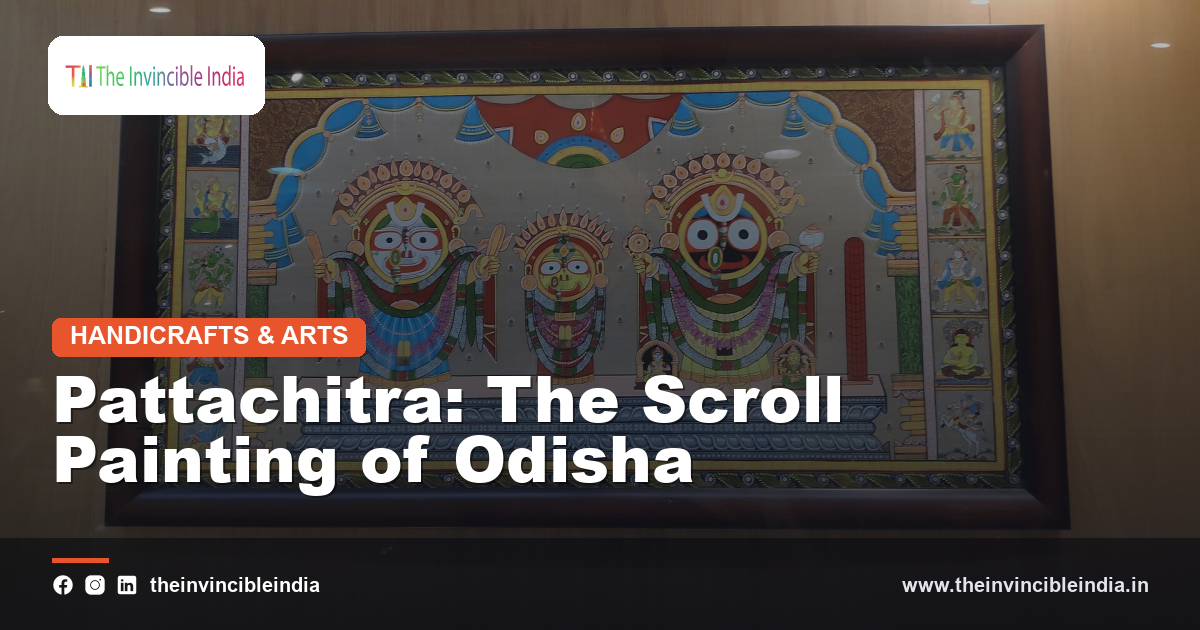
Pattachitra is the celebrated traditional scroll painting of Odisha, an ancient art of cloth-based painting renowned for its intricate detail, rich natural colours and deep devotion. The name comes from the words for cloth and picture, and the paintings, created on a specially prepared cloth canvas, are famous above all for their imagery of Lord Jagannath, the presiding deity of Odisha, along with scenes from mythology and the epics. Bordered with fine decorative patterns and painted in glowing natural pigments, Pattachitra is closely tied to the temple town of pilgrimage and religious devotion. Kept alive by dedicated communities of artists, it is one of India’s most exquisite folk traditions. This guide explores its history, technique, themes and living practice.
Quick Facts
| Detail | Information |
|---|---|
| Type | Traditional cloth-based scroll painting |
| Region | Odisha, eastern India |
| Meaning | From patta (cloth) and chitra (picture) |
| Central theme | Lord Jagannath and stories from mythology |
| Famous village | Raghurajpur, a village of Pattachitra artists |
| Recognition | Protected by a Geographical Indication (GI) tag |
The Scroll Painting of Odisha
Pattachitra is the traditional painting of Odisha, an art of great antiquity and refinement created on a cloth-based canvas. Its name, combining the words for cloth and picture, describes its essential nature: paintings made on specially prepared cloth, ranging from small pictures to long narrative scrolls. Renowned for their intricate detail, bold lines, glowing natural colours and elaborate decorative borders, Pattachitra paintings are deeply devotional, closely bound to the religious life of Odisha and above all to the worship of Lord Jagannath. As one of the most exquisite and distinctive folk art traditions of India, Pattachitra reflects the deep artistic and spiritual heritage of the region.
Ancient Origins
The tradition of Pattachitra is very old, rooted in the ancient religious and artistic culture of Odisha and closely connected to the worship at the great temple of Lord Jagannath. For centuries, the painters, known as chitrakars, have created devotional images and served the rituals of the temple and the needs of pilgrims. The art draws on a shared visual tradition that also shaped the region’s temple sculpture and manuscript painting. This deep antiquity and its bond with the temple give Pattachitra a profound sense of continuity and sacred purpose, as an art handed down through generations of dedicated artist families in the service of devotion.
The Bond with Jagannath
Pattachitra is inseparable from the worship of Lord Jagannath, the beloved deity of Odisha whose great temple stands at Puri. The distinctive images of Jagannath and his siblings are among the most cherished subjects of the art, and the paintings serve the devotion of pilgrims and the rituals of the temple. Indeed, the tradition includes the painting of images used in temple worship at certain times. This close connection to Jagannath gives Pattachitra its central theme and its devotional heart, and the art flourishes in and around the temple town, sustained by the endless stream of pilgrims and by the religious life of the region.
The Village of Raghurajpur
The most famous home of Pattachitra is Raghurajpur, a village near Puri celebrated as a village of artists, where almost every household is engaged in the craft. Recognised as a heritage crafts village, Raghurajpur is renowned for its many families of Pattachitra painters, who create their work in their homes and pass the tradition down through the generations. The village has become a centre for the art and a destination for those wishing to see it practised, and it embodies the living, community-based nature of the tradition. Raghurajpur stands as a symbol of the survival and flourishing of Pattachitra as a hereditary family craft.
Preparing the Canvas
A distinctive feature of Pattachitra is the careful preparation of the canvas, which is itself a specialised craft. The base is made by layering pieces of cloth together and coating them with a paste made from tamarind seeds and chalk or clay, building up a stiff, smooth surface. This prepared cloth, the patta, is then polished with a stone to make it firm and glossy, ready to take the fine lines and colours of the painting. This laborious preparation produces a durable, smooth ground quite different from ordinary cloth or paper, and it is essential to the character of the art. The making of the canvas is a traditional skill in its own right.
Natural Colours
Pattachitra is painted in glowing natural colours traditionally made by the artists themselves from local materials. Pigments are derived from minerals, stones, shells, soot and plants, producing a palette of rich, earthy and vivid hues, and these are bound and prepared according to traditional methods. The white comes from powdered shell or stone, the black from lamp soot, and other colours from various minerals and organic sources. The preparation of these natural colours is a painstaking craft, and their use gives Pattachitra its distinctive glowing quality and its harmony with the traditional character of the art. This use of natural pigments remains central to the authentic tradition.
Technique and Line
Pattachitra is renowned for the precision and beauty of its line work. The artist first sketches the composition and then builds it up with fine, controlled lines and carefully applied colour, working with great patience and skill. The bold, flowing outlines that define the figures are a hallmark of the art, and the finest details, including the delicate features of faces and the intricate patterns of borders and ornament, are executed with remarkable precision using very fine brushes. This mastery of line and detail, achieved through long training and practice, gives Pattachitra its characteristic combination of bold clarity and intricate refinement, and is central to the excellence of the tradition.
Themes and Subjects
The subjects of Pattachitra are drawn from religion and mythology. Foremost among them are images of Lord Jagannath and his siblings, along with depictions of other deities such as Krishna, Vishnu and Durga. Scenes from the great epics and the Puranas, especially the stories of Krishna and of Rama, are favourite subjects, often told in narrative form. The love of Radha and Krishna, drawn from devotional poetry, is a beloved theme. These devotional and mythological subjects give the art its sacred character and connect it to the religious imagination of Odisha, making each painting an object of both beauty and devotion.
Decorative Borders
A distinctive and beautiful feature of Pattachitra is its elaborate decorative borders, which frame the central image with intricate patterns of flowers, foliage, geometric motifs and small figures. These richly detailed borders are an integral part of the composition, enclosing and enhancing the main subject and displaying the artist’s skill in fine, ornamental work. The dense, patterned border is a hallmark of the style and contributes greatly to the rich, jewel-like appearance of a Pattachitra painting. The care lavished on these borders reflects the tradition’s love of detail and its horror of empty space, filling the whole surface with beauty and pattern.
Palm-Leaf Engraving
Closely related to Pattachitra is the traditional Odishan art of palm-leaf engraving, in which images and text are incised onto dried palm leaves with a fine stylus and then rubbed with colour so that the etched lines stand out. Many Pattachitra artists also practise this delicate craft, creating intricate illustrated manuscripts and decorative panels. The palm-leaf tradition shares the fine line work and devotional themes of Pattachitra and forms part of the same rich artistic heritage of Odisha. This related craft, demanding great precision and patience, adds another dimension to the work of the chitrakars and to the artistic traditions of the region.
A Hereditary Craft
Pattachitra is traditionally a hereditary craft, passed down within families of chitrakars from one generation to the next. Children learn the art from their elders, absorbing the skills of preparing the canvas and colours, the vocabulary of themes and motifs, and the demanding techniques of line and detail over years of practice within the family workshop. This transmission within artist families, especially concentrated in villages such as Raghurajpur, has preserved the tradition and its high standards across the centuries. The hereditary nature of the craft gives it continuity and depth, and the dedication of these artist families is the foundation on which the living tradition of Pattachitra rests.
Recognition and a GI Tag
Pattachitra is celebrated as one of the finest traditional arts of India, and its artists have received recognition and honours for their skill. To protect the tradition and support the community of artists, Odisha Pattachitra has been granted a Geographical Indication (GI) tag, which recognises it as a product distinctive to its region and helps safeguard its authenticity and reputation. The art is also supported through crafts promotion, tourism to villages such as Raghurajpur, and a market for the paintings within India and abroad. This recognition and support have helped sustain the tradition and provide a livelihood for the artist families who keep it alive.
Ganjifa: Painted Playing Cards
Among the traditional works of the Odishan chitrakars is ganjifa, the art of hand-painted playing cards. These cards, typically circular and painted with intricate figures and motifs in the Pattachitra style, were used for a traditional game and represent a fascinating offshoot of the painting tradition. Each set was painstakingly made and painted by hand, with designs often drawn from mythology, and a complete set could contain many finely decorated cards. Though the game itself has declined, the painted ganjifa cards survive as beautiful objects and as a testament to the versatility and skill of the Pattachitra artists, who applied their craft not only to devotional images but to these exquisite miniature works.
Pattachitra on New Surfaces
While the classic Pattachitra is painted on the prepared cloth patta, the artists have long applied their skills to other surfaces as well, and this versatility has helped the tradition thrive. Pattachitra work appears on palm leaf, on wood, on papier-mache items, on silk and on a range of decorative objects and products, all painted in the distinctive style with its fine lines and glowing colours. This adaptation to new surfaces and products has widened the market for the art and provided additional livelihood for the artist families, while spreading the beauty of the Pattachitra style. The ability to carry the tradition onto varied media, without losing its essential character, has been important to its survival and success.
Pattachitra Today
Today Pattachitra flourishes as a living tradition, sustained by dedicated communities of artists, above all in villages such as Raghurajpur, and cherished across India and around the world. The paintings serve the devotion of pilgrims and the religious life of Odisha, while also finding a wide market as exquisite works of art, and the imagery appears on many products. New generations of chitrakars carry the demanding craft forward, preserving its traditional techniques, themes and natural colours. In its intricate beauty, its glowing colours and its deep devotion to Lord Jagannath, Pattachitra remains one of the most exquisite and treasured folk art traditions of India.
Sources & Further Reading
- Ministry of Culture, Government of India, on the traditional arts of Odisha (indiaculture.gov.in).
- Geographical Indications Registry, Government of India, on the GI status of Odisha Pattachitra (ipindia.gov.in).
- Development Commissioner (Handicrafts), Ministry of Textiles, on traditional Indian handicrafts.
Frequently Asked Questions
What is Pattachitra?
Pattachitra is the traditional cloth-based scroll painting of Odisha, known for its intricate detail, bold lines, glowing natural colours and elaborate borders. Its name means cloth-picture, and it is famous for devotional imagery of Lord Jagannath and scenes from mythology.
Where is Pattachitra from?
Pattachitra is from Odisha in eastern India, closely tied to the worship of Lord Jagannath at Puri. Its most famous home is the village of Raghurajpur, celebrated as a village of Pattachitra artists.
How is the Pattachitra canvas prepared?
The Pattachitra canvas, called the patta, is made by layering pieces of cloth and coating them with a paste of tamarind seeds and chalk or clay, then polishing the surface with a stone to make it stiff, smooth and glossy, ready for painting.
What colours are used in Pattachitra?
Pattachitra traditionally uses natural colours made by the artists from local materials such as minerals, stones, shells, soot and plants, giving the paintings their distinctive glowing, earthy palette.
What themes does Pattachitra depict?
Pattachitra depicts devotional and mythological subjects, above all Lord Jagannath and his siblings, along with deities such as Krishna and Durga and scenes from the epics and the Puranas, including the love of Radha and Krishna.


