

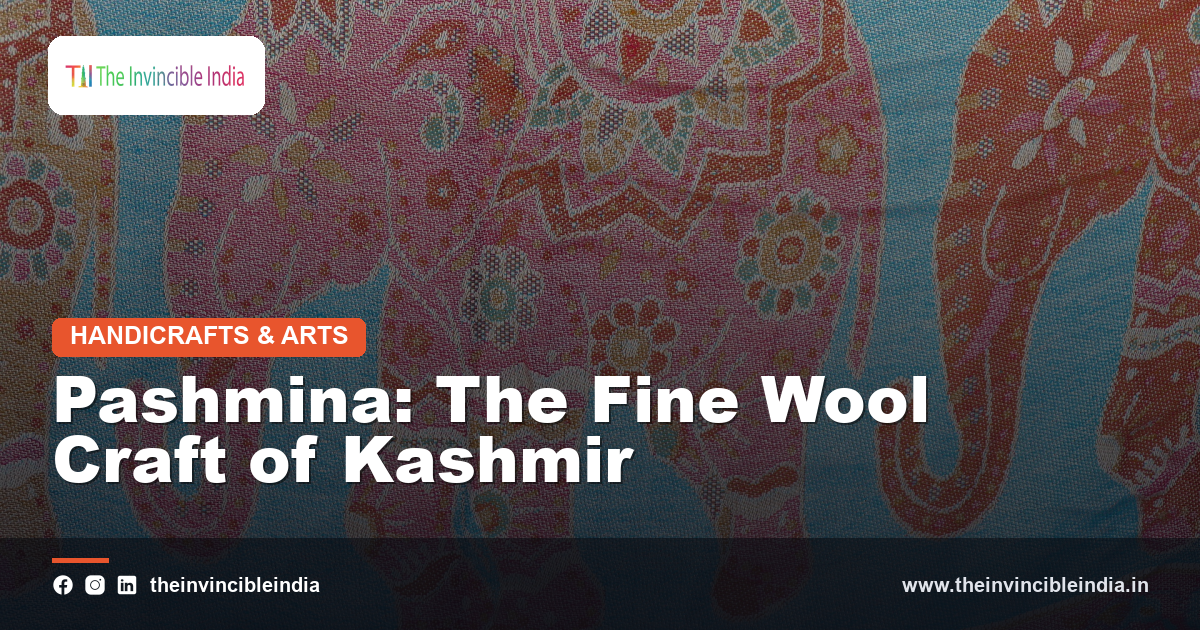
Pashmina is the exquisite fine-wool craft of Kashmir, whose shawls are among the most luxurious textiles in the world, prized for centuries for their extraordinary softness, warmth and lightness. Woven from the downy under-fleece of high-altitude Himalayan goats, hand-spun into an incredibly fine yarn and hand-woven on traditional looms, a true Pashmina shawl is the product of great skill and painstaking labour. Often further adorned with delicate weaving or embroidery, it represents the summit of Kashmiri craftsmanship. Rooted in the culture and economy of Kashmir and Ladakh, Pashmina is one of India’s most treasured handicraft traditions. This guide explores its source, its making, its famous techniques, how to recognise the genuine article and its living tradition.
Quick Facts
| Detail | Information |
|---|---|
| Type | Fine wool textile craft (shawls and wraps) |
| Region | Kashmir, with wool from the Changthang plateau of Ladakh |
| Source | The soft under-fleece of high-altitude Himalayan goats |
| Made by | Hand-spinning and hand-weaving |
| Famous techniques | Kani (twill-tapestry) weaving and sozni embroidery |
| Recognition | Kashmir Pashmina holds a Geographical Indication (GI) tag |
The King of Fine Wools
Pashmina is celebrated as one of the finest and most luxurious wools in the world, and its shawls have been treasured for centuries by royalty and connoisseurs alike. The word has become a byword for softness and quality, and a genuine Pashmina shawl is remarkable for being at once extraordinarily light, wonderfully warm and exquisitely soft to the touch. This unique combination of qualities comes from the exceptionally fine fibre from which it is made and the skilled hand-craftsmanship that turns that fibre into cloth. As the crowning achievement of Kashmiri textile art, Pashmina holds a special place among the great luxury crafts of India and the world.
The Source of the Fibre
The secret of Pashmina lies in its raw material, the fine, soft under-fleece grown by a special breed of goat that lives on the high, cold plateaus of the Himalayas, above all the Changthang region of Ladakh. To survive the extreme cold of these high altitudes, the goats grow a downy under-layer of extremely fine, soft fibre beneath their coarser outer hair, and it is this precious under-fleece that becomes Pashmina. The fibre is remarkably fine, far finer than ordinary wool, which is what gives Pashmina its softness, lightness and warmth. The harsh, high-altitude environment is essential to the quality of the fibre.
From Goat to Fleece
The soft under-fleece is gathered from the goats once a year, when they naturally shed their winter coat in the warmer season, and it is combed or collected by the nomadic herders of the high plateau who tend the animals. The raw fleece contains both the fine soft fibre and coarser guard hairs, and it must be carefully cleaned and sorted, with the coarse hairs painstakingly removed, to leave only the precious fine fibre. This cleaning and sorting is a laborious process, and the yield of fine fibre from each goat is small. From these high, remote pastures the raw material travels to Kashmir, where it is spun and woven into cloth.
Hand-Spinning the Yarn
One of the most crucial and skilled stages in making Pashmina is the spinning of the fine fibre into yarn, traditionally done entirely by hand. Because the fibre is so extremely fine and delicate, spinning it into a thread strong and even enough for weaving requires great skill and patience, and this work has traditionally been carried out by women using a simple spinning wheel. Hand-spinning produces the finest yarn and is essential to the quality of the best Pashmina, though it is slow and demanding work. The mastery of this delicate spinning is one of the foundations of the craft, and it is what allows the precious fibre to be turned into thread.
Hand-Weaving the Shawl
Once the yarn is spun, the shawl is woven on a traditional handloom, another stage demanding great skill. The fine, delicate yarn must be handled with care, and weaving a Pashmina shawl is slow, painstaking work that can take a long time to complete a single piece. The weavers, traditionally men, work the loom by hand to create the soft, fine cloth. The combination of hand-spun yarn and hand-weaving is what distinguishes true, high-quality Pashmina and gives it its exquisite character. This labour-intensive, entirely handmade process, from fibre to finished shawl, is central to the value and beauty of genuine Pashmina.
The Kani Weave
Among the most magnificent forms of Pashmina is the kani shawl, made using a special and highly intricate weaving technique. In kani weaving, the pattern is created during the weaving itself, using small wooden spools, called kanis, to weave in the coloured threads according to a coded pattern, building up elaborate designs, especially the famous curved paisley motif, directly in the weave. This is extraordinarily slow and skilled work, and a fine kani shawl can take many months or even years to complete. The kani technique represents the very summit of Pashmina weaving, and antique and fine kani shawls are among the most prized of all Kashmiri textiles.
Sozni and Embroidery
Many Pashmina shawls are further adorned with exquisite hand embroidery, the most celebrated form of which is sozni, a fine needle embroidery. In sozni work, delicate patterns, often floral or paisley motifs, are embroidered onto the shawl with such fineness and precision that the design may appear almost identical on both sides. This painstaking embroidery, worked over many months, adds greatly to the beauty and value of a shawl. Other richer forms of embroidery cover the shawl even more densely. The combination of the finest Pashmina cloth with this exquisite embroidery represents a pinnacle of Kashmiri craftsmanship, uniting the arts of weaving and needlework in a single luxurious textile.
The Paisley Motif
The most famous motif of Kashmiri shawls is the curved, teardrop-shaped design known around the world as paisley, which originated as a Kashmiri motif before it became internationally famous. This graceful, curling form, derived from plant and floral imagery, appears again and again in the woven and embroidered designs of Pashmina shawls, often filled with intricate floral detail. So closely associated is this motif with Kashmiri shawls that it spread across the world through their fame and trade. The paisley remains the signature motif of the tradition, and its elegant, flowing form is emblematic of the beauty and heritage of Kashmiri textile art.
A History of Luxury
Pashmina shawls have a long and illustrious history as objects of luxury and prestige. For centuries they were prized by emperors, kings and nobles, treasured at courts within India and beyond as symbols of wealth and refinement. In later centuries, Kashmiri shawls became hugely fashionable in Europe, where they were coveted luxury items, and their fame and their distinctive paisley motif spread far and wide through international trade. This long history as a treasured luxury, sought after by the powerful and the fashionable across many lands, reflects the extraordinary quality of Pashmina and has made it one of the most celebrated textiles in the history of the world.
Recognising Genuine Pashmina
Because true Pashmina is rare, precious and labour-intensive, the market is unfortunately full of imitations, and recognising the genuine article can be difficult. Real Pashmina is made from the fine Himalayan goat fibre and is hand-spun and hand-woven, giving it its characteristic softness, warmth and lightness, whereas many cheaper shawls sold as Pashmina are machine-made or blended with other fibres. To help buyers, genuine Kashmir Pashmina is protected by a Geographical Indication and can carry certification marks that authenticate it. Buyers are advised to seek such certification and to buy from reputable sources, since the fineness and hand-craftsmanship of true Pashmina justify its high value.
A GI Tag and Protection
To protect the authenticity of the craft and the interests of its artisans, Kashmir Pashmina has been granted a Geographical Indication (GI) tag, which recognises it as a product distinctive to its region and helps distinguish genuine Pashmina from imitations. Certification and labelling schemes have been introduced to authenticate genuine hand-crafted Kashmir Pashmina, giving buyers confidence and protecting the reputation of the craft. Such protection is especially important for a luxury product so widely imitated, helping to safeguard the livelihoods of the many artisans, spinners and weavers who depend on the craft, and to preserve the integrity of one of India’s most valuable textile traditions.
A Craft of Many Hands
A single Pashmina shawl passes through many hands before it is finished, and the craft supports a large community of people across Kashmir and Ladakh. From the nomadic herders who tend the goats and gather the fleece, to those who clean and sort the fibre, to the women who hand-spin the yarn, the men who weave the cloth, and the embroiderers who adorn it, each stage relies on specialised skill. This division of labour across many skilled hands is characteristic of the craft, and it means that Pashmina sustains the livelihoods of a great many families. The craft is thus not only an art but an important part of the economy and culture of the region.
Pashmina and Shahtoosh
It is important to distinguish Pashmina from shahtoosh, another extremely fine Himalayan wool with which it is sometimes confused. Shahtoosh comes from the Tibetan antelope, a protected and endangered animal that cannot be shorn like a goat, so obtaining the fibre has historically involved killing the animal. For this reason, the trade in shahtoosh is banned, and its production is illegal. Pashmina, by contrast, comes from the domesticated Changthangi goat, whose fleece is combed or gathered when it naturally sheds, so genuine Pashmina is an ethical and legal product. Buyers should be aware of this crucial difference and choose genuine, certified Pashmina, supporting a sustainable craft rather than an illegal and harmful trade.
Pashmina Today
Today Pashmina remains one of the most treasured luxury textiles in the world, cherished for its incomparable softness, warmth and beauty. Genuine hand-crafted Kashmir Pashmina continues to be made by skilled artisans, and it is sought after by connoisseurs across India and around the globe, while efforts through GI protection and certification work to safeguard it against imitation. The craft continues to support many families in Kashmir and Ladakh and to carry forward a tradition of great antiquity and refinement. In its exquisite fineness, its painstaking hand-craftsmanship and its long heritage of luxury, Pashmina remains a crowning achievement of Indian textile art.
Sources & Further Reading
- Ministry of Culture and Ministry of Textiles, Government of India, on the textile crafts of India (indiaculture.gov.in).
- Geographical Indications Registry, Government of India, on the GI status of Kashmir Pashmina (ipindia.gov.in).
- Development Commissioner (Handicrafts), Ministry of Textiles, on Kashmiri handicrafts.
Frequently Asked Questions
What is Pashmina?
Pashmina is the fine wool craft of Kashmir, whose luxurious shawls are hand-spun and hand-woven from the soft under-fleece of high-altitude Himalayan goats. It is prized for its extraordinary softness, warmth and lightness.
Where does Pashmina wool come from?
Pashmina wool comes from the fine, soft under-fleece of a special breed of goat that lives on the high, cold plateaus of the Himalayas, especially the Changthang region of Ladakh, where the harsh climate causes the goats to grow the precious fibre.
What is a kani Pashmina shawl?
A kani shawl is a magnificent form of Pashmina in which the pattern is woven directly into the cloth using small wooden spools called kanis to weave in coloured threads. It is extraordinarily slow, skilled work, and a fine kani shawl can take months or years to complete.
What is sozni embroidery?
Sozni is a fine needle embroidery used to adorn Pashmina shawls, in which delicate floral or paisley patterns are worked with such precision that the design can appear almost identical on both sides, adding greatly to the shawl’s beauty and value.
How can I tell if Pashmina is genuine?
Genuine Pashmina is made from fine Himalayan goat fibre and is hand-spun and hand-woven, giving it exceptional softness, warmth and lightness. Kashmir Pashmina is protected by a GI tag and can carry certification marks, so buyers should seek certification and reputable sources.


