

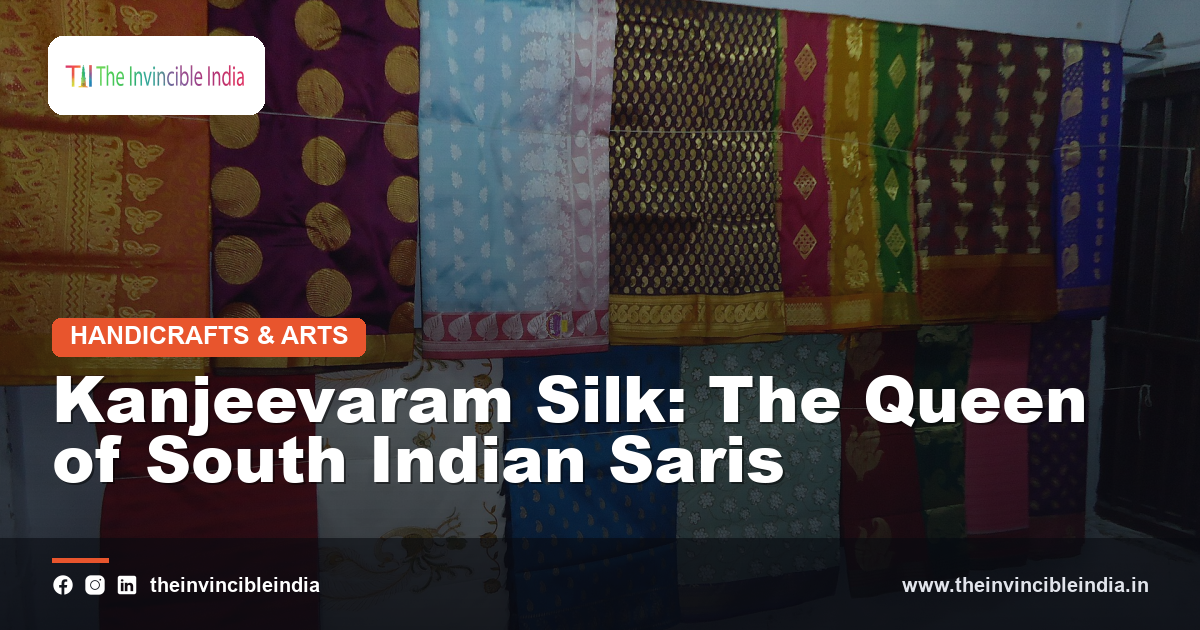
Kanjeevaram silk, also known as Kanchipuram silk, is the most celebrated sari tradition of South India, often called the queen of saris. Woven in the ancient temple town of Kanchipuram in Tamil Nadu, these saris are renowned for their pure, heavy mulberry silk, their rich gold zari, their striking contrast borders and their remarkable durability. Adorned with motifs inspired by the temples, nature and tradition of the South, a Kanjeevaram sari is a treasured object of luxury and the favoured attire for weddings and grand occasions. Rooted in the weaving heritage of a sacred city, it is one of India’s most cherished handicraft traditions. This guide explores its history, its silk and zari, its distinctive borders, its motifs, its weaving and its living tradition.
Quick Facts
| Detail | Information |
|---|---|
| Type | Luxury handwoven silk sari craft |
| Region | Kanchipuram, Tamil Nadu |
| Silk | Pure, heavy mulberry silk with gold zari |
| Signature feature | Striking contrast borders woven by the korvai technique |
| Motifs | Temple, floral and traditional South Indian designs |
| Recognition | Protected by a Geographical Indication (GI) tag |
The Queen of South Indian Saris
Kanjeevaram silk holds a place of honour as the most celebrated sari tradition of South India, often crowned the queen of saris for its richness, beauty and prestige. Woven in the temple town of Kanchipuram in Tamil Nadu, these saris are famed for their lustrous pure silk, their heavy gold work and their lasting quality, and they are treasured across South India and beyond. A Kanjeevaram sari is far more than a garment; it is an heirloom, a symbol of tradition and celebration, and the attire of choice for weddings and the grandest occasions. Rooted in a sacred and ancient city, Kanjeevaram silk is one of the great glories of Indian weaving.
The Temple Town of Kanchipuram
Kanjeevaram silk takes its name from Kanchipuram, one of the most ancient and sacred cities of South India, renowned for its magnificent temples and its deep religious and cultural heritage. This holy city, long a great centre of art, learning and devotion, has for centuries also been famed for its silk weaving. The temples and traditions of Kanchipuram have shaped the designs and character of its saris, whose motifs often draw on the imagery of temple architecture and South Indian tradition. The bond between the sacred city and its weaving is central to the identity of Kanjeevaram silk, which carries the name and the spirit of the temple town.
A Long Weaving Heritage
The weaving of silk in Kanchipuram has a long and distinguished history, and the city has been renowned as a centre of fine silk saris for generations. The tradition is sustained by communities of skilled weavers whose families have practised the craft for many generations, preserving the techniques and designs that make Kanjeevaram silk distinctive. Nurtured over the centuries and tied to the religious and cultural life of the temple town, the craft developed its characteristic qualities of pure heavy silk, rich zari and durable weaving. This deep heritage of skilled weaving, handed down through the generations of the city’s weaving communities, is the foundation of the Kanjeevaram tradition.
Pure and Heavy Silk
One of the defining qualities of a Kanjeevaram sari is its silk: pure, lustrous, heavy mulberry silk, prized for its richness and strength. Unlike lighter silks, Kanjeevaram silk is thick and substantial, giving the saris their characteristic weight, body and lasting quality. The silk is renowned for its durability, and a well-made Kanjeevaram sari can last for many years, even generations, which is part of why they are treasured as heirlooms. The lustre and richness of the pure silk, combined with its strength, are central to the beauty and value of a Kanjeevaram sari and distinguish it from lighter, less durable textiles.
Rich Gold Zari
The rich gold work, or zari, is a crowning feature of Kanjeevaram saris, lending them their opulent, luxurious appearance. Threads of gold, traditionally made from fine metal wound around a silk core, are woven into the silk to create shimmering borders, motifs and end-pieces that gleam against the coloured ground. The finest saris use generous, high-quality zari, and heavily worked pieces are especially prized and precious. The abundant gold work catches the light and gives the sari its festive splendour, and the skilful weaving of this zari into the heavy silk is one of the great arts of the Kanjeevaram tradition, contributing much to the richness of the finished sari.
The Contrast Border
A signature feature of the Kanjeevaram sari is its striking contrast border, in which the border and often the end-piece are woven in a colour boldly different from the body of the sari, creating a dramatic and beautiful effect. This contrast, such as a rich border set against a differently coloured body, is achieved through a special and skilful weaving technique. The border and body are woven so that the two parts are joined firmly together, allowing the bold colour contrast while ensuring the sari holds together strongly. This distinctive contrast border, vivid and elegant, is one of the most recognisable and admired features of the Kanjeevaram style.
The Korvai Technique
The striking contrast border of a fine Kanjeevaram sari is created by a special weaving technique traditionally known as korvai, in which the border, of a different colour from the body, is woven separately and interlocked with the body at the loom. This demanding technique, in which the different-coloured sections are joined by interlocking the threads where they meet, allows the bold contrast of colours while keeping the sari a single, strong piece of cloth. It requires great skill and, for the finest work, the coordination of more than one weaver. The korvai technique is a hallmark of authentic, high-quality Kanjeevaram weaving and a mark of the weaver’s mastery.
Temple and Traditional Motifs
Kanjeevaram saris are adorned with motifs drawn from the temples, nature and traditions of South India. Common designs include temple-inspired patterns, such as the jagged temple-border motif, along with floral and foliate designs, birds such as peacocks and swans, checks, stripes and traditional emblems. Many motifs carry auspicious or symbolic meaning and reflect the imagery of South Indian temple art and culture. These designs, worked in gold zari and contrasting colours, give the saris their distinctive character and beauty. The vocabulary of temple and traditional motifs connects the Kanjeevaram sari to the rich artistic and religious heritage of the region and is central to its identity.
Hand-Weaving the Sari
A genuine Kanjeevaram sari is woven by hand on a traditional loom, and the weaving of a fine, richly worked sari is slow, painstaking and highly skilled work that can take many days or even weeks. The heavy silk and gold zari must be handled with skill, and the intricate borders, motifs and korvai joins demand great expertise and care. The finest and most elaborate saris may require the work of more than one weaver and considerable time to complete. This labour-intensive hand-weaving, drawing on generations of accumulated skill, is what gives a genuine Kanjeevaram sari its quality, durability and beauty, and distinguishes it from lesser imitations.
The Weaving Community
The Kanjeevaram tradition is sustained by the skilled weaving communities of Kanchipuram and the surrounding region, for whom the craft is both a proud heritage and a livelihood. These artisans, whose families have often woven silk for many generations, carry the knowledge of the techniques, designs and standards that define Kanjeevaram silk. The craft supports a large number of people, from the weavers to those engaged in preparing the silk, the zari and the designs. This community of weavers is the living heart of the tradition, and the preservation of their skills and their livelihoods is essential to the continued flourishing of the Kanjeevaram craft.
The Wedding Sari
The Kanjeevaram sari holds a cherished and central place in South Indian weddings, where it is the traditional and much-desired attire for brides. Rich, opulent, durable and auspicious, a Kanjeevaram silk sari, often heavy with gold zari, is considered the ideal garment for a bride and an essential part of her trousseau, and it is treasured as an heirloom to be passed down through the generations. Beyond weddings, these saris are worn for festivals, ceremonies and grand occasions across South India. This deep association with weddings and celebrations is a major part of the enduring importance and demand for Kanjeevaram silk in South Indian life.
Protection and a GI Tag
Like other traditional textile crafts, Kanjeevaram silk faces competition from cheaper machine-made and imitation saris, which threaten the authentic craft and the livelihoods of the hand-weavers. To protect the tradition, Kanchipuram silk has been granted a Geographical Indication (GI) tag, which recognises genuine Kanjeevaram saris from the region and helps distinguish them from imitations. Efforts to support the weavers, promote the handloom craft and safeguard its authenticity are important for the survival of the tradition. The GI protection and such support help preserve the integrity of Kanjeevaram silk and protect the skilled artisans whose labour sustains this treasured craft.
Caring for a Kanjeevaram Sari
Because a Kanjeevaram sari is a valuable and long-lasting investment, often kept for generations, it is traditionally cared for with great attention. Pure silk saris with heavy zari are best stored carefully, folded gently and refolded from time to time to prevent creasing along the same lines, and wrapped in soft cloth to protect the delicate gold work and silk. They are kept away from damp and direct sunlight, which can harm the silk and tarnish the zari. Such careful storage helps preserve the sari’s lustre and strength over many years. This tradition of careful keeping reflects the value placed on these saris as treasured heirlooms to be handed down through the family.
Kanjeevaram Silk Today
Today Kanjeevaram silk remains the most celebrated sari tradition of South India, its saris cherished as objects of luxury, heirlooms and the favoured attire of brides and grand occasions. Genuine handwoven Kanjeevaram saris continue to be made by the skilled weavers of Kanchipuram, and GI protection and support for the handloom craft work to safeguard the tradition against imitation. The saris are sought after across India and among South Indian communities around the world. In its lustrous pure silk, its rich gold zari, its striking contrast borders and its temple-inspired motifs, Kanjeevaram silk remains a crowning glory of South Indian textile art.
Sources & Further Reading
- Ministry of Textiles, Government of India, on the handloom and silk traditions of India (texmin.nic.in).
- Geographical Indications Registry, Government of India, on the GI status of Kanchipuram silk (ipindia.gov.in).
- Ministry of Culture, Government of India, on the cultural heritage of Tamil Nadu (indiaculture.gov.in).
Frequently Asked Questions
What is Kanjeevaram silk?
Kanjeevaram silk, also called Kanchipuram silk, is the celebrated sari tradition of Kanchipuram in Tamil Nadu, often called the queen of saris. It is known for its pure, heavy mulberry silk, rich gold zari, striking contrast borders and remarkable durability.
What is special about a Kanjeevaram sari?
A Kanjeevaram sari is distinguished by its pure heavy silk, generous gold zari, striking contrast borders woven by the korvai technique, and temple-inspired motifs. It is prized for its durability and is a treasured heirloom and wedding sari.
What is the korvai technique?
Korvai is the special weaving technique used to create the Kanjeevaram sari’s contrast border, in which the border, of a different colour from the body, is woven separately and interlocked with the body at the loom, allowing a bold colour contrast while keeping the sari strong.
Why are Kanjeevaram saris popular for weddings?
Kanjeevaram saris are rich, opulent, durable and auspicious, making them the traditional and much-desired attire for South Indian brides. Heavy with gold zari, they are essential parts of a bride’s trousseau and are treasured as heirlooms.
Is Kanjeevaram silk protected by a GI tag?
Yes. Kanchipuram silk has been granted a Geographical Indication (GI) tag, which recognises genuine Kanjeevaram saris from the region and helps distinguish authentic handwoven saris from cheaper machine-made imitations.


