

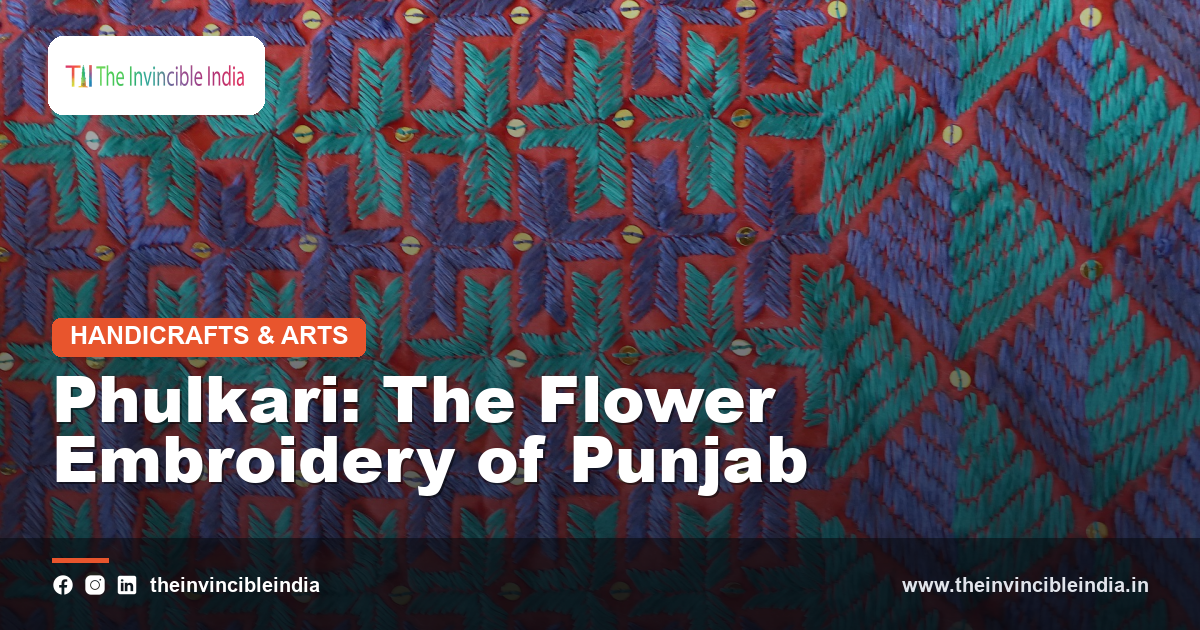
Phulkari is the vibrant folk embroidery of Punjab, an art whose very name means flower work and whose bright, joyful designs have adorned the shawls and dupattas of Punjabi women for generations. Worked in glossy, brightly coloured silk thread on coarse cotton cloth, using a distinctive darning stitch, Phulkari transforms plain fabric into a garden of geometric flowers and patterns. Far more than decoration, it has traditionally been bound up with the life of Punjabi women, embroidered at home for weddings, festivals and family occasions. Rich in colour and meaning, Phulkari is one of the most beloved folk handicraft traditions of India. This guide explores its meaning, its technique, its famous bagh, its role in folk life, its artisans and its living tradition.
Quick Facts
| Detail | Information |
|---|---|
| Type | Folk embroidery on cloth |
| Region | Punjab (and Haryana) |
| Meaning | Phulkari means flower work |
| Materials | Bright silk thread on coarse cotton cloth |
| Signature stitch | A distinctive darning stitch worked from the back |
| Recognition | Protected by a Geographical Indication (GI) tag |
The Flower Work of Punjab
Phulkari is the traditional folk embroidery of Punjab, and its name captures its essence: phul means flower and kari means work, so Phulkari is literally flower work. True to its name, the embroidery covers cloth with bright, geometric flowers and patterns, transforming plain fabric into a vivid garden of colour. For generations, Phulkari has adorned the shawls and head coverings of Punjabi women, especially for the great occasions of life, and it has been woven into the culture, songs and traditions of the region. Joyful, colourful and deeply rooted in folk life, Phulkari is one of the most beloved and characteristic craft traditions of Punjab.
An Embroidery of Folk Life
Phulkari has traditionally been a domestic folk art rather than a commercial craft, embroidered by women at home for their own families and for the great occasions of life. It was closely bound up with the life of Punjabi women, who created Phulkari shawls for weddings, births and festivals, and the making of these pieces was part of the rhythm of family and community life, accompanied by folk songs and shared work. A fine Phulkari was a treasured possession, often made for a daughter’s wedding and passed down through the family. This deep rootedness in the domestic and communal life of Punjabi women is central to the character and meaning of Phulkari.
The Materials
Phulkari is distinguished by its materials, which give it its characteristic look. The base cloth is traditionally a coarse, handspun and handwoven cotton fabric, sturdy and usually in an earthy red-brown or other deep shade, which provides a strong ground for the embroidery. The embroidery itself is worked in glossy, brightly coloured silk floss, whose sheen catches the light and gives Phulkari its vivid, lustrous appearance. The contrast between the coarse, dark cotton ground and the bright, silky embroidery is characteristic of the craft. This combination of humble base cloth and rich silk thread is central to the distinctive beauty and texture of Phulkari.
The Darning Stitch
The signature technique of Phulkari is a distinctive darning stitch, worked in a special way that gives the embroidery its characteristic appearance. The embroidery is worked largely from the reverse side of the cloth, with the silk thread laid in long and short stitches that, seen from the front, build up the bright geometric patterns. By varying the direction of the stitches, the embroiderer makes the silk catch the light differently across the design, creating a shimmering play of colour and sheen. This ingenious darning technique, worked from the back and relying on the direction and sheen of the thread, is fundamental to the beauty of Phulkari and distinguishes it from other embroideries.
Geometric Floral Patterns
The designs of Phulkari are characteristically geometric, with flowers and patterns built up from the darning stitches in bold, stylised, angular forms rather than naturalistic curves. Flowers, geometric shapes, and motifs drawn from nature and daily life are arranged in borders, scattered patterns or all-over designs, in bright, joyful colours. The geometric quality comes from the nature of the darning stitch and the counting of threads, giving the designs their distinctive angular, structured beauty. These bright geometric floral patterns, glowing in silk against the dark cloth, are the hallmark of Phulkari, and their bold, cheerful character reflects the exuberant folk spirit from which the craft springs.
The Bagh
The most magnificent form of Phulkari is the bagh, which means garden, in which the embroidery covers the entire surface of the cloth so densely that the base fabric is completely hidden beneath the silk. In a bagh, the whole shawl becomes a garden of embroidery, a continuous field of bright geometric patterns with no ground cloth visible, representing the most lavish and labour-intensive form of the craft. Such pieces were especially precious, created for the most important occasions, above all weddings, and they are masterpieces of the tradition. The bagh represents the summit of Phulkari, and fine old baghs are treasured as some of the most beautiful examples of Indian folk embroidery.
Phulkari and Weddings
Phulkari has a cherished place in Punjabi weddings, and the making and giving of Phulkari shawls has traditionally been an important part of marriage customs. A bride would traditionally receive Phulkari pieces as part of her trousseau, often embroidered lovingly by her mother, grandmother and other women of the family over a long period in anticipation of the wedding, and a special bagh might be made for the occasion. These pieces carried deep sentimental meaning as expressions of love, blessing and family bonds, and they were treasured heirlooms. This association with weddings and the loving labour of the family is central to the meaning and emotional value of Phulkari.
Colours and Their Joy
Colour is central to the joyful character of Phulkari, and the embroidery is famed for its bright, vivid palette. Glossy silk threads in brilliant shades, golden yellows, bright reds, pinks, oranges, greens and more, glow against the dark cotton ground, giving Phulkari its exuberant, celebratory appearance. The bright colours reflect the festive occasions for which the pieces were made and the joyful spirit of Punjabi folk culture. Particular colours could carry associations and meanings, and the combinations were chosen for their beauty and auspiciousness. This love of bright, joyful colour is one of the defining features of Phulkari and a large part of its cheerful, celebratory appeal.
A Women's Tradition
Phulkari has traditionally been a women’s art, embroidered by the women of the household and passed down from mother and grandmother to daughter through the generations. The skills were learned at home, and the making of Phulkari was part of the shared life of women, often carried out communally, accompanied by folk songs and conversation. Through Phulkari, women expressed their creativity, marked the great occasions of family life, and created treasured gifts and heirlooms. This deep association with women, and its transmission through the female line of the family, is central to the character and cultural meaning of Phulkari as an intimate, domestic and deeply personal folk art.
Folk Songs and Culture
Phulkari is woven into the wider folk culture of Punjab, appearing in its songs, sayings and traditions as a symbol of love, family and celebration. The making of Phulkari was often accompanied by folk songs, and the embroidery features in the poetry and cultural imagination of the region as an emblem of a woman’s love and labour and of the bonds of family. This presence in songs and culture reflects how deeply Phulkari was embedded in the life of Punjab, far beyond its role as mere decoration. This cultural resonance gives Phulkari a meaning that goes beyond the beautiful object, connecting it to the emotions, relationships and traditions of Punjabi life.
Decline and Revival
Like many traditional domestic crafts, Phulkari declined over time as ways of life changed and the old custom of embroidering pieces at home for the family weakened, and much of the fine old work survives only in collections and heirlooms. In recent decades, however, efforts have been made to revive and sustain the craft, as its beauty and cultural value have been recognised anew. Phulkari has been taken up commercially, providing income for artisans, and it has found new popularity in fashion and dress. These efforts at revival, along with growing appreciation for the tradition, have helped bring Phulkari back into wider use and secure a future for this beloved folk art.
Phulkari in Fashion
In recent times Phulkari has enjoyed renewed popularity in fashion and dress, prized for its bright, joyful beauty and its cultural resonance. The vibrant embroidery now adorns not only traditional dupattas and shawls but a range of garments and accessories, from suits and saris to bags and home furnishings, and designers have embraced its colourful appeal. This popularity has helped provide livelihoods for artisans and carried Phulkari to new markets and audiences. While much modern Phulkari is made commercially, the revival has renewed appreciation for the fine traditional work and kept the craft alive. This presence in contemporary fashion has given Phulkari a vibrant new life beyond its traditional domestic setting.
Recognition and a GI Tag
Phulkari is celebrated as one of the most beloved folk embroidery traditions of India, and it has been recognised and protected. Phulkari has been granted a Geographical Indication (GI) tag, which recognises it as a product distinctive to its region and helps protect its authenticity and the interests of the artisans. The craft is also supported through crafts promotion and its growing popularity in fashion, which provide livelihoods for the embroiderers. This recognition and support help sustain the tradition and the many artisans, especially women, who practise it. The GI protection affirms the value of Phulkari as a treasured part of India’s folk craft heritage.
Phulkari Today
Today Phulkari flourishes anew as one of the most cherished folk crafts of India, its bright flower embroidery beloved across the country and among Punjabi communities around the world. Revived and popular in fashion, it adorns garments, accessories and furnishings, while artisans, many of them women, create the embroidery as a source of livelihood and cultural pride. The fine old tradition of the bagh and the wedding Phulkari is remembered and treasured, and the craft carries forward the joyful spirit of Punjabi folk culture. In its bright colours, its geometric flowers and its deep roots in the life and love of Punjabi women, Phulkari remains one of India’s most joyful folk art traditions.
Sources & Further Reading
- Ministry of Textiles, Government of India, on the embroidery traditions of India (texmin.nic.in).
- Geographical Indications Registry, Government of India, on the GI status of Phulkari (ipindia.gov.in).
- Ministry of Culture, Government of India, on the folk traditions of Punjab (indiaculture.gov.in).
Frequently Asked Questions
What is Phulkari?
Phulkari is the traditional folk embroidery of Punjab, whose name means flower work. It is worked in bright, glossy silk thread on coarse cotton cloth using a distinctive darning stitch to create vivid geometric flowers and patterns, chiefly on shawls and dupattas.
What does the word Phulkari mean?
The word Phulkari means flower work, from phul meaning flower and kari meaning work, reflecting the floral designs that cover the cloth in this vibrant embroidery.
What is a bagh in Phulkari?
A bagh, meaning garden, is the most magnificent form of Phulkari, in which the embroidery covers the entire surface of the cloth so densely that the base fabric is completely hidden. Baghs were especially precious and made for the most important occasions, above all weddings.
What is the technique of Phulkari?
Phulkari uses a distinctive darning stitch worked largely from the reverse of the cloth in silk thread. By varying the direction of the stitches, the embroiderer makes the silk catch the light differently, creating shimmering geometric patterns on the front.
Is Phulkari protected by a GI tag?
Yes. Phulkari has been granted a Geographical Indication (GI) tag, which recognises it as a product distinctive to its region and helps protect its authenticity and the interests of the artisans who practise the craft.


