

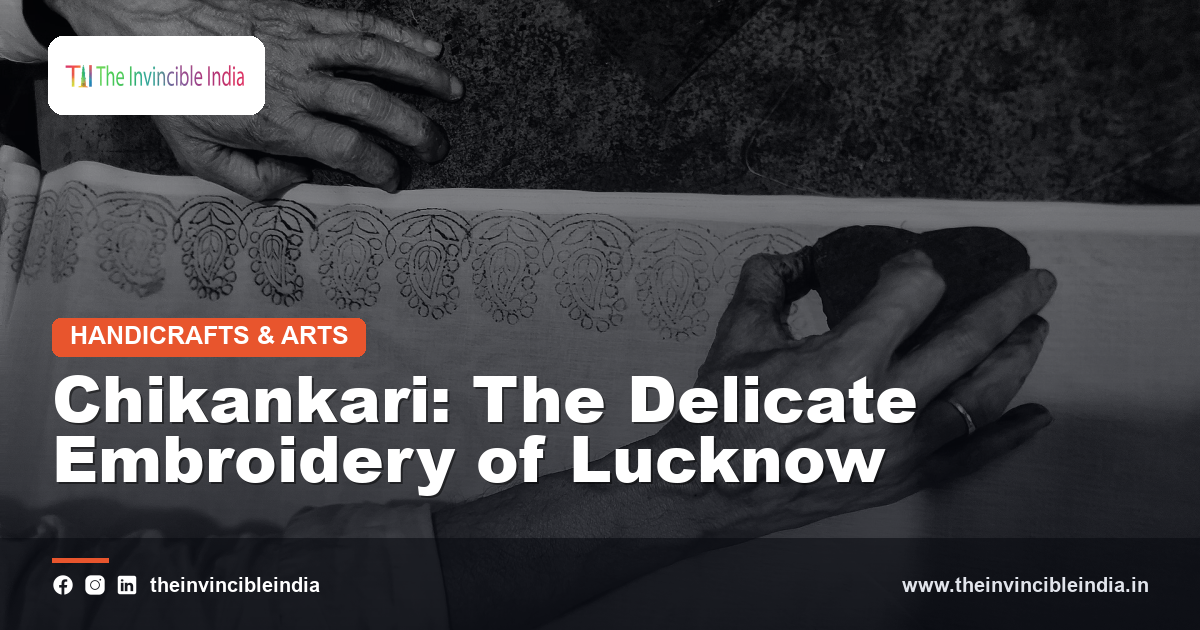
Chikankari is the exquisite hand embroidery of Lucknow, one of the most refined and delicate textile crafts of India, renowned for its subtle, shadowy beauty. Traditionally worked in fine white thread on soft white fabric, it creates intricate floral and paisley designs of great elegance through a rich vocabulary of stitches. Rooted in the courtly culture of the Mughals and the graceful heritage of Lucknow, Chikankari is prized for its lightness, its refinement and its timeless charm. Adorning garments and fabrics with delicate, airy patterns, it is among the most cherished of India’s handicraft traditions. This guide explores its origins, its famous white-on-white work, its many stitches, its making, its artisans and its living tradition.
Quick Facts
| Detail | Information |
|---|---|
| Type | Fine hand embroidery on fabric |
| Region | Lucknow, Uttar Pradesh |
| Classic style | Delicate white thread on soft white fabric |
| Origin | Associated with the Mughal court and Lucknawi culture |
| Feature | A rich variety of delicate stitches, including shadow work |
| Recognition | Lucknow Chikan craft holds a Geographical Indication (GI) tag |
The Delicate Art of Lucknow
Chikankari is the signature embroidery of Lucknow, the graceful city of Uttar Pradesh long famed for its refined culture, courtesy and craftsmanship. The most celebrated of the city’s many arts, Chikankari is renowned for its delicacy and subtlety, its intricate designs worked so finely that they seem to float upon the fabric. Traditionally created in white thread on white cloth, it achieves a soft, shadowy, almost ethereal beauty that is quite unlike bolder, more colourful embroideries. Bound up with the elegant heritage of Lucknow, Chikankari embodies a spirit of understated refinement, and it stands among the most exquisite and admired textile crafts of India.
Mughal Origins
The origins of Chikankari are traditionally traced to the Mughal court, and the craft is associated in legend with the refined tastes of Mughal royalty, who are said to have encouraged this delicate white embroidery. Whatever its precise beginnings, the art clearly reflects Mughal aesthetics, with its graceful floral designs and its emphasis on elegance and subtlety, and it flourished under the courtly culture of the era. Over time, the craft became especially rooted in Lucknow, which became its great centre. This Mughal heritage gave Chikankari its refined character and its vocabulary of flowing floral and paisley designs, and it remains central to the identity and prestige of the craft.
The Home in Lucknow
Chikankari found its enduring home in Lucknow, which became and remains the great centre of the craft. Under the patronage of the rulers and nobility of the city, and within its refined cultural world, the embroidery was cultivated and perfected, and it became one of the defining arts of Lucknawi culture. The city and the craft became inseparably linked, so that Chikankari is often simply called Lucknow embroidery. Today the craft is still centred on Lucknow and its surrounding areas, where a large community of artisans practises it. This deep bond between the craft and the city is central to its identity, and Lucknow remains the heart of the Chikankari tradition.
The White-on-White Tradition
The classic and most celebrated form of Chikankari is the delicate white-on-white work, in which white thread is embroidered onto soft white or pale fabric. This subtle combination creates a design that is revealed through texture, shadow and the play of light rather than through colour contrast, giving the embroidery its characteristic soft, understated and refined beauty. The effect is one of quiet elegance, the pattern emerging gently from the cloth. This white-on-white tradition is the purest and most classic expression of Chikankari, prized for its subtlety and grace. While Chikankari is now also done in colours, the delicate white work remains the heart and soul of the tradition.
The Fine Fabric
Chikankari has traditionally been worked on fine, soft, lightweight fabrics that suit its delicate character, above all fine cotton muslin, which allows the airy, floating quality of the embroidery to show to best effect. Light, breathable and elegant, such fabric is well suited to the warm climate and to the refined aesthetic of the craft. The fineness of the base cloth is important, for the delicate stitches and the subtle shadow effects depend on it. Today Chikankari is done on a range of fabrics, including cotton, muslin, silk and others, but the tradition of working on fine, soft, light cloth remains central to the beauty and character of the embroidery.
A Rich Vocabulary of Stitches
One of the glories of Chikankari is its rich and varied vocabulary of stitches, which gives the embroidery its texture, depth and beauty. The craft employs many different stitches, each with its own name and effect, from flat stitches that lie smoothly on the surface, to raised and knotted stitches that create texture and relief, to the delicate open jaali work that creates a net-like, lacy effect. A single piece may combine many of these stitches to build up its design, with different stitches used for different elements such as flowers, leaves, stems and fillings. This variety of stitches is central to the artistry of Chikankari and to the subtle richness of its designs.
Shadow Work
Among the most beautiful and characteristic of Chikankari stitches is the shadow work, a technique in which the embroidery is worked from the reverse side of the fabric so that the thread shows through the fine cloth as a soft, shadowy shape, with a neat outline on the front. This creates a delicate, muted effect, the design appearing to glow softly through the translucent fabric, and it is especially suited to the fine muslins on which Chikankari is worked. The shadow work is one of the signature techniques of the craft and a large part of its subtle, ethereal beauty, demonstrating the ingenuity and refinement of the Chikankari tradition.
The Knotted and Raised Stitches
Alongside the flat and shadow stitches, Chikankari is famous for its raised and knotted stitches, which add texture and three-dimensional richness to the embroidery. These include tiny knots and grain-like stitches that create raised dots and textured surfaces, often used to depict the centres of flowers, buds and small details, giving the design relief and liveliness. Worked with great precision, these delicate raised stitches add a tactile dimension to the otherwise flat embroidery and are prized as marks of fine workmanship. The skilful combination of flat, shadow and raised stitches allows the Chikankari artisan to create designs of remarkable subtlety, texture and beauty.
The Jaali Work
One of the most exquisite features of fine Chikankari is the jaali, or net, work, which creates delicate lattice-like patterns resembling fine lace. To make the jaali, the threads of the fabric are carefully teased apart with the needle to create tiny, regular openings, which are then secured with stitches, producing a net-like effect without cutting the cloth. This creates areas of delicate, airy openwork within the design, adding lightness and intricacy. The jaali work is among the most skilled and admired techniques of Chikankari, requiring great precision and patience, and it contributes much to the delicate, refined beauty for which the craft is renowned.
Floral Designs
The designs of Chikankari are predominantly floral, reflecting its Mughal heritage and its aesthetic of natural grace. Flowers, buds, leaves, creepers, vines and paisley motifs flow across the fabric in delicate, graceful patterns, often arranged in borders, sprays and all-over designs. These floral motifs, worked in the various delicate stitches, give Chikankari its characteristic elegance and its connection to the garden imagery beloved of Mughal art. The designs are typically light and airy rather than dense, in keeping with the subtle character of the craft. This vocabulary of delicate floral designs, refined over generations, is central to the beauty and identity of Chikankari embroidery.
The Making Process
Creating a piece of Chikankari involves several stages and often several hands. First the design is printed onto the fabric using carved wooden blocks, providing the pattern for the embroiderer to follow. Then the embroidery itself is worked by hand, stitch by stitch, following the printed design, a slow and skilled process that may involve different artisans for different stitches. Finally, the finished piece is carefully washed to remove the printed pattern, leaving only the embroidery on the clean fabric. This multi-stage process, from block-printing the design to the painstaking hand embroidery to the final washing, is characteristic of the craft, and each stage requires care and skill.
A Craft of Many Hands
Chikankari is often the work of many hands, with different artisans specialising in different parts of the process. Some prepare and print the designs, while others, often working from home, carry out the embroidery, and particular artisans may specialise in particular stitches, so that a fine piece may pass through several hands before it is complete. A great many of the embroiderers are women, for whom the craft provides an important source of income, often worked at home alongside other responsibilities. This division of labour and the involvement of a large community, especially of women artisans, is characteristic of the Chikankari tradition and central to its social and economic importance in Lucknow.
The Women Artisans
A large proportion of Chikankari embroidery is done by women, and the craft has long been an important source of livelihood and independence for many women in and around Lucknow. Working the delicate stitches by hand, often at home, these women embroiderers are the backbone of the tradition, and their skill and patience produce the exquisite work for which the craft is famed. The importance of the craft to the livelihoods of these women gives it a significant social dimension, and efforts to support Chikankari often focus on ensuring fair wages and recognition for the artisans. The women of Lucknow who embroider Chikankari are the living heart of this beautiful tradition.
Recognition and a GI Tag
Chikankari is celebrated as one of the finest embroidery traditions of India, and the craft of Lucknow has been recognised and protected. Lucknow Chikan craft has been granted a Geographical Indication (GI) tag, which recognises it as a product distinctive to the region and helps protect its authenticity against imitation, including cheaper machine-made copies. The craft is also supported through crafts promotion and a strong market for Chikankari garments and fabrics within India and abroad. This recognition and protection help sustain the tradition and the livelihoods of the many artisans, especially the women embroiderers, whose skill and labour sustain this precious craft.
Chikankari in Fashion
Chikankari has long been popular in Indian dress and has in recent times enjoyed a strong presence in fashion, prized for its elegance, its lightness and its timeless appeal. It adorns a wide range of garments, from traditional kurtas and saris to contemporary dresses and clothing, and designers have embraced it for its refined beauty and versatility. Its subtle, graceful character suits both traditional and modern styles, and it is especially favoured in the warm season for its lightness and airiness. This continued popularity in fashion has helped sustain the craft and provide work for its artisans, and it has carried the delicate embroidery of Lucknow to a wide and appreciative audience.
Chikankari Today
Today Chikankari flourishes as one of the most beloved and elegant textile crafts of India, its delicate embroidery cherished across the country and around the world. Genuine hand-worked Chikankari continues to be made by the skilled artisans of Lucknow, above all its women embroiderers, and GI protection and crafts support work to safeguard the tradition against machine-made imitation. The craft remains popular in fashion, adorning both traditional and contemporary garments. In its subtle white-on-white beauty, its rich variety of delicate stitches and its air of Mughal refinement, Chikankari remains one of the most exquisite and cherished embroidery traditions of India, a living emblem of the grace of Lucknow.
Sources & Further Reading
- Ministry of Textiles, Government of India, on the embroidery and handloom traditions of India (texmin.nic.in).
- Geographical Indications Registry, Government of India, on the GI status of Lucknow Chikan craft (ipindia.gov.in).
- Ministry of Culture, Government of India, on the cultural heritage of Lucknow (indiaculture.gov.in).
Frequently Asked Questions
What is Chikankari?
Chikankari is the delicate hand embroidery of Lucknow, traditionally worked in fine white thread on soft white fabric to create intricate floral designs. It is known for its subtle, shadowy beauty and its rich variety of delicate stitches, and has Mughal origins.
Where does Chikankari come from?
Chikankari is associated with the Mughal court in its origins and found its enduring home in Lucknow, in Uttar Pradesh, which became and remains the great centre of the craft, so much so that it is often called Lucknow embroidery.
What is shadow work in Chikankari?
Shadow work is a signature Chikankari technique in which the embroidery is worked from the reverse of the fine fabric so the thread shows through as a soft, shadowy shape with a neat outline on the front, creating a delicate, glowing effect through the translucent cloth.
What is jaali work?
Jaali, or net, work is an exquisite Chikankari technique in which the threads of the fabric are teased apart with the needle and secured to create tiny regular openings, producing a delicate lattice or lace-like effect without cutting the cloth.
Is Chikankari protected by a GI tag?
Yes. Lucknow Chikan craft has been granted a Geographical Indication (GI) tag, which recognises it as a product distinctive to the region and helps protect its authenticity against imitation, including cheaper machine-made copies.


