

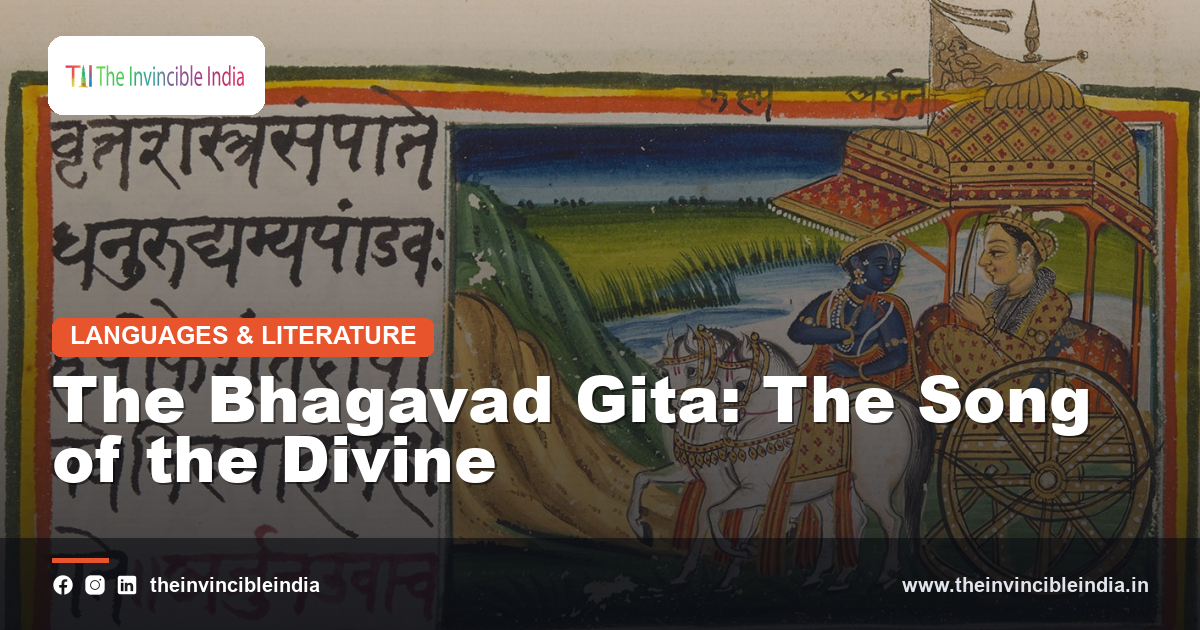
The Bhagavad Gita, often simply called the Gita, is one of the most revered and influential spiritual texts in the world, a profound dialogue on duty, devotion and the path to the divine. Set on the battlefield at the climax of the great epic the Mahabharata, it takes the form of a conversation between the warrior Arjuna, paralysed by doubt and despair, and his charioteer Krishna, an incarnation of the divine, who counsels him with sublime wisdom. In its verses, the Gita addresses the deepest questions of life, action, morality and the soul, offering timeless guidance that has inspired seekers for millennia. Composed in Sanskrit, it is cherished as a spiritual guide across India and the world. This guide explores its setting, its dialogue, its teachings and its enduring influence.
Quick Facts
| Detail | Information |
|---|---|
| Type | A revered spiritual and philosophical text |
| Setting | The battlefield of Kurukshetra, within the Mahabharata |
| Form | A dialogue between Arjuna and Krishna |
| Language | Composed in Sanskrit verse |
| Core teaching | On duty, action, devotion and the path to the divine |
| Influence | A spiritual guide for millions across India and the world |
The Song of the Divine
The Bhagavad Gita, whose name means the Song of the Lord or the Song of the Divine, is among the most beloved and revered of all spiritual texts, cherished by millions in India and admired around the world. Though it forms part of the great epic the Mahabharata, it stands on its own as a complete and profound spiritual teaching, a dialogue in which the deepest questions of life and the soul are addressed with sublime wisdom. Compact yet inexhaustibly rich, the Gita has been read, recited, studied and lived by countless people across the centuries. Its universal message and its spiritual depth have made it one of the great scriptures of humanity.
The Setting on the Battlefield
The Bhagavad Gita is set at a moment of high drama, on the battlefield of Kurukshetra, just as the great war of the Mahabharata is about to begin. The two vast armies face each other, and the warrior Arjuna, one of the Pandava brothers, asks his charioteer Krishna to drive him between the armies so that he may survey the field. There, seeing arrayed against him his own kinsmen, teachers and friends, Arjuna is overcome with grief and doubt. This dramatic setting, on the brink of a terrible war and in the midst of a profound personal crisis, provides the occasion for the great dialogue that follows, giving the Gita its urgency and its human depth.
Arjuna's Despair
The Gita opens with the despair of Arjuna, who, faced with the prospect of fighting and killing his own relatives, teachers and friends, is overwhelmed with sorrow and moral confusion. Torn between his duty as a warrior and his horror at the slaughter to come, he loses his will to fight, casts aside his weapons, and sinks down in anguish, questioning the whole meaning of the war and of his duty. This crisis of Arjuna, his paralysis in the face of an agonising moral dilemma, is the human starting point of the Gita. His despair represents the universal human experience of doubt and confusion in the face of life’s hardest choices, and it calls forth the teaching that follows.
Krishna the Divine Teacher
In response to Arjuna’s despair, his charioteer Krishna, revered as an incarnation of the divine, becomes his teacher and guide, and the dialogue between them forms the body of the Gita. Krishna counsels Arjuna with wisdom and compassion, gradually leading him out of his confusion and despair towards understanding and resolve. As the teaching unfolds, Krishna reveals himself not merely as a friend and charioteer but as the supreme divine reality, and at a climactic moment shows Arjuna his cosmic form. The relationship of Krishna and Arjuna, of the divine teacher and the human seeker, is at the heart of the Gita, and Krishna’s teaching is its precious content.
The Question of Duty
A central concern of the Bhagavad Gita is the question of duty, or dharma, which lies at the root of Arjuna’s crisis. Krishna teaches that Arjuna must not abandon his duty out of confusion or weakness, but must act in accordance with his role and responsibility, doing what is right even when it is hard. Yet this teaching on duty is subtle and profound, bound up with deeper truths about the nature of action, the self and the divine. The Gita’s exploration of duty, of the necessity of righteous action and the right spirit in which to perform it, is one of its most important and influential teachings, guiding countless people in the conduct of their lives.
Action Without Attachment
One of the most famous and important teachings of the Gita is the doctrine of action without attachment, the ideal of performing one’s duty and one’s work wholeheartedly, but without selfish attachment to the results. Krishna teaches that one should act because it is right to act, offering the fruits of one’s actions to the divine and remaining even-minded in success and failure, rather than being driven by desire for reward or fear of loss. This teaching offers a path to act in the world with dedication and skill while remaining free from anxiety and selfishness. The ideal of selfless, unattached action is among the Gita’s most celebrated and practical teachings.
The Paths of Yoga
The Bhagavad Gita sets out several paths, or yogas, by which one may reach the divine, offering a teaching broad enough to embrace different temperaments and ways of life. It speaks of the path of selfless action, of the path of knowledge and wisdom, and of the path of loving devotion to the divine, and it shows how these paths are interconnected. Rather than prescribing a single narrow way, the Gita offers a comprehensive vision of the spiritual life, allowing each seeker to find a path suited to their nature. This teaching of multiple, complementary paths to the divine is one of the great strengths and beauties of the Gita’s spiritual message.
The Path of Devotion
Among the paths the Gita teaches, the path of devotion, or bhakti, holds a special place, and it is presented as a way open to all. Krishna teaches that loving devotion to the divine, surrendering oneself with love and faith, is a sure and accessible path to liberation, dear to the divine and available to everyone regardless of their circumstances. This teaching of devotion, of a personal and loving relationship with the divine, has been immensely influential and lies at the heart of much of Indian religious life. The Gita’s exaltation of loving devotion as a path to the divine has brought comfort and guidance to countless devotees across the centuries.
The Nature of the Soul
To help Arjuna overcome his despair, Krishna teaches him about the true nature of the soul, or self, which is eternal and indestructible. The Gita teaches that the soul is not born and does not die, that it is beyond the reach of weapons, fire and water, and that it passes from one body to another as a person changes worn-out garments. Understanding the immortality and true nature of the self is central to the Gita’s teaching, for it places the trials and sorrows of life in a larger perspective and frees one from the fear of death. This profound teaching on the eternal soul is a cornerstone of the Gita’s philosophy.
The Vision of the Cosmic Form
One of the most awe-inspiring moments of the Bhagavad Gita comes when Krishna, at Arjuna’s request, reveals his universal, cosmic form, showing himself as the supreme divine reality that contains the whole universe. In this overwhelming vision, Arjuna beholds the infinite and majestic form of the divine, encompassing all of creation, all beings, all time. The vision fills Arjuna with wonder and awe, and it reveals the true nature of Krishna as the supreme godhead. This revelation of the cosmic form is a sublime and central passage of the Gita, one of the most powerful expressions in all of scripture of the majesty and all-encompassing nature of the divine.
A Universal Message
Though set within a specific story and tradition, the Bhagavad Gita speaks a universal message that has resonated far beyond its origins. Its teachings on duty and action, on facing life’s dilemmas with courage and wisdom, on the eternal soul and the path to the divine, address the deepest and most universal concerns of the human being. This universality has made the Gita beloved not only by Hindus but by people of many faiths and philosophies around the world, who find in it wisdom and guidance for their own lives. The Gita’s power to speak to the universal human condition, across cultures and centuries, is one of the secrets of its enduring greatness.
Influence on India and the World
The influence of the Bhagavad Gita has been immense, both within India and around the world. In India, it is one of the most revered of all scriptures, a spiritual guide turned to for wisdom and comfort in every circumstance of life, and it has shaped Indian thought, religion and culture profoundly. Leaders, thinkers and reformers have drawn inspiration from it. Beyond India, the Gita has been translated into many languages and admired by philosophers, writers and seekers across the world, who have found in it a source of profound wisdom. This vast influence, spanning cultures and centuries, testifies to the extraordinary depth and universality of the Gita’s message.
The Gita in Daily Life
For countless people, the Bhagavad Gita is not merely a text to be studied but a guide to be lived, a source of wisdom for the challenges of everyday life. Its teachings on doing one’s duty, on acting without selfish attachment, on remaining calm amid success and failure, and on devotion to the divine offer practical guidance for facing the difficulties, decisions and sorrows of ordinary existence. Many turn to the Gita in times of doubt, hardship or grief, finding in it strength, clarity and peace. This role as a living guide, applied to the real dilemmas and struggles of life, is central to the enduring importance and beloved status of the Gita.
A Text for All Seekers
One of the remarkable features of the Bhagavad Gita is its breadth and accessibility, offering something to seekers of every kind. With its multiple paths to the divine, its practical wisdom and its profound philosophy, it speaks to the person of action, the person of knowledge and the person of devotion alike, and to people of every background and circumstance. It does not demand withdrawal from the world but teaches how to live and act within it spiritually. This inclusiveness and breadth make the Gita a text for all seekers, and it is one of the reasons the Gita has been embraced so widely and has remained relevant to so many different people across the ages.
The Bhagavad Gita Today
Today the Bhagavad Gita remains one of the most revered and widely read spiritual texts in the world, cherished in India as a supreme scripture and admired across the globe as a source of profound wisdom. It continues to be recited, studied and lived, translated into countless languages and turned to for guidance in every circumstance of life. Its teachings on duty, selfless action, the eternal soul and the path of devotion continue to inspire and console millions. Timeless yet ever relevant, universal yet deeply personal, the Bhagavad Gita endures as one of the greatest spiritual treasures of India and of humanity, a song of the divine that continues to speak to the human heart.
Sources & Further Reading
- Ministry of Culture, Government of India, on the sacred literature of India (indiaculture.gov.in).
- Sahitya Akademi, national academy of letters, on the Bhagavad Gita and Sanskrit literature (sahitya-akademi.gov.in).
- The Bhagavad Gita, part of the Mahabharata of Vyasa.
Frequently Asked Questions
What is the Bhagavad Gita?
The Bhagavad Gita is one of the most revered spiritual texts in the world, a profound dialogue on duty, devotion and the path to the divine. Set on the battlefield within the Mahabharata, it is a conversation between the warrior Arjuna and Krishna, an incarnation of the divine.
What is the setting of the Bhagavad Gita?
The Bhagavad Gita is set on the battlefield of Kurukshetra, at the climax of the great epic the Mahabharata, just as the war is about to begin, when the warrior Arjuna is overcome with despair at the thought of fighting his own kinsmen.
What is the main teaching of the Bhagavad Gita?
The Gita teaches many things, but among its most famous teachings is the doctrine of action without attachment, performing one’s duty wholeheartedly but without selfish attachment to the results, along with the paths of selfless action, knowledge and loving devotion to the divine.
Who are the two speakers in the Bhagavad Gita?
The two speakers are Arjuna, the Pandava warrior overcome with doubt and despair, and Krishna, his charioteer, revered as an incarnation of the divine, who counsels Arjuna with sublime wisdom and reveals himself as the supreme divine reality.
Why is the Bhagavad Gita so influential?
The Bhagavad Gita is influential because its teachings on duty, action, the eternal soul and the path to the divine address universal human concerns with profound wisdom. It has guided seekers of many faiths across India and the world for millennia.


