

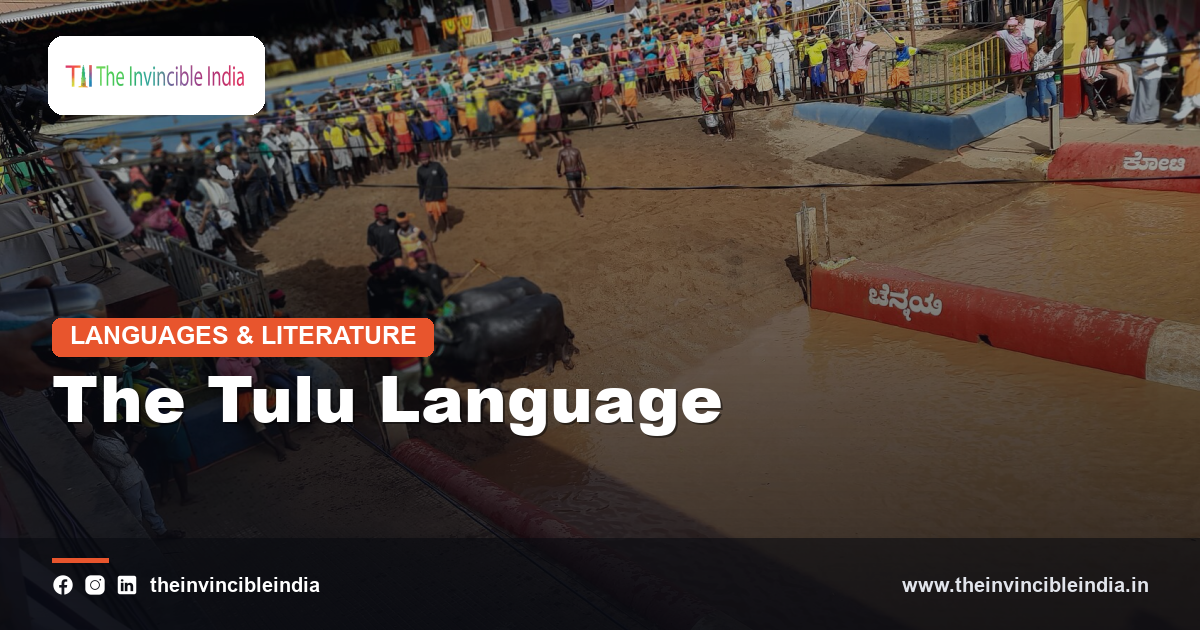
Tulu is a Dravidian language spoken along the southwestern coast of India, in the culturally distinct region of Tulu Nadu spanning parts of present-day Karnataka. Though closely tied to its neighbour, discussed in this guide to the Kannada language, Tulu has its own grammar, vocabulary and an especially rich oral tradition, including the epic paddana songs performed during ritual worship. Historically written in the distinctive Tigalari script and today most often printed in Kannada script, Tulu carries a layered linguistic history shaped by Dravidian roots, Sanskritic scholarship and coastal trade. From ritual performance and folk song to modern literature and cinema, Tulu remains a living marker of regional identity along India’s coast.
Quick Facts
| Detail | Information |
|---|---|
| Language Family | Dravidian, southern branch |
| Primary Region | Tulu Nadu, coastal Karnataka |
| Historic Script | Tigalari |
| Common Script Today | Kannada script |
| Notable Oral Tradition | Paddana epic songs |
| Associated Rituals | Bhuta Kola, Yakshagana |
Origins and Dravidian Classification
Tulu belongs to the Dravidian language family, one of the major language families of the Indian subcontinent, and is classified among the southern group of Dravidian languages that also includes Kannada, Tamil and Malayalam. Linguists consider Tulu to have branched off at a relatively early stage from the common ancestor it shares with these related languages, giving it a number of distinctive features not found in its closest neighbours.
Despite this early divergence, Tulu shares broad grammatical and vocabulary patterns typical of Dravidian languages, including its characteristic verb-final sentence structure. Comparative linguists regard Tulu as an important language for understanding the broader history of Dravidian development, given the antiquity of some of its grammatical features and its relatively distinct evolutionary path within the family.
Tulu Nadu: The Homeland of Tulu
Tulu is the principal language of Tulu Nadu, a culturally distinct coastal region spanning parts of present-day Karnataka, historically bound together by a shared language, cuisine, customs and social institutions. The region takes its name directly from the language, underscoring how closely Tulu identity has long been tied to this stretch of coastline between the Western Ghats and the Arabian Sea.
Tulu Nadu has traditionally been organised around distinct social and agrarian customs, many of which are reflected in the vocabulary and oral literature of the language itself. Even as administrative boundaries have shifted over time, Tulu Nadu persists as a recognised cultural and linguistic region, and pride in Tulu language and heritage remains a strong unifying thread.
The Tigalari Script and Its History
Historically, Tulu was written using the Tigalari script, a script that developed in the region and was also used for writing Sanskrit texts, particularly by communities associated with traditional scholarship along the coast. Tigalari, related to other scripts of southern India, has a long manuscript tradition, with palm-leaf texts preserving religious, literary and administrative material from earlier centuries.
Interest in Tigalari has grown in recent years among scholars and cultural activists who see the script as an important link to Tulu’s distinct linguistic and intellectual heritage. Workshops, digitisation projects and academic study of surviving manuscripts have contributed to a modest revival of interest in the script, even though it is no longer in everyday use.
Kannada Script in Modern Tulu Writing
In more recent centuries, and especially since the advent of printing, Tulu has come to be written predominantly in the Kannada script, reflecting the close political, administrative and educational ties between Tulu Nadu and the wider Kannada-speaking region. This shift made Tulu literature accessible to a readership already literate in Kannada, and it remains the practical basis for most Tulu publishing today.
The adoption of the Kannada script has not erased Tulu’s distinct linguistic identity, since the language itself remains grammatically and lexically separate from Kannada despite sharing a common Dravidian ancestry. Some cultural organisations continue to advocate for greater use of the Tigalari script alongside Kannada, viewing script choice as connected to cultural distinctiveness.
Sounds and Pronunciation of Tulu
Tulu possesses a phonological system typical of Dravidian languages, featuring a range of retroflex consonants alongside distinctions between short and long vowels that are important for correctly distinguishing meaning. Spoken Tulu has a number of regional and social variations, with noticeable differences in vocabulary and pronunciation across different parts of the coastal region.
These internal variations have not prevented mutual intelligibility, and speakers move comfortably between local variants depending on context. The rhythm and intonation of spoken Tulu are frequently noted as central to the performance style of its oral epics and ritual recitations, in which pitch, pacing and repetition play an important expressive role.
Grammar and Structure
Tulu grammar follows the broad Dravidian pattern of an agglutinative structure, in which suffixes are added to word roots to indicate grammatical relationships such as tense, case and number. Its verb system encodes fine distinctions of tense and aspect, while its noun system uses case markers to indicate the grammatical role of a word within a sentence.
Sentence order in Tulu typically places the verb at the end, consistent with the wider Dravidian family, though the language also permits flexibility in word order for emphasis. Certain grammatical features of Tulu are considered by linguists to preserve older Dravidian patterns not retained in the same way by some of its more widely spoken relatives.
Vocabulary and Regional Influences
The vocabulary of Tulu reflects both its Dravidian core and a long history of contact with neighbouring languages and cultures along India’s southwestern coast. Sanskrit has contributed significantly, particularly in religious, ritual and literary contexts, a pattern common to many Dravidian languages shaped by centuries of Sanskritic scholarship and temple culture.
Kannada, given its close geographic and administrative proximity, has also influenced everyday Tulu vocabulary, especially in education, governance and commerce. The region’s long history of coastal trade brought further contact with Arabic, Portuguese and other languages carried by traders who passed through its ports, leaving traces in certain specialised vocabulary.
Tulu Oral Epics: The Paddanas
Among the most distinctive features of Tulu culture is its tradition of paddanas, oral epic narratives sung or chanted during ritual and community occasions, particularly those associated with Bhuta worship and other local devotional practices. These lengthy narrative songs recount stories of local deities, heroic ancestors and legendary figures, preserving a body of oral literature transmitted through performance from one generation to the next.
Paddanas are typically performed by designated singers or ritual specialists whose knowledge of the texts is itself a mark of social standing. Scholars and folklorists have worked to record and document paddanas, recognising them as an invaluable source for understanding the region’s history, social structure and religious beliefs.
Yakshagana and Tulu Performance Traditions
The coastal region associated with Tulu is also home to Yakshagana, a traditional form of theatre that combines dance, music, elaborate costume and dialogue to enact stories drawn largely from Hindu epics and mythology. While Yakshagana is historically associated with the Kannada-speaking areas of the coast as well, Tulu-language variants and Tulu-speaking performers have long played an important role in sustaining the tradition.
Performances typically take place at night in open-air settings, drawing audiences from surrounding villages. The improvisational dialogue delivered by performers, often in Tulu, allows space for humour and topical commentary within the broader structure of the traditional narrative, and it remains an important vehicle through which the language is transmitted to new generations.
Bhuta Kola and Ritual Language
Bhuta Kola, a ritual form of spirit worship distinctive to Tulu Nadu, involves elaborate costumed performances in which performers are believed to embody local deities and ancestral spirits for the duration of the ritual. These performances are accompanied by paddanas and other forms of ritual speech and song in Tulu, making the language central to the religious and social fabric of the tradition.
Bhuta Kola typically takes place at shrines dedicated to local deities and forms part of the annual ritual calendar for many communities. The ritual serves not only a religious function but also a social one, often providing an occasion for addressing community concerns and reaffirming social bonds.
Folk Songs and Everyday Expression
Beyond its formal ritual literature, Tulu has a broad tradition of folk songs associated with agricultural work, life-cycle ceremonies, seasonal festivals and everyday domestic occasions. Songs sung during rice transplantation and harvest reflect the deep connection between the Tulu-speaking community and the agrarian rhythms of the coastal region, while wedding songs and lullabies preserve distinct genres tied to particular life events.
These folk songs, transmitted largely through oral tradition within families, often make use of repetition and call-and-response structures. Proverbs and idiomatic sayings drawn from everyday Tulu speech further enrich this oral tradition, encapsulating practical wisdom and social observation in concise, memorable form.
Early Written Literature and Manuscripts
Written literature in Tulu using the Tigalari script includes religious, devotional and some administrative texts preserved in palm-leaf manuscripts from earlier centuries, though the overall body of premodern written Tulu literature remains smaller than its extensive oral tradition. These early works, often composed by scholars connected to temples, reflect the interplay between Sanskritic literary culture and the local vernacular.
Manuscript collections held in libraries and private collections continue to be studied by researchers interested in reconstructing the fuller history of written Tulu before the modern era, a context that makes ongoing documentation especially valuable for understanding Tulu’s literary history.
Modern Tulu Literature and Print Culture
The modern period saw the emergence of printed Tulu literature, including poetry, short stories, novels and drama composed in the Kannada script and aimed at a growing readership within the Tulu-speaking community. Literary associations and journals devoted to Tulu have played an important role in nurturing this output, providing platforms for new writers.
Modern Tulu writers have explored themes ranging from rural life and social change to personal and communal identity, often drawing on the imagery of older oral literature while working in newer literary forms. Efforts to document and translate paddanas into written form have also formed part of this modern literary activity, bridging Tulu’s oral past and written present.
Tulu in Cinema, Media and Contemporary Life
Tulu has developed a modest but dedicated film industry, producing feature films in the language that cater to audiences within Tulu Nadu and among the wider Tulu-speaking diaspora. Tulu cinema, along with radio programming, television content and an increasingly active presence on digital and social media, has expanded the contexts in which the language is used by younger generations.
Cultural organisations continue to promote Tulu language and heritage through festivals and literary events. Language activists have also called for greater institutional recognition of Tulu, including its inclusion in wider educational curricula, reflecting a broader concern with ensuring the language’s continued vitality.
Tulu Language Today
Today, Tulu continues to be spoken across Tulu Nadu and among diaspora communities elsewhere, sustained by a combination of everyday family use, ritual and performance traditions, and a growing modern literary and media presence. Its oral epics, ritual songs and performance traditions such as Bhuta Kola and Yakshagana remain living practices rather than historical curiosities.
Ongoing documentation of paddanas, renewed interest in the Tigalari script, and continued production of modern Tulu literature, film and media reflect a community actively engaged in preserving and extending its linguistic heritage, ensuring Tulu remains a vibrant part of India’s linguistic and cultural landscape.
Sources & Further Reading
- Ministry of Culture, Government of India (indiaculture.gov.in).
- Sahitya Akademi (sahitya-akademi.gov.in).
Frequently Asked Questions
What language family does Tulu belong to?
Tulu is a Dravidian language, classified within the southern branch of the family alongside Kannada, Tamil and Malayalam, though it is considered to have diverged at a relatively early stage.
What script was traditionally used to write Tulu?
Tulu was traditionally written in the Tigalari script, also used for Sanskrit manuscripts in the region; today, Tulu is most commonly printed using the Kannada script.
What are paddanas?
Paddanas are oral epic songs performed in Tulu, especially during rituals such as Bhuta Kola, recounting stories of local deities and legendary ancestors transmitted through generations of oral performance.
What is Bhuta Kola?
Bhuta Kola is a ritual form of spirit worship native to Tulu Nadu in which costumed performers are believed to embody local deities, accompanied by ritual speech and song in the Tulu language.
Where is Tulu spoken?
Tulu is spoken primarily in the coastal region known as Tulu Nadu, spanning parts of present-day Karnataka, as well as among Tulu-speaking diaspora communities elsewhere in India and abroad.


