

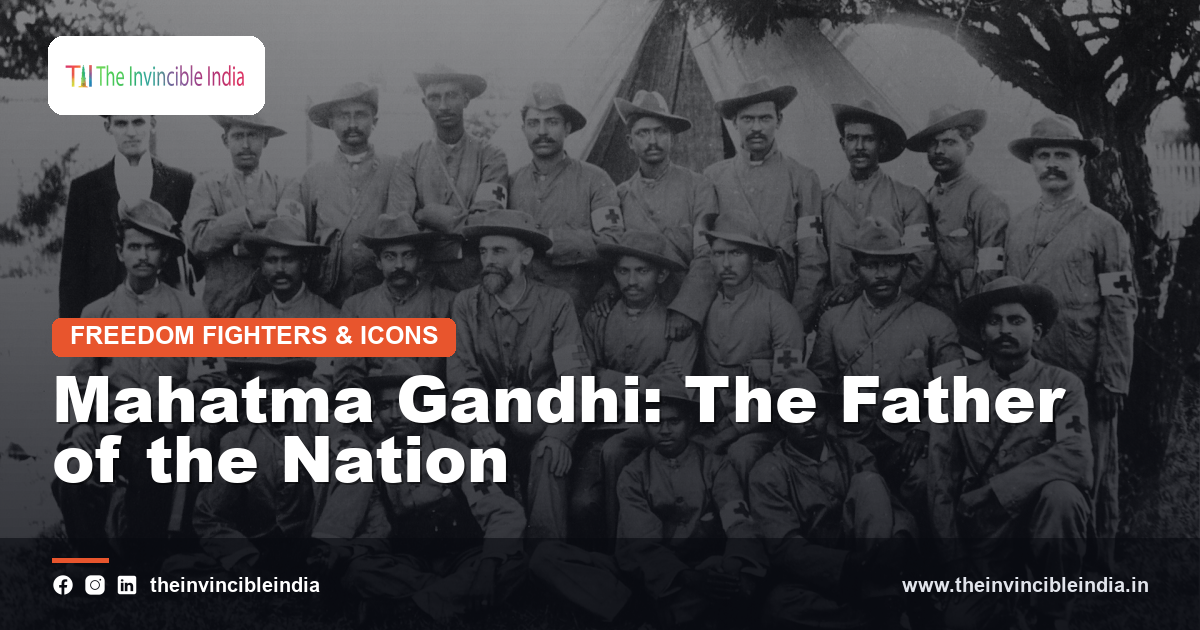
Mahatma Gandhi is one of the most revered figures in the history of India and the world, the leader who guided India’s struggle for freedom through his philosophy of non-violence and truth, and who is honoured as the Father of the Nation. Born Mohandas Karamchand Gandhi, he came to be called Mahatma, meaning great soul, and Bapu, meaning father, by a grateful nation. Through his unique methods of non-violent resistance, his simple and self-disciplined life, and his moral force, he inspired millions and led India towards independence, while his ideas influenced movements for justice and freedom across the world. This guide explores the life, philosophy, struggles and enduring legacy of Mahatma Gandhi, one of the greatest of India’s freedom fighters and national icons.
Quick Facts
| Detail | Information |
|---|---|
| Full name | Mohandas Karamchand Gandhi |
| Born | 2 October 1869, in Porbandar, Gujarat |
| Died | 30 January 1948 |
| Known as | Mahatma, Bapu, and the Father of the Nation |
| Philosophy | Ahimsa (non-violence) and satyagraha (truth-force) |
| Role | Leader of India’s non-violent freedom struggle |
The Father of the Nation
Mahatma Gandhi is honoured as the Father of the Nation in India, a title that reflects his central role in leading the country to freedom and his profound influence on its values and identity. Through his leadership of the freedom struggle and his moral example, he became the guiding spirit of the nation’s fight for independence and one of the most beloved and revered figures in its history. His philosophy of non-violence and truth, his simple life, and his deep commitment to justice and to the welfare of the poorest gave him an extraordinary moral authority. As the Father of the Nation, Mahatma Gandhi holds a unique and honoured place in the heart of India and in the memory of the world.
Early Life
Mohandas Karamchand Gandhi was born on 2 October 1869 in Porbandar, in the region of Gujarat, into a family of modest but respectable standing. Raised in an atmosphere of religious devotion and moral values, the young Gandhi was, by his own account, an ordinary and rather shy boy. He went to England to study law, an experience that broadened his horizons, and qualified as a barrister. His early life gave little sign of the extraordinary figure he would become, but the values instilled in his upbringing, and the experiences of his youth, laid the foundations of the character and convictions that would later shape his life and his leadership of the freedom struggle.
The Years in South Africa
A decisive period in Gandhi’s life was the time he spent in South Africa, where he went as a young lawyer and where he first developed his methods of non-violent resistance. Confronted with the racial discrimination and injustice faced by the Indian community there, Gandhi was transformed from a diffident young lawyer into a determined campaigner for justice, leading struggles against unjust laws. It was in South Africa that he developed and first practised his philosophy and method of satyagraha, non-violent resistance based on truth and moral force. These years were crucial in shaping Gandhi’s ideas and character, and he returned to India a seasoned leader with a powerful method of struggle that he would soon apply to the cause of India’s freedom.
Satyagraha: The Force of Truth
At the heart of Gandhi’s method was satyagraha, a term he coined meaning the force of truth or holding firmly to truth, a philosophy and technique of non-violent resistance to injustice. Satyagraha was based on the power of truth and moral force, and on the willingness to suffer for a just cause without inflicting harm on the opponent, seeking to win them over through moral appeal rather than to defeat them through violence. Through satyagraha, Gandhi believed, ordinary people could resist injustice and oppression with courage and dignity, without hatred or violence. This philosophy of satyagraha, of non-violent resistance grounded in truth, was Gandhi’s great and original contribution and the method by which he led the struggle for India’s freedom.
Ahimsa: Non-Violence
Central to Gandhi’s whole philosophy was ahimsa, non-violence, the principle of refusing to do harm to any living being, which he made the foundation of his life and his method of struggle. For Gandhi, non-violence was not merely a tactic but a deep moral and spiritual principle, a way of life rooted in love, truth and respect for all beings. He believed that non-violence was the greatest force available to humanity and that it was through non-violence, not violence, that lasting change and true justice could be achieved. This unwavering commitment to non-violence, applied to the struggle for freedom and to the whole conduct of life, is at the heart of Gandhi’s philosophy and his enduring influence on the world.
Leadership of the Freedom Struggle
After returning to India, Gandhi rose to become the pre-eminent leader of the Indian freedom struggle, transforming it into a mass movement that drew in millions of ordinary people. Under his leadership, the struggle for independence became a great non-violent movement of the whole people, and Gandhi’s moral authority and his method of satyagraha gave it a power and a dignity that inspired the nation and the world. He led a series of great campaigns against British rule, mobilising the masses and pressing the cause of freedom through non-violent resistance. Gandhi’s leadership of the freedom struggle, and his transformation of it into a mass non-violent movement, was decisive in India’s march towards independence and is central to his place in history.
The Salt March
One of the most famous episodes of Gandhi’s leadership was the Salt March of 1930, a powerful act of non-violent resistance that captured the imagination of India and the world. To protest against the unjust salt laws and taxes imposed by the British, Gandhi led a march of many days to the sea, where he made salt in defiance of the law, an act that sparked a great wave of civil disobedience across the country. The Salt March was a masterstroke of non-violent protest, dramatising the injustice of British rule and rallying the nation, and it became one of the iconic moments of the freedom struggle. This great act of civil disobedience demonstrated the power of Gandhi’s methods and remains one of the most celebrated episodes of the independence movement.
The Great Movements
Gandhi led a series of great movements against British rule, each a major campaign of non-violent resistance that advanced the cause of freedom. These included the Non-Cooperation Movement, in which Indians withdrew their cooperation from British institutions; the Civil Disobedience Movement, marked by the Salt March and the defiance of unjust laws; and the Quit India Movement, a great call for the British to leave India. Through these movements, Gandhi mobilised the masses, pressed the demand for freedom, and demonstrated the power of non-violent resistance, even as he and countless others were imprisoned. These great movements, led by Gandhi, were milestones in the freedom struggle and steadily built the pressure that led towards India’s independence.
A Life of Simplicity
Gandhi was renowned for his life of extraordinary simplicity, self-discipline and identification with the poorest of the people. He lived simply, wore the simple homespun clothing of the ordinary Indian, ate frugally, and practised rigorous self-discipline, rejecting luxury and material comfort. This simple life was an expression of his values and his solidarity with the poor, and it gave him a moral authority and an ability to connect with ordinary people that were central to his leadership. His example of simple living and high thinking inspired his followers and became part of his message. This life of simplicity, self-discipline and identification with the poor was integral to Gandhi’s character, his moral force and his extraordinary influence over the people of India.
The Spinning Wheel
A powerful symbol of Gandhi’s message was the spinning wheel, the charkha, and the homespun cloth known as khadi, which he promoted as symbols of self-reliance, dignity and the rejection of foreign rule. Gandhi encouraged Indians to spin their own cloth and to wear khadi, both to revive village industry and self-sufficiency and to boycott foreign cloth as a form of resistance to British economic domination. The spinning wheel became an emblem of the freedom struggle and of Gandhi’s vision of a self-reliant India rooted in its villages. This promotion of the charkha and khadi, as symbols of self-reliance and resistance and as a means of dignity and livelihood for the poor, was an important part of Gandhi’s message and method.
Champion of the Oppressed
Beyond the struggle for independence, Gandhi was a tireless champion of the poor, the oppressed and the marginalised, and he worked throughout his life for social reform and human dignity. He campaigned against untouchability and the mistreatment of the marginalised, working for their upliftment and dignity, and he laboured for the welfare of the poor, for communal harmony between different religious communities, and for the reform of many social ills. For Gandhi, the freedom of India was inseparable from the upliftment and dignity of its poorest and most oppressed people. This lifelong commitment to social reform and to the welfare and dignity of the oppressed was a central part of Gandhi’s mission and his vision of a just and free India.
A Message for the World
Gandhi’s philosophy of non-violence and truth was not only a method for India’s freedom but a message for all humanity, and his influence spread far beyond his own country. His demonstration that non-violent resistance could overcome injustice and oppression inspired movements for civil rights, freedom and justice around the world, and great leaders of such movements drew directly on his example and his methods. Gandhi became a global symbol of peace, non-violence and moral courage, and his ideas continue to inspire those who struggle for justice through peaceful means. This universal message, and its influence on movements for justice across the world, is one of the greatest aspects of Gandhi’s legacy and of his enduring importance to humanity.
The Path to Independence
Through decades of struggle, led in large part by Gandhi and the movement he inspired, India moved steadily towards its goal of freedom, which was finally achieved when the country won its independence. The long non-violent struggle, with its great movements, its sacrifices and its moral force, had built an irresistible demand for freedom, and Gandhi’s leadership had been central to this achievement. Yet the moment of independence was also marked by the pain of the partition of the land and by communal violence, which grieved Gandhi deeply, and he worked tirelessly for peace and communal harmony. The winning of India’s independence was the culmination of the freedom struggle to which Gandhi had devoted his life, and it stands as his and the nation’s great achievement.
His Final Days
In the difficult period around independence, marked by the tragedy of partition and terrible communal violence, Gandhi devoted himself to the cause of peace and harmony between communities, working to stop the violence and to heal the wounds of the nation. His efforts for communal harmony and his insistence on peace and tolerance were heroic, but they also aroused the anger of some extremists. On 30 January 1948, Gandhi was assassinated, a tragic end to the life of the apostle of non-violence, which plunged the nation and the world into grief. His death was mourned across India and around the globe. The manner of his passing, at the hands of violence while he worked for peace, only deepened the reverence in which he is held as a martyr for the cause of harmony and non-violence.
The Legacy of Gandhi
The legacy of Mahatma Gandhi is vast and enduring, in India and throughout the world. In India, he is honoured as the Father of the Nation, his birthday celebrated as a national day, his image and memory revered, and his ideals held up as a guide for the nation. Around the world, his philosophy of non-violence and truth continues to inspire movements for justice, peace and human rights, and his birthday is observed as an international day of non-violence. His life and message continue to be studied, admired and drawn upon by all who seek change through peaceful means. This enduring legacy, as the Father of the Nation and as a global apostle of non-violence, secures Gandhi’s place as one of the greatest and most influential figures in the history of humanity.
Gandhi Remembered Today
Today Mahatma Gandhi remains one of the most revered and beloved figures in India and one of the most admired in the world, his memory honoured and his ideals cherished. His birthday, Gandhi Jayanti, is celebrated as a national holiday in India and observed around the world as the International Day of Non-Violence, and his life and philosophy continue to be studied, taught and drawn upon by those who seek justice and peace. His image is among the most recognised in the world, and his message of non-violence, truth and simple living continues to resonate. As the Father of the Nation and a global icon of peace and non-violence, Mahatma Gandhi endures as one of the greatest of India’s national icons and a moral guide for humanity.
Sources & Further Reading
- Ministry of Culture, Government of India, on Mahatma Gandhi and the freedom struggle (indiaculture.gov.in).
- National Gandhi Museum and Gandhi Smriti, on the life and work of Mahatma Gandhi.
Frequently Asked Questions
Who was Mahatma Gandhi?
Mahatma Gandhi, born Mohandas Karamchand Gandhi, was the pre-eminent leader of India’s freedom struggle, who led it through his philosophy of non-violence and truth. Honoured as the Father of the Nation, he is one of the most revered figures in the history of India and the world.
What is satyagraha?
Satyagraha, a term coined by Gandhi meaning the force of truth, is his philosophy and method of non-violent resistance to injustice. It is based on the power of truth and moral force and on the willingness to suffer for a just cause without inflicting harm on the opponent.
What was the Salt March?
The Salt March of 1930 was a famous act of non-violent resistance led by Gandhi, in which he marched to the sea and made salt in defiance of the unjust British salt laws, sparking a great wave of civil disobedience across India and dramatising the injustice of British rule.
Why is Gandhi called the Father of the Nation?
Gandhi is honoured as the Father of the Nation because of his central role in leading India to freedom and his profound influence on its values and identity. Through his leadership of the freedom struggle and his moral example, he became the guiding spirit of the nation.
What is Gandhi's legacy in the world?
Gandhi’s philosophy of non-violence and truth has inspired movements for civil rights, freedom and justice around the world, and great leaders have drawn on his example. His birthday is observed internationally as the Day of Non-Violence, and he remains a global symbol of peace and moral courage.


