

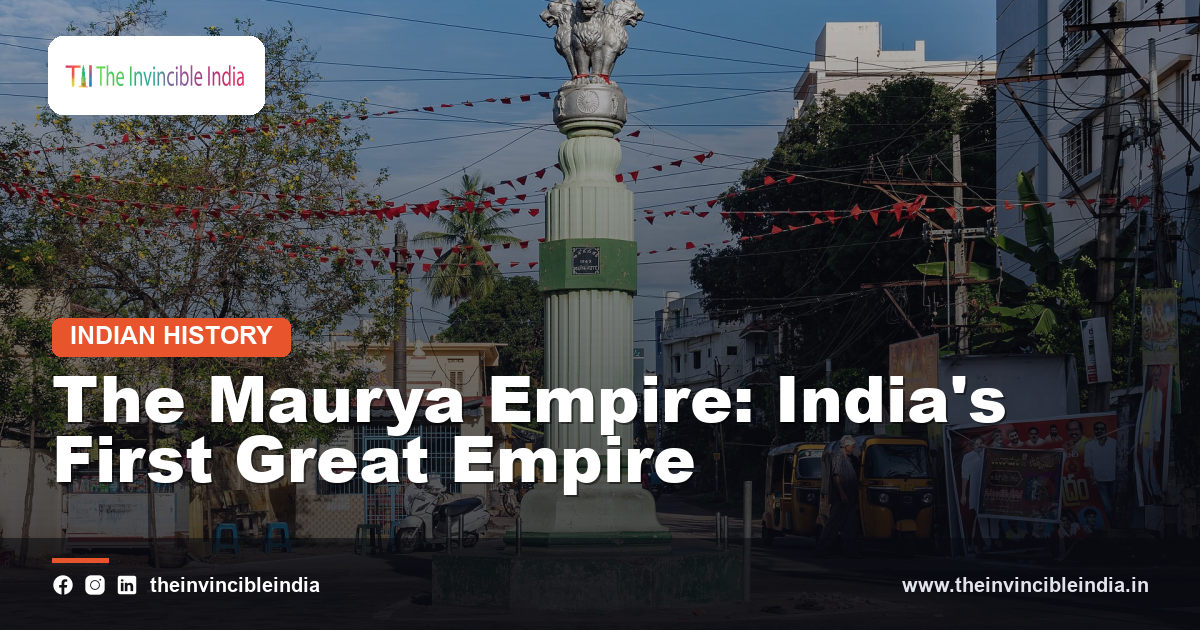
The Maurya Empire was the first great empire in the history of India, a mighty state that united much of the vast subcontinent under a single rule for the first time and stands as one of the greatest empires of the ancient world. Founded by Chandragupta Maurya and rising to its height under the great emperor Ashoka, the Maurya Empire was renowned for its vast extent, its powerful and organised government, its prosperity, and above all for the remarkable reign of Ashoka, who after a great conquest embraced peace and the way of dharma. The empire’s achievements and legacy have shaped India ever since, and its emblem endures as the state emblem of the Republic of India. This guide explores the Maurya Empire, its rise, its great rulers, its achievements and its legacy, one of the glories of India’s ancient history.
Quick Facts
| Detail | Information |
|---|---|
| Significance | India’s first great empire |
| Founder | Chandragupta Maurya |
| Greatest ruler | The emperor Ashoka |
| Extent | United much of the Indian subcontinent |
| Famed for | Its government, prosperity and the reign of Ashoka |
| Legacy | The Lion Capital is India’s state emblem |
India's First Great Empire
The Maurya Empire was the first great empire in the history of India, a mighty state that for the first time united much of the vast subcontinent under a single rule. Rising in ancient times, the Maurya Empire brought a great part of India under one powerful and organised government, achieving an extent, unity and greatness never before seen in the subcontinent, and it stands as one of the greatest empires of the ancient world and a landmark in the history of India. As India’s first great empire, uniting much of the subcontinent and standing among the greatest empires of the ancient world, the Maurya Empire holds a place of profound importance in the history of India and is one of the glories of its ancient civilisation.
Chandragupta Maurya, the Founder
The Maurya Empire was founded by Chandragupta Maurya, a great conqueror and empire-builder who rose to power and established the mighty Mauryan state. Chandragupta, aided by his wise counsellor Chanakya, overthrew the existing power, conquered vast territories, and forged a great empire spanning much of northern India, laying the foundations of the Mauryan state and dynasty and beginning one of the greatest chapters in Indian history. Chandragupta is honoured as the founder of the empire. This founding of the Maurya Empire by Chandragupta Maurya, the great conqueror and empire-builder who overthrew the existing power and forged a mighty state spanning much of India, is the beginning of the empire’s greatness, and Chandragupta is honoured as one of the great figures in the history of India.
Chanakya, the Great Counsellor
The rise of the Maurya Empire is closely linked with Chanakya, also known as Kautilya, the brilliant counsellor, strategist and thinker who guided Chandragupta to power. Chanakya, a master of statecraft, is remembered as the great mind behind the founding of the empire, who helped Chandragupta to overthrow the existing power and establish the Mauryan state, and he is famed as the author of a great treatise on statecraft, economics and government. Chanakya is one of the most celebrated figures of the age. This role of Chanakya, the brilliant counsellor and strategist who guided Chandragupta to power and is famed as a master of statecraft and the author of a great treatise on government, is a celebrated part of the story of the Maurya Empire, and Chanakya is honoured as one of the great political thinkers in the history of India.
A Vast Empire
The Maurya Empire grew to become a vast state, extending over a great part of the Indian subcontinent, the largest empire India had yet known. At its height, the empire stretched across northern India and far to the south, embracing an enormous territory of many peoples and regions under a single rule, an extent unprecedented in the history of the subcontinent, and this vastness was one of the great achievements of the empire. This vast extent is a mark of the empire’s greatness. This vast extent of the Maurya Empire, stretching across a great part of the Indian subcontinent to become the largest empire India had yet known, is one of the great marks of its greatness, and the unification of so vast a territory under a single rule was an unprecedented achievement in the ancient history of India.
A Powerful Government
The Maurya Empire was renowned for its powerful, organised and centralised government, which administered the vast empire with remarkable efficiency. The empire was governed by a strong central authority under the emperor, supported by an elaborate administration of officials, provinces and a great army, with systems of taxation, justice and administration that maintained order and unity across the vast territory, revealing a highly organised state. This powerful government is a great achievement of the empire. This powerful, organised and centralised government of the Maurya Empire, which administered the vast state with remarkable efficiency through an elaborate administration, army and systems of taxation and justice, is one of its great achievements and a mark of the sophistication of the Mauryan state.
Prosperity and Trade
Under the Mauryas, India enjoyed great prosperity, with a flourishing economy, agriculture, craft and trade both within the empire and with distant lands. The peace and order of the empire fostered a prosperous economy, with productive agriculture, flourishing crafts and industries, and extensive trade along the roads and routes of the empire and with distant lands, so that the Mauryan age was one of wealth and economic vitality. This prosperity is an important achievement of the empire. This great prosperity of the Maurya Empire, with its flourishing economy, agriculture, craft and trade both within the empire and with distant lands, fostered by the peace and order of the state, is an important achievement of the empire and a mark of the wealth and vitality of the Mauryan age.
Ashoka, the Great Emperor
The Maurya Empire reached its height and its greatest glory under Ashoka, one of the greatest and most remarkable rulers in the history of the world. Ashoka, the grandson of Chandragupta, ruled over the empire at its greatest extent, and after a great and bloody conquest he underwent a profound transformation, renouncing violence and embracing peace, dharma and the welfare of his people, becoming famed as a great and benevolent emperor. Ashoka is the crowning figure of the empire. This reign of Ashoka, the great emperor under whom the Maurya Empire reached its height and its greatest glory, and who after a great conquest embraced peace and dharma to become one of the most remarkable rulers in world history, is the crowning glory of the empire and one of the most celebrated chapters in the history of India.
The Transformation of Ashoka
One of the most famous events in Indian history is the transformation of Ashoka, who after the terrible bloodshed of a great war was filled with remorse and turned to the way of peace and dharma. Moved by the suffering caused by his conquest, Ashoka renounced war and violence, embraced the path of dharma, compassion and non-violence, and devoted himself to the moral and material welfare of his people and the spread of the teaching of peace, in one of the great moral transformations in history. This transformation is a famous and inspiring event. This transformation of Ashoka, who after the bloodshed of a great war turned in remorse to the way of peace, dharma and compassion, is one of the most famous and inspiring events in Indian history, and the great moral change in this powerful emperor is celebrated as a rare and noble example in the story of humanity.
The Edicts of Ashoka
Ashoka is famed for his edicts, the messages of dharma, morality and welfare that he had inscribed on pillars and rocks across his empire, among the most important records of ancient India. These edicts, carved in stone throughout the empire, proclaimed Ashoka’s principles of dharma, his care for the welfare of all beings, his call to moral conduct, tolerance and compassion, and his policies, and they are a remarkable and precious record of the ideals and rule of this great emperor. The edicts are a treasured legacy of Ashoka. These edicts of Ashoka, the messages of dharma, morality and welfare inscribed on pillars and rocks across the empire, are among the most important records of ancient India and a treasured legacy of the great emperor, revealing his noble ideals of peace, compassion and the welfare of all.
The Spread of Buddhism
Ashoka played a great role in the spread of Buddhism, which he embraced and promoted, sending it far beyond India and helping it to become a world religion. After his transformation, Ashoka embraced the teaching of the Buddha, promoted it throughout his empire, and sent missions to spread it to distant lands, playing a crucial role in the growth of Buddhism from an Indian teaching into one of the great religions of the world. This role in the spread of Buddhism is one of Ashoka’s greatest legacies. This great role of Ashoka in the spread of Buddhism, which he embraced and promoted and sent far beyond India through his missions, is one of his greatest legacies, and his patronage was crucial in the growth of Buddhism into a world religion, one of the most important contributions of the Maurya Empire to the world.
Art and the Pillars
The Maurya Empire, especially under Ashoka, produced remarkable art, above all the magnificent stone pillars crowned with beautiful sculptures. The Mauryan age saw the creation of great polished stone pillars erected by Ashoka, crowned with finely carved capitals, of which the most famous is the Lion Capital, a masterpiece of ancient Indian art, and this Mauryan art, with its skill and grandeur, is a glory of the age. The pillars and their capitals are treasures of the empire. This remarkable art of the Maurya Empire, above all the magnificent polished stone pillars of Ashoka crowned with beautiful capitals such as the famous Lion Capital, is a glory of the age, and the Mauryan pillars and their sculptures are treasured masterpieces of ancient Indian art and enduring symbols of the empire.
The Lion Capital
The most famous work of Mauryan art is the Lion Capital of Ashoka, a magnificent sculpture that has become the state emblem of the Republic of India. This beautiful capital, which once crowned one of Ashoka’s pillars, depicts four lions standing back to back, magnificently carved, and it has been adopted as the national emblem of India, so that this masterpiece of the Maurya Empire endures at the very heart of the modern nation. The Lion Capital is the crowning symbol of the empire’s legacy. This Lion Capital of Ashoka, the magnificent sculpture of four lions that once crowned a Mauryan pillar and has become the state emblem of the Republic of India, is the most famous work of Mauryan art and the crowning symbol of the empire’s enduring legacy at the very heart of the modern Indian nation.
The Decline of the Empire
After the great age of Ashoka, the Maurya Empire gradually declined, and in time the mighty empire came to an end. Following the reign of Ashoka, the empire weakened under his successors, and over time the vast state fragmented and declined, until the great Maurya Empire came to its end, though its achievements and legacy endured. This decline is the closing chapter of the empire’s story. This decline of the Maurya Empire after the great age of Ashoka, in which the mighty state gradually weakened and fragmented until it came to an end, is the closing chapter of the empire’s story, yet the greatness and legacy of the Maurya Empire endured long after the empire itself had passed into history.
The Legacy of the Mauryas
The Maurya Empire left a profound and enduring legacy as India’s first great empire, a model of unity, government and greatness, and above all through the reign of Ashoka and his ideals. The memory of the empire’s unity and greatness, the celebrated statecraft of its founding, the noble ideals of Ashoka and his role in the spread of Buddhism, and the magnificent Lion Capital that is now the emblem of the nation, all endure as a precious legacy of the empire. The Maurya Empire remains a glory of Indian history. As India’s first great empire, uniting much of the subcontinent, renowned for its government and prosperity, and glorified above all by the great emperor Ashoka and his ideals of peace and dharma, the Maurya Empire endures as one of the most important and celebrated chapters in the history of India and a great glory of its ancient civilisation.
Sources & Further Reading
- Archaeological Survey of India, on the Mauryan monuments and edicts (asi.nic.in).
- National Museum, New Delhi, on the Maurya Empire and Mauryan art.
Frequently Asked Questions
What was the Maurya Empire?
The Maurya Empire was India’s first great empire, a mighty ancient state that for the first time united much of the vast Indian subcontinent under a single rule. Founded by Chandragupta Maurya, it reached its height under the great emperor Ashoka and stands among the greatest empires of the ancient world.
Who founded the Maurya Empire?
The Maurya Empire was founded by Chandragupta Maurya, a great conqueror and empire-builder who, aided by his wise counsellor Chanakya, overthrew the existing power and forged a mighty empire spanning much of India, laying the foundations of the Mauryan state and dynasty.
Who was Ashoka?
Ashoka was the greatest ruler of the Maurya Empire and one of the most remarkable emperors in world history. After a great and bloody conquest, he embraced peace, dharma and compassion, promoted the welfare of his people, spread Buddhism, and inscribed his famous edicts across the empire.
What is the Lion Capital of Ashoka?
The Lion Capital of Ashoka is the most famous work of Mauryan art, a magnificent sculpture of four lions standing back to back that once crowned one of Ashoka’s pillars. It has been adopted as the state emblem of the Republic of India.
Why is the Maurya Empire important?
The Maurya Empire is important as India’s first great empire, which united much of the subcontinent and established a powerful and organised government. It is celebrated above all for the reign of the great emperor Ashoka, his ideals of peace and dharma, and his role in spreading Buddhism.


