

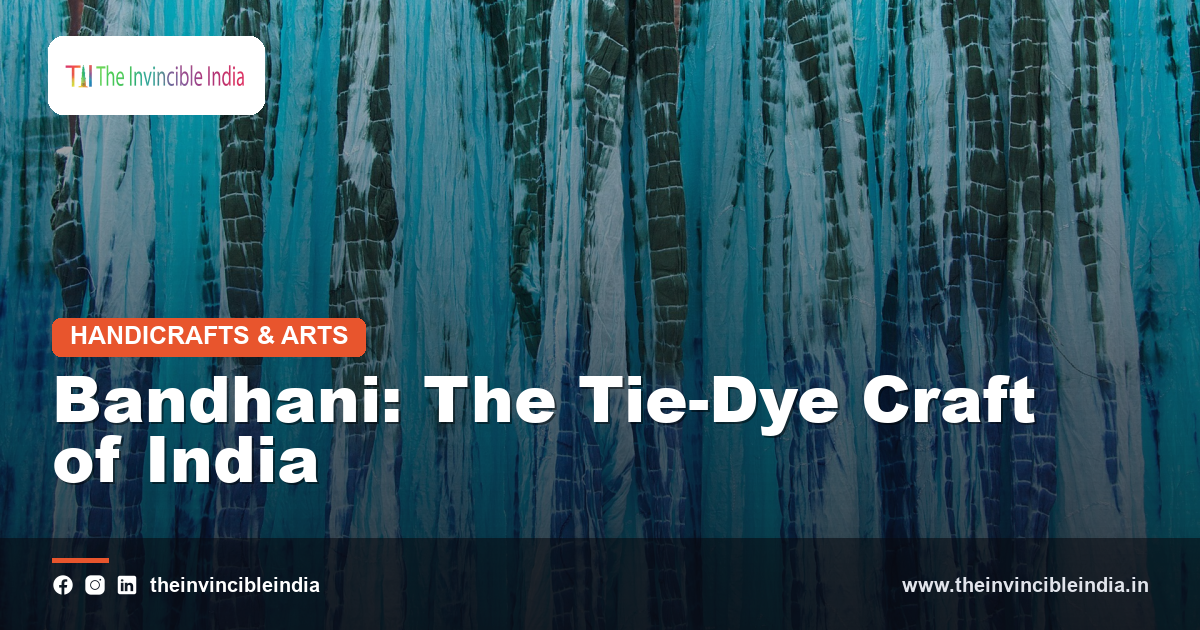
Bandhani is one of India’s oldest and most recognisable resist-dyeing traditions, in which cloth is tied into thousands of tiny knots before being dipped in dye to create fields of small, evenly spaced dots. Practised for generations across Gujarat and Rajasthan, the technique transforms plain cotton, silk, or georgette into vividly patterned fabric used for sarees, turbans, and ceremonial wraps. Closely linked to the broader tradition of traditional handicrafts of Rajasthan, Bandhani work is concentrated in family workshops where tying and dyeing are passed down as inherited skills. The finished cloth is prized for its fine, dense dot work, and it remains closely tied to regional festivals, weddings, and everyday dress.
Quick Facts
| Detail | Information |
|---|---|
| Also Known As | Bandhej, Bandhani |
| Primary Regions | Gujarat, Rajasthan |
| Core Technique | Tie-and-dye (resist dyeing) |
| Typical Fabrics | Cotton, silk, georgette, chiffon |
| Signature Motifs | Dots, waves, floral sprays, chequered grids |
| Common Uses | Sarees, odhnis, turbans, dupattas |
Origins and Historical Roots
Tie-dye resist techniques resembling Bandhani have been practised on the Indian subcontinent for many centuries, with the craft closely associated with communities in Gujarat and Rajasthan who specialised in dyeing and textile trade. Historical textile fragments and paintings from western India depict dotted patterns consistent with tied-resist work, suggesting the technique has deep roots in the region’s textile economy. Over time, Bandhani became linked with particular castes and family lineages who guarded the tying and dyeing knowledge as a hereditary craft.
The technique travelled along trade routes connecting Gujarat’s ports to other parts of India and beyond, carrying the reputation of its fine dotted cloth. It gradually became associated with courtly patronage as well as popular use, worn by rulers and common people alike in different qualities of cloth. This layered history has given Bandhani a status that combines everyday utility with ceremonial importance, a duality that continues to define the craft today.
What the Name Means
The word Bandhani derives from the Sanskrit and Hindi root bandh, meaning to tie or bind, a direct reference to the technique’s defining action of knotting cloth before dyeing. In Gujarat, the craft and its products are frequently called Bandhej, a regional variant of the same root, while the tied dots themselves are sometimes referred to individually within the trade.
The name reflects the labour at the heart of the craft: each dot in a finished piece corresponds to a single knot tied by hand, pinched from the fabric and wound tightly with thread before the cloth is dyed. Because the naming is tied to process rather than pattern alone, the term Bandhani applies broadly to any resist-tied cloth from the region rather than to a single fixed design. This linguistic clarity has helped the craft retain a distinct identity even as it has spread into new markets and fabric types over time.
Geographic Centres of Production
Bandhani production is historically concentrated in a handful of towns and cities across Gujarat and Rajasthan, each known for particular colour palettes and finishing styles. In Gujarat, towns in the Kutch and Saurashtra regions, along with the city of Jamnagar, have long been recognised centres where dyeing families cluster in dedicated neighbourhoods. In Rajasthan, cities such as Jodhpur and Sikar have their own established Bandhani traditions, often distinguished by particular colour combinations and pattern arrangements suited to local dress.
These centres developed largely independently but share the same underlying tying and dyeing method, with visible differences in dot density, colour choice, and the layout of larger motifs. Water quality, dye availability, and local market demand all shaped how each centre’s Bandhani evolved. Today, buyers and connoisseurs often look for indications of a piece’s town of origin as a marker of authenticity and quality, since each centre carries its own reputation within the trade.
The Basic Tie-Dye Principle
At its core, Bandhani relies on a simple resist principle: any part of the cloth that is tightly bound before dyeing will not absorb colour, leaving a small pale dot surrounded by dyed fabric once the binding is removed. This principle allows artisans to build complex patterns purely through the placement and density of tied points, without any painting, printing, or drawing of colour onto the surface.
The contrast between the resisted dot and the surrounding dyed ground is what gives Bandhani its distinctive stippled appearance, whether the dots are scattered loosely or packed into dense geometric fields. Multiple rounds of tying and dyeing can be layered to introduce more than one colour into a single piece. The elegance of the technique lies in this economy of means, achieving intricate visual effects through a repeated, disciplined manual process rather than specialised tools or machinery.
Preparing the Fabric
Before any tying begins, the cloth intended for Bandhani is washed and treated to remove starch and impurities so that it will absorb dye evenly. Cotton is typically prepared through simple washing and sun-drying, while silk and finer fabrics may require gentler handling to preserve their sheen and drape. The fabric is then folded in a manner appropriate to the intended pattern, since the folding determines how the tied dots will repeat across the finished cloth once it is opened out.
Artisans often use a light outline, traditionally marked with a wooden block dipped in a temporary pigment, to guide the placement of ties across the fabric. This outline tells the person tying where each pinch of cloth should be knotted. Careful preparation at this stage is essential, since any unevenness in folding or marking will be magnified once the dyeing and dot pattern are complete.
The Tying Process
The tying stage is the most labour-intensive part of Bandhani and is traditionally carried out by women working with remarkable speed and precision, often within family workshops. Using a fingernail or a small metal tool, the artisan pinches a tiny point of cloth, winds it tightly with thread, and secures it before moving to the next point, repeating the action thousands of times across a single length of fabric.
A single saree or odhni can require an enormous number of individual ties, and the density of these knots directly determines the fineness of the finished dot pattern. Skilled tiers can produce extremely small, uniform dots that give a piece its refined and expensive appearance, while looser ties are used for bolder, more affordable designs. The tied cloth is inspected to ensure even spacing before it is handed on to the dyer.
Dyeing Techniques and Colour Sequence
Once tying is complete, the cloth is dyed in a carefully planned sequence that allows multiple colours to appear in the finished piece. Dyeing generally proceeds from the lightest colour to the darkest, since each successive dye bath will only affect the areas of cloth left exposed after new ties are added to protect earlier colours. A length of fabric may pass through several rounds of tying and dyeing before its final pattern is complete.
Traditional dyes were drawn from natural and mineral sources, while many workshops today use synthetic dyes for their consistency and wider colour range. After the final dye bath, the cloth is washed and the thousands of tied knots are carefully undone, usually by hand, to reveal the dotted pattern beneath, a stage often considered the most satisfying part of the process.
Common Motifs and Patterns
Bandhani patterns range from simple, evenly scattered dots to elaborate compositions built from squares, diamonds, and floral arrangements formed entirely by the placement of tied points. Some of the most recognised traditional layouts include a central medallion surrounded by a field of small dots, borders made of denser dot lines, and diagonal or wave-like arrangements achieved by varying the spacing of ties.
Certain motifs carry regional or ceremonial associations, appearing more frequently on bridal cloth than on everyday garments. The overall visual effect depends heavily on the contrast between the ground colour and the resisted dots, with darker grounds such as red, maroon, or black often used to make the pale dots stand out sharply, giving Bandhani a distinctive textured quality immediately recognisable from a distance.
Regional Styles: Gujarat and Rajasthan
While the underlying tie-and-dye method is shared across Gujarat and Rajasthan, the two regions have developed recognisably different Bandhani styles over generations of practice. Gujarati Bandhani, particularly from Kutch and Jamnagar, is often associated with fine, closely packed dots and colour combinations linked to local bridal and festival traditions. Rajasthani Bandhani, produced in centres such as Jodhpur and Sikar, tends to favour bold colour contrasts and slightly larger dot work suited to traditional dress.
These stylistic differences are not rigid boundaries, since traders and artisans have long moved between regions, but connoisseurs often use dot size, colour palette, and pattern layout to make an informed guess about a piece’s origin, reflecting how a single technique can diversify under different local tastes and market demands.
Leheriya and Related Tie-Dye Techniques
Bandhani is often discussed alongside Leheriya, another resist-dyeing tradition from Rajasthan that produces diagonal wave-like stripes rather than discrete dots, created by rolling and binding the fabric diagonally before dyeing. Although the two techniques differ in method and visual result, they share the same resist-dyeing logic and are frequently practised within the same dyeing communities, sometimes even combined on a single piece of cloth.
Mothra and other named variants extend this family of techniques further, layering wave patterns with grid-like dot work to create more elaborate compositions. This shared heritage means that skills such as fabric folding, dye sequencing, and colour judgment transfer readily between Bandhani and its related tie-dye crafts practised across the same region.
Bandhani Sarees and Odhnis
Among the most celebrated products of the craft are Bandhani sarees and odhnis, long veils traditionally worn by women across Gujarat and Rajasthan. A well-made Bandhani saree typically features a densely dotted body, a contrasting border, and a more elaborate pallu, the decorative end piece, often combining multiple colours achieved through sequential dyeing.
These garments are frequently given as part of bridal trousseaus, with particular colour and pattern combinations understood within communities to signal marital status, family background, or festive occasion. The fine gradation of dot density, from tightly packed borders to more open central fields, reflects the skill of the tying artisan as much as the dyer, making these pieces valued heirlooms as well as everyday garments.
Turbans and Bandhani in Menswear
Bandhani is not limited to womenswear; brightly dyed and dotted turbans remain an important part of traditional male dress in Rajasthan and parts of Gujarat. These turbans are typically dyed in bold colours such as red, orange, or yellow, sometimes combined with tie-dyed patterns that create visual interest across the length of cloth as it is wound around the head.
The choice of turban colour and pattern can carry social meaning, at times reflecting regional identity, caste tradition, or the nature of an occasion such as a wedding. Bandhani fabric is also used for men’s stoles and ceremonial wraps, underlining that the craft has never been a narrowly gendered tradition.
Role in Weddings and Festivals
Bandhani holds a particularly strong association with weddings and seasonal festivals across Gujarat and Rajasthan, where specific colours and patterns are understood to be appropriate for particular occasions. Certain combinations, such as red and yellow grounds with white dots, are closely linked with bridal wear and auspicious ceremonies, while other palettes are reserved for everyday use.
Families frequently commission new Bandhani garments ahead of weddings, treating the purchase as both a practical and symbolic investment in the celebration. The craft’s deep integration into ritual life has helped sustain demand for handmade Bandhani even as machine-printed imitations have entered the market, since many buyers continue to value the authenticity of genuinely hand-tied cloth.
The Artisan Community
Bandhani production has traditionally been organised around family workshops in which tying, dyeing, and finishing are divided among household members according to skill and experience. Women and children have historically played a central role in the tying stage, valued for their patience and fine finger control, while dyeing has often been carried out by more experienced family members familiar with colour sequencing.
Many artisan families belong to communities that have practised Bandhani for generations. Government programmes, craft cooperatives, and geographical indication recognition for certain Bandhani-producing areas have supported these communities in recent decades, helping to protect their livelihoods and the authenticity of hand-tied Bandhani against mechanised imitation prints.
Modern Adaptations and Fashion
In recent decades, Bandhani has moved beyond traditional sarees and turbans into contemporary fashion, appearing on dupattas, kurtas, western-style garments, and home furnishings designed for a wider domestic and international market. Fashion designers have incorporated Bandhani fabric into modern silhouettes, pairing traditional dot patterns with contemporary cuts to appeal to younger buyers.
This expansion has created new outlets for artisan workshops, though it has also increased competition from machine-printed fabrics that mimic the dotted appearance without the labour of genuine tying. The craft’s adaptability, its capacity to sit comfortably on both a traditional saree and a modern accessory, has been an important factor in keeping Bandhani commercially relevant.
Bandhani Today
Bandhani today occupies a position that blends deep cultural continuity with ongoing commercial adaptation, remaining an essential part of festive and bridal wardrobes while also reaching new audiences through contemporary fashion and home textiles. The craft continues to be practised largely by hereditary artisan communities in Gujarat and Rajasthan, whose tying and dyeing skills remain difficult to replicate through mechanised processes.
Recognition through craft development programmes and growing consumer interest in handmade, traceable textiles have helped sustain demand for genuine Bandhani in domestic and export markets. As long as families in its historic centres continue to tie and dye cloth by hand, Bandhani is likely to remain one of India’s most visually distinctive textile traditions.
Sources & Further Reading
- Ministry of Textiles, Government of India (texmin.nic.in).
- Ministry of Culture, Government of India (indiaculture.gov.in).
Frequently Asked Questions
What does the word Bandhani mean?
Bandhani comes from the word bandh, meaning to tie, referring directly to the tying technique used to resist dye and create the craft’s characteristic dotted patterns. In Gujarat the craft is also commonly called Bandhej.
How is Bandhani different from other tie-dye techniques?
Bandhani is distinguished by its very fine, densely packed dots created through thousands of individual hand-tied knots, producing more intricate patterns than most other resist-dyeing traditions. Related techniques such as Leheriya use folding and binding to create wave-like stripes rather than dots.
Which fabrics are commonly used for Bandhani?
Cotton and silk are the most traditional fabrics for Bandhani, though georgette and chiffon are also widely used today for lighter garments such as dupattas and odhnis. The choice of fabric affects both drape and achievable dot fineness.
Is Bandhani made only in Gujarat?
No, Bandhani is produced across both Gujarat and Rajasthan, with well-known centres in towns such as Jamnagar, Bhuj, Jodhpur, and Sikar, each known for particular colour and pattern preferences.
How can one identify genuine hand-tied Bandhani?
Genuine hand-tied Bandhani typically shows slight irregularities in dot size and spacing, along with a small, tightly puckered knot mark at the centre of each dot, features that machine-printed imitations rarely reproduce accurately.


