

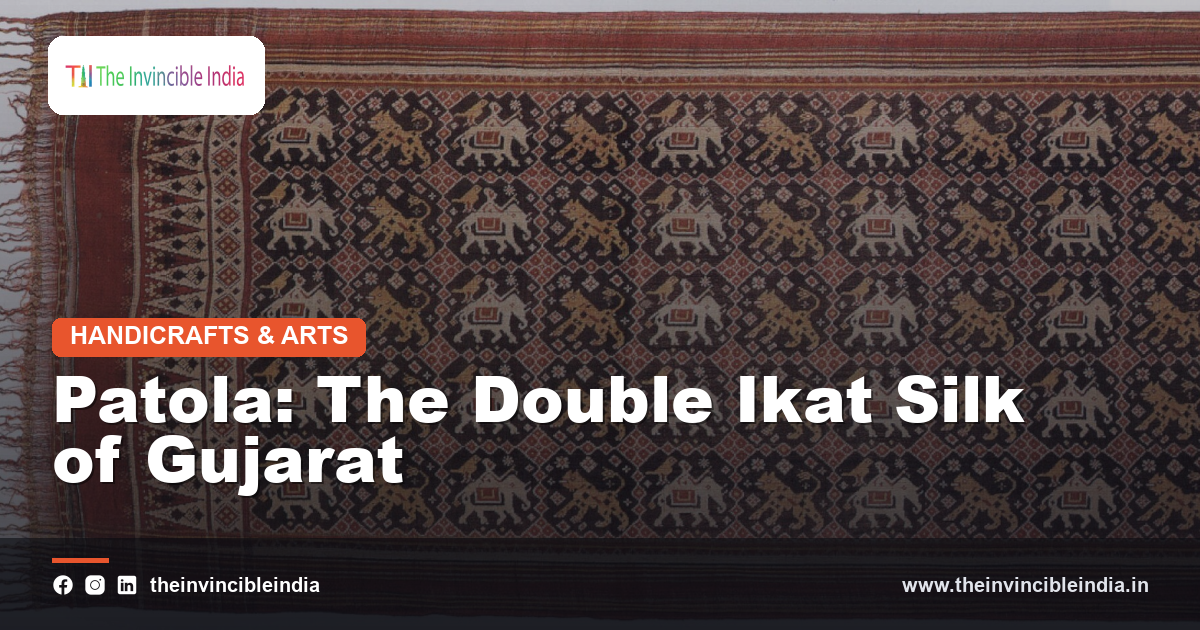
Patola is a double ikat silk weaving tradition from Patan in Gujarat, in which both the warp and weft threads are separately tie-dyed before weaving so that the finished pattern emerges precisely from the interlocking of pre-dyed yarns rather than from any dyeing or printing applied after weaving. This double-resist method is considerably more demanding than the single ikat technique used in traditions such as the Pochampally Ikat of Telangana, since both sets of threads must be dyed and aligned with extreme precision for the pattern to appear correctly. Patola sarees, prized for their vivid colours and geometric-floral motifs, remain among the most technically demanding and highly valued handwoven textiles in India.
Quick Facts
| Detail | Information |
|---|---|
| Also Known As | Patan Patola |
| Primary Region | Patan, Gujarat |
| Core Technique | Double ikat (warp and weft resist-dyed) |
| Typical Fabric | Pure silk |
| Signature Motifs | Parrots, elephants, flowers, dancing figures, grids |
| Traditional Weaving Families | Salvi community |
What Is Double Ikat
Double ikat is a resist-dyeing and weaving technique in which both the warp threads, running lengthwise on the loom, and the weft threads, running crosswise, are individually tied and dyed in a planned pattern before weaving begins. When the two sets of pre-dyed threads are woven together with precise alignment, their patterns interlock to form the finished design.
This differs significantly from single ikat, in which only one set of threads is resist-dyed, making double ikat considerably more complex and demanding of precision. Because any misalignment will blur the intended pattern, double ikat weaving requires exceptional skill, and only a small number of textile traditions worldwide practise it.
Patan as the Home of Patola
The town of Patan in Gujarat has been closely associated with double ikat silk weaving for many centuries, giving the craft its widely used name, Patan Patola. Patan’s historical importance as a centre of trade and administration in Gujarat likely supported the development of such a resource-intensive craft, which required stable patronage and skilled artisan communities.
Over time, Patola became closely identified with Patan specifically, with the technique closely guarded within a small number of weaving families. This close geographic association has persisted, with genuine Patan Patola still commanding a premium in the market today.
The Salvi Weaving Families
Patola weaving in Patan has traditionally been practised by a small number of families belonging to the Salvi community, who have preserved and transmitted the craft’s demanding techniques across many generations through close family apprenticeship. Because Patola weaving requires such precision and years of accumulated skill, knowledge has remained concentrated within these few families.
Family members typically specialise in different stages of the process, including design planning, tying, dyeing, and weaving, working collaboratively on a single saree that may take many months to complete, sustaining the craft as a living tradition.
Planning the Design
Before any dyeing begins, a Patola design must be carefully planned and calculated in precise detail, since the finished pattern depends entirely on knowing exactly where each colour must appear on both the warp and weft threads once woven together. This planning stage requires working out precisely which sections of thread must be tied and dyed which colour, and in what sequence.
Even small errors in this calculation can result in a badly misaligned pattern once weaving begins, making accurate planning as critical to the finished result as the physical skills of tying and dyeing themselves.
The Tying and Dyeing Process
Once a design is planned, sections of both the warp and weft silk threads are bound tightly at calculated points to prevent dye from penetrating those areas during dyeing. The bound threads are dyed in a sequence of colours, with ties added and removed at each stage to build up the multiple colours required for the finished pattern.
Because Patola sarees typically feature several distinct colours, this sequence must be repeated multiple times for both warp and weft, requiring careful record-keeping to ensure the two sets of threads will align correctly once woven, a stage that alone can take many weeks.
Aligning Warp and Weft
The most technically demanding stage of Patola production is the careful alignment of the dyed warp and weft threads on the loom, since the finished pattern will only appear correctly if the pre-dyed sections of each thread meet at precisely the right point during weaving. Weavers must make continuous fine adjustments as they work.
This delicate, ongoing correction process requires intense concentration and experience, and it is this exacting alignment work that distinguishes accomplished Patola weavers from less experienced practitioners, and a major reason double ikat weaving takes so much longer than most other handloom techniques.
Weaving on the Loom
Patola is woven on a traditional handloom adapted to accommodate the careful, deliberate pace required for double ikat weaving, quite different from the faster rhythms possible when weaving with plain, undyed thread. Weavers typically work slowly and methodically, checking pattern alignment frequently.
Because of the resist-dyed pattern already present in the thread, the visual design becomes apparent only gradually as weaving proceeds. A single saree can take several months to weave once all preparatory tying and dyeing is complete, one key reason genuine Patola sarees command such high prices.
Reversibility of Patola
One of the most distinctive characteristics of a genuine Patola saree is that its pattern appears identically on both sides of the fabric, since the design is created entirely through the dyed thread structure rather than through any surface application of colour or embroidery. This reversibility is considered a hallmark of authentic double ikat weaving.
This is a useful practical indicator for identifying genuine Patola, since printed or embroidered imitations will typically show a clear right and wrong side. The reversible quality also gives Patola sarees a practical advantage against wear and fading.
Motifs and Patterns
Traditional Patola motifs include stylised parrots, elephants, flowers, dancing female figures, and intricate geometric grids, often arranged in repeating rows across the body of the saree with more elaborate compositions reserved for the border and pallu. Certain motif combinations have historically been considered especially auspicious for weddings.
The geometric precision required to render these motifs through double ikat weaving gives Patola patterns a distinctive slightly soft-edged quality, a natural consequence of the process rather than a flaw, distinguishing genuine handwoven double ikat from sharper-edged printed imitations.
Patola Sarees and Their Uses
Patola sarees have historically held significant ceremonial and social importance, particularly within certain Gujarati communities where they are closely associated with weddings and other major life events. Their high cost, reflecting the enormous labour involved, has traditionally made them valuable family heirlooms passed down across generations.
Beyond weddings, Patola sarees have also historically been used in trade and diplomatic gift-giving. The saree remains the most common traditional format, though the technique has occasionally been applied to smaller items such as stoles, albeit far less commonly.
Rajkot Patola and Single Ikat Comparison
In addition to the double ikat Patan Patola, a related but distinct single ikat tradition, sometimes referred to as Rajkot Patola, is produced in other parts of Gujarat using a less complex resist-dyeing method applied to only one set of threads. While visually similar, single ikat Rajkot work is considerably faster and less expensive to produce.
This distinction is broadly comparable to the difference between double ikat Patola and other single ikat traditions such as Pochampally Ikat. Buyers seeking authentic double ikat Patan Patola are generally advised to verify the specific weaving technique and place of production.
Time and Cost of Production
The combined demands of design planning, precise tying and dyeing, and careful hand-weaving mean that a single genuine Patan Patola saree can take many months, in some cases well over a year, to complete from start to finish. This extended production time is directly reflected in the high market price of authentic Patola sarees.
The cost also reflects the use of fine silk thread and the relatively small number of weaving families able to produce genuine double ikat work, helping preserve the craft’s reputation as an exceptional textile achievement rather than a mass-market product.
Patola in Trade History
Historical accounts suggest that Patola textiles were valued not only within India but also as an export commodity traded along maritime routes connecting Gujarat’s ports to markets in Southeast Asia, where fine Indian textiles were highly prized among local elites. This reflects Gujarat’s long-standing importance as a centre of maritime commerce.
Surviving historical examples of Patola fabric found outside India offer evidence of this wider trade reach, situating the craft within a much broader history of Indian textiles as a valued global trade commodity.
Geographical Indication and Recognition
In recognition of its distinctive regional character and the specialised skill required to produce it, Patan Patola has received formal geographical indication recognition, a legal status intended to protect the name and reputation of products closely tied to a specific place and traditional method of production. This helps distinguish genuine Patan-produced work from other products marketed under similar names.
Alongside this formal recognition, craft documentation and museum collections have helped preserve detailed records of traditional Patola techniques, supporting both scholarly understanding and practical preservation efforts.
Challenges and Preservation
Despite its prestige, Patola weaving faces significant challenges related to the very small number of families capable of producing genuine double ikat work to the exacting standard the craft demands. The lengthy training required discourages many potential successors, particularly where alternative careers offer more immediate financial return.
Competition from printed and single-ikat imitations that visually resemble Patola at a fraction of the price further complicates the economic position of genuine weavers. Government recognition and continued demand from collectors have helped support the small remaining community of Patola weavers.
Museums, Documentation, and Collectors
Historic examples of Patola weaving are held in museum and private collections both within India and internationally, valued as important records of the craft’s technical achievement and its long trading history. These preserved pieces, some dating back well before modern export markets developed, provide valuable reference points for understanding how motifs, colour combinations, and weaving precision have evolved within the Patan tradition over time.
Collectors and connoisseurs continue to seek out genuine antique and contemporary Patola sarees, often placing considerable value on pieces with well-documented provenance connecting them to established Salvi weaving families. This ongoing scholarly and collector interest, alongside government and cultural institution support, helps sustain awareness of Patola as a significant textile art form rather than simply a luxury commercial product, reinforcing the importance of preserving accurate historical and technical knowledge of the craft.
Patola Today
Patola remains one of India’s most technically extraordinary textile traditions, a double ikat weaving craft in which pattern is created entirely through the precise pre-dyeing and alignment of both warp and weft silk threads. Concentrated in the town of Patan and preserved by a small number of Salvi weaving families, the craft continues to demand exceptional patience and inherited skill.
Geographical indication recognition and continued institutional support have helped protect the craft’s identity against imitation, though its long-term survival still depends on training new generations of weavers in this uniquely demanding technique.
Sources & Further Reading
- Ministry of Textiles, Government of India (texmin.nic.in).
- Ministry of Culture, Government of India (indiaculture.gov.in).
Frequently Asked Questions
What makes Patola different from other ikat weaving?
Patola uses double ikat, meaning both the warp and weft threads are separately tie-dyed before weaving, unlike single ikat traditions where only one set of threads is resist-dyed, making Patola considerably more complex to produce.
Where is genuine Patola made?
Genuine Patan Patola is made in the town of Patan in Gujarat, traditionally by a small number of families from the Salvi community who have preserved the craft’s demanding techniques across generations.
Why are Patola sarees so expensive?
Patola sarees are expensive because producing a single piece can take many months due to the precise design planning, repeated tying and dyeing of both warp and weft threads, and the slow, careful hand-weaving required.
How can you identify a genuine double ikat Patola?
A genuine double ikat Patola saree shows an identical pattern on both sides of the fabric, since the design comes from the dyed thread structure itself rather than surface printing, which typically shows a clear right and wrong side.
Is all Patola-style fabric made using double ikat?
No, some Patola-style fabric, sometimes called Rajkot Patola, is made using a faster and less expensive single ikat technique, which is considered a distinct product from genuine double ikat Patan Patola.


