

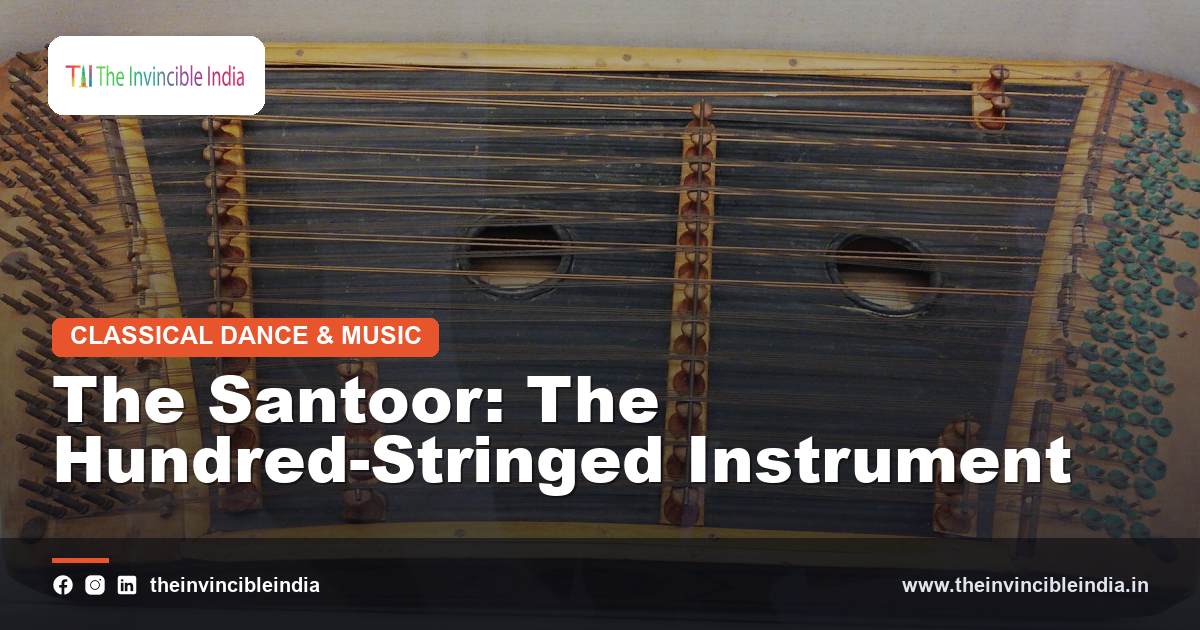
The santoor is a trapezoid-shaped hammered string instrument from Kashmir, whose shimmering, cascading tone comes from a pair of light wooden mallets striking taut metal strings stretched across a shallow wooden box. Long central to the devotional and courtly music of the Kashmir valley, it was for centuries a regional treasure largely unknown to wider Indian audiences until it was carefully adapted for the concert stage of Hindustani classical music in the twentieth century. That adaptation required new playing techniques capable of sustaining melody and ornamentation on an instrument built for rhythmic, percussive strokes, and the result is one of the most distinctive and admired sounds in Indian music today. This guide traces the santoor’s origins, construction, technique, repertoire and modern standing.
Quick Facts
| Detail | Information |
|---|---|
| Type | Hammered string instrument (chordophone) |
| Origin | Kashmir, North India |
| Body | Trapezoid wooden box, traditionally walnut |
| Strings | Around a hundred strings across many bridges |
| Played with | A pair of light curved wooden mallets (mezrab) |
| Traditions | Kashmiri Sufiana Mousiqi and Hindustani classical music |
What Is the Santoor
The santoor is a trapezoid-shaped chordophone in which sound is produced by striking taut strings with a pair of light mallets rather than by plucking or bowing them. This places it in the wider hammered-dulcimer family found in various forms across Asia, Europe and the Middle East, though the Kashmiri santoor has its own distinct proportions, stringing and repertoire. Its many strings are arranged across a shallow wooden soundbox and grouped into courses that pass over small movable bridges, giving the instrument a shimmering, resonant quality unlike any other in Indian classical music. The rapid, cascading patterns it can produce and its bright, bell-like timbre have made it instantly recognisable to listeners far beyond its Himalayan homeland.
Kashmiri Origins and Sufiana Mousiqi
The santoor developed within the classical music tradition of the Kashmir valley known as Sufiana Mousiqi, a refined devotional and courtly repertoire shaped over centuries by the region’s distinctive cultural blend of Central Asian, Persian and Indian influences. Within this tradition the santoor served largely as an accompanying and ensemble instrument, supporting singers and dancers in a repertoire built on its own set of melodic modes known as maqams. For generations the instrument remained closely tied to this regional practice and was little known outside Kashmir, its sound inseparable from the valley’s distinctive musical and cultural identity. This deep regional rootedness gave the santoor a character quite different from the instruments of the mainstream Hindustani classical stage.
Construction and Materials
A santoor is built as a shallow trapezoid box, traditionally crafted from walnut wood prized for its resonance and its availability in the Kashmir region. The top surface is fitted with rows of small bridges over which the strings are strung in closely spaced courses, and the box is hollow beneath to allow the sound to project and sustain. Careful attention is paid to the thickness and seasoning of the wood, since these affect the tonal warmth and sustain of the instrument. Fine metal tuning pins anchor the strings at one end, allowing each course to be adjusted precisely. The result is a light, portable instrument capable of a surprisingly full and resonant sound.
The Hundred Strings
The santoor takes its identity from its dense array of metal strings, traditionally numbering close to a hundred, though the exact count can vary between instrument makers and regional styles. The strings are grouped into courses, with several strings tuned in unison to the same note passing over a shared bridge, which increases volume and gives each struck note a rich, layered resonance. This arrangement allows the santoor to cover a wide melodic range within a compact frame, and the closely packed bridges require considerable precision from the player, who must strike accurately to sound the intended note among so many closely spaced strings.
The Mezrab Mallets
The santoor is played with a pair of light, curved wooden mallets known as mezrabs, held loosely between the fingers so that the wrist can move with speed and flexibility. Unlike a hard mallet on a Western dulcimer, the mezrab is shaped to produce a soft yet clear attack, allowing the player to draw out both delicate, sustained phrases and rapid, sparkling runs. Technique centres on controlling the angle, speed and pressure of each stroke, since these determine tone colour as much as pitch. Mastery of the mezrabs, developed over years of practice, is what allows a skilled player to coax genuinely melodic, singing lines from what is fundamentally a percussive instrument.
Tuning the Instrument
Tuning a santoor is a demanding and time-consuming task because of the sheer number of strings involved, each of which must be adjusted individually using the tuning pins to bring its course into agreement with the others. Players generally retune the instrument for each raga they intend to perform, since the santoor’s fixed bridges mean that, unlike a fretless instrument, its available notes are set in advance rather than shaped freely during play. This makes thorough preparation essential before a performance, and experienced musicians develop an intimate, practical knowledge of how their particular instrument responds, since subtle differences in construction and stringing give each santoor its own individual character.
Playing Technique
Playing the santoor well requires far more than striking strings in rhythm; the mallets must be used to imitate the sustained, gliding phrases that are central to Hindustani melody. Because a struck string naturally decays quickly, players developed techniques of rapid repeated strokes and careful damping to simulate the long, connected lines that a bowed or sung note can achieve. Ornamentation, ranging from quick grace notes to subtle shifts in emphasis, is built through precise control of the mallets rather than through finger pressure on the strings themselves. This technical vocabulary, refined over decades, transformed the santoor from a primarily rhythmic accompaniment into an instrument capable of genuine melodic expression.
From Folk Ensemble to Concert Stage
For much of its history the santoor functioned within ensembles, providing rhythmic and melodic support to vocalists and dancers in the Kashmiri tradition rather than standing as a solo concert instrument. Bringing it to the wider Hindustani classical stage required rethinking both its technique and its repertoire, since the demands of an extended solo raga performance are very different from those of ensemble accompaniment. This transformation, carried out gradually over the twentieth century, involved refining the mallets, adjusting the instrument’s construction and developing new approaches to sustain and ornamentation. The effort succeeded in establishing the santoor as a respected solo voice within a classical tradition long dominated by instruments such as the sitar and sarod.
Adaptation to Hindustani Classical Music
The santoor’s rise within Hindustani classical music owes much to musicians, most notably Pandit Shivkumar Sharma, who devoted themselves to reshaping its technique so that it could render the full grammar of raga performance, including slow melodic development, ornamentation and rhythmic improvisation. This required experimentation with mallet design, stringing and playing posture, alongside the patient work of demonstrating the instrument’s expressive potential to classical audiences accustomed to other instruments. Through sustained effort and performance, the santoor gradually won acceptance as a legitimate and celebrated vehicle for serious classical music, a development widely regarded as one of the notable instrumental innovations in twentieth-century Indian music.
Repertoire and Ragas
In its concert form, the santoor performs the full architecture of a Hindustani instrumental recital, opening with an unmetered alap that unfolds the chosen raga slowly and meditatively before moving into rhythmic compositions set to a tabla accompaniment. Players draw on the same body of ragas performed by other Hindustani instruments, adapting phrasing and ornamentation to suit the santoor’s particular strengths and limitations. The instrument is especially admired for the way its shimmering, resonant strokes can evoke both serene, contemplative moods and passages of rapid, dazzling virtuosity, giving performers considerable scope for interpretation within the disciplined structure of raga performance.
Ensemble and Accompaniment Roles
Although best known today as a solo concert instrument, the santoor continues to serve in ensemble and accompaniment settings, both within the Kashmiri Sufiana tradition from which it emerged and in broader collaborative performances. It blends well with other melodic instruments and with the voice, its bright timbre providing a distinctive counterpoint to bowed or plucked strings. In film music and light classical settings the santoor is often used for its atmospheric, evocative quality, lending scenes and songs a sense of serenity or grandeur. This versatility across solo, ensemble and accompanying roles has helped keep the instrument in continuous and varied use.
Sound Character and Timbre
The santoor’s tone is often described as shimmering, bell-like and cascading, a quality that arises directly from its construction: many closely tuned strings struck by light mallets produce a dense, resonant wash of overtones around each note. This gives the instrument a shimmering quality especially suited to conveying tranquillity and depth, and it can also produce rapid, glittering runs of great technical brilliance. Because the sound decays naturally after each stroke, skilled players learn to shape phrases through rhythm and repetition rather than sustained pressure, giving santoor music a rippling, layered texture that is immediately distinctive among Indian classical instruments.
Global Cousins of the Santoor
The santoor belongs to a broad family of hammered string instruments found under different names in many cultures, including the Iranian santur, from which the Kashmiri name likely derives, alongside various hammered dulcimers of the Middle East, Central Asia and Europe. While these instruments share the basic principle of struck strings over a resonating box, each tradition has developed its own construction, tuning system and repertoire suited to its regional music. The Kashmiri santoor stands apart in its adaptation to the demands of Hindustani raga performance, a development that has given this ancient family of instruments a distinctly Indian classical voice.
Learning the Santoor
Learning the santoor demands patient, disciplined practice, since students must develop precise control over both mallets independently while training their ear to navigate the instrument’s dense array of strings and bridges. Training typically follows the traditional guru-shishya method common to Hindustani classical music, with students absorbing technique, repertoire and musical sensibility directly from an experienced teacher over an extended period. Early lessons focus on basic strokes, damping and simple melodic patterns, gradually building toward the sustained phrasing and ornamentation required for raga performance. As with other classical instruments, genuine mastery is understood as the work of many years rather than a fixed course of study.
The Santoor in Contemporary Music
Beyond the classical concert stage, the santoor has found a home in film music, fusion projects and instrumental albums, where its evocative, meditative sound is often used to suggest mountain landscapes, serenity or introspection. Musicians have paired it with instruments from other traditions and with electronic textures, exploring new sonic possibilities while drawing on its classical technique. This crossover appeal has introduced the santoor to audiences who might never encounter a full Hindustani classical recital, broadening appreciation for the instrument even as its core identity remains anchored in the disciplined raga tradition from which its modern voice emerged.
The Santoor Today
Today the santoor holds a secure and admired place among India’s classical instruments, performed by dedicated soloists, taught in music institutions and heard in settings ranging from formal concert halls to film soundtracks. Its journey from a regional Kashmiri ensemble instrument to a celebrated voice of Hindustani classical music stands as one of the more remarkable transformations in modern Indian musical history. Continued interest from younger musicians and audiences alike suggests the instrument’s distinctive shimmering sound will remain a valued part of India’s living classical tradition for generations to come, carrying forward the artistry of the valley where it first took shape.
Sources & Further Reading
- Sangeet Natak Akademi, national academy for music, dance and drama (sangeetnatak.gov.in).
- Ministry of Culture, Government of India (indiaculture.gov.in).
Frequently Asked Questions
What is a santoor?
The santoor is a trapezoid-shaped hammered string instrument from Kashmir, played by striking around a hundred metal strings with a pair of light wooden mallets. It is used both in the Kashmiri Sufiana Mousiqi tradition and, since the twentieth century, as a solo instrument in Hindustani classical music.
How many strings does a santoor have?
A santoor typically has close to a hundred strings, arranged in courses that pass over many small bridges on its trapezoid soundbox, though the exact number can vary between instrument makers.
How is the santoor played?
The santoor is played with a pair of light, curved wooden mallets called mezrabs, held between the fingers. Players strike the strings with controlled speed and pressure, using repeated strokes and damping to imitate sustained melodic lines.
Who helped bring the santoor into classical music?
Pandit Shivkumar Sharma is widely credited with adapting the santoor’s playing technique so it could perform full Hindustani classical raga recitals, helping establish it as a respected solo concert instrument in the twentieth century.
What tradition did the santoor originally come from?
The santoor originated within Sufiana Mousiqi, the classical devotional and courtly music tradition of the Kashmir valley, where it traditionally served as an ensemble and accompanying instrument.


