

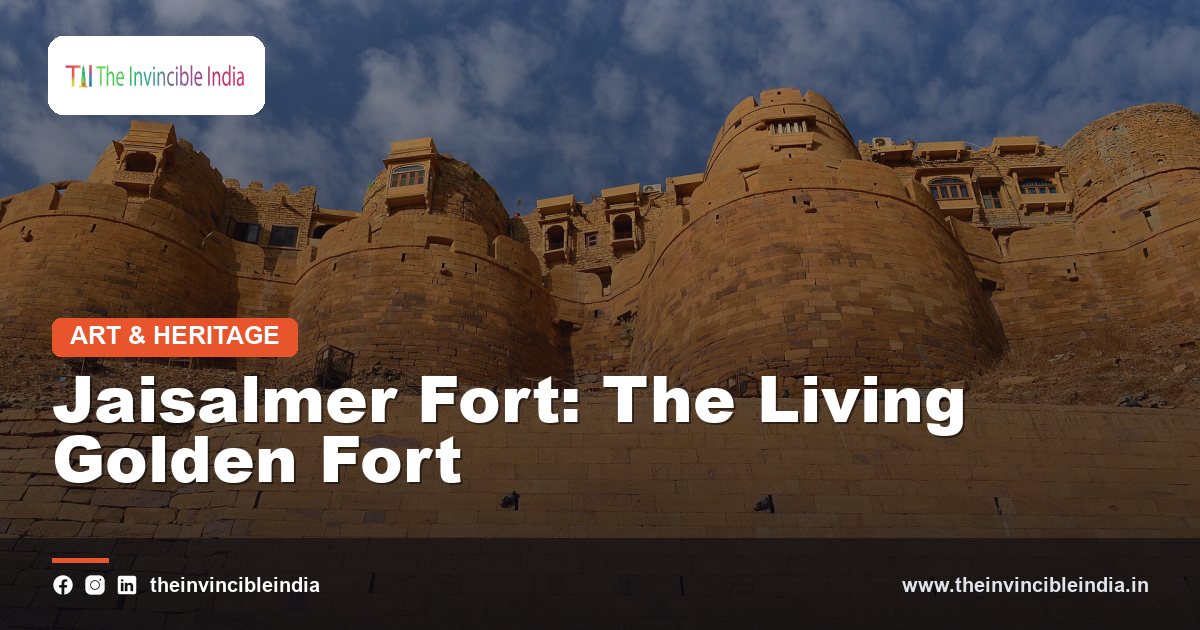
Jaisalmer Fort rises abruptly from the flat expanse of the Thar Desert, its ramparts crowning Trikuta Hill above the modern city of Jaisalmer in western Rajasthan. Built from a distinctive local sandstone that glows gold in the sunlight, the fort has earned the popular name Sonar Quila, and it remains one of the rare examples among the great forts of India that continues to function as an inhabited town rather than a preserved ruin. Its narrow lanes still shelter homes, temples, and merchant havelis, giving visitors a living sense of desert fortress life that has endured for centuries.
Quick Facts
| Detail | Information |
|---|---|
| Location | Jaisalmer, Rajasthan |
| Also known as | Sonar Quila (Golden Fort) |
| Founded | 12th century by Rawal Jaisal |
| Material | Yellow sandstone |
| Setting | Trikuta Hill, Thar Desert |
| Recognition | UNESCO World Heritage Site (Hill Forts of Rajasthan) |
A Fort Rising from the Desert
Jaisalmer Fort rises abruptly from the flat expanse of the Thar Desert, its ramparts crowning Trikuta Hill above the modern city of Jaisalmer in western Rajasthan. Built from a distinctive local sandstone, the fort takes on a warm golden hue in daylight and an even richer amber glow at sunset, a quality that has earned it the popular name Sonar Quila, or Golden Fort. Its silhouette dominates the horizon for travelers approaching across the desert plains, much as it would have for caravans and armies centuries ago.
The fort’s commanding position atop the hill was chosen deliberately, offering both a defensive vantage point and visibility over the surrounding trade routes that once crossed this remote stretch of desert. This combination of natural elevation and striking material has made Jaisalmer Fort one of the most recognizable silhouettes among India’s great desert strongholds.
Founding by Rawal Jaisal
The fort is traditionally credited to Rawal Jaisal, a Rajput ruler of the Bhati clan, who established it in the twelfth century as the seat of his kingdom. According to local tradition, Jaisal chose the site on the advice of a hermit and moved his capital here from an earlier, less defensible location, giving the new settlement his own name.
The founding of the fort marked the beginning of Jaisalmer as a princely capital, and the Bhati rulers who succeeded Jaisal continued to expand and strengthen the stronghold over succeeding generations. This long association between the fort and a single ruling lineage is characteristic of many Rajput strongholds, where dynastic identity and fortress architecture developed together over centuries of continuous occupation.
The Golden Sandstone
The fort’s walls, bastions, and interior structures are built almost entirely from a fine-grained yellow sandstone quarried from the surrounding region, a material that has shaped both the visual character and the building traditions of Jaisalmer. This sandstone is prized for its workability, allowing artisans to carve delicate lattice screens, brackets, and decorative panels directly into structural stone.
Over time, exposure to sun and wind gives the stone a deepening golden patina, reinforcing the fort’s identity as a golden citadel rising from the desert. This same sandstone tradition extends into the havelis and temples of the old city below the fort, creating a visual continuity between the citadel and the settlement that grew up in its shadow.
A Living Fort
What distinguishes Jaisalmer Fort from most other historic strongholds in India is that it remains inhabited to this day, with a resident population continuing to live, work, and worship within its walls. Narrow lanes inside the fort are lined with homes, shops, guesthouses, and temples that have evolved organically over generations, giving the fort the atmosphere of a living town rather than a preserved monument.
This continuous habitation sets Jaisalmer apart from forts that have been emptied of residents and maintained purely as historic sites. While this living quality gives the fort a distinctive vibrancy, it also presents particular challenges for conservation, since everyday use, plumbing, and construction must be balanced carefully against the need to protect a centuries-old structure.
Strategic Position on Trade Routes
Jaisalmer’s location placed it along caravan routes connecting India with Central Asia, Persia, and Egypt, a position that allowed the city to prosper as a trading post for goods such as textiles, spices, and other merchandise moving across the desert. The fort’s rulers levied tolls and duties on passing caravans, generating substantial wealth that funded the construction of palaces, temples, and elaborate merchant mansions.
This mercantile prosperity is reflected in the scale and ornamentation of the fort and the city beneath it, which grew wealthier than its arid, resource-poor setting might otherwise suggest. The decline of these overland trade routes in later centuries gradually reduced Jaisalmer’s commercial importance, though the architectural legacy of its trading heyday remains vividly preserved.
The Fort's Bastions and Walls
Jaisalmer Fort is encircled by massive walls punctuated by numerous bastions, built in two concentric layers to strengthen its defenses against attack. The outer wall follows the natural contours of Trikuta Hill, while an inner wall provides a second line of defense around the fort’s core structures, a layout typical of major Rajput fortifications.
These fortifications were designed not only to repel direct assault but also to withstand prolonged sieges, with thick stone walls capable of absorbing damage from period artillery. The bastions, several of which remain accessible to visitors, offer sweeping views over the surrounding desert and the old city, illustrating the defensive logic that shaped the fort’s original construction.
The Raj Mahal Palace
At the heart of the fort stands the Raj Mahal, the former royal palace of the Bhati rulers, a multi-story complex of courtyards, balconies, and ornately carved facades. The palace served as the political and ceremonial center of the kingdom, housing the ruler’s residence alongside halls used for audiences and administration.
Its architecture reflects the characteristic Rajput palace style, combining defensive solidity with delicate stone latticework, projecting balconies, and decorative arches. Portions of the palace have been adapted into a museum displaying artifacts related to the fort’s royal history, allowing visitors to explore the spaces once reserved for the ruling family and its court.
Jain Temples within the Fort
Among the fort’s most celebrated structures are a group of Jain temples dating to the medieval period, renowned for their intricate carving and architectural refinement. Built primarily in yellow sandstone, these temples are dedicated to Jain tirthankaras and feature elaborately sculpted pillars, ceilings, and doorways that rank among the finest examples of Jain temple art in the region.
These temples reflect the historical presence of a prosperous Jain merchant community in Jaisalmer, whose patronage supported ambitious religious construction alongside the fort’s Rajput rulers. Their survival within the fort’s walls, largely intact after many centuries, offers a valuable window into the artistic and devotional life of Jaisalmer’s mercantile society.
Havelis of Merchant Wealth
Beyond the fort itself, the city of Jaisalmer is known for its havelis, grand mansions built by wealthy merchant families using the same golden sandstone as the fort. These residences are distinguished by elaborately carved facades, projecting balconies known as jharokhas, and finely detailed stonework that rivals the ornamentation found on royal and religious buildings.
The havelis stand as a testament to the prosperity generated by Jaisalmer’s trading economy, with merchant families investing their wealth in increasingly elaborate architectural display. Several of these mansions remain standing today, their carved stone facades forming an integral part of Jaisalmer’s distinctive golden cityscape alongside the fort that overlooks them.
Architecture and Urban Planning
The layout of Jaisalmer Fort reflects a carefully considered approach to defensive urban planning, with narrow, winding lanes designed to slow the advance of any attacking force that breached the outer walls. Structures within the fort are closely clustered, sharing walls and creating a dense, interconnected urban fabric typical of fortified desert settlements.
This compact arrangement also served practical purposes in the desert climate, providing mutual shading and reducing exposure to sun and wind. The resulting urban pattern, still visible today in the fort’s surviving lanes and courtyards, illustrates how defensive necessity and environmental adaptation shaped the everyday experience of life within the fort’s walls.
The Rajput Legacy
Jaisalmer Fort stands as one of the enduring monuments to Rajput political and architectural achievement in the desert regions of western India. The Bhati rulers who governed from the fort were part of a wider network of Rajput clans whose forts, palaces, and courtly traditions shaped the historical landscape of Rajasthan.
The fort’s continued association with this dynastic history is preserved not only in its architecture but also in local memory, where stories of the Bhati rulers and their court remain part of Jaisalmer’s cultural identity. This legacy situates the fort within a broader tradition of Rajput fortress-building found across the region.
Sieges and Turbulent History
Like many Rajput strongholds, Jaisalmer Fort experienced periods of conflict over the course of its long history, including sieges by rival powers seeking control of its strategic and commercial advantages. Such episodes tested the fort’s defenses and, according to tradition, were met with fierce resistance from its Rajput defenders.
These turbulent chapters are remembered as part of the fort’s broader historical narrative, reflecting the volatile political landscape of medieval Rajasthan in which regional kingdoms frequently vied for territory and resources. The fort’s survival through these episodes speaks to the strength of its fortifications and the resolve of the rulers who defended it.
UNESCO World Heritage Recognition
Jaisalmer Fort is recognized as part of the UNESCO World Heritage Site known as the Hill Forts of Rajasthan, a serial listing that includes several major fortifications across the state celebrated for their architectural and historical significance. This designation, shared among a group of related UNESCO World Heritage Sites in India, acknowledges Jaisalmer’s importance within the broader story of Rajput military architecture.
Inclusion in this heritage listing has drawn additional international attention to the fort’s conservation needs, encouraging collaboration between heritage authorities and local stakeholders. The recognition affirms Jaisalmer’s place among the most architecturally significant hill forts of Rajasthan, alongside other celebrated strongholds of the region.
Conservation Challenges
Jaisalmer Fort faces significant conservation challenges linked to modern infrastructure introduced within its historic core, particularly the installation of piped water and sewage systems in a structure originally designed for a desert climate with minimal moisture. Water seepage into the fort’s foundations has been identified as a serious threat, gradually weakening the sandstone and destabilizing sections of the walls.
Heritage authorities and conservation organizations have worked to address these issues through drainage improvements and structural monitoring, seeking to balance the needs of the fort’s resident population with the imperative of preserving its ancient fabric. This ongoing effort illustrates the particular difficulty of conserving a fort that continues to function as an active, inhabited settlement.
Jaisalmer Fort in Popular Imagination
The fort’s dramatic desert setting and golden architecture have made it a popular subject for photographers, filmmakers, and travelers, contributing to Jaisalmer’s reputation as one of Rajasthan’s most evocative destinations. Its winding lanes, carved havelis, and sweeping ramparts offer a vivid sense of desert fortress life that few other sites can match.
This popular appeal has helped sustain a local economy built around tourism, hospitality, and traditional crafts, even as it introduces new pressures on the fort’s preservation. The balance between welcoming visitors and protecting a fragile, centuries-old structure remains a defining feature of how Jaisalmer Fort is experienced and managed today.
Jaisalmer Fort Today
Today Jaisalmer Fort continues to function as both a living settlement and a major heritage destination, its golden ramparts still sheltering homes, temples, and shops much as they have for centuries. Its dual identity as an inhabited town and a historic monument makes it a distinctive presence among India’s great forts.
As conservation efforts continue alongside daily life within its walls, Jaisalmer Fort remains a powerful symbol of Rajasthan’s desert heritage and Rajput architectural achievement, its silhouette against the Thar Desert as striking today as it must have been to travelers arriving centuries ago.
Sources & Further Reading
- Archaeological Survey of India (asi.nic.in).
- Rajasthan Tourism, Government of Rajasthan.
Frequently Asked Questions
Where is Jaisalmer Fort located?
Jaisalmer Fort stands atop Trikuta Hill in the city of Jaisalmer, in the Thar Desert region of western Rajasthan.
Why is Jaisalmer Fort called the Golden Fort?
It is built from yellow sandstone that takes on a golden hue in sunlight, especially at sunset, giving rise to its popular name Sonar Quila.
What makes Jaisalmer Fort a living fort?
Unlike most historic forts, a significant resident population continues to live within its walls, maintaining homes, shops, and temples inside the fortifications.
Is Jaisalmer Fort a UNESCO World Heritage Site?
Yes, it is included within the Hill Forts of Rajasthan, a UNESCO World Heritage Site recognizing several major Rajasthani fortifications.
What can visitors see inside the fort?
Visitors can explore the Raj Mahal palace, intricately carved Jain temples, narrow lanes, and bastions offering views over the surrounding desert.


