

Sangam literature refers to the vast body of classical poetry composed in early Tamil, standing among the oldest surviving literary traditions of the languages discussed in our Tamil language guide. Named after legendary assemblies of poets and scholars, this literature encompasses hundreds of poems dealing with love, war, ethics and the natural world, composed by a diverse range of poets over an extended classical period. Organised into anthologies and shaped by sophisticated poetic conventions linking human emotion to landscape, Sangam literature offers a richly detailed window into the society, values and aesthetic sensibilities of ancient Tamil-speaking communities. Its careful preservation through oral and manuscript tradition has allowed later generations to access a literary heritage of remarkable sophistication. This guide explores its anthologies, themes and continuing legacy.
Quick Facts
| Detail | Information |
|---|---|
| Language | Old Tamil |
| Period | Ancient classical Tamil period |
| Meaning of Sangam | Assembly or academy of poets |
| Major Themes | Akam (love, interior life) and Puram (war, public life) |
| Key Grammar Text | Tolkappiyam |
| Legacy | Foundational influence on later Tamil poetry and literary theory |
What Is Sangam Literature
Sangam literature refers to a substantial body of classical poetry composed in early Tamil, regarded as one of the earliest and most sophisticated literary traditions among the Dravidian languages. The term encompasses a wide range of poems, collected into anthologies, that address themes ranging from romantic love and family life to warfare, kingship and ethical conduct.
Distinguished by its refined poetic technique and careful attention to natural imagery, Sangam literature is valued not only for its literary artistry but also as an important historical and cultural record. It offers insight into the social organisation, values and everyday life of ancient Tamil-speaking communities, preserved through centuries of careful transmission.
The Sangam Assemblies
According to Tamil literary tradition, the name Sangam derives from legendary assemblies of poets and scholars who gathered to compose, discuss and refine literary works under royal patronage. These assemblies are remembered as centres of learning where poetic excellence was cultivated and celebrated, giving the literary corpus produced during this period its collective name.
While later tradition surrounded these assemblies with legendary embellishment, the core idea of an organised community of poets, supported by patrons and engaged in shared literary activity, reflects the collaborative and highly cultivated nature of early Tamil poetic culture. This communal dimension helps explain the remarkable consistency of technique found across many Sangam poems.
Historical Period
Sangam literature is generally associated with an early classical period in Tamil history, a formative era during which Tamil poetic conventions, vocabulary and literary theory developed considerable sophistication. Scholars continue to study and debate the finer points of this period’s chronology, but there is broad agreement on its status as a foundational stage in Tamil literary history.
This period saw the composition of a substantial body of verse addressing both personal and public themes, reflecting a society with well-developed social structures, trade networks and cultural institutions. The literature produced during this era remains a primary source for understanding the values and conditions of early Tamil civilisation.
Major Anthologies
Sangam poetry has been preserved chiefly through a set of classical anthologies that collect individual poems by theme, metre or subject matter, compiled by later editors from the wider body of circulating verse. These anthologies group poems addressing similar concerns, such as courtly praise, romantic longing or the hardships of separation, allowing readers to appreciate thematic variety within a shared poetic tradition.
The survival of these carefully organised collections has been essential to the preservation of Sangam literature, providing structure to what might otherwise have remained a scattered body of individual compositions. Modern scholars continue to rely on these anthologies as the primary textual basis for studying the Sangam corpus.
Akam and Puram Poetry
Sangam poetry is traditionally divided into two broad categories, Akam and Puram, distinguishing poems concerned with interior, personal experience from those addressing external, public life. Akam poetry generally explores themes of love, courtship and domestic emotion, while Puram poetry addresses war, heroism, kingship and the public responsibilities of rulers and warriors.
This division reflects a deliberate and sophisticated literary framework rather than a simple thematic split, with each category governed by its own conventions regarding characters, settings and permissible content. Together, Akam and Puram poetry provide a comprehensive picture of both the private and public dimensions of life in ancient Tamil society.
Themes of Love in Akam Poetry
Akam poetry explores the emotional landscape of romantic love with considerable subtlety, depicting stages such as first meeting, union, separation, patient waiting and eventual reunion between lovers. These poems generally avoid naming specific individuals, instead presenting emotional situations in a generalised, universal manner intended to resonate broadly with readers and listeners.
The emotional content of Akam poetry is closely tied to natural landscape, with particular settings, seasons and elements of the natural world used symbolically to reflect the emotional state of the characters involved. This careful integration of nature and emotion gives Akam poetry a distinctive lyrical quality admired throughout the history of Tamil literature.
Themes of War and Heroism in Puram Poetry
Puram poetry turns attention outward to the public sphere, celebrating the courage of warriors, the generosity of kings and the values associated with heroism, honour and leadership in ancient Tamil society. These poems often commemorate the deeds of chieftains and rulers, praising their valour in battle and their patronage of poets and scholars.
Beyond glorifying martial achievement, Puram poetry also reflects broader ethical concerns, including the responsibilities of kingship, the pain of loss in war and the value of generosity toward the needy. This combination of celebration and ethical reflection lends Puram poetry a depth that extends well beyond simple heroic praise.
Tolkappiyam and Grammar
Among the most important texts associated with the Sangam period is the Tolkappiyam, a comprehensive treatise on Tamil grammar, poetics and rhetoric that also provides valuable insight into the conventions governing Sangam poetry itself. It systematically addresses phonology, grammar and literary theory, reflecting a highly developed linguistic and literary consciousness.
The Tolkappiyam’s discussion of poetic themes and conventions, including the classification of Akam and Puram poetry, offers scholars an invaluable internal framework for interpreting the wider Sangam corpus. Its survival alongside the poetic anthologies themselves allows for a fuller understanding of the theoretical principles that shaped classical Tamil literary composition.
Poetic Conventions and Landscape
A distinctive feature of Sangam poetics is its system of associating particular emotional themes with specific types of landscape, each characterised by its own typical flora, fauna, season and human activity. This framework allowed poets to evoke complex emotional states through carefully chosen natural imagery rather than direct statement.
This landscape-based symbolism required considerable skill and shared cultural knowledge, as audiences needed to recognise the conventional associations between particular settings and the emotional situations they represented. The result is a poetic tradition notable for its economy and suggestiveness, achieving emotional depth through precise, evocative natural description rather than lengthy explanation.
Language and Style
Sangam poetry is composed in early Tamil, marked by a concise, disciplined style that favours suggestion and implication over elaborate description. Poets worked within strict metrical and structural conventions, yet achieved considerable variety and emotional nuance within these constraints, a testament to the sophistication of early Tamil poetic craft.
The language of Sangam poetry, while ancient, retains a clarity and precision that later scholars and readers have continued to admire, contributing to its status as a touchstone of literary excellence in the Tamil tradition. This stylistic discipline, combined with rich symbolic content, distinguishes Sangam verse from later, more ornate literary developments.
Society Reflected in Sangam Poetry
Beyond its literary merit, Sangam poetry serves as a valuable historical resource, offering detailed glimpses into the social organisation, occupations, trade and daily customs of ancient Tamil society. References to agriculture, fishing, trade and craft occupations appear throughout the poems, illustrating the varied livelihoods that sustained the communities described.
The poems also reflect social values such as generosity, hospitality and respect for learning, alongside recognition of hierarchy and the roles of chieftains and rulers within local political structures. This wealth of incidental social detail has made Sangam literature an important source for historians studying early Tamil civilisation alongside its purely literary qualities.
Poets of the Sangam Age
Sangam literature was composed by a notably diverse range of poets, drawn from varied social backgrounds and including a number of women poets whose works are preserved within the classical anthologies. This diversity of authorship contributes to the range of perspectives and experiences reflected across the surviving corpus.
Many poems are attributed to individual named poets, while others survive without clear attribution, reflecting the collaborative and sometimes anonymous nature of literary transmission during this period. The recognition accorded to skilled poets within Sangam society, including patronage from chieftains and rulers, underscores the high value placed on poetic achievement in this classical culture.
Preservation Through Manuscripts
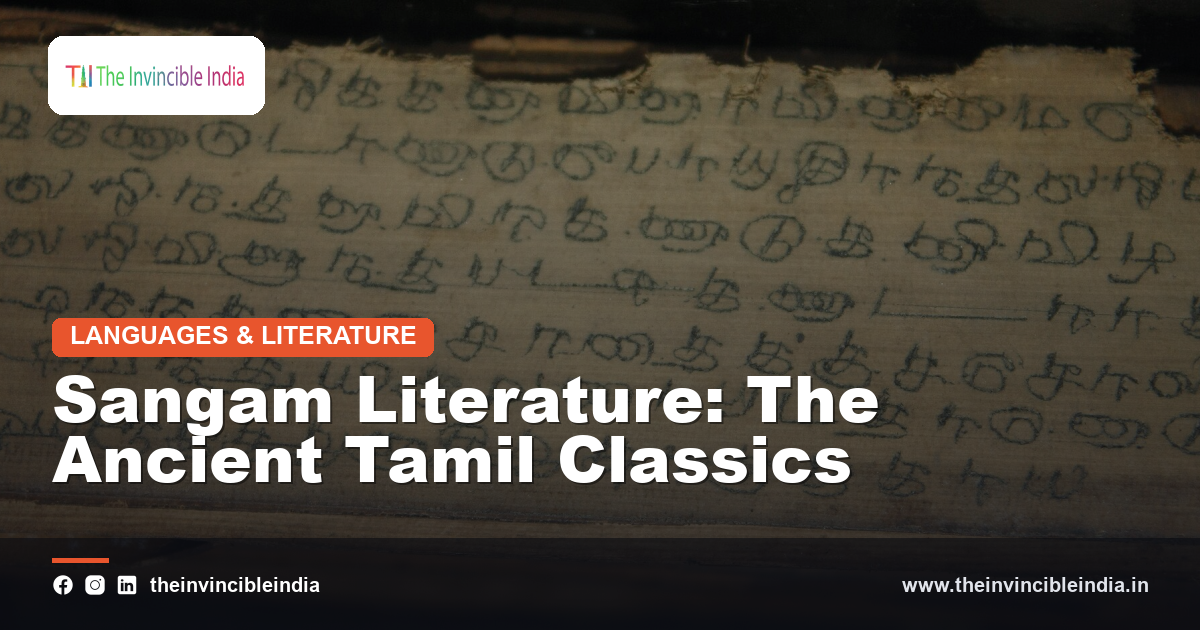
Sangam literature survived for many centuries chiefly through palm leaf manuscripts, a fragile medium requiring careful copying and recopying to prevent loss through decay. Scribes and scholars associated with monastic and educational institutions played an important role in maintaining these texts across generations, ensuring their transmission into the modern era.
The physical vulnerability of palm leaf manuscripts means that not all Sangam-era compositions have survived, and scholars believe that a considerable body of poetry existing during the classical period has since been lost. The anthologies that do survive are therefore treated with particular care, representing a precious remnant of a much larger original literary tradition.
Rediscovery and Modern Scholarship
Interest in Sangam literature saw a significant revival in more recent centuries, as scholars worked to locate, edit and publish surviving manuscripts that had previously circulated in limited and scattered form. This scholarly effort brought Sangam poetry to a much wider readership, both within Tamil-speaking regions and among students of comparative literature elsewhere.
Modern critical editions, translations and academic studies have since deepened understanding of the historical, linguistic and literary dimensions of Sangam literature, cementing its position within university curricula and literary scholarship. This renewed attention has ensured that a body of poetry composed many centuries ago continues to reach engaged and appreciative modern audiences.
Influence on Later Tamil Literature
The themes, conventions and aesthetic sensibilities established in Sangam literature exerted a lasting influence on later developments in Tamil poetry, including devotional and courtly literature composed in subsequent centuries. Later poets frequently drew upon Sangam imagery and thematic structures, adapting them to new religious and literary contexts.
This continuity between classical Sangam poetry and later Tamil literary traditions illustrates the depth of its foundational influence, providing a shared reservoir of technique and imagery upon which subsequent generations of poets could draw. Even as Tamil literature evolved in new directions, the imprint of Sangam poetic sensibility remained clearly discernible.
Sangam Literature Today
Today, Sangam literature is celebrated as a cornerstone of Tamil cultural identity and a significant contribution to world literary heritage, studied in schools, universities and literary societies across Tamil-speaking regions and beyond. Its poems continue to be recited, translated and analysed for both their artistic achievement and their historical value.
The enduring appeal of Sangam poetry lies in its combination of technical refinement, emotional depth and vivid engagement with the natural world, qualities that continue to resonate with readers many centuries after its composition. As a living link to the ancient Tamil past, Sangam literature remains a source of pride and continued scholarly and popular interest.
Sources & Further Reading
- Sahitya Akademi.
- Ministry of Culture, Government of India (indiaculture.gov.in).
Frequently Asked Questions
What is Sangam literature?
Sangam literature is a large body of classical poetry composed in early Tamil, addressing themes of love, war and ethics, and regarded as a foundational tradition within Tamil literary history.
What do Akam and Puram mean in Sangam poetry?
Akam refers to poems dealing with interior, personal experience such as love, while Puram refers to poems addressing public life, particularly war, kingship and heroism.
What is the Tolkappiyam?
The Tolkappiyam is a comprehensive early treatise on Tamil grammar and poetics, offering valuable insight into the conventions that shaped Sangam poetry.
How was Sangam literature preserved?
Sangam literature was preserved chiefly through palm leaf manuscripts, later compiled into classical anthologies that survive as the primary textual basis for studying the tradition today.
Why is Sangam literature historically significant?
Beyond its literary qualities, Sangam literature offers detailed insight into the social organisation, occupations and values of ancient Tamil society, making it an important historical resource.


