

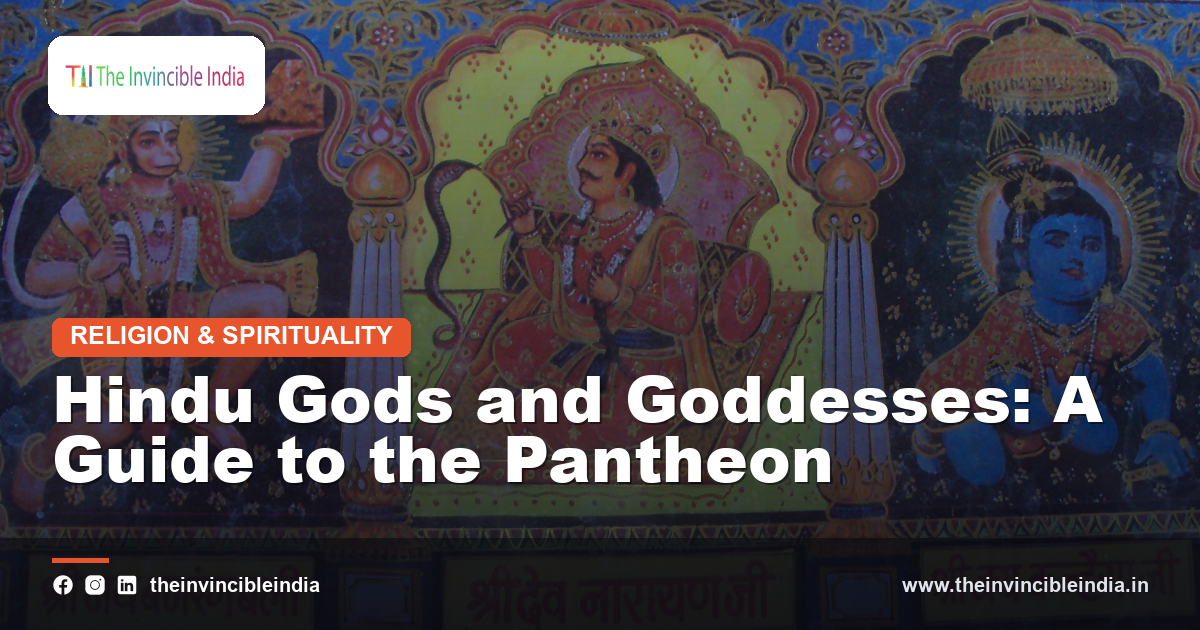
The Hindu gods and goddesses form one of the richest and most colourful pantheons in all of religion, a vast array of divine forms worshipped with deep devotion across India and the Hindu world. From the great deities such as Vishnu, Shiva and the Goddess to beloved figures such as Ganesha, Hanuman, Lakshmi and Saraswati, the Hindu deities embody the many aspects and powers of the divine, each with rich mythology, symbolism and forms of worship. Yet behind this profusion of gods lies the profound teaching that they are all forms of the one ultimate reality. This guide explores the great Hindu gods and goddesses, their forms and meanings, their symbols and mounts, and the one divine behind the many, a central part of Hinduism.
Quick Facts
| Detail | Information |
|---|---|
| Type | The deities of the Hindu tradition |
| Underlying belief | All deities are forms of the one reality, Brahman |
| Great deities | Vishnu, Shiva and the Goddess (Devi) |
| Beloved deities | Ganesha, Hanuman, Lakshmi, Saraswati and many more |
| Features | Rich iconography, symbols, mounts and consorts |
| Worship | Through devotion, ritual, festival and pilgrimage |
A Rich Pantheon
Hinduism is famous for its rich and colourful pantheon of gods and goddesses, a vast array of divine forms worshipped across the tradition, each with its own character, mythology, symbolism and forms of worship. This profusion of deities, from great cosmic gods to beloved and approachable figures, gives Hindu religious life its extraordinary colour and variety, offering devotees many ways to approach and love the divine. The gods and goddesses are depicted in art and sculpture, celebrated in myth and festival, and worshipped in temples and homes across India. This rich pantheon, one of the most elaborate and beloved in any religion, is one of the most distinctive and vibrant features of Hinduism and its devotional life.
One Reality, Many Forms
Although Hinduism worships many gods and goddesses, it is not simple polytheism, for underlying the many deities is the profound teaching that they are all forms, aspects or expressions of the one ultimate reality, Brahman. In this understanding, the divine is one, but it can be approached and worshipped in countless forms, each revealing an aspect of the infinite. Some traditions worship one supreme deity as the highest form of this reality, while honouring others as its manifestations. This teaching of one reality behind the many forms is central to Hindu thought and reconciles the worship of many deities with the belief in one ultimate divine, offering devotees many paths to the one truth.
Vishnu the Preserver
Among the greatest of the Hindu deities is Vishnu, revered as the preserver and protector of the universe, who maintains cosmic order and righteousness. Vishnu is worshipped as a supreme deity by a great tradition of devotees, and he is especially known for descending to earth in various incarnations, or avatars, to restore righteousness whenever it declines. Among his most beloved incarnations are Rama and Krishna, whose stories are cherished throughout India. Depicted with his characteristic symbols and attributes, and worshipped in many forms and temples, Vishnu is one of the central deities of Hinduism, embodying the sustaining and protecting power of the divine and the promise that the divine acts to preserve the world and righteousness.
Shiva the Transformer
Another of the supreme Hindu deities is Shiva, a profound and many-sided god associated with destruction and transformation, but also with creation, meditation, asceticism and grace. Shiva is worshipped as the supreme deity by a great tradition of devotees, and he embodies the paradoxes of the divine, at once the fierce destroyer and the compassionate lord, the great ascetic and the loving husband and father. He is often worshipped in a symbolic form as well as in his many depictions, and he is associated with meditation, yoga and the cosmic dance. Shiva is one of the central deities of Hinduism, embodying the transforming power of the divine and the deep truths of creation, destruction and renewal.
The Great Goddess
The Divine Feminine holds a central place in Hinduism, worshipped as the great Goddess, or Devi, who embodies the supreme power and energy of the divine. The Goddess is revered in many forms, from the fierce and powerful to the gentle and nurturing, and she is worshipped as the supreme deity by a great tradition of devotees who honour her as the ultimate reality and the source of all power. In her various forms she is the destroyer of evil, the giver of prosperity and wisdom, and the loving mother of the universe. The worship of the Goddess is one of the great streams of Hinduism, and the Divine Feminine, as supreme power and cosmic mother, is one of the most important and beloved aspects of the Hindu divine.
Ganesha, the Remover of Obstacles
Among the most beloved of all Hindu deities is Ganesha, the elephant-headed god, revered as the remover of obstacles and the lord of beginnings, worshipped at the start of any new venture. With his distinctive elephant head and his endearing form, Ganesha is one of the most widely worshipped and affectionately regarded of the gods, invoked for success, wisdom and good fortune. His image is found everywhere, and his great festival is celebrated with much joy and devotion. As the remover of obstacles, the patron of beginnings and the giver of wisdom and success, Ganesha holds a special place in the hearts of devotees, and his worship at the outset of undertakings is one of the most cherished practices of Hindu devotional life.
Hanuman, the Devoted
Another greatly beloved deity is Hanuman, the mighty monkey god renowned for his strength, courage and boundless devotion to Rama. Famous for his role in the epic Ramayana, in which he serves Rama with total devotion and performs great deeds of valour, Hanuman is worshipped as the ideal devotee and as a powerful protector who grants strength and courage. His image is found in countless temples, and he is invoked for protection, strength and steadfast devotion. As the embodiment of devotion, service, strength and courage, Hanuman is one of the most popular and beloved of the Hindu deities, cherished by devotees who look to him as a model of faithful devotion and a powerful and protecting divine friend.
Lakshmi and Saraswati
Among the most beloved goddesses are Lakshmi and Saraswati, who embody prosperity and wisdom respectively. Lakshmi is the goddess of wealth, prosperity, fortune and beauty, worshipped for abundance and well-being, and she is especially honoured at the festival of Diwali. Saraswati is the goddess of knowledge, learning, music and the arts, worshipped by students, scholars and artists for wisdom and skill. These two goddesses, embodying the blessings of prosperity and of learning, are worshipped with deep devotion across India, and their worship reflects the Hindu honouring of both material well-being and the life of the mind and spirit. Lakshmi and Saraswati are among the most cherished and widely worshipped of the Hindu goddesses.
Krishna and Rama
Two of the most beloved forms of the divine in Hinduism are Krishna and Rama, revered as incarnations of Vishnu and cherished as gods in their own right. Krishna, the enchanting divine cowherd, teacher and lover, whose life and deeds are celebrated in myth and devotion, and who delivers the teaching of the Bhagavad Gita, is one of the most beloved of all deities. Rama, the ideal and righteous prince of the epic Ramayana, is likewise revered and worshipped across India. The devotion to Krishna and Rama is among the richest and most beloved streams of Hindu religious life, and these two divine figures, at once gods and heroes of the great epics, hold a special place in the hearts of countless devotees.
The Symbols of the Gods
The Hindu deities are depicted with a rich array of symbols and attributes, each carrying meaning, which help to identify the gods and express their nature and powers. The deities are often shown with multiple arms, holding various objects, weapons and emblems that symbolise their qualities and functions, and each has characteristic features and forms. These symbols are not mere decoration but a visual language, expressing the powers, virtues and cosmic roles of the gods. Understanding the symbols of the deities helps to read the rich iconography of Hindu art and to appreciate the meanings embodied in the images of the gods. This symbolic language of the deities is a fascinating and important part of the Hindu tradition and its art.
The Divine Mounts
A distinctive feature of the Hindu deities is that many of them are associated with a particular animal or bird as their vehicle or mount, on which they are depicted riding and which carries its own symbolism. These divine mounts, each associated with a particular god or goddess, are part of the identity and iconography of the deities and often express something of their nature or powers. The mounts are themselves honoured in connection with the deities they carry. This charming and meaningful feature, in which each of the great deities has an animal companion and vehicle, is a distinctive part of the Hindu pantheon and its iconography, adding to the richness and symbolism of the depictions of the gods and reflecting the honouring of the animal world.
Consorts and Divine Families
The Hindu deities are often depicted with consorts and as members of divine families, expressing the completeness of the divine and the honouring of relationships. The great gods are paired with goddesses who embody their complementary powers, and the deities are connected in divine families with their children and relations, whose stories are told in the myths. These divine pairings and families express the balance of the masculine and feminine aspects of the divine and give the pantheon a rich web of relationships and stories. The depiction of the deities with their consorts and families is an important part of the Hindu tradition, expressing the wholeness of the divine and providing a rich mythology of divine relationships beloved by devotees.
The Deities in Mythology
The Hindu gods and goddesses come vividly to life in the vast mythology of the tradition, the countless stories of their deeds, adventures and relationships told in the epics, the Puranas and the wider tradition. These myths, rich in drama, meaning and beauty, tell of the creation and preservation of the world, the battles of the gods against demons, the incarnations of the deities, and their loves, families and exploits. Through these stories, the deities become personal, beloved and full of character, and the myths convey deep spiritual and moral truths. This rich mythology is inseparable from the worship of the deities and is one of the great treasures of Hindu culture, bringing the gods to life for devotees across the ages.
Worship of the Deities
The Hindu deities are worshipped in a rich variety of ways, from grand temple ritual to simple household devotion. Worship, or puja, involves honouring the deity with prayers, offerings of flowers, food and light, and expressions of devotion, performed in temples where the deities are enshrined and in the shrines of the home. Devotion is also expressed through the singing of hymns, the celebration of festivals, pilgrimage to holy sites, and personal prayer and love. Each deity has its own forms of worship, festivals and sacred places. This rich and varied worship of the deities, offering many ways to approach and love the divine, is the heart of the everyday religious life of Hindus and the living expression of devotion to the gods.
Regional and Local Deities
Beyond the great pan-Indian deities, Hinduism embraces a vast number of regional and local gods and goddesses, worshipped in particular areas, villages and communities. These local deities, often with their own myths, traditions and forms of worship, are woven into the religious life of their communities and are honoured alongside the great gods of the wider tradition. This rich layer of regional and local deities adds enormously to the diversity of Hindu worship and reflects the way the tradition has embraced and honoured the sacred as it is understood in every locality. The worship of these local and regional deities, alongside the great gods, is an important and vibrant part of the living religion and its extraordinary variety across the land.
The Deities Today
Today the Hindu gods and goddesses continue to be worshipped with deep devotion across India and the Hindu world, their images enshrined in temples and homes, their festivals celebrated with joy, and their stories cherished and retold. The deities remain a vivid and beloved presence in the lives of countless devotees, worshipped, loved and turned to for blessing, guidance and grace. Their images and stories continue to inspire art, festival and devotion, and their worship remains at the heart of Hindu religious life. As the rich and colourful pantheon of one of the world’s great religions, and as forms of the one divine offering many paths to the sacred, the Hindu gods and goddesses endure as a beloved and living part of the spiritual heritage of India.
Sources & Further Reading
- Ministry of Culture, Government of India, on the religious traditions of India (indiaculture.gov.in).
- The Puranas and the epics, the classical sources of Hindu mythology.
Frequently Asked Questions
Who are the main Hindu gods and goddesses?
The main Hindu deities include the great gods Vishnu the preserver, Shiva the transformer, and the Goddess (Devi), along with beloved figures such as Ganesha, Hanuman, Lakshmi, Saraswati, Krishna and Rama, and many others, each with rich mythology and forms of worship.
Does Hinduism worship many gods or one God?
Hinduism worships many gods and goddesses, but in its deeper understanding these are all forms, aspects or expressions of the one ultimate reality, Brahman. The divine is one, but it can be approached and worshipped in countless forms, offering many paths to the sacred.
Who is Ganesha?
Ganesha is the beloved elephant-headed Hindu god, revered as the remover of obstacles and the lord of beginnings, worshipped at the start of any new venture and invoked for success, wisdom and good fortune. He is one of the most widely worshipped of the deities.
What are the mounts of the Hindu deities?
Many Hindu deities are associated with a particular animal or bird as their vehicle or mount, on which they are depicted riding and which carries its own symbolism. These divine mounts are part of the identity and iconography of the gods and goddesses.
How are Hindu deities worshipped?
Hindu deities are worshipped through puja, honouring the deity with prayers and offerings of flowers, food and light in temples and home shrines, as well as through the singing of hymns, the celebration of festivals, pilgrimage and personal devotion.


