

Vikramashila was one of the most renowned Buddhist centres of higher learning in ancient India, established under royal patronage to serve as a major hub for the study of Buddhist philosophy, ritual and scholarship. Founded in the region of present-day Bihar, the university flourished for several centuries, attracting students and teachers not only from across the Indian subcontinent but also from Tibet, Southeast Asia and other parts of the wider Buddhist world. Vikramashila continued a long tradition of organised Buddhist learning in eastern India that had earlier flourished under the patronage associated with the era of the Gupta Empire, and it went on to play an especially significant role in the transmission of Buddhist teachings to Tibet. Its history offers valuable insight into the intellectual and religious life of medieval Buddhist India.
Quick Facts
| Detail | Information |
|---|---|
| Region | Present-day Bihar, eastern India |
| Founded Under | Pala dynasty patronage |
| Known For | Major centre of Buddhist scholarship |
| Students From | India, Tibet and beyond |
| Notable Role | Transmission of Buddhism to Tibet |
| Modern Status | Archaeological site under preservation |
What Was Vikramashila?
Vikramashila stands among the most important centres of Buddhist learning to have flourished in ancient and medieval India, recognised for its role as a major monastic university dedicated to the study and transmission of Buddhist thought. Established through royal patronage, the institution developed into a large and well-organised centre where monks and scholars pursued advanced study across a range of subjects connected to Buddhist philosophy, ritual and practice.
Its reputation extended well beyond the borders of the Indian subcontinent, drawing students and teachers from various parts of the wider Buddhist world during the height of its influence. Vikramashila is often discussed alongside other great centres of ancient Indian Buddhist scholarship as part of a broader tradition of monastic higher education that flourished in the region for centuries.
Founding Under the Pala Dynasty
Vikramashila was founded under the patronage of the Pala dynasty, a ruling family known for its strong support of Buddhist institutions across the eastern Indian region during the medieval period. Pala rulers invested significant resources in establishing and maintaining monastic centres of learning, viewing such patronage as both a religious duty and a means of enhancing the prestige of their kingdom.
The establishment of Vikramashila reflected this broader pattern of royal support for Buddhist scholarship, positioning the institution as one of the flagship centres of learning under Pala rule. Royal endowments provided the university with the resources needed to support a large community of resident scholars and students over an extended period.
Location and Setting in Ancient Bihar
Vikramashila was located in the eastern Indian region corresponding to present-day Bihar, an area with a long-standing association with Buddhist history and monastic tradition stretching back many centuries. The chosen site benefited from its position within a region that already hosted other significant centres of Buddhist learning.
This geographic concentration of major learning centres in eastern India reflects the region’s broader historical significance in the development and spread of Buddhist thought and institutions. The area’s continued association with Buddhist history provided a meaningful backdrop for the establishment of a major new centre of Buddhist scholarship, one that was significant both practically and symbolically.
Structure and Organisation of the University
As a monastic university, Vikramashila was organised around a resident community of monks and scholars who lived, studied and taught within the institution’s premises according to established rules of monastic discipline. The university is understood to have included multiple halls of learning and living quarters designed to accommodate a substantial population of students and teachers.
Leadership and administration of the institution were entrusted to senior scholars and monastic officials responsible for maintaining academic standards and religious discipline within the community. This organisational structure allowed Vikramashila to function as a coherent and enduring institution rather than a loose gathering of individual teachers.
Curriculum and Fields of Study
The curriculum at Vikramashila is understood to have encompassed a range of subjects connected primarily to Buddhist philosophy, scripture and ritual practice, alongside related fields of study that supported advanced religious scholarship. Students engaged in the careful study of Buddhist texts and commentaries, developing expertise in interpreting and teaching complex philosophical and doctrinal material.
The university’s curriculum reflected the sophisticated intellectual tradition of Buddhist scholarship that had developed in India over preceding centuries, drawing on a substantial body of accumulated texts and teachings. This focus on rigorous, text-based study distinguished the university as a serious centre of religious and philosophical education.
Buddhist Philosophy and Tantric Studies
Vikramashila is particularly associated with the study of tantric Buddhist traditions, which had become an increasingly significant strand of Buddhist practice and philosophy in India during the period of the university’s operation. Scholars at the institution engaged deeply with tantric texts, rituals and philosophical frameworks, contributing to the development and systematisation of this important tradition.
This specialisation distinguished Vikramashila from some other contemporary centres of Buddhist learning and contributed significantly to its distinctive scholarly reputation, with lasting consequences for Buddhist traditions that developed outside India, particularly in Tibet, where tantric Buddhism became especially influential.
Teachers and Scholars of Vikramashila
Vikramashila is associated with numerous respected teachers and scholars who contributed to its reputation as a leading centre of Buddhist learning during the period of its operation. These scholars engaged in teaching, textual study and the composition of commentaries and treatises that contributed to the broader development of Buddhist philosophical and religious thought.
Some teachers associated with the university went on to travel beyond India, carrying their learning and the traditions of Vikramashila to other regions, particularly Tibet, where their teachings had a lasting influence on the development of Tibetan Buddhism. Their collective legacy extended the influence of Vikramashila well beyond its physical location.
Students from Across Asia
Vikramashila attracted students from across the Indian subcontinent as well as from more distant regions associated with the wider Buddhist world, including Tibet and parts of Southeast Asia. This diverse student body reflected the university’s broad reputation and the perceived value of the education it offered, particularly for those seeking specialised training in Buddhist philosophy.
Students who travelled considerable distances to study at Vikramashila would often spend extended periods in residence, and upon completing their studies many returned to their home regions, carrying with them the teachings and traditions they had learned and further extending Vikramashila’s intellectual influence.
Vikramashila's Role in Spreading Buddhism to Tibet
One of the most historically significant aspects of Vikramashila’s legacy is its role in the transmission of Buddhist teachings to Tibet, a process that had a profound and lasting impact on the development of Tibetan Buddhism. Scholars associated with the university travelled to Tibet to teach and helped establish institutions and traditions that would shape Tibetan Buddhist practice for centuries afterward.
This connection between Vikramashila and Tibetan Buddhism is remembered as one of the most consequential outcomes of the university’s scholarly activity, extending its influence far beyond the Indian subcontinent and reflecting the broader pattern of cultural exchange that characterised Buddhist networks across Asia.
Relationship with Nalanda and Other Centres
Vikramashila is often discussed alongside Nalanda, another renowned centre of Buddhist learning in ancient India, as one of the great monastic universities of the period, with the two institutions sometimes described as having a complementary or occasionally competitive relationship. Both universities drew students and teachers from across the Buddhist world and contributed significantly to the development of Buddhist philosophy.
The coexistence of multiple major centres of Buddhist learning in eastern India during this period reflects the region’s exceptional importance as a hub of Buddhist scholarship and religious life, with students and scholars sometimes moving between institutions to further a broader exchange of ideas.
Royal Patronage and Institutional Support
The sustained operation of Vikramashila over several centuries depended heavily on continued royal patronage, particularly from successive rulers of the Pala dynasty, who provided the resources necessary to maintain the institution’s buildings, community and academic activities. This patronage typically took the form of land grants, endowments and material support.
The close relationship between religious institutions and royal authority was a defining feature of the period, with rulers gaining prestige and religious merit through their support of major centres of learning such as Vikramashila. The eventual weakening of this patronage relationship in later periods would have significant consequences for the university’s continued operation.
Daily Life and Monastic Discipline
Daily life at Vikramashila followed the disciplined rhythms typical of Buddhist monastic institutions, combining periods of study, meditation, ritual observance and communal responsibilities within a structured monastic framework. Residents of the university adhered to codes of conduct governing behaviour, study and interaction within the community.
This structured daily routine supported an environment conducive to sustained scholarly work, allowing students and teachers to dedicate significant time and attention to their studies over extended periods. The monastic character of the institution also reinforced its religious identity, integrating academic study closely with spiritual practice and communal religious life.
Architecture and Physical Layout
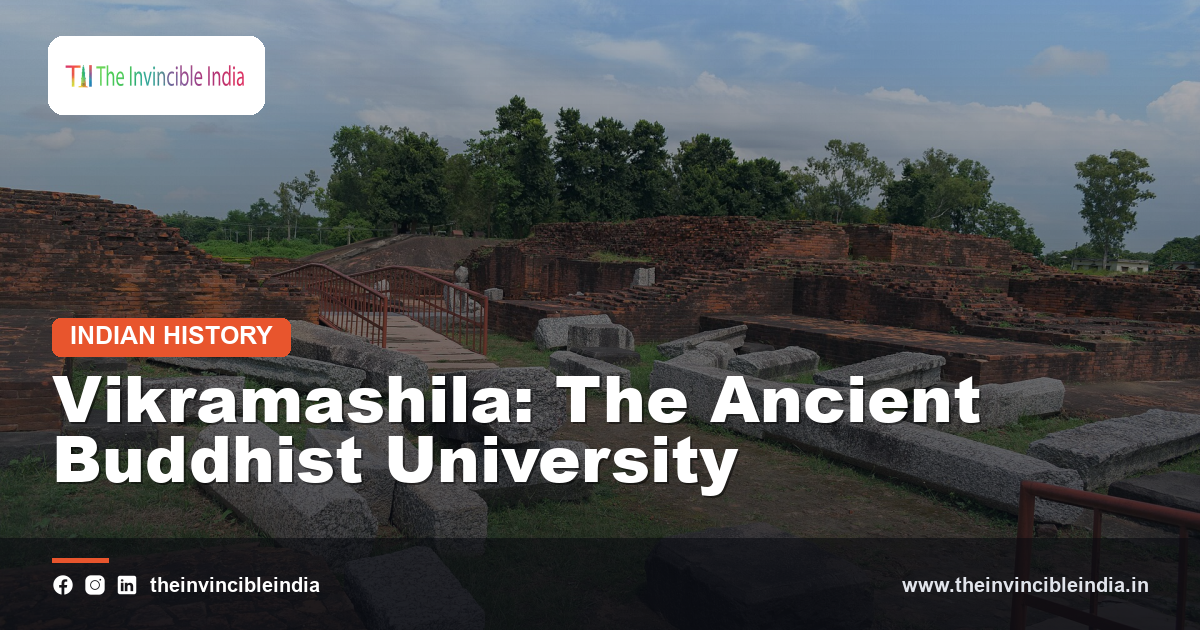
Archaeological remains at the site associated with ancient Vikramashila reveal a substantial complex of structures, including what are understood to have been monastic cells, shrines and other buildings consistent with its historical role as a major centre of Buddhist learning and worship. The layout and scale of these remains provide physical evidence supporting the historical accounts of Vikramashila as a large and well-organised institution.
Architectural features uncovered at the site reflect building styles and techniques characteristic of the broader eastern Indian Buddhist tradition during the period of the university’s operation, contributing valuable information about its physical organisation and daily functioning.
Decline of Vikramashila
The decline of Vikramashila is generally associated with a combination of factors, including the weakening of Pala dynasty patronage and the broader political and religious changes that affected the region in the centuries following the university’s height. Invasions and shifting political control in the region during this later period are understood to have brought significant disruption to major Buddhist institutions across eastern India.
As royal support diminished and the broader environment for large monastic institutions became more difficult, the university’s ability to sustain its scholarly community and physical infrastructure was significantly undermined, closing an important chapter in the history of Buddhist scholarship in India.
Rediscovery and Archaeological Excavation
The site associated with ancient Vikramashila was identified and studied through archaeological investigation in more recent history, drawing on historical accounts and textual references that had preserved memory of the university’s location and significance. Excavation work at the site has uncovered substantial remains of the ancient institution.
This archaeological work has been significant in confirming and expanding scholarly understanding of the university’s scale, layout and historical role as a major centre of Buddhist learning. Ongoing preservation and research efforts at the site aim to protect these important remains while continuing to develop understanding of Vikramashila’s place in history.
Vikramashila's Legacy Today
Today, Vikramashila is remembered as one of the great centres of Buddhist scholarship in Indian history, notable both for its intellectual achievements and for its lasting role in the transmission of Buddhist teaching to Tibet and beyond. The site continues to attract researchers, students of Buddhist history and visitors interested in the region’s rich monastic heritage.
Vikramashila’s legacy is frequently invoked in discussions of the history of Buddhism in India and its spread across Asia, and contemporary scholarship continues to draw on the traditions and texts associated with the university to better understand the development of Buddhist philosophy during the medieval period. Its legacy remains an enduring part of India’s intellectual and religious heritage.
Sources & Further Reading
- Archaeological Survey of India (asi.nic.in).
- Ministry of Culture, Government of India (indiaculture.gov.in).
Frequently Asked Questions
What was Vikramashila known for?
Vikramashila was a major Buddhist monastic university in ancient India, renowned for its scholarship in Buddhist philosophy and tantric studies and for training teachers who carried Buddhism to Tibet.
Who founded Vikramashila?
Vikramashila was established under the patronage of the Pala dynasty, which was known for its strong support of Buddhist institutions in eastern India.
Where was Vikramashila located?
Vikramashila was located in the eastern Indian region corresponding to present-day Bihar, an area long associated with Buddhist history and monastic learning.
How is Vikramashila connected to Tibetan Buddhism?
Scholars associated with Vikramashila travelled to Tibet and played a significant role in transmitting Buddhist teachings and traditions that shaped Tibetan Buddhism.
How does Vikramashila compare to Nalanda?
Both were major Buddhist monastic universities in eastern India during a similar period, drawing international students, though each had its own scholarly emphasis and institutional character.


