

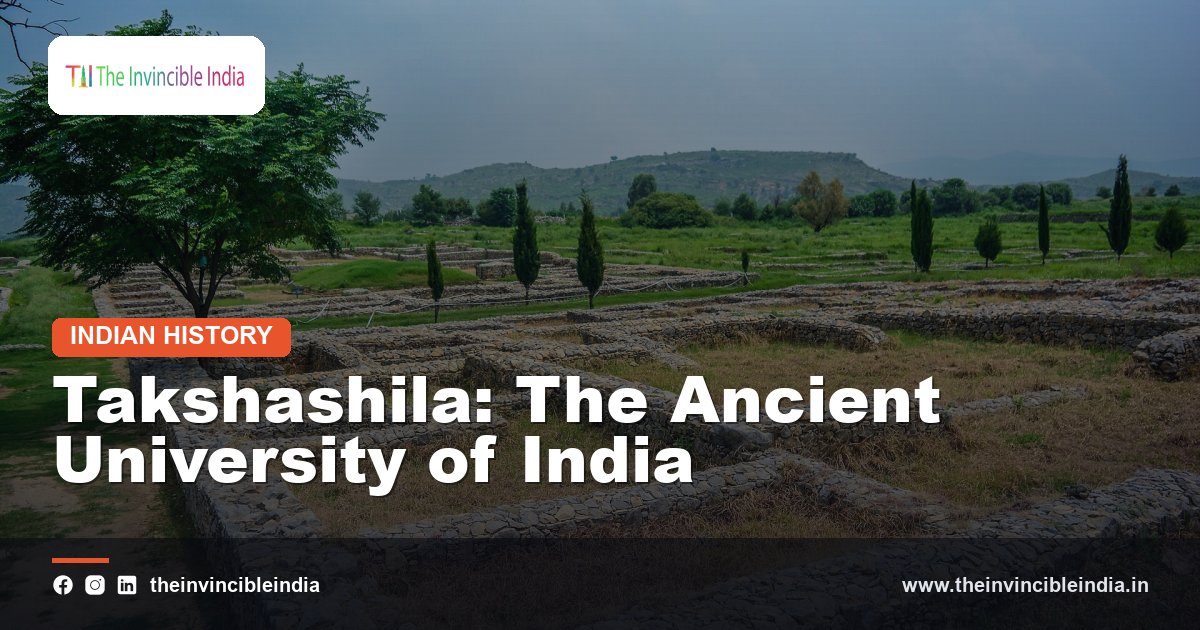
Takshashila, also known as Taxila, was one of the earliest and most renowned centres of learning in ancient India, drawing students and teachers from across the subcontinent and beyond to study a wide range of subjects at what many historians describe as an early form of university. Located in the ancient region of Gandhara, in what is now northern Pakistan, Takshashila flourished for many centuries as a hub of scholarship, craft and religious study, benefiting from its position along important trade and cultural routes connecting South Asia with Central Asia and beyond. The city’s reputation for learning is associated with numerous notable figures of ancient Indian tradition and was closely linked to the broader political history of the region, including periods under the Maurya Empire. Its legacy as an early centre of organised education continues to be celebrated in India today.
Quick Facts
| Detail | Information |
|---|---|
| Region | Ancient Gandhara (present-day Punjab, Pakistan) |
| Known For | Early centre of higher learning |
| Subjects Taught | Philosophy, medicine, law, and more |
| Era of Prominence | From the mid-first millennium BCE |
| Modern Site | Taxila, UNESCO World Heritage Site |
| Notable Association | Teachers and scholars of ancient India |
What Was Takshashila?
Takshashila, often rendered in English as Taxila, holds a distinguished place in the history of Indian education as one of the earliest known centres where advanced learning was organised on a significant scale. Ancient and later traditions describe it as a place where students travelled, sometimes from considerable distances, to study under respected teachers across a range of subjects rather than a single narrow discipline.
While it differed in structure from a modern university, with instruction typically organised around individual teachers and their students, the scale and reputation of learning at Takshashila have led many historians to describe it using the term university in a general sense. Its long-standing association with scholarship, craft and religious study made it one of the most respected centres of intellectual life in the ancient world.
Geographic Setting in Ancient Gandhara
Takshashila was located in the ancient region of Gandhara, in the northwestern part of the Indian subcontinent, corresponding to areas in present-day Punjab province in Pakistan. This position placed the city at an important crossroads connecting South Asia with Central Asia, Persia and, through further trade routes, the wider ancient world.
The surrounding region’s role as a frontier zone exposed Takshashila to a wide range of cultural, religious and intellectual influences, contributing to the diversity of subjects and perspectives associated with its centres of learning. Fertile land and access to trade routes also supported the economic development necessary to sustain a significant urban centre with a substantial population of students, teachers and traders.
Origins and Early History
The early history of Takshashila as a settlement predates its later fame as a centre of learning, with the site developing over an extended period into an important urban centre within the broader Gandhara region. As the settlement grew, it increasingly attracted scholars, religious teachers and students, gradually building the reputation for learning that would define its later historical identity.
This growth was likely supported by the city’s economic prosperity and its position along significant trade routes, which provided both the resources and the connectivity needed to sustain an intellectual community. Over time, references to Takshashila as a place of learning appear across a range of ancient Indian literary and religious traditions.
A Centre for Advanced Study
What distinguished Takshashila from many other ancient settlements was its sustained role as a destination for advanced study, attracting individuals seeking instruction beyond basic education in a range of specialised fields. Teachers of considerable reputation are associated with the city in various ancient traditions, drawing students who sought to study under acknowledged experts in particular subjects.
This model of education, centred on relationships between individual teachers and their students, allowed for a degree of specialisation and mentorship that contributed to the high regard in which Takshashila-trained scholars were held. The concentration of respected teachers and dedicated students in one location created an intellectual environment conducive to the exchange of ideas across different fields.
Subjects and Fields of Learning
Historical and literary traditions associate Takshashila with instruction across an unusually wide range of subjects, including medicine, law, philosophy, warfare, and various practical and scholarly crafts. This breadth of subject matter suggests that the city functioned as a genuine centre of diverse learning rather than a school focused on a single discipline.
Instruction in medicine, in particular, is frequently mentioned in connection with Takshashila, reflecting the city’s association with the development and transmission of ancient Indian medical knowledge. The presence of multiple fields of study within a single centre of learning would have facilitated exchange of ideas between disciplines, reflecting a sophisticated and wide-ranging approach to education.
Students and Teachers
Students who studied at Takshashila are described in various traditions as coming from different parts of the Indian subcontinent and, in some cases, from beyond its borders, reflecting the city’s broad reputation as a centre of learning. This diversity of origin would have exposed students to a range of perspectives and traditions, contributing to the intellectual richness associated with the city.
Teachers at Takshashila held significant social and intellectual standing, with successful completion of study under a respected teacher serving as an important credential for individuals pursuing careers in fields such as governance, medicine or scholarship. This teacher-student model provided an effective framework for transmitting specialised knowledge across generations.
Takshashila's Association with Ancient Scholars
Takshashila is associated in various ancient and later traditions with a number of notable figures of Indian history and legend, reflecting the city’s long-standing reputation as a place where prominent individuals received their education or later taught. While specific biographical claims linking particular individuals to Takshashila vary across different sources and should be treated with appropriate historical caution, the consistent association of the city with notable scholarship underscores its broad reputation.
This reputation contributed to Takshashila’s enduring image as a place fundamentally connected to intellectual achievement and advanced learning, a powerful symbol of ancient Indian intellectual achievement that has helped preserve the city’s memory well beyond the period of its active operation.
Political History and Regional Rule
The political history of the region around Takshashila reflects its position as a frontier zone, with control of the city and surrounding territory passing between different regional and, at times, external powers over the course of ancient history. Its location made it a point of contact between the Indian subcontinent and powers arriving from Persia and Central Asia.
This shifting political history did not prevent Takshashila from maintaining its reputation as a centre of learning, suggesting that its intellectual institutions had a degree of resilience and continuity independent of changes in political control. This combination of political significance and intellectual reputation gave Takshashila a distinctive role in the broader history of the northwestern subcontinent.
Takshashila Under the Maurya Empire
Takshashila came under the authority of the Maurya Empire during the period of that empire’s expansion across much of the Indian subcontinent, integrating the city and its surrounding region into a much larger unified political structure. Under Mauryan administration, the city is understood to have continued its role as an important regional centre, benefiting from the broader stability and connectivity that the empire’s administration provided.
This period placed Takshashila within a wider imperial network that connected it more closely with other major centres of the subcontinent, potentially facilitating greater exchange of scholars, ideas and resources. This association with the Maurya Empire reinforced Takshashila’s standing as a place of both political and intellectual significance.
Trade Routes and Cultural Exchange
Takshashila’s location along significant trade routes connecting South Asia with Central Asia and regions further west made it an important node for both commercial and cultural exchange throughout much of its history. Merchants, travellers and scholars passing along these routes would have contributed to the flow of goods, ideas and knowledge through the city.
This connectivity likely played a part in the diversity of subjects and influences associated with Takshashila’s centres of learning, as the city absorbed and transmitted ideas from a wide geographic range. Trade also provided an important economic foundation for the city, illustrating the close historical relationship between trade routes and centres of learning in the ancient world.
Religious Life at Takshashila
Religious life at Takshashila reflected the broader diversity of belief and practice found in ancient Gandhara, with the city serving as a centre for various religious traditions over the course of its history, including significant Buddhist institutions in later periods. Monasteries and religious centres associated with Buddhism became prominent features of the city and surrounding region.
This overlap between academic and religious life meant that many students and teachers at Takshashila engaged with both worldly subjects and questions of philosophy and spiritual practice, reflecting the integrated approach to knowledge characteristic of much of ancient Indian education. Archaeological remains of religious structures continue to offer insight into this dimension of the city’s past.
Architecture and Urban Layout
Archaeological remains at the site of ancient Takshashila reveal a city with organised urban planning, including structured streets, residential areas and public buildings that reflect a significant level of civic development for its time. Excavated structures associated with religious and educational activity provide physical evidence of the city’s role as a centre of both spiritual and intellectual life.
The layout and construction of these structures reflect architectural styles and techniques characteristic of the wider Gandhara region, which itself was shaped by a blend of South Asian and Central Asian influences. Continued archaeological study has added considerably to historical understanding of daily life and urban organisation at ancient Takshashila.
Decline of the Ancient City
Like many great centres of the ancient world, Takshashila eventually experienced a decline, associated with a combination of shifting trade routes, changing political circumstances and the broader transformations that affected the northwestern subcontinent in the centuries following its peak. Invasions and changes in regional political control over an extended period disrupted the stability that had allowed the city’s institutions of learning to flourish.
As the city’s prominence waned, its role as a centre of scholarship and trade diminished, and the site was eventually abandoned or reduced to a much smaller settlement, closing a remarkable chapter in the history of ancient Indian education. Its physical remains, however, endured to be rediscovered by later generations.
Rediscovery and Archaeological Study
The site of ancient Takshashila was identified and studied by archaeologists in more recent history, following earlier travellers’ accounts that had preserved some memory of the city’s location and historical significance. Systematic excavation work uncovered the remains of the ancient city, including its urban structures, religious buildings and other physical evidence of its history.
This archaeological rediscovery provided crucial confirmation and additional detail for the historical accounts of Takshashila found in ancient literary and religious traditions. The rediscovery of Takshashila has been instrumental in restoring the city’s place in the historical narrative of ancient Indian education and civilisation.
Takshashila as a UNESCO Heritage Site
In recognition of its outstanding historical and archaeological significance, the site of ancient Takshashila has been designated as a UNESCO World Heritage Site, reflecting its importance not only to Indian and Pakistani history but to the wider history of human civilisation. This designation has helped support continued preservation and study of the site.
The heritage status also raises international awareness of Takshashila’s historical role as an early centre of organised learning, situating it within global discussions of the history of education. This international recognition affirms the enduring significance of Takshashila’s contribution to intellectual history, ensuring its legacy continues to be studied well into the future.
Takshashila's Legacy Today
Today, Takshashila is remembered across India and beyond as a symbol of the subcontinent’s long and distinguished tradition of learning, frequently cited in discussions of the history of education in South Asia. Its legacy is invoked in the naming of educational institutions, cultural references and popular accounts of ancient Indian achievement.
Scholars continue to study the site and its associated historical traditions to better understand the nature of ancient education, the subjects taught, and the broader intellectual culture of the period. Takshashila’s story serves as a reminder of the deep historical roots of organised higher learning in the Indian subcontinent, a legacy that remains a source of pride in discussions of India’s intellectual heritage.
Sources & Further Reading
- Archaeological Survey of India (asi.nic.in).
- Ministry of Culture, Government of India (indiaculture.gov.in).
Frequently Asked Questions
What was Takshashila known for?
Takshashila was known as one of ancient India’s most important centres of learning, where students studied a wide range of subjects including medicine, law and philosophy under respected teachers.
Where is ancient Takshashila located?
The ancient city of Takshashila, also known as Taxila, was located in the historic region of Gandhara, in what is now Punjab province in present-day Pakistan.
Was Takshashila a university in the modern sense?
Not exactly. It functioned more as a cluster of individual teachers and their students studying various subjects, though its scale and reputation led many to describe it as an early university.
How is Takshashila connected to the Maurya Empire?
Takshashila came under Mauryan administration as the empire expanded across the subcontinent, becoming part of one of ancient India’s most influential imperial territories.
Is Takshashila recognised as a heritage site today?
Yes, the archaeological remains of ancient Takshashila have been designated a UNESCO World Heritage Site in recognition of their historical and cultural significance.


