

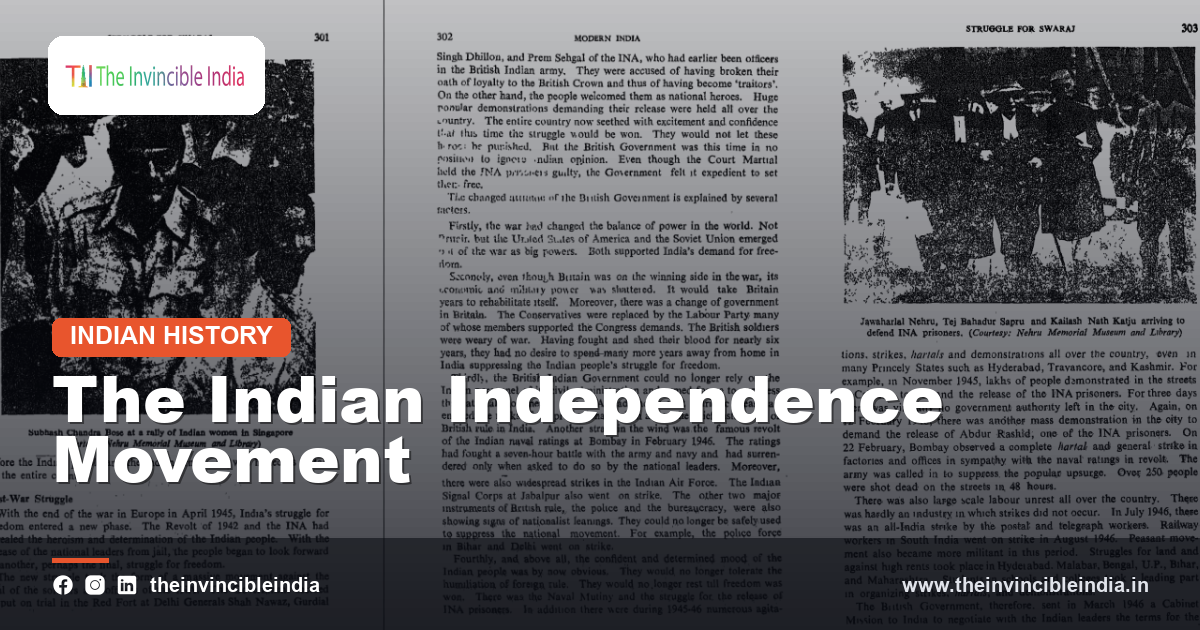
The Indian independence movement was a sustained, decades-long effort by the people of the Indian subcontinent to end colonial rule and secure self-governance. Growing out of earlier episodes of resistance such as the Revolt of 1857, the movement gathered organizational strength in the late nineteenth century and matured into a mass phenomenon in the twentieth, drawing in people across region, religion, class, and gender. It combined constitutional appeals, revolutionary activity, and, most distinctively, large-scale non-violent civil resistance under the leadership of Mahatma Gandhi and other prominent figures. This guide surveys the movement’s origins, its major organizations and campaigns, and the events that led to independence in 1947.
Quick Facts
| Detail | Information |
|---|---|
| Also Known As | Indian freedom struggle |
| Approximate Span | Mid-19th century to 1947 |
| Key Method | Satyagraha and non-violent resistance |
| Leading Organization | Indian National Congress |
| Prominent Leader | Mahatma Gandhi |
| Outcome | Independence achieved in 1947 |
Roots of Colonial Discontent
Resentment toward colonial rule in India developed gradually as British economic policy, administrative control, and social interventions reshaped daily life across the subcontinent. Traditional industries faced disruption, land revenue systems placed heavy demands on cultivators, and political power remained concentrated in foreign hands with little accommodation for Indian participation in governance. Early expressions of discontent took varied forms, from localized peasant and tribal uprisings to petitions from an emerging educated class seeking greater representation. The uprising of 1857, though ultimately suppressed, exposed the depth of grievance across large parts of northern and central India and prompted a fundamental reorganization of colonial administration. These early currents of resistance, while not yet unified into a single movement, established a lasting undercurrent of political awareness that later generations would build upon and organize more systematically.
Rise of Political and National Consciousness
The later decades of the nineteenth century saw the gradual emergence of a modern political consciousness among educated Indians, many of whom had been exposed to Western liberal ideas through English-language education. Newspapers, associations, and public debate created new spaces for articulating shared grievances and aspirations that extended beyond regional or local concerns toward a broader sense of Indian identity. Early reform associations and provincial bodies gave voice to demands for administrative fairness, wider access to public service, and greater Indian involvement in decision-making. This period also witnessed a revival of interest in India’s own cultural, religious, and historical heritage, which fed into a growing sense of national pride. Together, these currents of education, associational activity, and cultural revival laid essential groundwork for the emergence of an organized national movement in the years that followed.
Formation of the Indian National Congress
The founding of the Indian National Congress in the late nineteenth century marked a turning point, providing for the first time a regular, all-India platform where educated Indians from different provinces could gather to discuss shared political concerns. In its early years, the Congress functioned largely as a moderate body, submitting petitions and resolutions seeking incremental reform within the existing colonial framework rather than challenging British rule outright. Annual sessions brought together lawyers, journalists, and civic leaders who debated questions of representation, economic policy, and administrative reform. Although modest in its early demands, the Congress steadily built organizational experience and a nationwide network of members and sympathizers. This foundation would prove essential decades later, when the organization evolved into the principal vehicle for mass political mobilization against colonial rule.
Moderates and the Extremist Current
By the early twentieth century, tension emerged within the nationalist movement between a moderate faction favoring gradual, constitutional methods and a more assertive current impatient with the pace of reform. The moderate approach emphasized dialogue, petitions, and working within colonial institutions to secure incremental change. The more assertive current, sometimes associated with calls for self-rule and the revival of indigenous economic and cultural practices, argued for more direct forms of pressure and mass participation. This internal debate reflected a broader question that would recur throughout the movement’s history: how best to balance patience and confrontation in pursuit of political change. The interplay between these approaches, rather than the dominance of either alone, helped shape the strategic flexibility that later characterized the wider independence struggle.
Partition of Bengal and the Swadeshi Movement
The administrative partition of the Bengal province in the early twentieth century provoked widespread protest and gave rise to the Swadeshi movement, a campaign encouraging the use of indigenous goods and the boycott of foreign products. The movement combined economic self-reliance with political protest, mobilizing students, traders, and the wider public in a manner that went beyond the more limited petitioning of earlier decades. Public meetings, boycotts, and the promotion of domestic industry became recognizable tools of nationalist protest for the first time on a large scale. Although the immediate administrative measure was eventually reversed, the episode demonstrated the mobilizing power of economic nationalism and direct public action. Swadeshi ideas concerning self-reliance would resurface repeatedly in later phases of the independence movement, including during Gandhi’s own campaigns.
Emergence of Mahatma Gandhi
Mahatma Gandhi’s return to India after years of activism abroad introduced a new philosophy and method into the nationalist movement, centered on non-violent resistance, or satyagraha, and the mobilization of ordinary people rather than a narrow educated elite. Gandhi’s early efforts in India focused on specific local grievances involving peasants and workers, through which he refined his approach of disciplined, non-violent mass action. His emphasis on self-reliance, simplicity, and moral persuasion resonated widely and gradually reshaped the Congress from a body of petitioners into a mass movement capable of sustained public campaigns. Gandhi’s leadership style, combining symbolic action with practical organization, proved highly effective in unifying diverse social groups behind common campaigns. His emergence as a national leader marked the beginning of the movement’s most active and broadly participatory phase.
The Non-Cooperation Campaign
Under Gandhi’s leadership, the Congress launched a mass Non-Cooperation campaign in the early 1920s, urging Indians to withdraw voluntarily from British institutions, including schools, courts, and government service, as a means of undermining colonial authority without resorting to violence. The campaign achieved remarkable popular participation, drawing students, professionals, and rural communities into coordinated public action on a scale not previously seen. It also marked a significant broadening of the movement’s social base, bringing together urban and rural participants under a shared program. Although the campaign was eventually called off following an outbreak of violence that contradicted its non-violent principles, it demonstrated the practical potential of organized mass non-cooperation as a political tool. This experience shaped the strategic thinking behind subsequent campaigns of civil disobedience.
Civil Disobedience and the Salt Campaign
The Civil Disobedience movement of the early 1930s, launched with Gandhi’s symbolic march to produce salt in defiance of colonial taxation, extended the strategy of non-violent resistance into a sustained nationwide campaign of deliberate law-breaking. Participants across the country followed Gandhi’s example by manufacturing salt, boycotting foreign cloth, and refusing to pay certain taxes, actions that led to widespread arrests but also to significant international attention. The campaign demonstrated the movement’s capacity to translate a specific, easily understood grievance into a broad symbol of resistance to colonial authority. Negotiations following the campaign led to a temporary truce and limited political concessions, though fundamental questions of self-rule remained unresolved. The episode reinforced satyagraha as the movement’s central method and further expanded its popular reach.
Revolutionary and Armed Resistance
Alongside the mainstream non-violent movement, a parallel current of revolutionary activity persisted throughout the independence struggle, drawing particularly on younger activists impatient with the pace of constitutional and non-violent methods. Revolutionary groups engaged in clandestine organization and occasional acts of defiance against colonial authority, viewing armed or direct resistance as a legitimate complement to mass civil disobedience. While never as broadly organized as the Congress-led campaigns, this current contributed significantly to the movement’s emotional and symbolic force, producing figures widely remembered for their sacrifice. The coexistence of non-violent mass mobilization and more militant currents reflected the genuine diversity of opinion within the independence movement about appropriate means. Both strands, in different ways, kept sustained pressure on colonial authority over several decades.
Women in the Freedom Struggle
Women participated extensively in the independence movement, taking part in protest marches, boycotts, and campaigns of civil disobedience, often facing arrest and hardship alongside their male counterparts. Gandhi actively encouraged women’s participation, viewing their involvement in activities such as spinning, picketing, and salt-making as central rather than peripheral to the movement’s success. Prominent women leaders organized local campaigns, addressed public gatherings, and took on significant organizational responsibilities within the Congress and allied bodies. Their participation helped broaden the movement’s social base and challenged prevailing assumptions about women’s role in public life. This widespread involvement of women across class and region remains one of the notable and enduring features of the independence struggle’s mass character.
Peasant and Regional Movements
Beyond the campaigns coordinated by the national leadership, numerous regional and peasant movements addressed local grievances related to land revenue, tenancy conditions, and forest rights, often drawing on the broader language and methods of the nationalist struggle. These movements, while sometimes locally focused, connected rural populations to the wider political current and demonstrated that resistance to colonial rule extended well beyond urban, educated circles. Leaders of national stature frequently engaged directly with these local struggles, lending them visibility and linking specific economic grievances to the larger demand for self-rule. The integration of rural discontent into the national movement broadened its social and geographic reach considerably. This connection between local economic grievance and national political demand remained a defining feature of the movement’s mass character throughout its history.
The Second World War and Quit India
The onset of the Second World War placed India’s political future under renewed pressure, as colonial authorities sought Indian support for the war effort without offering clear commitments on self-government. Dissatisfaction with this position led the Congress to launch the Quit India movement in 1942, demanding an immediate end to British rule and calling for mass, though officially non-violent, civil resistance. The colonial government responded with widespread arrests of national leaders and a firm crackdown, leading to significant unrest across the country even as organized leadership was largely removed from public life. Though the movement did not achieve its immediate demand, it signaled unmistakably that continued colonial rule had become untenable in the eyes of a large part of the population. It stands as one of the movement’s most intense phases of confrontation.
The Indian National Army and Wartime Currents
Parallel to the mass movement inside India, some nationalists pursued armed struggle from abroad during the Second World War, forming military units that sought to challenge colonial rule with external support amid the global conflict. Although these wartime military efforts did not achieve their immediate objectives, the postwar trials of associated soldiers generated enormous public sympathy and became a significant rallying point for nationalist sentiment across India. Public reaction to these trials revealed the extent to which nationalist feeling had spread through the armed forces and the wider population alike. This episode added a further dimension to the movement, illustrating how war-era developments abroad fed back into domestic political pressure. Its psychological impact on colonial authority and Indian public opinion proved considerable in the movement’s final years.
Constitutional Negotiations and Provincial Politics
Alongside mass campaigns, the independence movement also proceeded through a long sequence of constitutional negotiations, commissions, and limited reforms that gradually expanded Indian participation in provincial and central governance. Successive rounds of dialogue between nationalist leaders and colonial authorities addressed questions of representation, federal structure, and the pace of self-government, producing incremental changes even as fundamental demands for full independence remained unmet. Provincial elections and expanded legislative councils gave Indian political parties growing experience in governance and public administration. These constitutional developments, while falling short of full self-rule, built administrative and political capacity that would prove valuable after independence. The interplay between mass agitation and constitutional negotiation characterized much of the movement’s later trajectory toward 1947.
The Path to Independence and Partition
In the years following the Second World War, mounting political pressure, economic strain, and shifting international circumstances led colonial authorities to accelerate plans for the transfer of power. Negotiations among British authorities and Indian political leadership, complicated by differing visions of the subcontinent’s future among various parties, culminated in a decision to both grant independence and divide British India into two new dominions. This outcome brought profound joy at the end of colonial rule alongside immense human upheaval as communities were displaced across new borders. The transfer of power in 1947 represented the formal culmination of decades of organized struggle, even as it arrived accompanied by the tragedy of partition. The dual character of this moment, triumphant and sorrowful, continues to shape how the period is remembered.
Legacy of Leaders and the Movement's Values
The independence movement produced a wide range of leaders whose contributions extended well beyond the moment of 1947, shaping the institutions, values, and political culture of the new nation. Figures associated with non-violent resistance, constitutional reform, and social justice each left a distinct mark on how independent India approached governance, civil rights, and nation-building. The movement’s emphasis on unity across religious and regional lines, even amid the tensions that led to partition, informed later commitments to pluralism and democratic representation. Its methods, particularly non-violent mass mobilization, influenced political movements well beyond India’s borders in the decades that followed. This broad legacy of leadership and method remains a defining reference point in discussions of India’s modern political identity.
The Indian Independence Movement Today
The Indian independence movement is commemorated today through national holidays, museums, memorials, and educational curricula that preserve its history for successive generations. Public institutions and historical sites associated with key campaigns and leaders continue to attract visitors interested in the movement’s events and personalities. Scholarly research continues to examine the movement’s many strands, from mass non-violent campaigns to regional uprisings and revolutionary activity, deepening understanding of its complexity beyond a few well-known episodes. The movement’s core values of civic participation, non-violent protest, and self-determination remain widely referenced in contemporary political discourse both in India and internationally. This enduring public and scholarly engagement reflects the continuing significance of the independence movement in shaping national memory and identity.
Sources & Further Reading
- Ministry of Culture, Government of India (indiaculture.gov.in).
- National Archives of India (nationalarchives.nic.in).
Frequently Asked Questions
What was the Indian independence movement?
It was a sustained political movement spanning several decades that sought to end British colonial rule in India through a combination of constitutional reform, mass civil resistance, and, in parallel, revolutionary activity, culminating in independence in 1947.
Who led the Indian independence movement?
Many leaders contributed over time, but Mahatma Gandhi became its most prominent figure from the 1910s onward, popularizing non-violent mass resistance alongside other leaders within the Indian National Congress and allied organizations.
What role did the Indian National Congress play?
Founded in the late nineteenth century, the Congress evolved from a moderate petitioning body into the principal organization coordinating mass campaigns and negotiations that led toward independence.
What methods did the movement use?
Methods included non-violent civil disobedience, boycotts, constitutional negotiation, and, alongside these, currents of revolutionary and armed resistance, reflecting a range of strategic approaches pursued over the movement’s long history.
When did India gain independence?
India achieved independence from British colonial rule in 1947, an outcome accompanied by the partition of British India into two separate dominions.


