

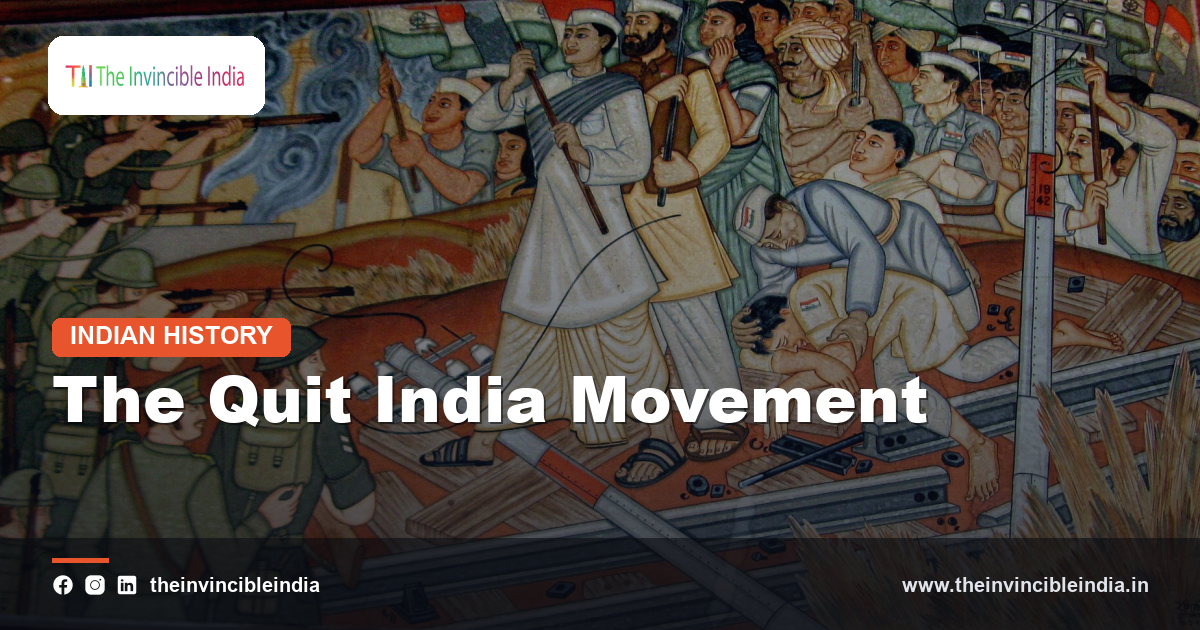
The Quit India Movement of 1942 was one of the most intense and widespread campaigns of the entire independence struggle, launched at a moment when the Second World War had brought colonial rule under unprecedented strain. Building on the mass mobilization strategies developed during the earlier Non-Cooperation Movement, and continuing a tradition of resistance to colonial authority reaching back to the Revolt of 1857, the Congress called for an immediate end to British rule, prompting a sweeping government crackdown even as spontaneous unrest spread across much of the country. Though it did not achieve its immediate demand, the movement demonstrated unmistakably that continued colonial rule had lost public legitimacy. This guide traces the movement’s wartime background, its dramatic launch, the widespread resistance and repression that followed, and its lasting place in the history of the freedom struggle.
Quick Facts
| Detail | Information |
|---|---|
| Also Known As | August Kranti (August Revolution) |
| Year Launched | 1942 |
| Called By | Indian National Congress |
| Key Slogan | Do or Die |
| Government Response | Mass arrests of Congress leadership |
| Immediate Outcome | Suppressed, but weakened colonial legitimacy |
Background: World War II and Political Deadlock
The outbreak of the Second World War placed India’s political future at the center of an unresolved conflict between colonial authorities seeking Indian cooperation for the war effort and nationalist leaders unwilling to offer unconditional support without a clear commitment to self-government. Indian involvement in the war had been declared by colonial authorities without meaningful consultation with elected Indian representatives, a decision that deepened resentment across the political spectrum. Congress ministries in several provinces resigned in protest, leaving a political vacuum even as the demands of wartime administration intensified. Repeated rounds of negotiation between British authorities and nationalist leaders failed to produce an agreement on the terms of Indian participation in the war or a timeline for self-rule. This prolonged deadlock created the immediate political context from which the Quit India Movement would emerge.
The Cripps Mission and Its Failure
In an effort to secure Indian cooperation for the war, British authorities dispatched a mission in early 1942 offering a proposal for eventual self-government following the conclusion of the conflict, along with certain wartime arrangements in the interim. Congress leaders found the proposals unsatisfactory, particularly regarding the pace and certainty of the promised self-government and the provisions for provinces and states to opt out of a future union. Negotiations broke down without agreement, leaving nationalist leaders convinced that continued reliance on British goodwill would not produce timely progress toward independence. The failure of this mission significantly hardened Congress opinion and strengthened the argument, particularly from Gandhi, that only a direct and immediate demand for British withdrawal could break the political impasse. This episode is widely regarded as a decisive turning point leading toward the Quit India resolution.
Gandhi's Call for Immediate Withdrawal
Following the collapse of wartime negotiations, Gandhi increasingly argued that the continued presence of British rule in India, regardless of promises for the future, had become both unjust and a practical obstacle to effective wartime governance. He framed the demand for immediate withdrawal not as an act of hostility toward the allied war effort broadly, but as a necessary step to allow India to organize its own defense and administration as a free nation. Gandhi’s proposal called for a mass movement grounded in non-violent resistance, urging ordinary citizens to be prepared for significant personal sacrifice in pursuit of this demand. His famous exhortation to activists to either succeed or die trying captured the heightened intensity of this particular campaign compared to earlier phases of the movement. This uncompromising stance set the tone for the resolution that followed.
The Quit India Resolution
In August 1942, the Congress formally adopted the Quit India resolution, demanding an immediate end to British rule and authorizing a mass movement of non-violent resistance under Gandhi’s leadership if the demand was not met. The resolution was accompanied by explicit instructions urging non-violent, disciplined struggle, even as leaders anticipated that authorities would respond with arrests and suppression before the movement could fully organize. The scale and directness of this demand marked a significant escalation compared to earlier campaigns, reflecting the leadership’s judgment that the wartime moment offered a decisive opportunity to press for full independence. News of the resolution spread rapidly, generating widespread anticipation and readiness for action among Congress supporters across the country. This formal declaration set in motion the events that would unfold in the following days and weeks.
Arrest of the National Leadership
Anticipating the disruptive potential of the movement, colonial authorities moved swiftly to arrest Gandhi and virtually the entire senior leadership of the Congress within hours of the resolution’s adoption, before any coordinated national campaign could be organized. This immediate and comprehensive crackdown left the movement without its established leadership structure at the very outset, forcing local activists and lower-level organizers to take initiative largely on their own. The arrests, rather than suppressing public sentiment, provoked immediate and widespread outrage, triggering spontaneous protests, strikes, and demonstrations in cities and towns across the country. The absence of centralized direction gave the resulting unrest a notably decentralized and, at times, unpredictable character compared to earlier, more carefully coordinated campaigns. This early removal of leadership fundamentally shaped how the movement subsequently developed.
Spontaneous Uprising Across the Country
In the absence of top leadership, the Quit India Movement took on a strikingly spontaneous and widespread character, with strikes, protests, and acts of civil disobedience erupting in cities, towns, and villages across many parts of the country. Students, workers, and ordinary citizens organized local actions, including strikes in educational institutions and industrial establishments, often coordinated informally through local networks rather than central directives. In several regions, protestors targeted symbols of colonial authority, including government buildings and communication infrastructure, reflecting the intensity of public frustration with continued colonial rule. The scale of this spontaneous participation surprised colonial authorities and demonstrated the depth of popular support for the demand of immediate independence. This widespread, decentralized uprising is a defining feature that distinguishes Quit India from earlier, more centrally organized campaigns.
Underground Activity and Alternative Leadership
With senior leaders imprisoned, a number of Congress activists who evaded arrest organized underground networks to sustain the movement, coordinating communication, distributing information, and, in some cases, operating clandestine radio broadcasts to maintain public morale and provide direction. These underground efforts helped sustain a degree of coordinated activity even amid heavy government surveillance and repression. Some activists associated with these networks later became prominent public figures, having gained recognition for their role in sustaining resistance during this difficult period. Underground organizers faced considerable personal risk, operating outside the protection of any legal or organizational structure while colonial authorities actively sought to dismantle their networks. This underground dimension of the movement illustrates the resourcefulness and determination of activists operating without formal leadership.
Parallel Governments in Some Regions
In certain areas, particularly where colonial administrative control weakened significantly amid the unrest, local activists established informal parallel governing structures that took on administrative functions such as maintaining order and resolving local disputes for a period of time. These parallel arrangements, though limited in scope and duration, demonstrated a striking degree of local organizational capacity and popular legitimacy independent of the colonial administration. Such structures typically operated for a limited period before colonial authorities reasserted control through military and police action. Their emergence, however brief, offered a striking illustration of how deeply colonial authority had been challenged in some localities during this period. These episodes remain notable, if localized, examples of the movement’s most ambitious expressions of self-governance.
Government Repression and Response
Colonial authorities responded to the widespread unrest with extensive use of police and military force, including mass arrests, curfews, and, in various locations, more forceful measures to restore order amid ongoing protests and disruption. Thousands of participants were imprisoned over the following months, and press censorship was tightened considerably to limit the spread of information about the scale of the unrest. The severity of the government’s response drew criticism both within India and, to some extent, internationally, even as wartime priorities limited the attention such criticism received at the time. This extensive repression ultimately succeeded in suppressing the organized movement within several months, though at a considerable cost to the perceived legitimacy of continued colonial rule. The scale of the crackdown remains a significant aspect of how the episode is remembered.
Role of Students and Youth
Students and younger activists played a particularly prominent role in the Quit India Movement, organizing strikes, boycotting classes, and participating actively in street demonstrations across university towns and cities. Youth networks, often more willing to take direct risks than more established political figures, contributed significantly to sustaining the movement’s momentum during the period when senior leadership remained imprisoned. Some student activists took on organizational responsibilities well beyond their years, coordinating local actions and disseminating information through informal channels. This prominent youth involvement reflected a broader generational shift within the independence movement, as younger activists increasingly sought more direct and immediate forms of resistance. Their contribution added considerable energy and reach to the movement during its most intense phase.
Women's Participation in Quit India
Women continued their significant involvement in the freedom struggle during the Quit India Movement, participating in protests, underground organizing, and, in some notable instances, taking on leadership roles within clandestine networks sustaining the movement after the arrest of senior leaders. Their participation spanned a wide range of activities, from public demonstrations to quieter but essential organizational work supporting activists in hiding. Many women faced arrest and hardship for their involvement, reflecting the serious risks borne by all participants in this particularly intense phase of resistance. Their sustained engagement reinforced the broader pattern of women’s active participation throughout the independence movement rather than in any single isolated campaign. This continued involvement remains an important part of the movement’s overall historical record.
Regional Variations in the Movement
The intensity and character of the Quit India Movement varied considerably across different regions of the country, shaped by local political conditions, the strength of Congress organization, and the responsiveness of colonial administration in each area. Some regions experienced particularly intense and sustained unrest, including instances of parallel administrative activity, while others saw more limited or short-lived protest given differing local circumstances. Rural areas in some regions saw significant peasant participation, linking the movement to existing local grievances over administration and taxation. This regional diversity illustrates that Quit India, like earlier phases of the independence struggle, was not a uniform national event but a mosaic of locally inflected responses to a shared national call. Understanding these regional variations offers a more complete picture of the movement’s true scope.
Communication, Censorship, and Public Opinion
Colonial authorities imposed strict censorship on press coverage of the Quit India Movement, seeking to limit public knowledge of the scale of unrest and the severity of the government’s response during the critical early months of the campaign. In response, underground pamphlets, clandestine broadcasts, and word-of-mouth communication became important means of sustaining public awareness and morale despite official restrictions. These alternative channels of communication, though limited in reach compared to mainstream media, played a meaningful role in keeping the movement’s message alive during a period of intense suppression. International awareness of events in India during this period remained constrained both by censorship and by the overriding priorities of wartime news coverage elsewhere. This tightly controlled information environment shaped how contemporaries, and later historians, could piece together the movement’s full extent.
Decline and Aftermath of the Movement
By the months following its launch, sustained government repression, the continued imprisonment of national leadership, and the physical toll of extended unrest gradually brought the most active phase of the Quit India Movement to an end, though isolated resistance and underground activity persisted in some areas for a longer period. Most senior Congress leaders, including Gandhi, remained imprisoned for an extended period, effectively removing them from active political life during the movement’s later phase and the concluding years of the war. Despite its suppression, the movement left a lasting impression on both colonial authorities and the Indian public regarding the depth and breadth of popular support for immediate independence. Its aftermath fed directly into the political negotiations that resumed once wartime conditions eased and leaders were eventually released. The movement’s legacy proved far more enduring than its relatively short active phase might suggest.
Significance in the Freedom Struggle
The Quit India Movement holds a distinctive place in the history of the independence struggle as the most direct and uncompromising mass demand for immediate self-rule made during the entire colonial period. Unlike earlier campaigns that sought specific reforms or concessions, Quit India explicitly rejected any continuation of British authority, however qualified, marking a clear escalation in the movement’s political demands. The scale of spontaneous popular participation, occurring largely without central leadership, demonstrated conclusively that support for independence extended deeply into the general population rather than being confined to organized political circles. Even though the immediate demand was not met, the movement is widely regarded by historians as a critical factor in convincing colonial authorities that continued rule had become politically unsustainable. Its significance, therefore, lies as much in what it revealed as in what it immediately achieved.
The Quit India Movement Today
The Quit India Movement is commemorated today through national observances, memorials, and educational materials that recognize its place as a defining episode in the final years of the independence struggle. Sites associated with the movement’s key events and its underground networks continue to be studied and visited by those interested in this particularly intense chapter of history. Historical scholarship continues to explore the movement’s decentralized character and regional variations, offering an increasingly detailed picture beyond the well-known events surrounding its dramatic launch. The movement’s core message, that colonial rule had lost its legitimacy in the eyes of the people, remains a frequently cited example of mass political mobilization in discussions of India’s path to independence. This continued attention reflects the movement’s lasting significance in the national historical narrative.
Sources & Further Reading
- National Archives of India (nationalarchives.nic.in).
- Ministry of Culture, Government of India (indiaculture.gov.in).
Frequently Asked Questions
What was the Quit India Movement?
The Quit India Movement was a mass campaign launched by the Indian National Congress in 1942 demanding an immediate end to British rule in India, met with widespread arrests and a significant government crackdown.
Why was the Quit India Movement launched in 1942?
It followed the failure of wartime negotiations, including the Cripps Mission, and reflected growing conviction among nationalist leaders that only a direct demand for immediate withdrawal could resolve the political deadlock.
What does 'Do or Die' mean in this context?
It was Gandhi’s exhortation to participants to commit fully to the struggle for immediate independence, reflecting the heightened intensity and urgency of the Quit India campaign compared to earlier movements.
How did the British respond to the movement?
Colonial authorities responded with the mass arrest of Congress leadership, extensive use of police and military force, and strict press censorship, suppressing the organized movement within several months.
What was the significance of the Quit India Movement?
Although suppressed, it demonstrated widespread popular support for immediate independence and is regarded as a key factor that weakened the long-term legitimacy of continued British rule in India.


