

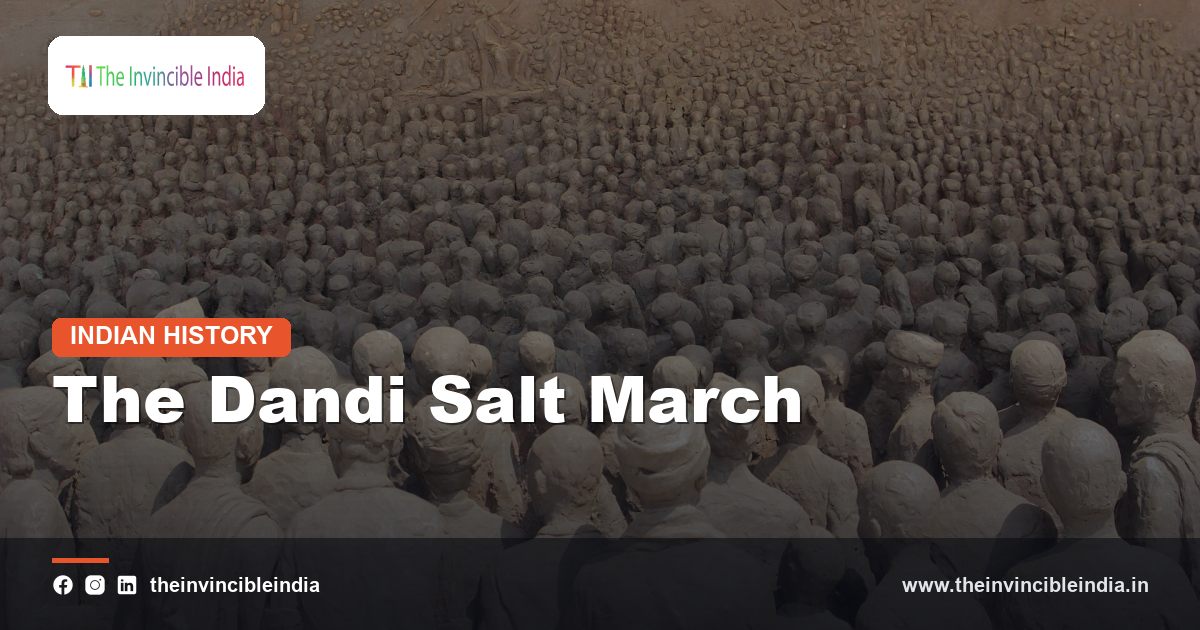
The Dandi Salt March of 1930 stands among the most memorable episodes of the Indian independence struggle, a carefully planned act of civil disobedience that transformed a modest household commodity into a powerful symbol of resistance against colonial rule. Following the strategic lessons of the earlier Non-Cooperation Movement, and continuing a tradition of resistance to colonial authority reaching back to the Revolt of 1857, Gandhi chose to challenge the colonial monopoly on salt production and taxation, leading a growing procession of followers on a lengthy walk to the coast to make salt in open defiance of the law. The march ignited the broader Civil Disobedience Movement and drew worldwide attention to the Indian cause. This guide traces the march’s background, its unfolding events, and its lasting impact on the freedom struggle.
Quick Facts
| Detail | Information |
|---|---|
| Led By | Mahatma Gandhi |
| Year | 1930 |
| Purpose | Protest against the colonial salt tax and monopoly |
| Destination | The coastal village of Dandi, Gujarat |
| Method | Non-violent civil disobedience (satyagraha) |
| Outcome | Launch of the nationwide Civil Disobedience Movement |
Background: The Demand for Complete Independence
By the close of the 1920s, the Indian National Congress had moved decisively toward demanding complete independence rather than the more limited self-governing status it had earlier been willing to accept within the British Empire. This hardening of position reflected growing impatience with the slow pace of constitutional reform and a renewed conviction that only direct action could compel meaningful political change. Gandhi, having stepped back from the front line of organized protest after the Non-Cooperation Movement’s suspension, began searching for an issue capable of mobilizing the broadest possible segment of Indian society around this renewed and more assertive demand. The choice of an issue affecting the daily lives of virtually every Indian, regardless of class, region, or religion, was central to his strategic thinking. This search for a unifying and universally relatable grievance led directly to the selection of salt as the focus of the coming campaign.
Gandhi's Choice of Salt as a Symbol
Salt, an essential commodity subject to a colonial monopoly and associated tax, offered Gandhi an issue that touched every household in India regardless of wealth or social position, making it an unusually powerful vehicle for mass protest. By choosing to challenge the legal prohibition on Indians producing their own salt, Gandhi could frame the campaign in terms of a basic injustice affecting rich and poor alike, rather than an abstract constitutional demand understood mainly by the educated elite. The symbolic power of salt lay precisely in its ordinariness, transforming a routine act of production into a direct and easily understood challenge to colonial law. Critics at the time, including some within the colonial administration, initially underestimated the potential of such a seemingly modest issue to galvanize mass sentiment. This underestimation would prove significant as the campaign unfolded and captured widespread public attention.
Planning the March
Gandhi announced his intention to march from his ashram to the coastal village of Dandi in Gujarat, where he would produce salt in open violation of colonial law, giving colonial authorities considerable advance notice of his plans. This transparency was deliberate, reflecting Gandhi’s belief that satyagraha depended on openness and moral clarity rather than secrecy or surprise. He carefully selected a small initial group of followers to accompany him on the march, planning a route through numerous villages where he intended to address local communities along the way. The march was designed not merely as a journey to a destination but as an extended, mobile campaign of public education and mobilization. This deliberate and transparent planning process reflected the disciplined, strategic approach that had come to characterize Gandhi’s method of organizing mass civil disobedience.
The March Begins
In March 1930, Gandhi set out from his ashram accompanied by a modest group of followers, beginning a walk of considerable distance toward the coastal village he had selected as his destination. News of the march spread quickly through press coverage, and crowds gathered along the route to witness Gandhi’s passage, reflecting the growing public anticipation the campaign had generated even before its climactic act. The disciplined, measured pace of the march, combined with Gandhi’s practice of addressing gatherings at each stop, created a sustained and highly visible act of public political theater. Observers noted the striking image of an elderly leader walking steadily toward a symbolic confrontation with colonial law, an image that would come to define the campaign in public memory. This opening phase set the tone for the growing momentum that would characterize the following weeks.
The Route and Daily Rhythm of the March
The march proceeded over several weeks through numerous villages, following a carefully planned route that allowed Gandhi to address local communities and explain the purpose of the campaign directly to ordinary people along the way. Each day followed a disciplined rhythm of walking, rest, and public meetings, during which Gandhi spoke about the significance of the salt tax and the broader goals of the independence movement. Local communities along the route often provided food, shelter, and logistical support to the marchers, reflecting growing grassroots enthusiasm for the campaign as it progressed. Journalists accompanying the march provided regular reports that kept public attention focused on its progress, both within India and increasingly abroad. This sustained daily engagement with ordinary communities was central to the march’s effectiveness as a tool of political mobilization.
Growing Participation Along the Way
As the march progressed, the number of participants grew steadily, with local volunteers joining the original group at various points along the route, transforming a modest procession into a substantial and highly visible demonstration. This expanding participation reflected the campaign’s success in translating a symbolic protest into a genuinely popular movement engaging communities well beyond Gandhi’s immediate circle of associates. Public enthusiasm along the route also encouraged similar acts of salt-related civil disobedience to be planned in other parts of the country, extending the campaign’s reach even before Gandhi reached his final destination. The visible momentum of the march itself became an important element of its political impact, demonstrating growing public readiness for direct action. This organic growth in participation underscored the depth of public support the campaign was able to generate.
Arrival at Dandi and the Symbolic Act
Upon reaching the coastal village of Dandi after several weeks of walking, Gandhi performed the symbolic act of producing salt from seawater in direct and deliberate violation of colonial law, an act witnessed by a large gathering of followers and reported widely in the press. Though the quantity of salt produced was modest, its significance lay entirely in its symbolism as a public, peaceful act of lawbreaking intended to demonstrate the illegitimacy of the colonial monopoly. The act at Dandi served as a signal for coordinated acts of civil disobedience to begin across the country, as Indians in numerous other locations proceeded to make or sell salt in open defiance of the law. This carefully staged culmination of the march achieved precisely the symbolic and mobilizing effect Gandhi had intended from the outset. It marked the formal beginning of the wider Civil Disobedience Movement.
Spread of Civil Disobedience Nationwide
Following the events at Dandi, acts of civil disobedience related to salt production spread rapidly to other parts of the country, with local leaders organizing similar demonstrations along coastlines and in inland communities. The campaign quickly expanded beyond salt alone to include boycotts of foreign cloth, refusal to pay certain taxes, and other forms of non-violent resistance to colonial authority. This rapid diffusion demonstrated how a single, carefully chosen symbolic act could catalyze a much broader nationwide campaign of civil disobedience. Participation extended across regions and social groups, reflecting the campaign’s success in engaging a genuinely diverse cross-section of Indian society. The spread of the movement well beyond its original geographic focus illustrated the effectiveness of Gandhi’s strategy of symbolic, replicable protest.
Government Response and Mass Arrests
Colonial authorities responded to the growing civil disobedience campaign with widespread arrests, detaining tens of thousands of participants, including much of the senior Congress leadership, over the following months. Gandhi himself was arrested some weeks after the march’s culmination, though his imprisonment did little to slow the momentum of the broader movement, which continued under the direction of other leaders and local organizers. The scale of the government’s response drew significant public attention both within India and abroad, highlighting the severity of colonial reaction to what remained, in its methods, a strictly non-violent campaign. This heavy-handed response, rather than suppressing public sympathy for the movement, in many respects reinforced its moral standing in the eyes of observers. The scale of arrests during this period remains one of the most striking features of the Civil Disobedience Movement.
International Attention on the Campaign
The Dandi March and the broader Civil Disobedience Movement attracted considerable international press coverage, introducing Gandhi and the Indian independence cause to a global audience in an unprecedented way. Foreign correspondents traveled with or reported on the march, and images and accounts of the campaign circulated widely in newspapers outside India, shaping international perceptions of the colonial relationship. This international visibility placed additional, if indirect, pressure on colonial authorities, who found their handling of the movement increasingly scrutinized by outside observers. The march is often credited with significantly raising Gandhi’s international profile and with helping establish non-violent civil disobedience as a widely recognized model of political protest well beyond India’s borders. This global attention marked a notable shift in how the Indian independence struggle was perceived internationally.
Role of Women in the Salt Satyagraha
Women played a highly visible and active role in the salt satyagraha, participating in the production and sale of illegal salt, picketing shops selling foreign cloth, and facing arrest alongside male participants in significant numbers. Gandhi actively encouraged this participation, viewing women’s involvement as essential to the campaign’s mass character rather than a secondary contribution. Many women who had not previously taken part in public political activity stepped forward during this period, reflecting the campaign’s broad appeal across social boundaries. Their sustained involvement in the salt campaign built directly on the pattern of women’s participation established during earlier phases of the independence movement. This prominent role for women during the Civil Disobedience Movement remains one of its most notable social dimensions.
The Dharasana Salt Works Protest
Following the Dandi March, a notable act of civil disobedience took place at the Dharasana salt works, where volunteers advanced in organized, non-violent lines to protest against the government-controlled salt production facility, submitting to arrest and physical restraint without resistance. Accounts of the discipline shown by protestors in the face of forceful police response drew considerable attention both within India and internationally, reinforcing the moral contrast between non-violent protest and the methods used to suppress it. This episode became one of the most widely reported demonstrations of the entire Civil Disobedience Movement, illustrating the practical application of satyagraha principles under significant physical hardship. The disciplined conduct of participants at Dharasana is frequently cited as an example of the movement’s core philosophy in action. It remains a significant chapter within the broader salt satyagraha campaign.
The Gandhi-Irwin Pact and Negotiations
Facing sustained civil disobedience and mounting political pressure, colonial authorities eventually entered into negotiations with Gandhi, resulting in an agreement that led to the suspension of the Civil Disobedience Movement in exchange for the release of political prisoners and certain limited concessions. This agreement did not resolve the fundamental political questions underlying the independence movement, but it represented a significant moment of direct negotiation between Gandhi and colonial authorities on largely equal terms. Gandhi subsequently traveled to participate in constitutional discussions in London, representing the Congress in negotiations over India’s political future. Although the concessions achieved fell well short of the movement’s ultimate goals, the agreement demonstrated the practical political leverage that sustained civil disobedience had generated. This negotiated pause set the stage for further rounds of political engagement in the following years.
Immediate Outcomes of the Campaign
In the immediate term, the Dandi March and the Civil Disobedience Movement it launched did not secure full independence or an end to the colonial salt monopoly, but they succeeded in demonstrating the scale of coordinated resistance the nationalist movement could mobilize. The campaign significantly strengthened Congress organization at the local level, drawing new participants into sustained political activity across the country. It also reinforced Gandhi’s standing as the movement’s central strategic figure, whose methods had once again proven capable of translating a specific grievance into broad-based mass action. The negotiated truce that followed, while limited in its immediate concessions, kept the political process moving forward rather than allowing the confrontation to remain unresolved indefinitely. These immediate outcomes set important precedents for the campaigns that would follow in subsequent years.
Long-Term Significance of the Salt March
The Dandi Salt March holds enduring significance as one of the clearest demonstrations of how a carefully chosen symbolic act could galvanize mass political mobilization on a national scale. It cemented satyagraha as the defining method of the Indian independence movement and confirmed Gandhi’s unique capacity for translating abstract political demands into concrete, universally relatable action. The march’s combination of moral clarity, strategic planning, and sustained public engagement offered a model that influenced non-violent movements in other parts of the world in subsequent decades. Its imagery, an elderly leader walking steadily toward a symbolic act of defiance, remains among the most recognizable in the history of the independence struggle. This lasting influence extends well beyond the specific political outcomes achieved at the time.
The Dandi March in Memory Today
The route of the Dandi March is commemorated today through memorials, markers, and preserved sites that trace Gandhi’s original path from his ashram to the coastal village where the march culminated. National observances continue to recall the march as a defining moment in the history of non-violent resistance, and educational materials widely reference the campaign as an example of effective symbolic protest. Scholarly and public interest in the march’s detailed daily progress and the communities it passed through continues to deepen historical understanding of its organization and impact. The march’s core lesson, that a modest, universally understood grievance could anchor a mass movement for far larger political change, remains widely studied in the context of nonviolent political strategy. This continued attention reflects the Dandi March’s lasting place in India’s national memory.
Sources & Further Reading
- National Archives of India (nationalarchives.nic.in).
- Ministry of Culture, Government of India (indiaculture.gov.in).
Frequently Asked Questions
What was the Dandi Salt March?
The Dandi Salt March was a 1930 campaign led by Gandhi, involving a march to the coastal village of Dandi to produce salt in defiance of the colonial salt tax and monopoly, launching the Civil Disobedience Movement.
Why did Gandhi choose salt for the protest?
Salt was an essential commodity used by every household regardless of wealth or class, making the colonial tax on it a widely felt grievance that could unite people across Indian society in protest.
How long did the Dandi March last?
The march covered a considerable distance over several weeks, with Gandhi and a growing group of followers walking from his ashram to the coastal village of Dandi in Gujarat.
What happened after the march reached Dandi?
Gandhi produced salt from seawater in symbolic violation of colonial law, an act that triggered a wave of similar civil disobedience across the country and marked the start of the broader Civil Disobedience Movement.
What was the outcome of the Civil Disobedience Movement?
The movement led to widespread arrests and eventually to negotiations resulting in the Gandhi-Irwin Pact, which brought a temporary suspension of the campaign and limited political concessions.


