

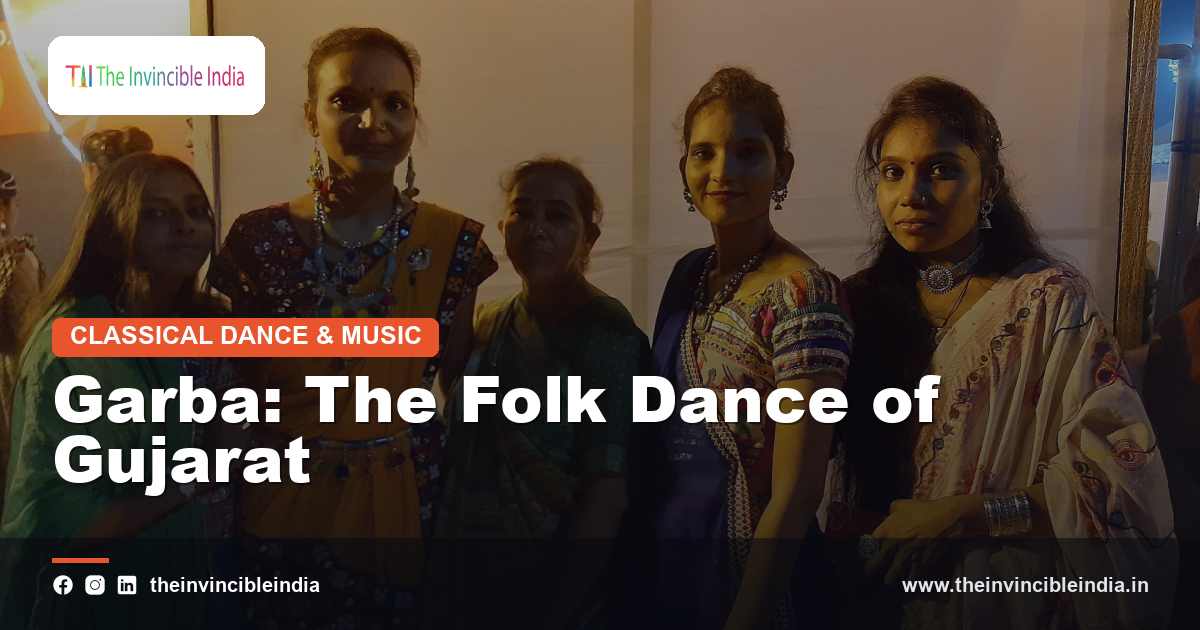
Each autumn, as the nine nights of Navratri unfold across Gujarat and beyond, courtyards, streets and halls fill with the rhythmic clapping, swirling skirts and joyous singing of Garba, one of India’s most recognisable folk dances. Performed by dancers moving in concentric circles around a central lamp or image of the goddess, Garba is at once an act of devotion and a vibrant community celebration, open to participants of every age and skill level. Its steady, accessible steps and infectious rhythm have carried it far beyond its Gujarati homeland, into diaspora communities and popular culture around the world. This guide explores what Garba is, its religious roots, its music and costume, and how it continues to be practised today.
Quick Facts
| Detail | Information |
|---|---|
| Type | A circular folk dance performed during Navratri |
| Origin | Gujarat, western India |
| Formation | Concentric circles moving around a central lamp or deity |
| Season | Primarily the nine nights of Navratri |
| Related form | Dandiya Raas, performed with sticks |
| Participants | Open to dancers of all ages and skill levels |
What Is Garba
Garba is a traditional circular folk dance native to the state of Gujarat, performed most prominently during the festival of Navratri as an act of devotion to the mother goddess. Dancers move together in one or more concentric rings, executing simple, repeating steps timed to rhythmic clapping and call-and-response singing, allowing large numbers of participants to join in regardless of prior training. Unlike many classical dance forms that require years of specialised instruction, Garba is designed as a communal activity, its steps deliberately accessible so that entire neighbourhoods and families can dance together through the night. This inclusive, participatory character is central to Garba’s identity and has made it one of the most widely practised folk dances in India today.
Origins and Meaning
The word Garba is generally understood to derive from the Sanskrit term for a womb, referring to the perforated earthen lamp, called a garbo, that traditionally sits at the centre of the dance circle, its flickering light symbolising life and the divine feminine presence. Dancers circle this lamp, or in many modern settings an image of the goddess, moving in unison around a fixed devotional centre. This symbolism connects the dance directly to its religious purpose, framing the act of dancing itself as a form of reverence and celebration of feminine divine energy rather than mere entertainment. Over generations, this devotional core has remained constant even as the scale and setting of Garba performances have grown considerably.
Association with Navratri
Garba is inseparably linked with Navratri, the nine-night festival honouring the goddess in her various forms, during which communities across Gujarat gather each evening to dance in her honour. Public grounds, temple courtyards and dedicated pavilions fill with dancers for hours at a stretch, with performances often continuing late into the night across the full span of the festival. The dance is understood not simply as accompaniment to the festival but as one of its central devotional expressions, alongside prayer and the lighting of lamps. This close bond between dance and festival has made Navratri, in many parts of Gujarat, virtually synonymous with the sight and sound of Garba.
The Circular Formation
The defining visual feature of Garba is its circular formation, with dancers arranged in one or several concentric rings that rotate steadily around a central point. This circular movement is often interpreted as a symbol of the cycle of life and time, with the dancers’ continuous rotation representing the unending rhythm of creation and dissolution associated with the goddess. Larger gatherings may feature multiple rings moving simultaneously, sometimes in opposite directions, creating a striking visual pattern when viewed from above. The discipline of maintaining the circle while dancing in step with dozens or hundreds of others is itself part of the dance’s communal appeal, requiring cooperation and shared rhythm among all participants.
Garba and the Goddess
At its devotional core, Garba is offered in honour of the goddess, most commonly identified with forms of Durga or Amba, whose presence is invoked through the central lamp or an installed image around which the dancers circle. Many Garba gatherings begin with a brief prayer or the lighting of the ceremonial lamp before dancing commences, marking the transition from ordinary time into a devotional, celebratory space. The songs sung during Garba frequently include verses in praise of the goddess, reinforcing the dance’s religious dimension even as it functions simultaneously as social celebration. This dual character, at once sacred and festive, is fundamental to how Garba is understood within Gujarati culture.
Traditional Costumes
Garba is performed in vivid, richly decorated traditional attire, with women typically wearing the chaniya choli, a flared, embroidered skirt paired with a fitted blouse and a draped scarf known as an odhani, all adorned with mirrors, embroidery and vibrant colour. Men commonly wear a kediyu, a flared, gathered upper garment, paired with a dhoti or churidar and a turban, completing an equally colourful ensemble. Jewellery, including elaborate necklaces, bangles and ornamental hair pieces, further enhances the visual spectacle, catching the light as dancers turn and sway. This attention to costume transforms Garba gatherings into a striking display of colour and craftsmanship, closely tied to Gujarat’s broader textile and embroidery traditions.
Music and Rhythm
Garba is danced to a distinctive musical accompaniment built on steady, repeating rhythmic cycles, traditionally sung live by a lead vocalist and chorus and accompanied by drums, most commonly the dholak, along with other percussion and, in contemporary settings, additional instruments. The songs, called garba or garbi, often narrate devotional themes, folk tales or seasonal celebrations, sung in call-and-response fashion that allows the assembled dancers to join the singing as they move. The tempo typically builds gradually over the course of an evening, beginning with slower, simpler patterns and accelerating as the night progresses, drawing dancers into an increasingly energetic and immersive rhythm.
Garba and Dandiya Raas
Garba is often performed alongside, and sometimes conflated with, Dandiya Raas, a related but distinct dance in which participants strike short decorated sticks together in rhythm while moving through interweaving patterns. While Garba is traditionally danced with open hands and claps in a devotional circle, Dandiya Raas introduces the percussive clash of sticks and a more playful, interactive choreography between paired or rotating partners. Many contemporary Navratri events feature both forms across the course of an evening, with Garba often performed earlier as the more devotional opening and Dandiya Raas following as a livelier, more energetic continuation. Understanding this distinction helps clarify two related but separate strands of Gujarati festive dance.
Movements and Steps
The basic vocabulary of Garba consists of simple, repeating steps involving coordinated turns, claps and shifts of weight, performed in unison by the entire circle of dancers moving steadily in one direction. Variations range from the most basic three- or four-step patterns suitable for beginners to more elaborate sequences incorporating additional turns, claps and hand gestures favoured by experienced dancers and performed at competitive or staged events. Despite this range, the underlying structure remains cyclical and communal, designed so that dancers of differing skill can dance side by side within the same circle. This scalability, from simple to intricate, is part of what allows Garba to function equally well as mass participation and as skilled performance.
Garba as a Community Dance
Beyond its devotional and artistic dimensions, Garba functions as a powerful vehicle for community bonding, bringing together neighbours, extended families and entire towns in a shared nightly activity throughout Navratri. Participation typically crosses lines of age, gender and social background, with children, elders and everyone in between joining the same circles, an inclusiveness that is central to the dance’s cultural significance. Many communities organise their own local Garba gatherings, often in a temple courtyard, housing society or public ground, sustaining a sense of collective identity and continuity year after year. This communal character distinguishes Garba from more specialised performance traditions and helps explain its deep and lasting popularity.
Regional Variations within Gujarat
Although Garba is recognised nationally as a single dance form, its style, costume and musical accompaniment vary considerably across the different regions of Gujarat, each contributing its own local flavour to the broader tradition. Certain areas favour particular rhythmic patterns, styles of embroidery or lyrical repertoires, reflecting the diversity of local custom within the state’s wider Garba tradition. Some communities preserve older, simpler forms of the dance closely tied to household or temple worship, while others have developed more elaborate performance styles suited to larger public gatherings. This regional diversity within a shared framework illustrates how a single folk tradition can accommodate considerable local variation while remaining instantly recognisable.
Garba in Diaspora Communities
Wherever Gujarati communities have settled around the world, Garba has travelled with them, becoming a prominent feature of Navratri celebrations in cities across North America, the United Kingdom, East Africa and beyond. Community halls and cultural associations abroad organise their own Garba nights, often drawing participants well beyond the Gujarati community itself, as the dance’s accessible steps and festive atmosphere appeal broadly across cultural lines. These diaspora celebrations serve an important role in maintaining cultural continuity, allowing successive generations born outside India to remain connected to Gujarati heritage through active participation rather than passive observation. In this way, Garba has become a genuinely global expression of Indian folk culture.
Modern and Competitive Garba
In recent decades, Garba has increasingly moved beyond purely devotional and communal settings into large-scale organised events, including ticketed festivals, sponsored competitions and elaborately choreographed stage performances. Choreographers have developed intricate, athletic variations designed for competitive display, judged on synchronisation, complexity and stamina, drawing enthusiastic participants who train and rehearse well before the festival season begins. Recorded music, elaborate lighting and professional sound systems have also become common at larger gatherings, supplementing or replacing the live singing of earlier generations. While these modern developments have expanded Garba’s scale and visibility considerably, its essential circular structure and communal spirit have generally remained intact.
Garba in Popular Culture
Garba’s vibrant costumes, energetic rhythm and joyous atmosphere have made it a frequent subject of depiction in Indian films, television and popular media, often used to represent festive celebration and cultural vitality more broadly. Such depictions have helped introduce the dance to audiences well beyond Gujarat, contributing to its recognition as a symbol of Indian festivity nationally and internationally. Fashion associated with Garba, particularly the chaniya choli, has likewise gained wider popularity, worn at festive occasions even outside the immediate context of Navratri. This broader cultural visibility has reinforced Garba’s status as one of the most widely recognised folk dance traditions to emerge from any single Indian state.
Learning and Practising Garba
While Garba’s basic steps are traditionally learned informally within families and communities simply by joining the circle and following more experienced dancers, many cities now offer organised classes and workshops, particularly in the weeks leading up to Navratri, for those wishing to refine their steps or learn more elaborate variations. These classes cater to enthusiasts of all backgrounds, reflecting the dance’s broad and growing appeal beyond its traditional community. Because Garba’s underlying steps are comparatively simple compared to classical dance forms, most learners are able to participate confidently after only modest practice, reinforcing the dance’s identity as an open and welcoming tradition rather than an exclusive specialist art.
Preservation and Continuity
Despite considerable modernisation in music, costume and scale, the core devotional and communal purpose of Garba continues to be actively maintained by cultural organisations, temple committees and local communities who organise traditional gatherings each Navratri season. Efforts to document and teach older, simpler forms of the dance help ensure that newer generations remain connected to its devotional roots even as more elaborate contemporary variations flourish alongside them. Cultural institutions in Gujarat and beyond have also taken an interest in recording and preserving traditional Garba songs and rhythmic patterns, recognising their value as an important strand of the state’s living folk heritage. This dual continuity, of both tradition and innovation, characterises Garba’s ongoing evolution.
Garba Today
Today Garba remains one of India’s most vibrant and widely practised folk dances, drawing enormous participation each Navratri across Gujarat, other parts of India and Gujarati communities worldwide. Its blend of devotion, community spirit and infectious rhythm continues to appeal across generations, sustaining both intimate neighbourhood gatherings and vast, professionally organised festival events. Whether performed around a simple household lamp or on a brightly lit stage before thousands, Garba retains its essential character as a joyous, inclusive circular dance offered in honour of the goddess. Its enduring popularity stands as a testament to the lasting power of Gujarat’s rich folk cultural heritage.
Sources & Further Reading
- Ministry of Culture, Government of India, on the folk dance heritage of India (indiaculture.gov.in).
- Sangeet Natak Akademi, national academy for music, dance and drama (sangeetnatak.gov.in).
Frequently Asked Questions
What is Garba dance?
Garba is a traditional circular folk dance from Gujarat, performed during Navratri in devotion to the goddess, in which dancers move together in rhythmic steps around a central lamp or deity image.
What is the difference between Garba and Dandiya Raas?
Garba is traditionally danced with claps and open hands in a devotional circle, while Dandiya Raas involves striking short sticks together in rhythm, and the two are often performed together across a single Navratri evening.
When is Garba performed?
Garba is performed primarily during the nine nights of Navratri, though it may also be danced at other festive and cultural occasions throughout the year.
What do dancers wear for Garba?
Women typically wear an embroidered chaniya choli with a draped odhani, while men wear a kediyu with a dhoti or churidar, both styles adorned with mirrors, embroidery and colourful ornamentation.
Is Garba only performed in Gujarat?
No, while Garba originates in Gujarat, it is now performed widely across India and within Gujarati diaspora communities around the world during Navratri celebrations.


