

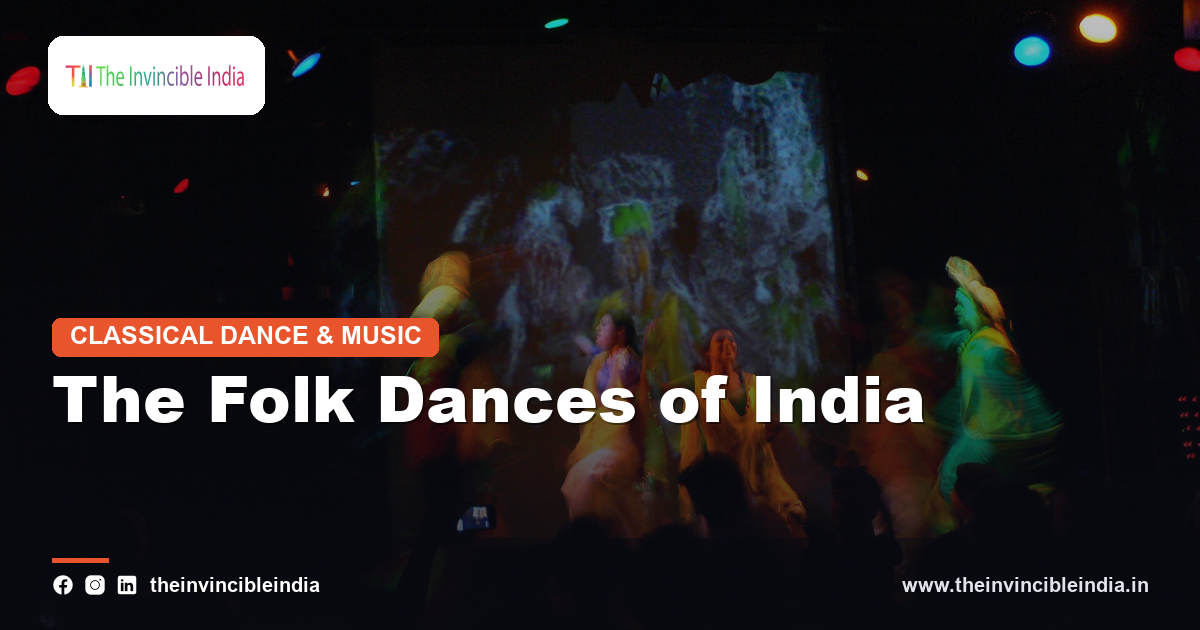
Alongside its refined classical dance traditions, India possesses an equally rich and far more numerous body of folk dances, community art forms born not in royal courts or temple halls but in villages, fields and marketplaces across the length and breadth of the country. Where classical dance follows codified rules of movement, gesture and theory passed down through formal training, folk dance grows organically from the rhythms of everyday life, agricultural cycles, seasonal festivals, religious observances and communal celebration. Nearly every region and community of India has developed its own distinctive folk dances, each reflecting local costume, music, occasion and temperament, so that the folk dance tradition as a whole offers an unparalleled window into the sheer diversity of Indian cultural life. This guide surveys the character, origins and regional variety of India’s folk dances.
Quick Facts
| Detail | Information |
|---|---|
| Nature | Community dance forms rooted in everyday and festive life |
| Origins | Agricultural cycles, festivals, harvests and local traditions |
| Contrast with classical dance | Less formally codified, more communal and spontaneous |
| Diversity | Nearly every region has its own distinctive folk dances |
| Occasions | Harvests, weddings, festivals and religious celebrations |
| Examples | Bhangra, Garba, Bihu, Ghoomar and many others |
A Tradition of the People
Folk dance in India is, at its heart, a tradition belonging to ordinary people rather than to trained specialists, performed by farmers, villagers and communities as a natural extension of daily and seasonal life rather than as a formally studied art. It requires no years of rigorous classical training to participate, and indeed its accessibility and communal spirit are central to its character, inviting broad participation rather than showcasing the virtuosity of a single trained performer. This grassroots, participatory quality distinguishes folk dance sharply from the classical traditions, and it is precisely this accessibility that has allowed folk dance to remain such a vital, living presence in the everyday cultural life of communities across India.
Roots in Agriculture and Season
A great many Indian folk dances trace their origins to the agricultural calendar, celebrating the sowing of crops, the arrival of the monsoon or, most commonly, the joy and relief of a successful harvest. Communities have long marked these pivotal agricultural moments with dance, music and feasting, expressing gratitude, marking the changing seasons and reinforcing the shared rhythms of rural life that bind a community together. This deep connection to the land and its cycles gives many folk dances an earthy, celebratory character, quite distinct from the more contemplative or devotional moods often associated with classical dance, and it explains why so many folk dances remain closely tied to specific times of the agricultural year.
Bhangra of Punjab
Among the most internationally recognised of India’s folk dances is Bhangra, originating in the Punjab region and traditionally associated with the harvest festival of Baisakhi. Performed with tremendous energy, Bhangra features vigorous, athletic movements, high leaps and enthusiastic shouts, accompanied by the driving beat of the dhol, a large double-headed drum slung around the drummer’s neck and struck with sticks. Traditionally a dance for men celebrating a bountiful harvest, Bhangra has since spread far beyond its Punjabi origins, embraced across India and internationally as a joyous, high-spirited dance performed at weddings, festivals and celebrations of every kind.
Garba and Dandiya of Gujarat
From Gujarat come Garba and the related Dandiya Raas, graceful circular dances performed especially during the autumn festival of Navratri in honour of the goddess. Garba involves dancers moving in concentric circles with rhythmic clapping and swaying steps, often around a central lamp or image of the goddess, while Dandiya Raas adds decorated wooden sticks that dancers strike together in coordinated rhythmic patterns as they move. Both dances draw enormous numbers of participants during the festival season, transforming open grounds into vast circles of colourfully dressed dancers, and both have become widely popular celebrations of community and devotion well beyond Gujarat itself.
Bihu of Assam
In Assam, the Bihu dance is performed during the Bihu festivals that mark key points in the agricultural year, most prominently the spring festival celebrating the Assamese new year and the start of the sowing season. Characterised by brisk, energetic footwork, distinctive hip movements and hand gestures, Bihu dance is traditionally performed by young men and women together, accompanied by instruments such as the dhol, pepa and gogona, and is closely associated with themes of youthful joy, courtship and the renewal of the agricultural cycle. Bihu remains a defining cultural expression of Assamese identity and one of the most vibrant folk traditions of Northeast India.
Ghoomar of Rajasthan
Ghoomar, originating among the royal and community traditions of Rajasthan, is a graceful dance performed by women in flowing, colourful skirts called ghagras, whose swirling, twirling movements give the dance its very name. Dancers move in circular formations, their skirts billowing dramatically as they turn, often accompanied by traditional Rajasthani folk songs and instruments. Traditionally performed during festivals and family celebrations such as weddings, Ghoomar has come to be regarded as an emblem of Rajasthani culture, admired for the visual spectacle created by dozens of dancers turning together in flowing, colourful unison.
Lavani of Maharashtra
Lavani, from Maharashtra, is a vigorous and expressive dance form traditionally performed by women, known for its powerful rhythms, expressive movements and close connection to traditional folk theatre and storytelling. Accompanied by the dholki drum and sung with spirited, often narrative lyrics, Lavani performances combine dance, music and dramatic expression, and the form has historically been closely linked with travelling folk theatre troupes that toured rural Maharashtra. Distinguished by its bold energy and emotional expressiveness, Lavani remains an important and celebrated part of Maharashtrian folk culture, valued for its dramatic intensity as much as its dance technique.
Dances of the Northeast
India’s northeastern states are home to a particularly rich diversity of folk dances, each community maintaining distinctive traditions closely tied to local festivals, harvests and social occasions. These dances often feature synchronised group formations, distinctive traditional costumes and jewellery, and accompaniment by regional instruments, reflecting the strong communal and tribal traditions of the region. Many of these dances celebrate agricultural events, seasonal changes or important community milestones, and they remain vital expressions of the distinct cultural identities maintained by the numerous communities of Northeast India, a region whose folk dance heritage is exceptionally varied even within a relatively compact geographic area.
Dances of Tribal Communities
Across many regions of India, tribal communities maintain their own distinctive folk dance traditions, often closely integrated with religious beliefs, seasonal festivals and important life events such as marriages and harvests. These dances frequently involve large groups moving in coordinated, often circular formations, accompanied by traditional drums and other percussion instruments, with costume, jewellery and body ornamentation playing an important expressive role alongside the movement itself. Tribal folk dances represent some of the most direct living connections to ancient patterns of community celebration in India, preserved through generations largely outside the influence of courtly or classical performance traditions.
Dances of Devotion and Ritual
Many Indian folk dances are performed not for entertainment alone but as part of religious ritual and devotional practice, accompanying temple festivals, processions and seasonal religious observances across the country. These devotional folk dances often involve the whole community rather than trained specialists, expressing collective faith and celebration through movement, music and often elaborate traditional costume. The close intertwining of dance with religious life in many parts of India reflects a broader pattern in which artistic and spiritual expression are not sharply separated, and communal dance becomes a natural, embodied form of shared worship and celebration.
Costume and Ornamentation
A striking feature of India’s folk dances is the sheer variety and vibrancy of the traditional costumes and ornamentation associated with each regional style, from the swirling, mirror-worked skirts of Rajasthan to the distinctive woven textiles and jewellery of the Northeast. These costumes are rarely incidental to the dance but are integral to its visual and cultural meaning, often carrying symbolic significance related to local identity, marital status, festival or region. The visual spectacle created by large groups of dancers in coordinated traditional dress is a defining and cherished aspect of folk dance performance, contributing enormously to the sense of occasion and community celebration that surrounds these events.
Music and Instruments
Folk dance across India is almost always inseparable from folk music, with regional drums, wind instruments and songs providing the essential rhythmic and melodic accompaniment that shapes each dance’s distinctive character. Instruments such as the dhol, various regional drums, and simple wind and string instruments feature prominently, often played by musicians who move or perform alongside the dancers themselves rather than remaining seated apart. The songs accompanying folk dance frequently carry lyrics related to the occasion being celebrated, whether harvest, festival or life event, reinforcing the close and organic connection between music, dance and the community occasions that give rise to them.
Folk Dance and Community Identity
Folk dances across India serve an important function beyond entertainment, acting as powerful expressions and reinforcements of local and regional community identity, distinguishing one region’s cultural character from another’s through distinctive movement, music and costume. Participating in a community’s traditional folk dance connects individuals to a shared local heritage and to generations of predecessors who performed the same or similar dances at the same festivals and occasions. This role in sustaining community identity helps explain why folk dances have proven so resilient over time, continuing to be practised and valued even as other aspects of traditional rural life have changed considerably.
Folk Dance on the National Stage
In more recent times, many regional folk dances have moved beyond their local settings to be showcased on national and even international stages, performed at cultural festivals, official celebrations and increasingly in popular film and media. This wider exposure has introduced dances such as Bhangra and Garba to audiences far removed from their original regional and agricultural contexts, contributing to their enormous popularity across India and, in some cases, among diaspora communities abroad. While this broader visibility has undoubtedly helped sustain interest in folk traditions, it has also prompted ongoing efforts to ensure that the dances’ original community context and meaning are not entirely lost amid their popular celebration.
Preserving Folk Dance Traditions
Recognising the cultural value of India’s folk dance heritage, various cultural institutions and government bodies work to document, support and encourage the continued practice of regional folk dances, often through festivals, competitions and educational programmes. Because folk dances are typically transmitted informally within communities rather than through structured schools, sustained community participation remains the single most important factor in keeping these traditions alive and authentic. These preservation efforts recognise that the great strength of folk dance has always been its living, communal character, and that supporting its continuation means supporting the communities and occasions from which each dance naturally arises.
The Folk Dances of India Today
Today the folk dances of India remain a vibrant and living part of cultural life across the country, performed at festivals, weddings and community celebrations much as they have been for generations, even as some have also found new audiences on wider stages. This extraordinary diversity of regional dance, each form shaped by its own local history, agricultural rhythm, religious practice and community identity, stands as one of the richest and most varied folk dance traditions found anywhere in the world. Alongside the codified classical dance forms, this vast body of communal, participatory dance continues to express the everyday joys, faith and shared identity of India’s many regions and communities.
Sources & Further Reading
- Sangeet Natak Akademi, national academy for music, dance and drama, on the folk and traditional performing arts of India (sangeetnatak.gov.in).
- Ministry of Culture, Government of India, on the regional cultural heritage of India (indiaculture.gov.in).
Frequently Asked Questions
What is the difference between folk dance and classical dance in India?
Classical dance follows codified rules of movement, gesture and theory taught through formal training, while folk dance grows organically from community life, festivals and agricultural cycles, is more communal and participatory, and requires no formal classical training.
What is Bhangra?
Bhangra is an energetic folk dance from Punjab, traditionally associated with the harvest festival of Baisakhi, featuring vigorous, athletic movements accompanied by the driving beat of the dhol drum, now popular across India and internationally.
What is Garba?
Garba is a graceful circular folk dance from Gujarat, performed especially during the Navratri festival in honour of the goddess, in which dancers move in concentric circles with rhythmic clapping and swaying steps.
Why are many Indian folk dances linked to harvests?
Many folk dances trace their origins to the agricultural calendar because communities have long marked pivotal moments such as sowing and harvesting with dance, music and feasting, expressing gratitude and celebrating the shared rhythms of rural life.
Are folk dances still performed today?
Yes, India’s folk dances remain a vibrant part of cultural life, performed at festivals, weddings and community celebrations across the country, with some, such as Bhangra and Garba, also gaining wide national and international popularity.


