

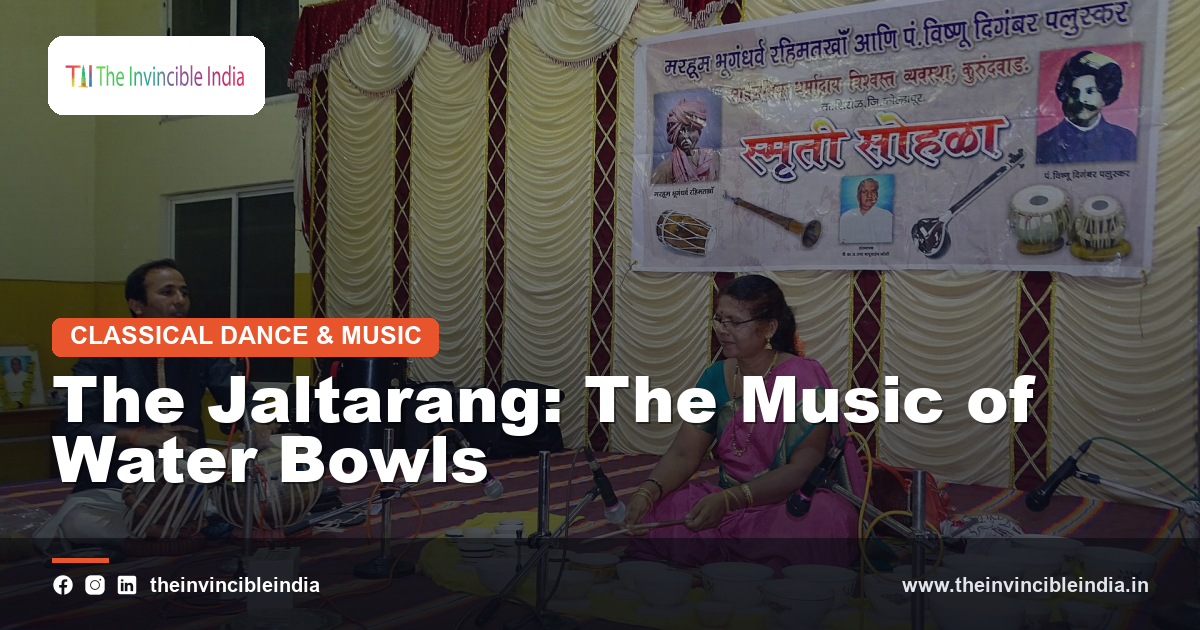
The jaltarang, whose name is often understood to mean waves of water, is one of the more unusual instruments in Indian classical music, consisting of a set of china or metal bowls filled with varying amounts of water and struck along the rim with a pair of light wooden mallets. Each bowl is tuned by adjusting the water it holds, so that together the set spans a melodic range capable of rendering a full raga within the framework of Hindustani classical music as well as Carnatic performance. Once more widely known, the instrument has become rare, sustained today by only a small number of dedicated performers. This guide traces its history, construction, tuning and continuing, if fragile, place in Indian musical life.
Quick Facts
| Detail | Information |
|---|---|
| Type | Melodic percussion of tuned water bowls (idiophone) |
| Origin | Ancient India, referenced in early musical texts |
| Bowls | China clay or metal bowls of graduated sizes |
| Tuning medium | Water level poured into each bowl |
| Played with | A pair of light wooden mallets or sticks |
| Status | Rare, sustained by a small number of dedicated performers |
What Is the Jaltarang
The jaltarang is a melodic percussion instrument consisting of a set of bowls, traditionally made of china clay or metal, arranged in a shallow curve or row and filled with water to differing levels so that each produces a distinct pitch when struck. A performer plays the instrument by tapping the rims of the bowls with a pair of light wooden sticks, moving quickly between them to render melodic lines much as a mallet player would on a xylophone or similar tuned percussion instrument. Its delicate, bell-like tone and the visible, tactile presence of water as a tuning medium make it one of the most distinctive instruments in the Indian classical tradition.
Meaning of the Name
The name jaltarang combines two elements broadly understood as water and waves or rhythm, a fitting description of an instrument whose very tuning depends on the presence and quantity of water within each bowl. This name reflects the instrument’s close, literal relationship with its tuning medium in a way unmatched by most other classical instruments, whose tuning depends on tension, length or thickness of strings or membranes rather than a liquid poured directly into the sounding body. The name has long served to distinguish the instrument clearly in musical literature and popular understanding alike, emphasising its unusual construction from the outset.
Ancient and Historical References
References to instruments built from tuned vessels appear in early Indian musical and literary sources, suggesting that some form of water-tuned percussion has a long history within the subcontinent’s musical culture, even if the exact instrument described in ancient times may have differed somewhat from the jaltarang played today. Over subsequent centuries the instrument was refined and adapted, eventually finding a place within both courtly and devotional musical settings. This long, if not always continuous, historical thread situates the jaltarang among the older instrumental traditions of Indian music, distinguishing it from instruments developed more recently.
The Bowls and Materials
A jaltarang set typically comprises a series of bowls of graduated size, most often made from fine china clay chosen for its clear, ringing tone when struck, though metal bowls are also used by some performers. The bowls are arranged carefully in a curved or semicircular row in front of the seated player, ordered from the largest, lowest-pitched bowl to the smallest, highest-pitched one, so that a smooth melodic run can be played by moving the mallets across them in sequence. The quality and thickness of each bowl affects its tone considerably, making careful selection an important part of assembling a good instrument.
Water as a Tuning Medium
Unlike almost any other instrument in Indian classical music, the jaltarang is tuned not through mechanical adjustment of strings or membranes but by carefully controlling the amount of water poured into each bowl, since a fuller bowl produces a lower pitch and a shallower one a higher pitch. This unusual tuning method requires a keen ear and considerable patience, as even small changes in water level noticeably shift a bowl’s pitch. The direct, visible relationship between water level and musical pitch is part of what makes the jaltarang such a striking and memorable instrument to witness in performance.
Arranging the Bowls
Before a performance, the bowls of a jaltarang must be arranged in careful order according to pitch, typically in a shallow arc that allows the player’s mallets to reach each one comfortably without unnecessary movement between distant bowls. This arrangement is as much a practical consideration as a musical one, since fluid melodic playing depends on being able to move rapidly and accurately between adjacent bowls during fast passages. Experienced performers develop their own preferred layouts suited to their playing style and the specific set of bowls they use, refined through long practice with a particular instrument.
Playing Technique with Mallets
The jaltarang is played by striking the rims of its bowls with a pair of light wooden sticks or mallets, held loosely to allow for quick, controlled movement across the arrangement of bowls. Producing a smooth melodic line requires considerable dexterity, since the player must strike accurately and with consistent force to maintain evenness of tone while moving rapidly between bowls of different sizes. Ornamentation and phrasing, central to Indian classical melody, must be approximated through careful timing and repetition of strokes, since, unlike a bowed or plucked string, a struck bowl cannot be bent in pitch once sounded.
Achieving a Melodic Range
A full jaltarang set is assembled and tuned to cover the notes needed for a given raga, meaning a performer must have access to enough bowls, and enough control over their tuning, to render both the fixed scale and the more subtle melodic movement expected in a serious performance. Because each bowl produces only a single fixed pitch once tuned, achieving a genuinely expressive melodic range demands both a well-chosen set of bowls and a player capable of shaping phrasing through rhythm, repetition and dynamic control rather than through pitch inflection alone.
Tuning Before a Performance
Preparing a jaltarang for performance is a lengthy and exacting process, requiring the performer to add or remove water from each bowl in turn while testing its pitch against a reference tone, repeating the process until the full set is correctly tuned to the chosen raga. This preparation can take a considerable amount of time before a concert even begins, reflecting the unusually hands-on and immediate relationship this instrument has with its tuning process compared to instruments tuned through pegs, strings or straps. Such careful preparation is essential, since even a slightly mistuned bowl can be immediately noticeable within a melodic phrase.
Retuning During Performance
Because water gradually evaporates and can be disturbed by the vibration of playing, a jaltarang may require subtle retuning even during the course of a performance, a practical challenge unique among Indian classical instruments. Experienced players learn to anticipate and manage these small shifts, sometimes making quick adjustments between passages to keep the bowls in tune. This ongoing sensitivity to environmental and physical change adds a further layer of difficulty to jaltarang performance, demanding not only musical skill but also close, continuous attention to the physical condition of the instrument itself.
Jaltarang in Hindustani Music
Within Hindustani classical music the jaltarang has historically been used to render ragas in a manner broadly analogous to melodic instruments such as the santoor, opening with a slow, exploratory unfolding of the raga before moving into more rhythmic passages. Its bell-like, resonant tone lends a particular delicacy to this repertoire, though the instrument’s practical limitations, including the lengthy preparation required and the difficulty of achieving continuous pitch inflection, have restricted its use largely to specialist performers rather than the broader instrumental mainstream of the tradition.
Jaltarang in Carnatic Music
The jaltarang has also historically found a place within Carnatic music, where it has been adapted to the melodic and rhythmic conventions of the South Indian classical tradition. As in Hindustani practice, its role has remained specialised rather than widespread, valued by connoisseurs for its distinctive timbre and historical pedigree even as more commonly used instruments dominate mainstream Carnatic concert programming. Performers working in this tradition must similarly master the demanding preparation and playing technique the instrument requires, adapting its repertoire to Carnatic melodic structures and performance conventions.
Jaltarang Repertoire
Jaltarang performances typically follow the broader conventions of Indian classical instrumental music, presenting ragas through a structured unfolding from slow melodic exploration to more rhythmically engaged passages performed with percussion accompaniment. Given the instrument’s particular strengths, lighter, more melodically direct ragas are often favoured, allowing the jaltarang’s clear, bell-like tone to be appreciated fully without requiring the continuous pitch-bending more easily achieved on bowed or plucked string instruments. This repertoire, though narrower than that of more mainstream instruments, has been carefully preserved and passed on by the small community of dedicated jaltarang performers.
A Rare and Fragile Tradition
Today the jaltarang is among the rarest instruments in Indian classical music, its lengthy preparation time, delicate bowls and specialised technique making it far less practical for regular performance than most other instruments in the tradition. As a result, relatively few musicians have taken up serious study of the instrument in recent generations, and its repertoire and technique survive largely through the efforts of a small number of committed practitioners and teachers. This fragility places the jaltarang among the more vulnerable strands of India’s classical instrumental heritage.
Efforts at Revival
In recent years, growing interest in India’s less commonly heard classical instruments has brought renewed attention to the jaltarang, with dedicated musicians performing and teaching the instrument in an effort to keep its tradition alive for future generations. Cultural institutions and music academies have occasionally featured the jaltarang in concerts and educational programmes, introducing new audiences to its unusual construction and delicate sound. While such efforts remain modest in scale compared to the instrument’s wider historical reach, they represent an important thread of continuity for a tradition otherwise at risk of fading from active practice.
The Jaltarang Today
The jaltarang survives today as a rare but treasured part of India’s classical instrumental heritage, admired for its unique construction and its gentle, resonant sound whenever it is performed. Sustained by a small number of dedicated musicians and occasional institutional support, its future depends heavily on continued interest from students willing to undertake its demanding preparation and technique. As audiences increasingly seek out India’s less familiar musical traditions, the jaltarang’s delicate music of water bowls stands as a reminder of the sheer inventiveness found throughout the country’s long classical instrumental history.
Sources & Further Reading
- Sangeet Natak Akademi, national academy for music, dance and drama (sangeetnatak.gov.in).
- Ministry of Culture, Government of India (indiaculture.gov.in).
Frequently Asked Questions
What is a jaltarang?
The jaltarang is a melodic percussion instrument made of a set of bowls filled with water to different levels, each tuned to a distinct pitch and struck with light wooden mallets to produce melody.
How is a jaltarang tuned?
A jaltarang is tuned by adjusting the amount of water in each bowl. A fuller bowl produces a lower pitch and a shallower bowl a higher pitch, allowing the full set to be tuned to a chosen raga.
What is a jaltarang made of?
A jaltarang typically consists of bowls made of fine china clay, though metal bowls are also used, arranged in a curved row in front of the seated player and filled with water.
Is the jaltarang commonly performed today?
No. The jaltarang is quite rare today, sustained by a small number of dedicated performers, largely because of the lengthy preparation and specialised technique the instrument requires.
How is the jaltarang played?
The jaltarang is played by striking the rims of its water-filled bowls with a pair of light wooden mallets, moving between bowls to produce a melodic line.


