

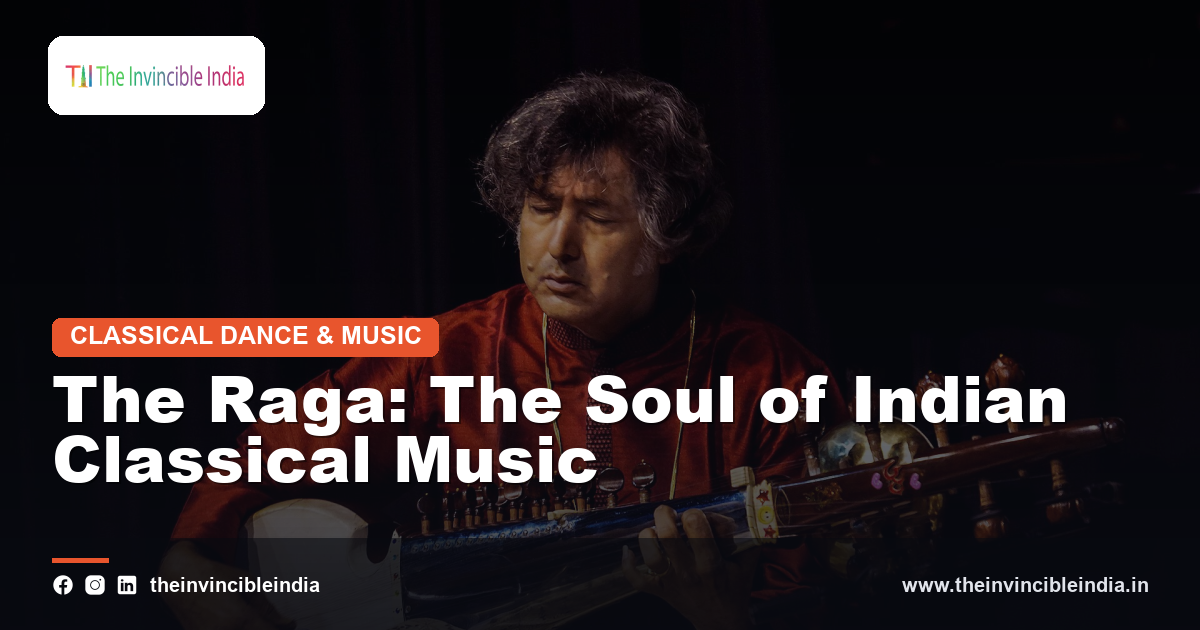
The raga is the very soul of Indian classical music, the melodic framework upon which both the Hindustani and Carnatic traditions are built. Far more than a scale, a raga is a living entity with its own personality, mood and rules of movement, offering the performer a disciplined structure within which to improvise with complete freedom. Each raga is associated with particular emotions, times of day or seasons, and a distinctive way of ascending and descending through its notes, so that no two ragas ever feel alike. Understanding the raga is the key to understanding Indian classical music itself, since every performance, whether vocal or instrumental, unfolds as the exploration of a single chosen raga. This guide explains what a raga is, how it works and why it remains central to Indian musical life.
Quick Facts
| Detail | Information |
|---|---|
| Type | A melodic framework at the heart of Indian classical music |
| Not the same as | A Western scale, though it shares some features |
| Core elements | A set of notes, rules of ascent and descent, and characteristic phrases |
| Character | Each raga carries its own mood, or rasa |
| Association | Many ragas are linked to a time of day or season |
| Use | The basis for improvisation in both Hindustani and Carnatic music |
More Than a Scale
A raga is often introduced to newcomers as a scale, but this description, while a useful starting point, understates what a raga truly is. A scale is simply a fixed sequence of notes, whereas a raga is a complete musical personality, defined not only by which notes it uses but by how those notes are approached, emphasised, combined and coloured. Two ragas may share exactly the same set of notes yet sound utterly distinct because of differences in phrasing, in which notes are stressed, and in the characteristic turns of melody that identify each one. To call a raga a scale is therefore rather like calling a person a skeleton: technically present, but missing everything that gives it life and identity.
The Notes of a Raga
Every raga is built from a selection of notes drawn from the twelve-note octave used in Indian music, and it need not use all twelve. Many ragas employ five, six or seven notes, and the pattern of ascent may differ from the pattern of descent, so that a note present on the way up might be omitted on the way down, or vice versa. This selective and directional use of notes is fundamental to a raga’s identity, and departing from it, even by a single note, can change the raga entirely or destroy its character. Musicians learn these note patterns, called the arohana and avarohana, as the essential skeleton of each raga, memorised precisely before any improvisation can begin.
Characteristic Phrases
Beyond its notes, a raga is defined by certain characteristic phrases, short melodic turns that recur throughout a performance and instantly identify the raga to a knowledgeable listener. These phrases capture the particular way a raga likes to move, which notes it lingers on, which it touches only in passing, and which combinations give it its flavour. A skilled musician weaves these phrases naturally into improvisation, returning to them often enough to keep the raga’s identity clear while still creating fresh and spontaneous melody. Learning to recognise and reproduce these phrases is one of the central tasks of classical music training, since without them a performance may use the correct notes yet fail to sound like the raga at all.
The Vadi and Samvadi
Within every raga, certain notes carry special importance, chief among them the vadi, the most prominent note, and the samvadi, the second most important. The vadi is emphasised more than any other note in a performance, lingered upon and returned to repeatedly, while the samvadi supports it in a secondary role. Together these two notes act almost like the tonal centre of gravity for the raga, shaping the contours of the melody around them. Identifying the vadi and samvadi is one of the first steps in learning a new raga, since the way a musician treats these notes does much to convey the particular mood and character that distinguishes one raga from another.
Mood and Emotion
Each raga is traditionally believed to evoke a particular mood or emotional flavour, known as its rasa, and this emotional character is considered inseparable from its musical structure. Some ragas are associated with devotion and peace, others with romance, longing, heroism or joy, and a skilled performer aims to bring out this emotional colouring so that listeners feel the intended mood even without understanding the technical structure. This belief in the emotional power of the ragas gives Indian classical music much of its expressive depth, treating melody not merely as an abstract pattern of sound but as a vehicle capable of stirring specific and recognisable feelings in the human heart.
Ragas and the Time of Day
A striking feature of the Hindustani tradition in particular is the association of many ragas with specific times of day or seasons, so that certain melodies are considered proper only for the early morning, others for midday, evening or the depths of night, and still others for particular seasons such as the monsoon or spring. This time theory reflects a belief that the character of a raga resonates naturally with the mood of a given hour or season, and traditional performers and listeners take this scheme seriously, scheduling concerts and practice accordingly wherever possible. While not always strictly observed in modern concert life, the time associations of the ragas remain a cherished and defining part of the classical tradition.
Raga in Hindustani Music
In the Hindustani classical tradition of North India, the raga is explored through an elaborate and largely improvised structure that typically begins with the alap, a slow, unmetered unfolding of the raga’s notes and character without rhythmic accompaniment. This is followed by compositions set to rhythmic cycles, accompanied by the tabla, in which the performer alternates between the fixed composed melody and passages of increasingly elaborate improvisation. The Hindustani approach places great emphasis on this gradual, meditative unveiling of a raga’s personality, allowing performer and listener alike to dwell deeply in its mood before the music builds towards rhythmic excitement and virtuosic display.
Raga in Carnatic Music
In the Carnatic classical music of South India, the raga is likewise central, but it is approached through its own distinct conventions, including the alapana, an improvised and unmetered exploration of the raga’s character similar in spirit to the Hindustani alap. Carnatic music organises its ragas within an elaborate and highly systematic theoretical framework, classifying scales into parent structures from which numerous ragas are derived. Compositions in Carnatic music are usually more fixed and elaborately structured than in the Hindustani style, yet they still leave substantial room for the performer’s improvisational exploration of the chosen raga’s melodic possibilities.
Melodic Framework, Not Fixed Melody
It is essential to understand that a raga is not itself a single fixed tune but rather a framework within which countless different melodies can be created, all recognisably belonging to that raga. This is what allows Indian classical music to be so richly improvisational: a performer does not simply reproduce a memorised piece but creates new melodic content in real time, guided by the rules, phrases and mood of the raga. Two performances of the same raga by different musicians, or even by the same musician on different occasions, will never be identical, yet both will be unmistakably recognisable as explorations of that one raga, a balance of discipline and freedom that lies at the heart of the tradition.
Learning a Raga
Learning a raga is a gradual and disciplined process, traditionally undertaken under the close guidance of a guru, and it goes far beyond memorising a set of notes. A student must absorb the raga’s characteristic phrases, its treatment of the vadi and samvadi, its typical ornaments and its emotional character, largely through careful listening and patient imitation over months or years. Only after this deep internalisation can a student begin to improvise convincingly within the raga’s boundaries. This lengthy apprenticeship reflects the fact that a raga is less a piece of information to be learned than a musical sensibility to be cultivated, absorbed slowly until it becomes second nature.
The Number of Ragas
Indian classical music encompasses a very large number of ragas, with new ones occasionally created even in modern times, though only a portion remain in regular performance. Some ragas are extremely popular and frequently heard, forming the core repertoire that most students learn first, while others are rare, demanding or associated with particular lineages and heard only occasionally in concert. Both Hindustani and Carnatic traditions maintain elaborate systems for classifying and relating their ragas to one another, grouping them into families based on shared scales or melodic features. This vast and still-growing repertoire reflects centuries of musical creativity across the Indian subcontinent.
Raga and Instrumental Music
While the raga tradition is rooted in vocal music, considered the most direct expression of a raga’s character, it is equally central to instrumental performance on instruments such as the sitar, the sarod, the bansuri and the veena. Instrumentalists strive to make their instruments sing in the manner of the human voice, reproducing the same slides, ornaments and phrasing that define vocal renditions of a raga. This close relationship between vocal and instrumental approaches to raga has shaped the technique and construction of Indian instruments themselves, many of which are specifically designed to imitate the expressive, gliding quality of the singing voice as it moves through a raga.
The Drone and the Raga
No exploration of a raga takes place without the continuous accompaniment of a drone, typically provided by the tanpura, which sounds a small number of fixed notes throughout a performance. This unchanging drone establishes the tonal centre against which every note of the raga is heard and judged, giving listeners and performers alike a constant reference point. The drone may seem a modest, background element, but it is indispensable, since the precise intonation and emotional colour of a raga’s notes can only be fully appreciated in relation to this steady, sustained foundation. A performance without a drone would lose much of its tonal clarity and grounding.
Ragas Beyond the Concert Hall
Although most closely associated with formal classical concerts, ragas also inform devotional music, film scores and various folk and light classical genres across India, demonstrating the deep penetration of raga-based thinking into the wider musical culture. Composers of film music have often drawn on well-known ragas to lend a particular mood or flavour to a song, while devotional singers use ragas to enhance the emotional and spiritual power of their hymns. This broad presence of raga beyond the concert hall shows that the raga is not a narrow academic concept but a living musical resource, understood and felt by audiences far beyond the specialists of classical music.
Preserving the Raga Tradition
The raga tradition has been preserved and transmitted for centuries chiefly through the guru-shishya relationship, in which knowledge passes directly from teacher to student through listening, imitation and correction rather than through written notation alone. While some notation systems exist and are used for reference, they can never fully capture the subtle ornaments, microtonal inflections and improvisational spirit that bring a raga to life. Institutions such as music academies and cultural bodies now support this living oral tradition alongside the older lineages of hereditary and discipleship-based teaching, helping ensure that the vast repertoire of ragas continues to be learned accurately and passed on to future generations.
The Raga Today
Today the raga remains the living foundation of Indian classical music, studied by students, performed by musicians and appreciated by audiences across India and around the world. Far from being a fixed relic of the past, the raga tradition continues to evolve, with contemporary musicians exploring known ragas in new ways and occasionally introducing new ones, while remaining faithful to the essential principles that have governed raga music for centuries. As both a rigorous discipline and a boundless field for creative expression, the raga endures as one of India’s most profound and distinctive contributions to the world’s musical heritage, a framework capable of infinite variation from a finite and carefully guarded set of rules.
Sources & Further Reading
- Sangeet Natak Akademi, national academy for music, dance and drama, on the theory and practice of Indian classical music (sangeetnatak.gov.in).
- Ministry of Culture, Government of India, on the classical music traditions of India (indiaculture.gov.in).
Frequently Asked Questions
What is a raga in simple terms?
A raga is a melodic framework in Indian classical music, defined by a set of notes, specific rules for ascending and descending through them, characteristic phrases, and an associated mood, from which a musician improvises new melodies while keeping the raga recognisable.
How is a raga different from a Western scale?
A scale is a fixed sequence of notes, while a raga also specifies which notes to emphasise, characteristic melodic phrases, a particular mood, and often an association with a time of day, making it a far richer and more personality-laden musical concept.
Are ragas linked to specific times of day?
Yes, particularly in the Hindustani tradition, many ragas are traditionally associated with a specific time of day or season, reflecting a belief that their character resonates with the natural mood of that hour, though this is followed loosely in modern concert life.
What are the vadi and samvadi of a raga?
The vadi is the most emphasised note of a raga and the samvadi is the second most important, and together they act as a tonal centre of gravity, with a performer’s treatment of these two notes shaping much of the raga’s distinctive character.
Is a raga the same every time it is performed?
No. A raga is a framework for improvisation rather than a fixed melody, so no two performances are identical, yet both remain recognisable as the same raga through their shared notes, phrases, mood and rules of movement.


