

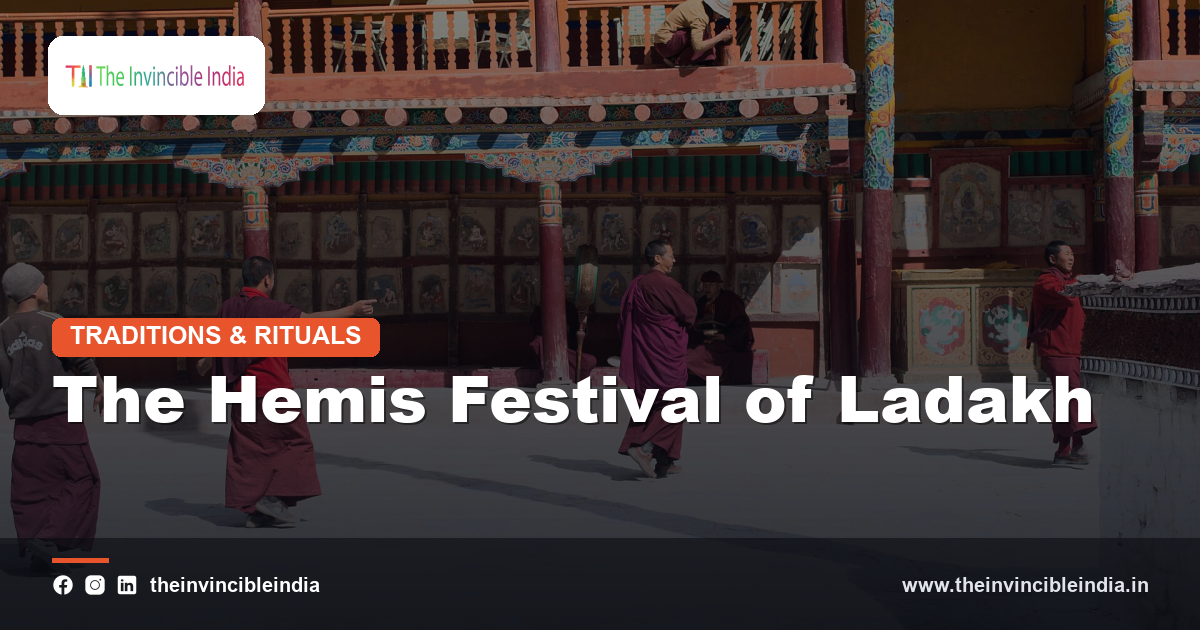
The Hemis Festival is one of the most vivid expressions of Buddhist monastic life in the trans-Himalayan region of Ladakh, held each year at Hemis Monastery amid the arid mountains of the union territory of Jammu and Kashmir. Renowned for its masked dances, ceremonial drums, and gathering of monks in elaborate costume, the festival draws pilgrims, local villagers, and visitors from far beyond the valley. Like other major seasonal celebrations across India, including the autumn observance of Navratri, Hemis reflects how ritual calendars structure community life, though its Buddhist character and high-altitude setting give it a distinct flavour. This guide explores its origins, rituals, and enduring place in Ladakhi identity.
Quick Facts
| Detail | Information |
|---|---|
| Location | Hemis Monastery, Ladakh, Jammu and Kashmir (UT) |
| Religious Tradition | Tibetan Buddhism, Drukpa Kagyu lineage |
| Main Feature | Masked chaam dances performed by monks |
| Associated Figure | Guru Padmasambhava (Guru Rinpoche) |
| Typical Season | Summer, per the Tibetan lunar calendar |
| Open To | Pilgrims, local residents, and visitors |
Origins and Meaning of the Festival
The Hemis Festival takes its name from Hemis Monastery, the largest and one of the most influential Buddhist institutions in Ladakh, where the celebration is centred each year. It commemorates the life and teachings associated with a revered spiritual master whose influence shaped the spread of Buddhism across the Himalayan belt, and it is observed according to the Tibetan lunar calendar rather than a fixed date on the standard civil calendar. For the monks who organise it and the villagers who attend, the festival is understood less as a public spectacle and more as an act of devotion, a way of renewing the community’s connection to its spiritual heritage. Over generations it has also become a marker of cultural continuity for Ladakh, a region whose Buddhist traditions differ markedly from those of the Indian plains. The festival’s meaning therefore operates on two levels at once, religious remembrance for the monastic community and cultural affirmation for the wider Ladakhi population who gather each year to witness it.
Hemis Monastery: A Seat of the Drukpa Lineage
Hemis Monastery, or Hemis Gompa, stands among the most prominent monastic establishments of the Drukpa Kagyu school of Tibetan Buddhism, a lineage with a long-standing presence in Ladakh. Built into the folds of a valley away from the main highway, the monastery has functioned for centuries as a centre of religious learning, meditation, and monastic administration for the surrounding region. Its architecture follows the conventions of Himalayan Buddhist monastic building, with prayer halls, painted murals, and a treasury of religious artefacts accumulated over generations of patronage. The monastery’s abbot and resident monks are responsible for maintaining its rituals, including the annual festival, and for training younger monks in the disciplines of chanting, ritual dance, and doctrinal study. Because of its size and standing, Hemis has long served as a reference point for Buddhist practice in Ladakh, drawing monks and devotees from smaller monasteries across the region to participate in its major ceremonial occasions.
Guru Padmasambhava and the Festival's Spiritual Roots
The festival’s devotional core centres on Guru Padmasambhava, also known as Guru Rinpoche, a spiritual figure credited across the Himalayan Buddhist world with helping establish Buddhist teaching and practice in the region during the early centuries of its transmission from India and Tibet. He is venerated as a guide who overcame obstacles to the spread of the Buddhist path, and his life is remembered through recitation, symbolic dance, and the display of sacred imagery during the Hemis observance. Rather than treating him as a distant historical figure, Ladakhi Buddhist tradition regards him as an ongoing source of blessing, invoked at the start of important rituals. The festival’s timing and structure are built around this remembrance, with monks performing the choreography associated with his legend and reciting prayers connected to his teaching. This spiritual framing gives Hemis its distinct character among Himalayan festivals, situating a communal celebration within a specific lineage of devotion rather than a purely seasonal occasion.
The Chaam: Masked Dance Tradition
At the heart of the Hemis Festival is the chaam, a tradition of masked ritual dance performed by monks in the monastery courtyard before an audience of pilgrims and visitors. Each dancer wears an elaborately painted mask representing a specific deity, protector figure, or symbolic character drawn from Buddhist cosmology, and moves through a sequence of slow, deliberate steps accompanied by percussion and horn. The dance is not entertainment in the conventional sense but a form of ritual enactment, believed to dispel negative influences and reaffirm the protective presence of Buddhist teachings over the community. Training for the chaam takes place well in advance, as the choreography, timing, and costume changes require considerable discipline from the monks involved. Similar masked-dance traditions exist at other Himalayan monasteries, but the Hemis version is among the most widely known outside the region, in part because of its scale and the accessibility of the monastery to visitors during festival season.
Symbolism of the Masks and Costumes
The masks worn during the chaam are carefully crafted objects in their own right, carved and painted to represent specific figures from the Buddhist pantheon, including wrathful protector deities whose fearsome appearance is understood as a defence against harm rather than a sign of malevolence. Bright colours, exaggerated features, and layered costumes of brocade and silk contribute to a visual language that would have been immediately legible to a traditional audience familiar with the underlying stories. The costumes themselves are often heavy and elaborate, requiring monks to train physically for the stamina the dances demand. Many of the masks and garments used in the festival are treated as monastery property, maintained and stored with care between performances, and some are considered old enough to carry their own history within the monastic community. The visual richness of the chaam is one of the main reasons the festival has become known well beyond Ladakh, offering a striking display of craftsmanship alongside its religious purpose.
Monastic Preparation and Rehearsal
Preparation for the Hemis Festival begins well before the day itself, as the monastery’s monks rehearse the sequence of dances, refresh the ritual objects to be used, and coordinate the logistics of hosting a large gathering of visitors. Senior monks who have performed the chaam in previous years often guide younger participants through the precise choreography, since even small deviations are considered significant in a tradition that values exactness in ritual performance. Musical accompaniment, provided by long horns, cymbals, and drums, is rehearsed alongside the dance steps to ensure the two remain synchronised during the actual event. Beyond the dance itself, monastery staff prepare the courtyard, arrange seating areas, and organise the ceremonial items that will be displayed. This period of preparation reflects the discipline embedded in monastic life more broadly, where structured routine and repeated practice are understood as a path to spiritual refinement, not merely a means of staging a public event.
The Ritual Structure of the Festival Day
On the day of the festival, the courtyard of Hemis Monastery fills with monks, local families, and visitors who gather to watch the sequence of ceremonies unfold. The proceedings typically open with prayers and the sounding of ceremonial horns, followed by the entrance of the masked dancers in a fixed order determined by tradition. Between dance sequences, monks may recite verses or perform additional ritual actions connected to the deities being represented. The event unfolds over the course of the day, with breaks that allow both performers and audience to rest before the next phase begins. Throughout, there is a clear distinction maintained between the sacred space of the ritual performance and the surrounding area where spectators are seated, reflecting the festival’s identity as a religious observance rather than a purely public entertainment. This structure has been maintained across generations, giving the festival a recognisable rhythm that returning visitors and devotees have come to expect.
Music, Drums, and Ceremonial Instruments
Music forms an inseparable part of the Hemis Festival, with long telescopic horns, hand cymbals, and large drums providing the rhythmic and tonal backdrop against which the chaam dancers move. These instruments are traditional to Himalayan Buddhist monastic practice and are also used during regular ritual life at the monastery, though the festival showcases them at their fullest. The deep resonance of the horns is intended to carry across the courtyard and beyond, signalling the different stages of the ceremony to both performers and onlookers. Drummers and cymbal players require considerable skill to maintain the precise tempo the dance demands, and their role is regarded as integral to the ritual’s effectiveness rather than incidental accompaniment. The combination of visual spectacle and layered sound is often what visitors remember most vividly, even though, for the monastic community, the music serves a functional and symbolic purpose within the wider structure of the observance.
The Sacred Thangka Display
Hemis Monastery is also known for its collection of thangkas, large painted or appliqued scroll images depicting Buddhist deities and teachers, some of which are considered among the most valuable pieces of religious art in the region. On especially significant occasions, an exceptionally large thangka associated with Guru Padmasambhava is unveiled and displayed to the public, an event treated with particular reverence by pilgrims who may travel considerable distances for the opportunity to view it. Because such a display does not occur every year, it is regarded as a rare privilege when it coincides with the festival calendar. The thangka itself is stored carefully between showings, reflecting both its material value and its spiritual significance to the monastic community. Its occasional display adds another layer of anticipation to the Hemis Festival for devotees, who understand the unveiling as a special blessing rather than a routine part of the annual programme.
Role of Lamas and Monks
The lamas and monks of Hemis Monastery are central to every aspect of the festival, from the months of preparatory rehearsal to the performance of the chaam and the recitation of accompanying prayers. Senior lamas oversee the ritual correctness of the proceedings, ensuring that the sequence of dances, music, and offerings follows established monastic convention. Younger monks, meanwhile, gain practical experience in ritual performance, learning skills that will remain part of their religious training for years to come. This intergenerational structure allows the festival’s traditions to be passed on directly through practice rather than through written instruction alone. Beyond their ceremonial duties, monks also serve as hosts to the visiting public, managing the flow of pilgrims and guests through the monastery grounds during the busiest day of the religious calendar. Their combined role as performers, ritual specialists, and custodians of the monastery underlines how deeply the festival is embedded in the institution’s daily monastic life.
Ladakhi Buddhist Culture and Identity
Beyond its religious content, the Hemis Festival occupies an important place in the cultural identity of Ladakh, a region where Tibetan Buddhist tradition has long coexisted with the broader cultural and religious diversity of the Indian Himalayas. For many Ladakhi families, attending the festival is as much an affirmation of local identity and heritage as it is an act of religious devotion, reinforcing ties to a community defined by shared language, custom, and monastic affiliation. The festival also provides an occasion for extended families to gather, for traditional dress to be worn, and for local food and craft to be shared among attendees. In a region that has experienced considerable social and economic change in recent decades, events like Hemis serve as anchors of continuity, connecting younger generations to practices maintained by their elders. This cultural dimension exists alongside, rather than in place of, the festival’s religious purpose, and the two are difficult to separate in practice.
Seasonal and Geographic Context of Ladakh
Ladakh’s high-altitude desert landscape, with its dramatic mountain ranges and short growing season, shapes the rhythm of life for its residents and, by extension, the timing of its festivals. The Hemis Festival falls during the summer months, when mountain passes are more accessible and travel within the region becomes easier, allowing pilgrims and visitors from more distant villages to attend. This period also coincides with a relatively active season for trade and tourism in Ladakh, meaning the festival draws a wider audience than it might during the harsher winter months when the region is more isolated. The physical setting of the monastery itself, tucked into a valley with views of surrounding peaks, adds to the atmosphere of the event, situating a centuries-old ritual tradition within one of the most striking landscapes in the Indian Himalayas. Geography and season together help explain both the practical timing of the festival and its long-standing appeal to visitors from outside the region.
Local Community Participation
While the monks of Hemis Monastery lead the ceremonial proceedings, the festival would not take its present form without the active participation of the surrounding lay community. Local families travel from nearby villages, often dressed in traditional Ladakhi attire, to attend the festival as an important date in their annual calendar. Some residents assist with logistical aspects of hosting the event, from managing crowds to supporting the monastery’s hospitality for visiting pilgrims. Stalls selling local handicrafts, food, and everyday goods often appear around the monastery grounds during the festival period, reflecting the way religious observance and community commerce have historically coexisted at such gatherings. For many Ladakhis, the festival is also a rare opportunity to meet relatives and acquaintances from other villages, turning a religious event into a broader social occasion. This blending of devotion, commerce, and community gathering is characteristic of major festivals across India, even as the specific rituals at Hemis remain distinct.
Visitors, Pilgrims, and Cultural Tourism
In recent decades, the Hemis Festival has become increasingly well known beyond Ladakh, drawing domestic and international visitors interested in Himalayan Buddhist culture and ritual performance. This growing attention has brought both opportunities and challenges for the monastery, which must balance its role as a functioning religious institution with its position as a notable destination for cultural tourism. Tour operators and travel agencies often build itineraries around the festival dates, and accommodation in the surrounding area can be in high demand during the period leading up to the event. For visitors, the festival offers a rare chance to observe a living monastic tradition rather than a staged reconstruction, though monastery authorities generally ask that guests observe appropriate conduct out of respect for the ritual’s sacred character. The presence of outside visitors has not fundamentally altered the festival’s structure, which continues to be organised primarily according to the needs and traditions of the monastic community rather than tourism demand.
Conservation of Monastic Heritage
Hemis Monastery’s role as custodian of religious art, ritual objects, and architectural heritage has made conservation an ongoing concern for those responsible for its upkeep. The monastery houses a range of valuable items, including painted thangkas, ritual masks, and manuscripts, all of which require careful storage and periodic restoration to withstand Ladakh’s extreme climate and the wear of repeated ceremonial use. Efforts to document and preserve these items have, in various periods, involved collaboration between monastic authorities and heritage or cultural organisations interested in safeguarding Himalayan Buddhist material culture. The festival itself, by keeping the associated rituals, music, and dance in active practice, functions as a form of living conservation, ensuring that skills and knowledge are transmitted through performance rather than becoming purely historical record. Balancing the practical demands of hosting a major public event with the long-term preservation of fragile artefacts remains a continuing responsibility for the monastery’s leadership.
Hemis Festival Today
Today, the Hemis Festival continues to serve the dual role it has long occupied, a solemn religious observance for the monastic community and a widely recognised cultural event for Ladakh as a whole. It remains rooted in the same core elements that have defined it for generations: the chaam dances, the ceremonial music, and the devotional focus on Guru Padmasambhava’s legacy. At the same time, growing outside interest has given the festival a visibility that extends well beyond the valley, introducing new audiences to a tradition long sustained primarily within monastic and local circles. Hemis Monastery and its resident monks continue to manage this balance, preserving the ritual integrity of the occasion while accommodating the interest of visitors drawn by its reputation. As one of the most distinctive expressions of Himalayan Buddhist culture in India, the Hemis Festival stands as a reminder of how deeply ritual, art, and community life remain interwoven in Ladakh’s monastic heritage.
Sources & Further Reading
- Ministry of Culture, Government of India (indiaculture.gov.in).
- Ministry of Tourism, Government of India (tourism.gov.in).
Frequently Asked Questions
What is the Hemis Festival?
The Hemis Festival is an annual Buddhist monastic celebration held at Hemis Monastery in Ladakh, featuring masked ritual dances and ceremonies connected to the legacy of Guru Padmasambhava. It is one of the most prominent religious festivals in the region.
Where does the festival take place?
It is held at Hemis Monastery, a major seat of the Drukpa Kagyu lineage of Tibetan Buddhism located in a valley in Ladakh, in the union territory of Jammu and Kashmir.
What is the chaam dance performed during the festival?
The chaam is a tradition of masked ritual dance performed by monks, in which each performer represents a specific deity or protective figure. It is considered a form of religious practice rather than simple entertainment.
Who organises the Hemis Festival?
The festival is organised by the monks and administration of Hemis Monastery, who oversee the months of preparation, rehearsal, and ritual arrangements required for the event each year.
Can visitors attend the Hemis Festival?
Yes, visitors and pilgrims from within Ladakh and beyond are welcome to attend, though guests are generally expected to observe respectful conduct given the ceremony’s religious significance.


