

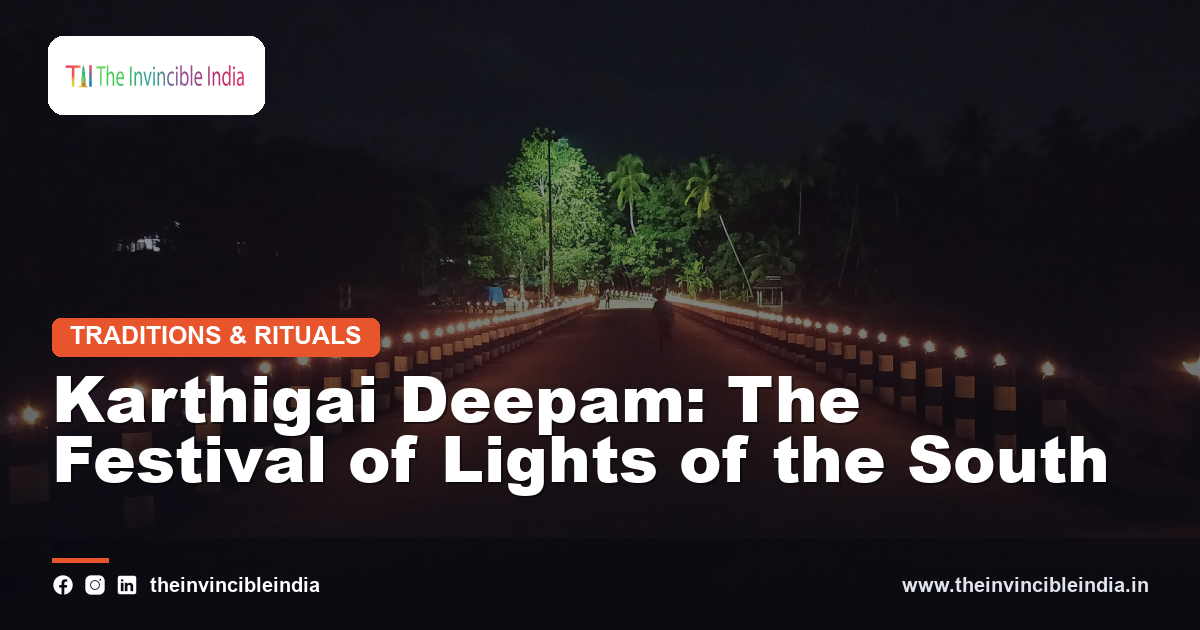
Karthigai Deepam is one of the most significant festivals of Tamil Nadu, celebrated as a festival of lights with a distinct identity from the more widely known Diwali celebrations of northern India. Observed during the Tamil month of Karthigai, when the moon aligns with the Krittika Nakshatra, the festival honours Lord Shiva and is closely associated with Lord Murugan. Its most striking expression is the lighting of countless deepams, or oil lamps, outside homes, temples, and public spaces across South India. The festival reaches its most dramatic form at Thiruvannamalai, where a massive flame is lit atop the hill overlooking the town, drawing pilgrims from across the region.
Quick Facts
| Detail | Information |
|---|---|
| Festival Type | Hindu festival of lights |
| Primary Region | Tamil Nadu and other parts of South India |
| Presiding Deities | Lord Shiva and Lord Murugan |
| Timing | Tamil month of Karthigai, coinciding with the Krittika Nakshatra |
| Key Site | Thiruvannamalai, home of the Annamalaiyar Temple |
| Associated Practices | Lighting of deepams, rangoli, and temple illuminations |
Origins and Meaning of Karthigai Deepam
Karthigai Deepam takes its name from the Tamil month of Karthigai and the deepams, or lamps, that are lit throughout the festival period. The celebration is counted among the oldest festivals observed in Tamil Nadu, with references to lamp-lighting customs during this month appearing in classical Tamil literary and devotional traditions. At its core, the festival is understood as a celebration of light overcoming darkness, a theme common to many festivals across India, expressed here through the specific regional customs of Tamil culture. The lighting of lamps is considered both a devotional offering and a symbolic gesture, inviting divine blessings into the home. Over time, the festival has retained its essentially devotional character while becoming a broader cultural occasion celebrated by Tamil communities both within India and abroad, linking present-day observance to a long continuous tradition.
The Krittika Nakshatra Connection
The timing of Karthigai Deepam is determined by the Krittika Nakshatra, a lunar asterism after which the festival takes its name. The festival falls on the full moon day when the moon is in conjunction with this star cluster, typically during the Tamil month of Karthigai. This astronomical basis for timing reflects a broader tradition within Hindu festival calendars of aligning celebrations with specific lunar positions rather than fixed calendar dates. The Krittika Nakshatra itself holds symbolic association with Lord Murugan in South Indian tradition, reinforcing the festival’s connection to this deity alongside Lord Shiva. This celestial grounding gives Karthigai Deepam a distinct calendrical identity separate from festivals of light observed elsewhere in India, situating it firmly within the astronomical and devotional framework particular to Tamil Hindu practice.
Mythological Significance: The Jyoti Lingam
Central to the religious meaning of Karthigai Deepam is the belief associated with Lord Shiva manifesting as a column of light, known as the jyoti lingam, at Thiruvannamalai. This narrative describes Shiva appearing in a form of infinite light to resolve a dispute over supremacy, ultimately choosing the hill at Thiruvannamalai as the site of this manifestation. The festival’s central act of lighting a great flame atop the hill is understood as a commemorative re-enactment of this divine appearance. This mythological grounding gives the festival’s most visually striking ritual, the lighting of the Maha Deepam, a specific theological meaning beyond its general symbolism of light and illumination. It positions Thiruvannamalai as uniquely significant within the observance, distinguishing it from the more generally distributed lamp-lighting practised in homes and temples elsewhere.
Thiruvannamalai and the Annamalaiyar Temple
Thiruvannamalai, home to the historic Annamalaiyar Temple, serves as the principal site associated with Karthigai Deepam. The temple, one of the largest in Tamil Nadu, is dedicated to Lord Shiva in his form associated with the sacred hill overlooking the town. During the festival, the temple becomes the focus of elaborate rituals, processions, and preparations leading up to the lighting of the great flame. Pilgrims travel from across Tamil Nadu and beyond to witness the ceremonies, many undertaking a ritual circumambulation of the hill known as Girivalam as part of their observance. The temple’s scale and historical importance make it a natural centre for the festival’s most significant rites, and its association with Karthigai Deepam has, over generations, become inseparable from the town’s broader religious identity.
The Maha Deepam Atop the Hill
The most visually dramatic element of Karthigai Deepam is the Maha Deepam, a great flame lit within a large cauldron atop Thiruvannamalai hill on the culminating night of the festival. Filled with ghee and a substantial wick, the flame is lit at an auspicious moment and is intended to remain visible for an extended period, symbolising the eternal light of Shiva. Thousands of devotees gather at the base of the hill and in the surrounding town to witness the lighting, often after completing the Girivalam circumambulation. The flame’s visibility from a great distance is considered symbolically significant, representing the illumination of divine presence across the land. This singular ritual act, performed once each year, stands as the ceremonial high point of the entire festival.
Lighting Lamps: Home Traditions
Beyond the grand ceremonies at Thiruvannamalai, Karthigai Deepam is observed in homes across Tamil Nadu and neighbouring regions through the simple but meaningful act of lighting rows of oil lamps. Households place lit deepams along windowsills, doorways, and courtyards, illuminating streets and neighbourhoods after nightfall. This domestic practice allows every family, regardless of location, to participate meaningfully in the festival’s central theme of light. The lamps are traditionally filled with sesame oil or ghee and are lit at dusk, often accompanied by prayers offered by family members. This widespread home-based observance ensures that Karthigai Deepam is experienced as both a grand public spectacle at pilgrimage sites and an intimate household ritual, connecting individual families to the festival’s broader religious significance.
Karthigai Deepam and Lord Murugan
While Karthigai Deepam is most closely associated with Lord Shiva through the Thiruvannamalai tradition, the festival’s timing and themes also connect it to Lord Murugan, whose worship is deeply significant in Tamil Hindu culture. The Krittika Nakshatra, from which the festival’s name derives, carries mythological associations with Murugan in South Indian tradition. Temples dedicated to Murugan across Tamil Nadu often hold special observances during the Karthigai Deepam period, including additional lamp-lighting and festive worship. This dual association with both Shiva and Murugan reflects the layered religious meanings that have accumulated around the festival over time, allowing devotees of either deity to find personal significance in its observance according to regional and familial traditions.
Temple Celebrations Across Tamil Nadu
Karthigai Deepam is celebrated not only at Thiruvannamalai but at temples throughout Tamil Nadu, each observing the festival with lamp-lighting ceremonies suited to local tradition. Temple premises are illuminated with rows of oil lamps, and special prayers and processions are conducted to mark the occasion. Many temples organise their own version of a central flame lighting, on a smaller scale than the Thiruvannamalai Maha Deepam, reflecting the festival’s broad regional observance beyond its principal pilgrimage site. These temple celebrations often draw local communities together for shared worship and festive gatherings, reinforcing social as well as religious bonds. The widespread nature of these observances demonstrates how a festival with one primary site of mythological significance can nonetheless be meaningfully celebrated across an entire region through localised temple traditions.
Karthigai Adai and Festive Foods
Food traditions associated with Karthigai Deepam include the preparation of adai, a savoury lentil and rice pancake, often prepared specifically for the festival and known in this context as Karthigai adai. Sweet dishes and traditional South Indian preparations are also made and shared among family members and neighbours during the festive period. Preparing and distributing these foods is considered part of the festival’s spirit of communal celebration, with households often exchanging dishes as a gesture of goodwill. These culinary customs, passed down through generations, add a distinct sensory dimension to the festival, linking taste and shared mealtime to the broader themes of light, devotion, and community that define Karthigai Deepam across Tamil households.
Rangoli and Decorative Customs
Alongside the lighting of lamps, households mark Karthigai Deepam with decorative kolam or rangoli patterns drawn at entrances using rice flour or coloured powders. These intricate geometric and floral designs are considered auspicious, welcoming prosperity and positive energy into the home during the festival period. The combination of illuminated lamps and decorated thresholds transforms residential streets into vibrant displays each evening of the festival. This tradition of decorative art, closely tied to South Indian domestic culture more broadly, finds heightened expression during Karthigai Deepam, when households often devote particular care and creativity to their kolam designs. Such decorative customs reinforce the festival’s association with beauty, welcome, and the symbolic dispelling of darkness.
Duration and Timing of the Festival
Karthigai Deepam falls during the Tamil month of Karthigai, which typically corresponds to the November-December period, with the main day of celebration determined by the alignment of the full moon with the Krittika Nakshatra. Preparations and associated observances, including the Girivalam pilgrimage at Thiruvannamalai, may extend over several days surrounding the principal date. The festival’s timing situates it within a broader season of festivals observed across India during this part of the year, though its specific customs and mythological associations remain distinctly Tamil. This lunar-based scheduling, rather than a fixed solar date, is characteristic of many traditional Hindu festivals and reflects the continued use of established calendrical systems in determining religious observance.
Regional Variations in South India
While Tamil Nadu remains the primary centre of Karthigai Deepam observance, related customs are also found in parts of Karnataka, Andhra Pradesh, and other neighbouring regions, often under related names and with locally adapted practices. The core themes of lamp-lighting and devotion to Shiva or regional deities remain consistent, even as specific rituals, foods, and the scale of celebration vary from place to place. This regional spread demonstrates how a festival rooted in a particular linguistic and cultural tradition can nonetheless resonate across a wider geographic area through shared religious themes. Understanding these variations offers insight into the broader networks of cultural exchange and religious practice that have historically connected communities across South India.
Comparisons with Diwali
Karthigai Deepam is sometimes described as a southern counterpart to Diwali, given the shared theme of lamp-lighting as an expression of festive devotion. However, the two festivals differ significantly in their mythological basis, timing, and associated deities, with Karthigai Deepam centred on Lord Shiva and the Krittika Nakshatra rather than the narratives associated with Diwali in other parts of India. Some households in Tamil Nadu observe both festivals, recognising them as distinct traditions with their own regional significance rather than variations of a single celebration. This comparison, while useful for those unfamiliar with South Indian traditions, should not obscure the festival’s independent identity and long-standing place within Tamil religious and cultural life.
Cultural Identity and Tamil Heritage
Karthigai Deepam holds a place of particular importance in Tamil cultural identity, reflecting a festival tradition that predates many other well-known Indian celebrations in its recorded literary references. Its continued observance, both through grand pilgrimage rituals and modest home-based lamp-lighting, reflects the resilience of Tamil religious and cultural practice across generations. For many Tamil families, the festival represents a connection to language, literature, and devotional tradition specific to their regional heritage, distinct from pan-Indian celebrations. This sense of cultural rootedness has helped sustain the festival’s popularity even as broader social and economic changes have reshaped many aspects of daily life in South India, reinforcing its role as a marker of Tamil identity.
Community and Family Participation
Karthigai Deepam brings together family and community in shared preparation and celebration, from the collective lighting of lamps in neighbourhoods to group participation in temple rituals and pilgrimage. Extended families often gather for the occasion, and neighbours frequently coordinate their lamp displays, turning individual household observance into a collective community event. Temples and local associations may also organise communal activities, including group lamp-lighting ceremonies and cultural programmes, that draw wider participation beyond individual households. This communal dimension reinforces social bonds within Tamil communities, both in India and among diaspora populations who continue to observe the festival abroad, ensuring that Karthigai Deepam remains a vibrant and shared cultural experience rather than a purely private religious observance.
Karthigai Deepam Today
Today, Karthigai Deepam continues to be observed with enthusiasm across Tamil Nadu and by Tamil communities worldwide, blending ancient ritual with contemporary life. The Thiruvannamalai celebrations continue to draw large numbers of pilgrims each year, while home-based lamp-lighting remains a cherished practice in households of all backgrounds. Modern conveniences, including electric lighting, have supplemented but not replaced the traditional oil lamps central to the festival’s identity. Cultural organisations and temples continue to promote awareness of the festival’s history and significance, helping ensure that younger generations understand its mythological and cultural roots. As both a major pilgrimage occasion and an intimate household tradition, Karthigai Deepam remains one of the clearest expressions of Tamil religious and cultural continuity in the present day.
Sources & Further Reading
- Tamil Nadu Tourism, Government of Tamil Nadu (tamilnadutourism.tn.gov.in).
- Hindu Religious and Charitable Endowments Department, Tamil Nadu.
Frequently Asked Questions
What is Karthigai Deepam?
Karthigai Deepam is a Tamil festival of lights honouring Lord Shiva, observed with the lighting of oil lamps in homes and temples and a great flame lit atop the hill at Thiruvannamalai.
When is Karthigai Deepam celebrated?
The festival falls during the Tamil month of Karthigai, on the full moon day when it coincides with the Krittika Nakshatra, generally in the November-December period.
What is the Maha Deepam?
The Maha Deepam is a great flame lit in a large cauldron atop Thiruvannamalai hill on the main night of Karthigai Deepam, symbolising Shiva’s manifestation as a column of light.
Is Karthigai Deepam the same as Diwali?
No. Although both are festivals of light, Karthigai Deepam has a distinct Tamil origin, timing, and mythology centred on Lord Shiva and the Krittika Nakshatra, separate from Diwali’s traditions.
What foods are associated with Karthigai Deepam?
Karthigai adai, a savoury lentil and rice pancake, is a traditional dish prepared for the festival, alongside various South Indian sweets shared among family and neighbours.


