

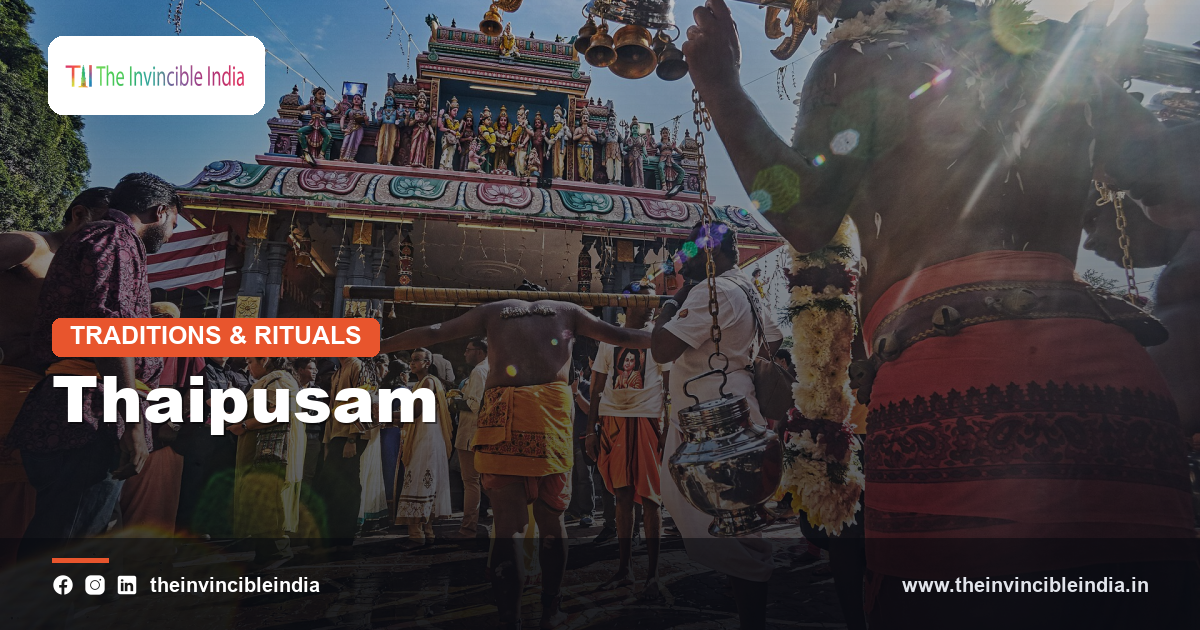
Thaipusam is a significant festival among Tamil Hindus, dedicated to Lord Murugan, the son of Shiva and Parvati and a deity of great importance in South Indian tradition, much as Maha Shivaratri centres devotion on his father. Observed on the full moon day of the Tamil month of Thai, the festival is known for its distinctive practices of penance and devotion, most visibly expressed through the carrying of the kavadi, a ceremonial burden borne by devotees fulfilling vows. Major celebrations take place at the Palani temple in Tamil Nadu and at Batu Caves in Malaysia, where large processions of devotees, some undertaking body piercing as an act of faith, draw considerable attention each year.
Quick Facts
| Detail | Information |
|---|---|
| Festival Type | Tamil Hindu festival of devotion and penance |
| Primary Regions | Tamil Nadu, and Tamil communities in Malaysia, Singapore, and elsewhere |
| Presiding Deity | Lord Murugan |
| Timing | Full moon day in the Tamil month of Thai |
| Key Sites | Palani in Tamil Nadu and Batu Caves in Malaysia |
| Associated Practices | Kavadi bearing, vel piercing, and milk pot offerings |
Origins and Meaning of Thaipusam
Thaipusam takes its name from the Tamil month of Thai and the star Pusam, under which the festival falls each year. The celebration is dedicated to Lord Murugan, revered across Tamil Hindu tradition as a deity of valour, protection, and youthful energy, and is understood as a day to honour his victory over the forces of evil in mythological narrative. The festival’s central themes of penance, vow fulfilment, and gratitude have made it one of the most visibly devotional occasions within Tamil religious life. Its observance is especially prominent among Tamil communities, both within India and in regions with significant Tamil diaspora populations, where the festival has taken on considerable public and cultural significance beyond its purely religious origins, reflecting the deep and continuing devotion Tamil communities hold for Murugan.
Lord Murugan and His Significance
Lord Murugan occupies a central place in Tamil Hindu devotion, worshipped as a deity of war, wisdom, and youthful vigour, and closely associated with the hills and forests of South India. As the son of Shiva and Parvati, Murugan is understood within a broader Shaiva theological framework, yet he holds a distinct and deeply personal significance for Tamil devotees that sets his worship apart. Numerous temples across Tamil Nadu, including several situated atop hills, are dedicated to him, reflecting his association with elevated, sacred landscapes. Thaipusam stands as one of the principal occasions on which devotees express their devotion to Murugan, often through vows made in times of difficulty and fulfilled through acts of penance and offering during the festival itself.
The Legend of Idumban and the Kavadi
The practice of carrying the kavadi during Thaipusam is traditionally linked to the story of Idumban, a devoted follower entrusted with transporting two hills sacred to Murugan using a pole balanced across his shoulders. According to this narrative, Idumban’s unwavering devotion and eventual encounter with Murugan established the kavadi as a symbol of faith and service. This legend provides the devotional and symbolic basis for the kavadi-bearing tradition observed by devotees today, who carry various forms of the kavadi as an expression of similar dedication. The story of Idumban continues to be recounted and celebrated during Thaipusam, particularly in regions where kavadi bearing remains the festival’s most prominent and recognisable practice, linking present-day devotion to a long-established mythological precedent.
The Kavadi: Meaning and Forms
The kavadi, at its simplest, is a physical burden carried by devotees as an offering to Murugan, typically consisting of a decorated wooden or metal frame carried across the shoulders. Kavadis vary considerably in form and complexity, ranging from simple structures adorned with flowers and peacock feathers to elaborate arches supported by hooks or skewers attached to the devotee’s skin. Regardless of form, the kavadi is understood as a physical manifestation of a vow undertaken in gratitude or in petition for divine favour. Devotees often prepare for weeks through fasting and prayer before carrying the kavadi in procession toward a temple dedicated to Murugan, where it is ceremonially presented as fulfilment of their devotional commitment.
Vel Piercing and Acts of Penance
Among the most striking practices associated with Thaipusam is the piercing of the skin, cheeks, or tongue with small skewers known as vel, named after Murugan’s sacred spear. Devotees who undertake this practice typically do so after a period of fasting, prayer, and ritual purification, entering a state described by many participants as one of trance-like focus that lessens the sensation of pain. This act of penance is understood as an offering of the body itself, expressing a level of devotion beyond conventional prayer or ritual. While striking to observers unfamiliar with the tradition, such practices are regarded within their religious context as a serious and voluntary expression of personal faith, undertaken according to individual vows rather than as a general expectation placed on all devotees.
Preparatory Fasting and Austerity
Devotees intending to carry a kavadi or undertake more intensive acts of penance during Thaipusam typically observe a period of fasting and austerity in the weeks leading up to the festival. This preparation often includes dietary restrictions, abstention from certain worldly pleasures, celibacy, and increased time devoted to prayer and temple visits. The purpose of this preparatory period is to purify the mind and body before the physical and spiritual demands of the festival day itself. Such disciplined preparation is considered integral to the devotional value of the eventual offering, with many devotees viewing the weeks of austerity as being as spiritually significant as the day of the festival itself, reinforcing the seriousness with which vows made to Murugan are treated.
Paal Kudam: The Milk Pot Offering
Alongside kavadi bearing, many devotees at Thaipusam carry paal kudam, or pots of milk, as an offering to Murugan. This practice, generally considered a less physically demanding form of devotion than kavadi bearing, is nonetheless approached with equal seriousness and often forms part of a family’s collective participation in the festival. Devotees carry the milk pots in procession toward the temple, where the milk is offered in ritual bathing of the deity’s image, known as abhishekam. The paal kudam offering allows a wider range of devotees, including children and elderly participants, to take part meaningfully in the festival’s devotional practices, broadening participation beyond those undertaking the more intensive penances associated with kavadi and piercing.
Palani: A Principal Pilgrimage Site
Palani, home to one of the most significant temples dedicated to Lord Murugan, serves as a principal pilgrimage destination during Thaipusam. Situated atop a hill in Tamil Nadu, the temple draws large numbers of devotees who undertake the climb, often on foot, as part of their devotional observance. The site’s association with Murugan and its long-standing role in Tamil religious life make it a natural focus for Thaipusam celebrations, alongside its significance during other festivals throughout the year. Pilgrims travelling to Palani during Thaipusam frequently combine the physical challenge of the ascent with acts of penance such as kavadi bearing, reinforcing the site’s reputation as a place where devotion is expressed through both effort and offering.
Batu Caves and the Malaysian Celebration
Batu Caves, a limestone hill complex near Kuala Lumpur housing a major temple dedicated to Murugan, hosts one of the largest Thaipusam celebrations outside India. The festival there draws enormous crowds of devotees and observers, with pilgrims climbing a long flight of steps to the cave temple while carrying kavadis or milk pots. The scale of the Batu Caves celebration reflects the strength and continuity of Tamil Hindu tradition within the Malaysian diaspora, where Thaipusam has become both a major religious observance and a significant cultural event recognised by the wider public. This celebration demonstrates how a festival rooted in South Indian tradition has been sustained and adapted by diaspora communities while retaining its core devotional practices and meaning.
Music, Trance, and Devotional Atmosphere
The atmosphere surrounding Thaipusam processions is often intense, shaped by rhythmic drumming, devotional music, and chanting that accompany kavadi bearers on their journey to the temple. This music is believed to help sustain devotees through the physical demands of the procession, and many participants describe entering a focused, trance-like state supported by the surrounding sound and communal energy. Family members and supporters often walk alongside kavadi bearers, offering encouragement and assistance throughout the procession. This combination of music, movement, and collective devotion creates an atmosphere that many participants and observers describe as deeply intense, reflecting the seriousness and emotional weight carried by those fulfilling significant personal vows during the festival.
Family and Community Support
Thaipusam is rarely an individual undertaking; devotees carrying kavadis or undertaking piercing are typically supported by family members and friends throughout their preparation and the procession itself. Supporters assist with the physical logistics of carrying elaborate kavadis, provide encouragement during the journey, and often participate in the preparatory fasting alongside the primary devotee. This communal support underscores the social dimension of the festival, in which personal devotion is embedded within a network of family and community relationships. Temples and community organisations also play a role in facilitating the festival, managing crowds, coordinating processions, and providing logistical support to ensure that devotees can complete their vows safely and with appropriate ceremonial dignity.
Vows and Their Fulfilment
Central to the practice of Thaipusam is the concept of a vow, or vratam, made by a devotee to Murugan, often in exchange for divine assistance during a period of difficulty, illness, or need. The kavadi, piercing, or milk pot offering carried during the festival represents the fulfilment of this vow, undertaken voluntarily and according to the devotee’s personal circumstances and capacity. This transactional yet deeply spiritual relationship between devotee and deity is a recurring feature of Hindu devotional practice more broadly, and Thaipusam provides one of its most visible and physically demanding expressions. The act of fulfilling a vow during the festival is considered to bring a sense of closure and gratitude, reinforcing the devotee’s ongoing relationship with Murugan.
The Symbolism of the Vel
The vel, or sacred spear associated with Murugan, holds deep symbolic significance throughout Thaipusam, representing both the deity’s power to vanquish evil and the piercing instruments used by some devotees as acts of penance. Beyond its literal use in piercing rituals, the vel appears throughout the festival’s iconography, carried by devotees, displayed at temples, and referenced in devotional songs and prayers. The symbol embodies the protective and combative aspects of Murugan’s character, reinforcing the festival’s underlying theme of overcoming hardship through faith and discipline. This symbolism extends the meaning of Thaipusam beyond the specific practices observed by any one devotee, situating individual acts of devotion within a broader theological framework centred on Murugan’s role as a protector.
Thaipusam in the Indian Diaspora
Thaipusam has become a significant cultural and religious marker among Tamil diaspora communities, particularly in Malaysia, Singapore, Mauritius, and other regions with historical Tamil migration. In these communities, the festival often takes on added significance as an expression of cultural continuity and identity, celebrated publicly with official recognition in some countries. Diaspora communities have, over generations, adapted certain aspects of the festival’s organisation and scale while maintaining its core devotional practices, including kavadi bearing and temple worship. This global observance of Thaipusam illustrates the broader phenomenon of Indian festivals travelling with migrant communities and continuing to serve as vital connections to ancestral religious and cultural traditions across generations, even far from their region of origin.
Respect, Devotion, and Interpretation
Thaipusam’s more intense practices, particularly piercing and kavadi bearing, are sometimes viewed by outside observers primarily through the lens of their physical intensity rather than their devotional meaning. Within the tradition itself, these acts are understood as serious, voluntary expressions of faith undertaken by individuals fulfilling personal spiritual commitments, supported by extensive preparation and communal care. Approaching the festival with an understanding of its underlying devotional logic, rather than viewing it solely as a spectacle, allows for a more respectful appreciation of its significance to practitioners. Religious authorities and temple organisations generally emphasise the voluntary and carefully prepared nature of these practices, distinguishing them clearly from self-harm and situating them firmly within an established framework of devotional penance.
Thaipusam Today
Today, Thaipusam continues to be observed with considerable devotion both in Tamil Nadu and among Tamil communities across the world, with major celebrations at Palani and Batu Caves drawing large numbers of participants and observers each year. Modern infrastructure, medical support, and crowd management have been incorporated into the festival’s organisation in many locations, helping ensure the safety of devotees undertaking demanding acts of penance. Despite these practical adaptations, the festival’s core devotional structure, centred on vows made to Murugan and fulfilled through kavadi bearing and offering, remains fundamentally unchanged. Thaipusam’s continued vitality reflects the enduring strength of devotion to Murugan within Tamil religious life and its successful transmission across generations and geography.
Sources & Further Reading
- Ministry of Tourism, Government of India (tourism.gov.in).
- Hindu Religious and Charitable Endowments Department, Tamil Nadu.
Frequently Asked Questions
What is Thaipusam?
Thaipusam is a Tamil Hindu festival dedicated to Lord Murugan, observed through acts of devotion and penance, most notably the carrying of the ceremonial kavadi.
When is Thaipusam celebrated?
Thaipusam falls on the full moon day of the Tamil month of Thai, generally in January or February.
What is a kavadi?
A kavadi is a ceremonial burden, often a decorated frame carried across the shoulders, borne by devotees at Thaipusam as an offering to Murugan in fulfilment of a vow.
Why do some devotees pierce their skin during Thaipusam?
Vel piercing is undertaken by some devotees as a voluntary act of penance and devotion, prepared for through weeks of fasting and prayer, and is regarded within the tradition as a serious spiritual offering.
Where are the major Thaipusam celebrations held?
The Palani temple in Tamil Nadu and the Batu Caves temple complex in Malaysia host two of the largest and best-known Thaipusam celebrations.


