

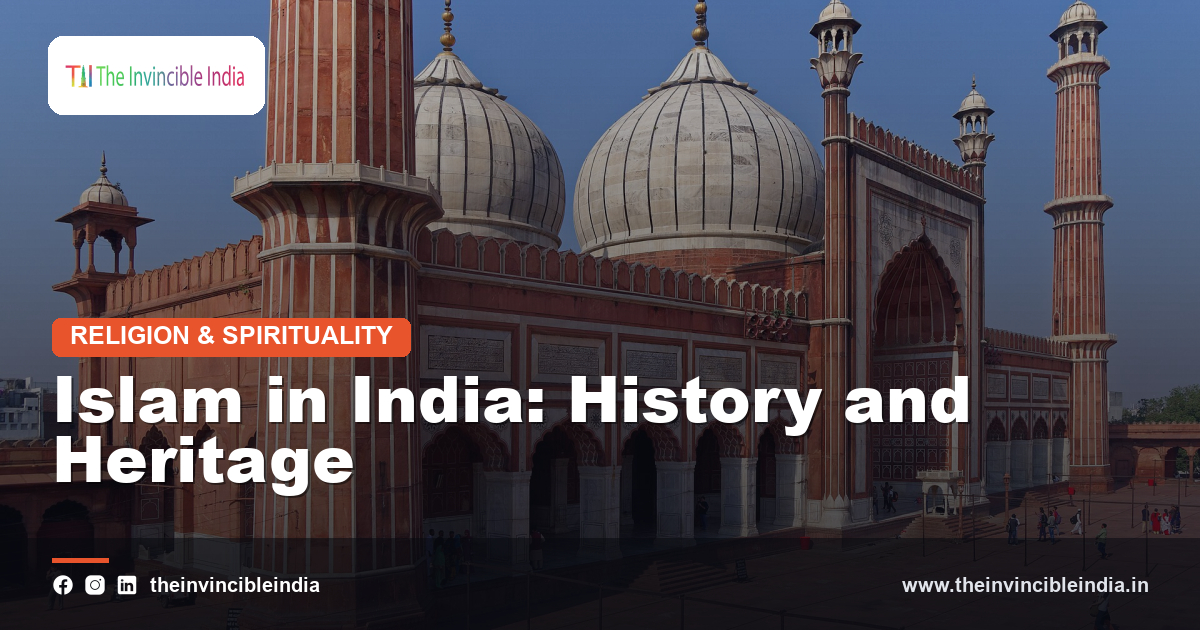
Islam is one of the principal faiths practiced across the Indian subcontinent, with a presence spanning well over a thousand years. Its story in India is one of trade, migration, statecraft, and the gradual growth of a distinct regional Muslim culture that blended Arab, Persian, Central Asian, and indigenous Indian influences. Communities of Muslims can be found in almost every state, following diverse schools of jurisprudence and mystical traditions such as Sufism. The architectural, linguistic, culinary, and artistic legacy of Islam in India is visible in monuments, festivals, and everyday life. This guide surveys the arrival, growth, beliefs, and enduring heritage of Islam in India in general terms, tracing how a global faith took root and flourished within India’s plural civilization.
Quick Facts
| Detail | Information |
|---|---|
| Faith | Islam, one of India’s major religious communities |
| Adherents in India | Among the largest Muslim populations of any country |
| Historical eras | Introduced via trade, later spread through sultanates and empires |
| Major traditions | Sunni and Shia, with widespread Sufi orders |
| Key architecture | Mosques, dargahs, and Indo-Islamic monuments |
| Sacred text | The Quran |
Early Arrival Through Trade
Islam reached the Indian subcontinent long before any political conquest, carried by Arab traders who sailed the monsoon winds to the western coast in search of spices, textiles, and other goods. Coastal towns of present-day Kerala and Gujarat became meeting points where Arab merchants settled, married into local families, and gradually introduced their faith to the communities around them. This peaceful, commercial route of transmission meant that some of India’s oldest Muslim communities developed far from the centers of later political power in the north. Mosques built in these early trading towns reflect a fusion of local building traditions with Islamic requirements for congregational prayer.
Over generations, these coastal communities developed distinct customs, cuisines, and dialects while remaining connected to the wider Islamic world through pilgrimage and trade networks. Their history illustrates that the presence of Islam in India began as a story of commerce and coexistence rather than conquest, laying a foundation that endured long after later dynasties made their own mark on the subcontinent.
Coastal Muslim Communities
Long before large-scale political change reached northern India, small but thriving Muslim communities had already taken root along the western and southern coasts. Regions such as Malabar in present-day Kerala and parts of coastal Gujarat became home to families descended from Arab traders who intermarried with local populations. These communities developed their own dialects, culinary traditions, and social customs while remaining devout in their religious practice. Mosques in these areas often display a distinctive architectural style, using sloped roofs and timber construction suited to the monsoon climate rather than the domes and arches associated with later Islamic architecture in the north.
Many of these coastal communities maintained active trade links with the Arabian Peninsula and East Africa for centuries, keeping them connected to broader currents in the Islamic world. Their long, largely peaceful history stands as an important reminder that the story of Islam in India began well before, and separately from, the establishment of Muslim political rule in the subcontinent’s interior.
The Delhi Sultanate Era
A new phase in the history of Islam in India began with the establishment of Muslim political rule in the north, culminating in a series of dynasties collectively remembered as the Delhi Sultanate. Rulers of these dynasties governed vast territories, built new cities, and patronized scholars, poets, and architects. The period saw the introduction of new administrative systems, coinage, and court culture influenced by Persian and Central Asian traditions. Alongside political change came a gradual expansion of the Muslim population through migration, conversion, and the growth of urban centers where diverse communities lived side by side.
Sultanate-era monuments, including forts, mosques, and tomb complexes, reflect a distinctive architectural language that blended Persian, Central Asian, and Indian building techniques. This era also fostered exchanges in language, cuisine, and the arts that would continue to develop under subsequent dynasties. The Delhi Sultanate thus laid important foundations for the deeper political and cultural presence of Islam that followed in later centuries.
The Mughal Empire and Its Legacy
The Mughal Empire, which governed large parts of the subcontinent for several centuries, represents one of the most significant chapters in the history of Islam in India. Mughal rulers presided over an era of remarkable architectural, artistic, and literary achievement, commissioning grand forts, gardens, and mausoleums that remain celebrated today. The empire brought together Persian court culture, Central Asian heritage, and Indian traditions into a distinctive synthesis visible in painting, music, cuisine, and administration.
Mughal patronage supported scholars, poets, and craftsmen from across the region, contributing to a shared cultural vocabulary that extended well beyond the court itself. The empire’s approach to governance also involved engagement with the subcontinent’s diverse religious communities, producing a complex and much-studied historical legacy. Monuments associated with this period continue to draw visitors and scholars interested in Indo-Islamic history, and the Mughal era remains a touchstone for understanding how Islamic and Indian traditions interacted and enriched one another over a long historical span.
Indo-Islamic Architecture
Indo-Islamic architecture refers to the distinctive building style that emerged as Islamic architectural elements were adapted to Indian materials, climate, and craftsmanship. Domes, arches, minarets, and geometric ornamentation associated with mosque design were combined with indigenous techniques such as intricate stone carving and lattice screens known as jali work. Grand mosques, forts, tombs, and gardens built across the subcontinent illustrate this fusion, often incorporating red sandstone, marble, and inlay work characteristic of Indian craftsmanship.
Calligraphy featuring Quranic verses frequently adorns walls and gateways, blending religious text with decorative art. Many of these structures were designed not only as places of worship or royal residence but also as expressions of imperial identity and aesthetic achievement. Regional variations developed as local builders and patrons adapted the style to different climates and available materials. Today, Indo-Islamic monuments are recognized among the most significant architectural achievements associated with the shared cultural heritage of India.
Sufism and Its Spread
Sufism, the mystical dimension of Islam, played a central role in the spread and popular reception of the faith across India. Sufi teachers, often organized into orders, traveled widely and established centers where seekers of all backgrounds could gather for spiritual instruction, music, and communal meals. Their emphasis on personal devotion, love of the divine, and inclusivity resonated with many across the subcontinent’s religious landscape, contributing to a distinctly Indian expression of Islamic spirituality.
Sufi shrines, known as dargahs, became sites of pilgrimage attracting devotees regardless of their formal religious affiliation, reflecting the inclusive character of many Sufi teachings. Music, poetry, and storytelling associated with Sufi practice helped convey spiritual ideas in accessible, often vernacular language, leaving a lasting imprint on Indian culture well beyond strictly religious contexts. Sufism remains one of the most visible and widely appreciated expressions of Islamic spirituality in India today.
Sunni and Shia Communities
Muslims in India, as elsewhere in the world, are broadly divided into Sunni and Shia communities, distinguished historically by differing views on religious leadership following the early period of Islam. The great majority of Indian Muslims identify as Sunni, following one of the established schools of Islamic jurisprudence, while Shia communities are concentrated in certain regions and cities with their own distinct religious and cultural institutions.
Both communities observe the core practices of Islam, including daily prayer, fasting, and pilgrimage, while maintaining some differences in ritual observance and commemorative traditions. Shia communities in India are particularly associated with distinctive processions and gatherings during certain months of the Islamic calendar, marked by poetry, oratory, and communal mourning traditions. Sunni and Shia Muslims alike have contributed to India’s shared cultural, architectural, and intellectual heritage over many centuries.
Core Beliefs and Practices
At the heart of Islamic practice in India, as elsewhere, lie the foundational beliefs and observances shared by Muslims worldwide. Central to the faith is belief in one God and in the Quran as its central scripture, alongside recognition of the Prophet Muhammad’s role in conveying its message. Daily life for observant Muslims is structured around five prayers performed at set times, a practice that shapes both individual routine and communal rhythm in neighborhoods with significant Muslim populations.
Fasting during the month of Ramadan, giving to charity, and undertaking pilgrimage to Mecca when able are among the other central obligations observed by the faithful. These practices are woven into Indian Muslim life through local customs, seasonal observances, and community gatherings that vary somewhat by region while retaining their essential religious meaning.
Mosques as Centers of Worship
Mosques serve as the primary places of congregational worship for Muslims and function as important centers of community life across India. Beyond their role in daily and Friday prayers, mosques often host religious instruction, charitable activities, and social gatherings that bring together members of the local community. Architecturally, Indian mosques range from grand imperial structures built by ruling dynasties to modest neighborhood mosques constructed by local communities, each reflecting the resources and traditions of its builders.
Many historic mosques feature courtyards, ablution facilities, and minarets, alongside prayer halls oriented toward Mecca. Some of the oldest mosques in India, particularly along the western coast, are notable for adapting local building materials and techniques rather than following Middle Eastern architectural conventions. As gathering places, mosques continue to serve both religious and social functions, anchoring neighborhoods and providing continuity across generations.
Islamic Festivals in India
Islamic festivals are observed with enthusiasm across Indian Muslim communities, marking key moments in the religious calendar with prayer, feasting, and social gatherings. Eid al-Fitr, celebrated at the end of the fasting month of Ramadan, brings families together for special prayers, festive meals, and the exchange of gifts and greetings. Eid al-Adha commemorates themes of sacrifice and devotion and is likewise marked by communal prayer and charitable giving.
Other observances, including commemorative gatherings during certain months of the Islamic calendar, hold particular significance for Shia communities and are marked by processions, recitations, and acts of remembrance. Regional variations in celebration reflect the diversity of Indian Muslim culture, with local customs, foods, and music enriching the core religious observance in different parts of the country.
Qawwali and Devotional Music
Qawwali, a form of devotional music closely associated with Sufi practice, represents one of the most distinctive musical contributions of Islamic culture to India. Performed by groups of singers accompanied by harmonium and percussion, qawwali sets devotional poetry to rhythmic, often rousing melodies intended to evoke spiritual ecstasy and closeness to the divine. Traditionally performed at Sufi shrines, qawwali sessions draw audiences from diverse backgrounds who gather to listen, and sometimes join in, regardless of their own religious affiliation.
The lyrics often draw on Persian and Urdu poetic traditions, expressing themes of divine love, longing, and unity that transcend narrow sectarian boundaries. Over time, qawwali has also found audiences well beyond its original devotional setting, influencing popular music and gaining recognition on concert stages both in India and internationally.
Urdu Language and Literature
Urdu, a language that developed in India through the interaction of Persian, Arabic, Turkic, and local vernacular influences, holds a central place in the cultural heritage associated with Islam in the subcontinent. Written in a script derived from Persian and Arabic, Urdu became the language of much poetry, storytelling, and courtly expression in the centuries following the establishment of Muslim political rule in northern India. Its poetic traditions, particularly the ghazal, a lyrical form dealing with love, longing, and spiritual themes, achieved widespread popularity across social and religious lines.
Beyond poetry, Urdu prose, journalism, and scholarship flourished in various centers of learning across the subcontinent, producing an enduring literary heritage. Today, Urdu continues to be spoken and cherished across India, valued for its poetic richness and historical association with a shared, composite culture.
Islamic Art and Calligraphy
Islamic artistic traditions in India found expression through calligraphy, manuscript illustration, textile design, and decorative crafts that continue to be admired for their intricacy and skill. Calligraphers rendered Quranic verses and poetic texts in elegant scripts, adorning manuscripts, monuments, and everyday objects with sacred and literary language. Miniature painting, developed particularly under royal patronage, combined Persian artistic conventions with Indian subject matter and color sensibilities, producing a distinctive regional style.
Textile arts, including fine embroidery, weaving, and dyeing techniques, were often closely associated with Muslim craftsmen and continue to be practiced in various parts of the country. Decorative metalwork, tilework, and inlaid stone further illustrate the range of artistic expression connected to Islamic culture in India, sustained today by craftspeople who continue to pass on specialized skills.
Dargahs and Pilgrimage
Dargahs, the shrines built at the tombs of revered Sufi saints, form an important part of the pilgrimage landscape associated with Islam in India. These sites attract visitors from across religious communities who come seeking blessings, offering prayers, or simply honoring the memory of a saint known for compassion and spiritual wisdom. Some of the most visited dargahs draw large numbers of pilgrims throughout the year, with particular gatherings held during annual commemorations associated with the saint’s passing.
Rituals at these shrines often include the offering of flowers or cloth, recitation of prayers, and participation in devotional music such as qawwali. The inclusive character of many dargahs, where people of different faiths are welcomed, reflects the broader spirit of Sufi teaching that emphasizes universal compassion over sectarian boundaries.
Contributions to Indian Cuisine
The culinary heritage associated with Islam in India represents one of its most widely enjoyed and everyday expressions, shaping regional food traditions across the subcontinent. Dishes involving slow-cooked meats, rice preparations, and the use of aromatic spices reflect a blending of Central Asian, Persian, and Indian culinary techniques developed over centuries. Bakeries, kebab houses, and street food traditions associated with Muslim communities remain integral to the food culture of many Indian cities, offering flavors that have become part of the broader national palate.
Festive occasions, particularly those marking the end of Ramadan, are accompanied by special sweets and dishes prepared and shared within families and communities. Regional variations in Islamic culinary tradition reflect local ingredients and tastes, producing distinct styles associated with different parts of the country.
Islam in India Today
Today, Islam remains one of India’s major religious traditions, practiced by a large and diverse population spread across every state and region. Contemporary Indian Muslims maintain the core practices of the faith while continuing to express distinctive regional cultures shaped by centuries of history, language, and local custom. Historic mosques, dargahs, and monuments remain active sites of worship and pilgrimage, drawing visitors and researchers interested in their architectural and spiritual significance.
Educational and religious institutions continue to train scholars and preserve traditions of Islamic learning, while artistic forms such as qawwali and Urdu poetry retain enthusiastic audiences. The heritage of Islam in India, built up over many centuries of trade, statecraft, scholarship, and devotion, remains a living and evolving part of the subcontinent’s shared cultural fabric.
Sources & Further Reading
- Ministry of Culture, Government of India (indiaculture.gov.in).
- Archaeological Survey of India (asi.nic.in).
Frequently Asked Questions
When did Islam first arrive in India?
Islam reached India through Arab traders along the western coast well before any political conquest, with communities forming in coastal regions such as Kerala and Gujarat. Political rule associated with Islam was established later, through subsequent dynasties in northern India.
What is the difference between Sunni and Shia Muslims in India?
The distinction relates to differing historical views on religious leadership after the early period of Islam. Most Indian Muslims are Sunni, while Shia communities are concentrated in particular regions with their own religious institutions and observances.
What is Sufism?
Sufism is the mystical tradition within Islam that emphasizes personal devotion, love of the divine, and inclusivity. It played a major role in the spread of Islam across India through teachers, shrines, and devotional music.
What is qawwali?
Qawwali is a form of devotional music associated with Sufi shrines, combining poetry and rhythmic melody to express themes of divine love and spiritual longing. It remains a popular living tradition in India.
What is Indo-Islamic architecture?
Indo-Islamic architecture refers to the distinctive style that emerged when Islamic architectural elements, such as domes and arches, were combined with Indian materials and craftsmanship, producing many of the subcontinent’s most celebrated monuments.


