

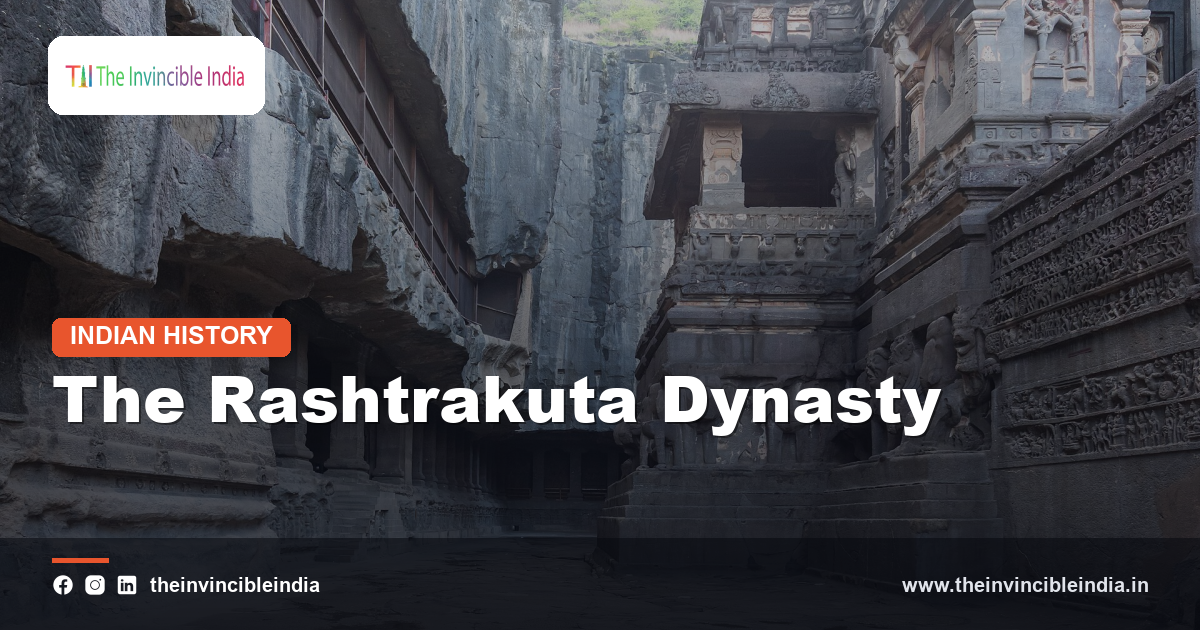
Among the many regional powers that shaped the medieval Deccan, few left a physical legacy as astonishing as the Rashtrakutas, whose artisans carved an entire temple complex from a single mass of rock at Ellora. Rising to prominence in the same broad region once contested by the Chola dynasty and other southern powers, the Rashtrakutas built an empire that, at its peak, extended influence from the heart of the Deccan toward the Gangetic plain in the north. Their court became a center of literary patronage in both Kannada and Sanskrit, while their engineers achieved one of the most remarkable feats of rock-cut architecture anywhere in the ancient world. This guide traces the dynasty’s rise, governance, culture, and lasting monuments.
Quick Facts
| Detail | Information |
|---|---|
| Region | Deccan Plateau, centered on present-day Maharashtra and Karnataka |
| Approximate Period | Roughly the 8th to the 10th century CE |
| Capital | Manyakheta (present-day Malkhed) |
| Signature Monument | The rock-cut Kailasa temple at Ellora |
| Religions Patronized | Shaivism, Vaishnavism, and Jainism |
| Literary Languages | Kannada and Sanskrit |
Origins of the Rashtrakutas
The Rashtrakutas rose to prominence in the Deccan during a period when the earlier Chalukya dynasty of Badami had begun to lose its grip over the region, creating an opening for a new power based further north within the plateau. Emerging initially as a regional ruling family, the Rashtrakutas gradually asserted independence and then supremacy over the territories once controlled by their Chalukya predecessors. Their consolidation of power involved both military campaigns and the careful cultivation of alliances with local chiefs and feudatory lords across the Deccan. Early Rashtrakuta rulers established the foundations of an administrative and military system that would allow the dynasty to grow into one of the most powerful states of its time. This transition from regional feudatory to imperial power marks one of the significant political realignments of early medieval Deccan history.
Rise to Deccan Supremacy
Once established as the dominant power in the Deccan, successive Rashtrakuta rulers extended their authority through a combination of military campaigns and diplomatic alliances, absorbing or subordinating rival regional powers. Their armies proved capable of sustained campaigning across considerable distances, a hallmark of Rashtrakuta military organization that allowed the dynasty to project influence well beyond its core territory. Control over the strategically important Deccan plateau, situated between northern and southern India, gave the Rashtrakutas a pivotal role in the wider politics of the subcontinent during this period. Their rise coincided with a broader era of shifting regional power balances across early medieval India, in which several ambitious dynasties competed for supremacy. The Rashtrakutas’ ability to sustain dominance over multiple generations reflects the strength of the administrative and military foundations laid by their early rulers.
Campaigns Toward Northern India
A distinctive feature of Rashtrakuta power was its rulers’ repeated ability to launch successful military campaigns far to the north, reaching as far as the Gangetic plain and the politically significant city of Kannauj. These expeditions placed the Rashtrakutas at the center of a prolonged three-way struggle for control of northern India, contested alongside other major regional powers of the era. While such campaigns rarely resulted in permanent northern territorial control, they brought considerable prestige, tribute, and plunder back to the Deccan, reinforcing Rashtrakuta claims to paramount status among contemporary Indian dynasties. The logistical achievement of marching and supplying an army across such distances speaks to the sophistication of Rashtrakuta military organization. These northern campaigns remain one of the most notable aspects of the dynasty’s political history, illustrating the reach of Deccan-based power during this period.
Manyakheta: The Rashtrakuta Capital
The Rashtrakutas established their principal capital at Manyakheta, a city that grew into an important center of political administration, trade, and courtly culture during the dynasty’s height. Positioned within the Deccan interior, the city served as the hub from which military campaigns were organized and from which royal patronage of religion, literature, and art radiated outward. Manyakheta’s prominence during this period is reflected in later inscriptions and literary references that describe it as a flourishing and well-ordered urban center. Though its later importance diminished with the decline of Rashtrakuta power, the city’s role as an imperial capital marks it as a significant site in the political geography of medieval Deccan India. The choice of an interior, defensible location for the capital also reflects the strategic priorities of a dynasty engaged in frequent campaigning on multiple fronts.
Administration and Government
Rashtrakuta governance combined central royal authority with a layered system of provincial administration, in which feudatory chiefs and appointed governors managed regional affairs while acknowledging the overlordship of the ruling dynasty. Copper plate inscriptions recording land grants to religious and educational institutions provide much of the surviving evidence for how the state organized revenue collection and local governance. This administrative flexibility allowed the Rashtrakutas to govern a large and diverse territory encompassing multiple linguistic and cultural regions without requiring uniform centralized control. Local customs and existing power structures were often incorporated into the broader Rashtrakuta administrative framework rather than replaced outright. This pragmatic approach to governance contributed significantly to the dynasty’s ability to maintain authority over an extensive Deccan empire for more than two centuries.
Religious Patronage and Tolerance
The Rashtrakutas are notable for their broad religious patronage, supporting Shaiva and Vaishnava traditions alongside significant encouragement of Jainism, which flourished under their rule in parts of the Deccan. Several Rashtrakuta rulers personally favored particular traditions while continuing to fund temples, monasteries, and religious endowments across different faiths within their territory. This pattern of pluralistic patronage reflects a broader tendency among many medieval Indian dynasties to support multiple religious communities as a means of securing loyalty and social cohesion across a diverse population. Jain scholars and institutions in particular benefited considerably from Rashtrakuta support, contributing to a notable flourishing of Jain literature and learning during this period. This inclusive approach to religious patronage stands as one of the defining cultural characteristics of Rashtrakuta rule.
The Kailasa Temple at Ellora
The most extraordinary achievement associated with Rashtrakuta patronage is the Kailasa temple at Ellora, an entire temple complex carved downward out of a single mass of volcanic rock rather than built up from separately quarried stone. Dedicated to Shiva and conceived to evoke the sacred mountain Kailasa, the temple includes a main shrine, surrounding courtyards, and subsidiary structures, all sculpted from the same continuous rock formation through the sustained removal of enormous quantities of stone. The scale of labor, planning, and artistic vision required to conceive and execute such a monument places it among the most remarkable engineering and artistic achievements of the ancient and medieval world. Intricate sculptural programs across the temple depict a wide range of mythological themes, executed with considerable technical skill. The Kailasa temple remains the single most celebrated symbol of Rashtrakuta cultural and artistic ambition.
Other Ellora and Deccan Monuments
Beyond the Kailasa temple, Rashtrakuta patronage contributed to the broader development of the wider Ellora cave complex, which includes shrines associated with Buddhist, Hindu, and Jain traditions carved into the same hillside over an extended period spanning several dynasties. Rashtrakuta-era additions and embellishments reflect the continuity of rock-cut architectural traditions in the region even as royal patronage shifted between different faiths. Elsewhere across their territory, the dynasty supported the construction and endowment of structural temples, though none approached the scale or fame of the Ellora complex. This pattern of concentrated investment in a single extraordinary site, alongside more modest patronage elsewhere, reflects the priorities of a court capable of mobilizing exceptional resources for a defining architectural statement. The wider Ellora complex today stands as a testament to centuries of overlapping religious and artistic patronage in the Deccan.
Literary Patronage in Kannada and Sanskrit
The Rashtrakuta court was an important center of literary activity, supporting scholars and poets working in both Kannada, the regional language of much of their core territory, and Sanskrit, the classical language of learned and courtly discourse across India. This dual patronage helped establish Kannada as a mature literary language capable of sophisticated poetic and philosophical expression, marking a significant stage in the development of South Indian vernacular literature. Sanskrit works produced or associated with the Rashtrakuta period covered a range of subjects, including poetry, grammar, and religious and philosophical treatises. Royal encouragement of both languages reflects the cosmopolitan character of the Rashtrakuta court, which drew on both regional and pan-Indian literary traditions. This literary flourishing stands alongside monumental architecture as one of the most significant cultural legacies of the dynasty.
Trade and Maritime Contacts
Rashtrakuta control over much of the western Deccan gave the dynasty access to important trade routes connecting the interior to Arabian Sea ports, facilitating exchange with merchants from the Arab world and beyond. Historical accounts from foreign travelers of the period describe the Rashtrakuta realm as a significant and well-ordered power engaged in active commerce, reflecting the dynasty’s broader reputation beyond the subcontinent. Goods moving through these trade networks included textiles, spices, and other regional products, exchanged for commodities brought by seaborne merchants. This trade activity contributed to the prosperity that supported the dynasty’s extensive architectural and literary patronage. The Rashtrakuta period thus represents an important chapter in the long history of Indian Ocean trade connecting the Deccan to a wider international commercial world.
Society and Court Life
Rashtrakuta society was organized around an agrarian base supplemented by craft production and trade, with land grants to religious and educational institutions recorded extensively in copper plate inscriptions that survive from the period. The royal court itself functioned as a center of cultural patronage, drawing scholars, poets, and religious teachers from different traditions who benefited from royal support and endowment. Feudatory chiefs and regional nobility played an important role in court life, participating in both military campaigns and the broader political and cultural affairs of the empire. Descriptions from contemporary and near-contemporary sources depict a court noted for its wealth and sophistication, consistent with the scale of monuments and literary works associated with the period. This picture of a prosperous, culturally active society underlies the dynasty’s substantial artistic and literary achievements.
Rivalries with Contemporary Powers
Throughout their history, the Rashtrakutas engaged in shifting rivalries and alliances with other major powers of the period, including the Pratiharas and Palas to the north, with whom they contested influence over the Gangetic plain, and various southern powers including the early Cholas. These competing relationships shaped much of Rashtrakuta military and diplomatic activity, requiring the dynasty to balance ambitions in the north with the need to secure its southern and western frontiers. Periods of successful campaigning were often followed by consolidation and defensive periods, reflecting the practical limits of sustaining control over such a wide sphere of influence. This constant negotiation of rivalry and alliance across multiple frontiers is characteristic of the complex political landscape of early medieval India. The Rashtrakutas’ ability to navigate these competing pressures for an extended period speaks to considerable political and military skill.
Decline of Rashtrakuta Power
By the later 10th century, internal succession disputes combined with renewed assertiveness among regional feudatories, particularly the Western Chalukyas who had once served under Rashtrakuta overlordship, gradually eroded the dynasty’s authority. Sustained campaigning on multiple distant fronts over previous generations may also have placed a cumulative strain on the resources and administrative cohesion of the empire. As central control weakened, former subordinate powers reasserted independence, eventually displacing the Rashtrakutas as the dominant force in the Deccan. This pattern of decline through internal fragmentation and the rise of former feudatories mirrors the trajectory of several other medieval Indian dynasties. The transition marked the end of one era of Deccan political history and the beginning of renewed Chalukya ascendancy in the region.
Legacy in Deccan History
The Rashtrakuta period is remembered as a significant era in the political and cultural history of the Deccan, notable both for the dynasty’s far-reaching military campaigns and for its extraordinary architectural and literary achievements. Later Deccan dynasties, including the Western Chalukyas who succeeded them, inherited administrative practices and cultural patterns first developed or consolidated under Rashtrakuta rule. The dynasty’s contribution to the maturation of Kannada literature left a lasting mark on the region’s cultural identity, while its architectural patronage set a benchmark for ambition rarely matched by later builders. Historians continue to regard the Rashtrakuta era as a high point of medieval Deccan power, comparable in significance to other major dynasties of the period across the subcontinent. This layered legacy continues to inform understanding of the region’s broader historical development.
The Rashtrakuta Dynasty Today
Today, the Rashtrakuta legacy is most visibly preserved at Ellora, where the Kailasa temple continues to draw scholars, pilgrims, and visitors from around the world as one of the most remarkable rock-cut monuments in existence. Recognized as a site of outstanding cultural significance, the wider Ellora complex remains a focus of conservation and academic study, with ongoing research into the techniques and organization behind its construction. Historical inscriptions and copper plates from the Rashtrakuta period continue to inform scholarly understanding of medieval Deccan administration, trade, and religious life. The dynasty’s contribution to Kannada literary tradition is also actively studied and celebrated within the broader history of South Indian languages. Through both monumental architecture and enduring scholarship, the Rashtrakuta dynasty remains a vivid presence in the historical memory of the Deccan.
Sources & Further Reading
- Archaeological Survey of India (asi.nic.in).
- Ministry of Culture, Government of India (indiaculture.gov.in).
Frequently Asked Questions
Who were the Rashtrakutas?
The Rashtrakutas were a powerful medieval dynasty that ruled much of the Deccan Plateau from roughly the 8th to the 10th century CE, known for extensive military campaigns and remarkable architectural patronage.
What is the Rashtrakuta dynasty famous for?
The dynasty is most famous for commissioning the Kailasa temple at Ellora, an entire temple complex carved from a single mass of rock, as well as for extending Deccan power toward northern India.
Where was the Rashtrakuta capital located?
The Rashtrakutas ruled from their capital at Manyakheta, present-day Malkhed, an important center of administration, trade, and courtly culture within the Deccan interior.
Which religions did the Rashtrakutas support?
Rashtrakuta rulers patronized Shaivism and Vaishnavism while also giving substantial support to Jainism, reflecting a broadly pluralistic approach to religious patronage across their empire.
What led to the decline of the Rashtrakuta dynasty?
Internal succession disputes and the resurgence of former feudatories, particularly the Western Chalukyas, gradually weakened central Rashtrakuta authority, leading to the empire’s eventual fragmentation.


