

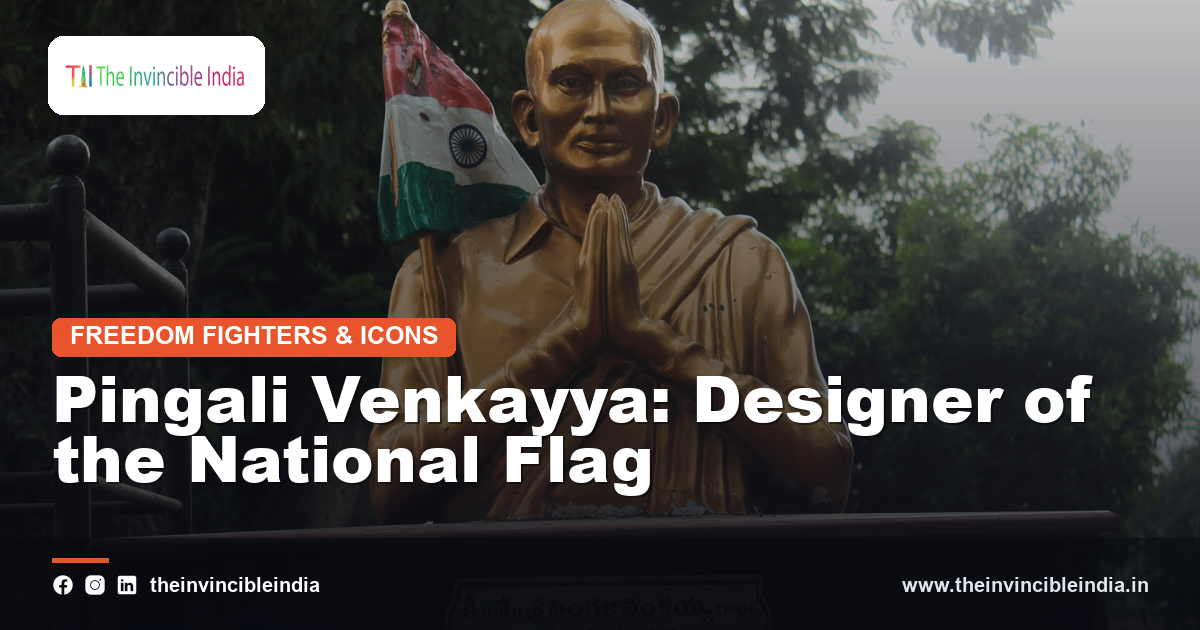
Pingali Venkayya holds a distinctive place among India’s freedom fighters as the man whose proposed flag design formed the basis for the tricolour that would eventually become the national flag of independent India. A man of wide-ranging interests spanning geology, agriculture and education, Venkayya devoted years of study to the flags of nations around the world before presenting his own design to Mahatma Gandhi and the Indian National Congress. Though he lived much of his later life in modest circumstances, his quiet, painstaking contribution gave the freedom movement one of its most enduring and universally recognised symbols. This guide traces the life, work and legacy of Pingali Venkayya.
Quick Facts
| Detail | Information |
|---|---|
| Known as | Designer associated with the Indian national flag |
| Born | 1876, near Machilipatnam, Andhra Pradesh |
| Background | Geologist, agriculturist and educationist |
| Known for | Proposing the flag design later developed into the tricolour |
| Associated with | Mahatma Gandhi and the Indian National Congress |
| Died | 1963, in modest circumstances |
The Man Behind a National Symbol
Pingali Venkayya is remembered as the quiet, methodical figure whose years of study and dedication gave India’s freedom movement one of its most powerful unifying symbols, the national flag. Unlike many of his contemporaries who are remembered chiefly for oratory or armed resistance, Venkayya’s contribution was scholarly and painstaking, built on careful research into the flags and symbols of nations across the world. His work reflected a conviction that a free India would need a flag capable of representing the unity and aspirations of its diverse population. As the man behind a national symbol, Pingali Venkayya’s legacy is inseparable from the tricolour that continues to represent the country today.
Early Life and Family Background
Pingali Venkayya was born in 1876 near Machilipatnam in the Krishna district of present-day Andhra Pradesh, into a family that valued education and encouraged his early curiosity about the wider world. From a young age he displayed an inquisitive and studious temperament, interests that would later expand into fields as varied as geology, agriculture and linguistics. His upbringing in coastal Andhra exposed him to a region with a strong tradition of scholarship and public engagement. This early environment nurtured the breadth of intellectual interest that would define Venkayya’s unusual and varied career in service of his country.
Education and Early Career
Venkayya pursued his education with notable seriousness, developing proficiency in multiple subjects and languages that reflected his wide-ranging curiosity. His early career took him through a variety of pursuits, including work connected to agriculture and education, long before his name became associated with the design of a national flag. This breadth of experience gave him practical skills in observation, experimentation and research that he would later apply to his study of flags and national symbols. His early education and career established the foundation for a life defined by patient, detailed study across several disciplines.
Service and Travels Abroad
As a young man, Pingali Venkayya travelled beyond India, including service that took him abroad during a period of British military engagement, an experience that broadened his exposure to different peoples, cultures and national symbols. These travels are widely understood to have deepened his interest in the flags used by different countries and armies, sparking a fascination with vexillology that would occupy him for years afterward. His time away from India also sharpened his awareness of colonial hierarchies and the absence of any distinct symbol representing Indians as a nation. These formative travels and service abroad set him on the path toward his later contribution to the freedom movement.
Return to India and Meeting Mahatma Gandhi
On returning to India, Venkayya became increasingly drawn to the nationalist movement then gathering strength under the leadership of the Indian National Congress. He came into contact with Mahatma Gandhi, whose emphasis on self-reliance and national dignity resonated strongly with Venkayya’s own emerging conviction that India needed a flag of its own to rally its people. This meeting proved decisive, giving Venkayya both encouragement and a platform through which to pursue his growing interest in designing a symbol capable of representing a united India. His association with Gandhi placed him within the orbit of the movement’s most influential leadership.
A Growing Interest in a National Flag
Venkayya’s interest in the idea of a national flag grew steadily during the early decades of the twentieth century, as he observed that the absence of such a symbol left the Indian national movement without a unifying visual identity comparable to those of other nations. He began collecting and studying information about flags used around the world, examining their colours, proportions and symbolism with careful attention. This growing interest reflected his belief that a well-designed flag could help unify Indians across regional, linguistic and religious lines in their shared pursuit of self-rule. This conviction would guide years of dedicated study that followed.
Years of Study on World Flags
Over a period of years, Pingali Venkayya undertook detailed study of the flags of numerous countries, compiling his research and observations into work intended to inform the design of a flag suited to India’s needs. This patient, scholarly effort set him apart from many contemporaries engaged in more immediately visible forms of nationalist activity. His research considered questions of colour symbolism, proportion and the practical requirements of a flag intended for wide public use. This sustained period of study on world flags gave Venkayya the depth of knowledge that would inform his eventual proposal to the Congress leadership.
Presenting the Design to Congress
Venkayya’s research culminated in a proposed flag design that he presented to the Indian National Congress, seeking the endorsement of a symbol that could represent the nationalist movement as a whole. His proposal was considered alongside other suggestions put forward during a period when the Congress was actively debating the need for a distinct national flag. The seriousness and detail of Venkayya’s research lent weight to his proposal within these discussions. This act of presenting his design to Congress marked the point at which years of private study translated into direct engagement with the movement’s leadership.
The Bezwada Congress Session of 1921
A significant moment in Venkayya’s association with the flag came at the Congress session held in 1921 in Bezwada, present-day Vijayawada, where he presented his design directly to Mahatma Gandhi. Gandhi is widely understood to have responded positively to the basic concept while suggesting refinements intended to give the flag broader symbolic resonance across India’s religious communities. This meeting at the Bezwada session represents the pivotal juncture at which Venkayya’s design began its transformation from a personal proposal into a symbol under active consideration by the national movement’s leadership.
Evolution of the Design
Following the discussions at the Bezwada session, the flag design associated with Venkayya underwent further evolution, incorporating additional elements intended to represent India’s diverse communities and its aspiration for self-reliance, including a spinning wheel motif associated with the Swadeshi movement. This evolving design came to be known informally as the Swaraj flag, used increasingly at Congress gatherings and nationalist demonstrations during the following decades. The gradual refinement of the design reflects the collaborative process through which national symbols are often shaped, building on Venkayya’s foundational research and proposal. This evolution set the stage for the flag’s eventual adoption in independent India.
From Swaraj Flag to National Tricolour
The flag associated with Pingali Venkayya’s early design continued to develop over the following decades, eventually informing the tricolour that was formally adopted as the national flag of India around the time of independence in 1947. While the final flag incorporated further modifications made by a specially constituted committee, its lineage is widely traced back to the design and research first advanced by Venkayya decades earlier. This connection between his early work and the flag flown over independent India represents the most significant and lasting outcome of his contribution to the national movement.
Interests Beyond the Flag
Beyond his contribution to the flag, Pingali Venkayya pursued a remarkably varied range of intellectual and practical interests, including work in geology and agriculture, where he is remembered for his study of cotton cultivation and mineral resources in the Andhra region. He also had an interest in languages and education, reflecting a broad, inquiring mind that extended well beyond any single field. This diversity of interests illustrates that his contribution to the flag, though his most celebrated achievement, formed only one part of a life devoted to study and public service across multiple disciplines.
A Life of Modesty in Later Years
Despite his significant contribution to a symbol that would come to represent the entire nation, Pingali Venkayya spent his later years in modest and, by many accounts, financially difficult circumstances, largely removed from public recognition. This quiet obscurity in old age stands in notable contrast to the enduring national importance of the flag associated with his name. His life in these later years reflects a broader pattern among many contributors to the freedom struggle whose work went unrewarded by material comfort or official recognition during their own lifetimes. This period underscores the selflessness that marked his contribution to the national cause.
Recognition Long After Independence
In the decades following independence, growing recognition of Pingali Venkayya’s role in the flag’s design led to renewed public interest in his life and work, including commemorative efforts undertaken by the government and cultural institutions. A postage stamp issued in his honour brought his contribution to wider public attention, helping to correct decades of relative obscurity. This gradual recognition, arriving long after his most significant contribution, reflects the sometimes delayed manner in which history comes to properly honour its quieter figures. Such recognition has helped secure Venkayya’s place in the broader narrative of India’s freedom struggle.
Memorials and Commemoration
In Andhra Pradesh and elsewhere in India, Pingali Venkayya is remembered today through memorials, institutions and commemorative programmes that honour his contribution to the design of the national flag. Public spaces and institutions bear his name, and his story is recounted in accounts of the freedom movement as an example of scholarly dedication placed in service of the national cause. These acts of commemoration ensure that his patient, research-driven contribution is not overshadowed by the more visible activities of contemporaries engaged in direct political agitation. Such memorials reflect the respect Venkayya has come to command in national memory.
Pingali Venkayya Today
Today Pingali Venkayya is remembered as the studious, dedicated figure whose careful research into world flags helped lay the foundation for the tricolour that represents independent India. His story is increasingly taught alongside those of more prominent political leaders, illustrating the many different forms that service to the freedom movement could take. He is remembered particularly for the patience and rigour of his research and for the modesty with which he pursued his contribution, seeking no personal recognition in return. As the figure most closely associated with the origins of India’s national flag, Pingali Venkayya endures as a quiet but essential part of the country’s freedom story.
Sources & Further Reading
- Ministry of Culture, Government of India, on the freedom movement and its national symbols (indiaculture.gov.in).
- Press Information Bureau, Government of India (pib.gov.in).
Frequently Asked Questions
Who was Pingali Venkayya?
Pingali Venkayya was an Andhra-born geologist, agriculturist and freedom fighter whose years of research into world flags led to a design proposal that formed the basis for the tricolour later adopted as India’s national flag.
What was Pingali Venkayya's contribution to the freedom movement?
He devoted years to studying the flags of different nations and presented his design to Mahatma Gandhi and the Indian National Congress, contributing the foundational concept that evolved into the national flag.
When did Venkayya present his flag design to Gandhi?
Venkayya presented his design at the Congress session held in Bezwada, present-day Vijayawada, in 1921, where Gandhi responded positively and suggested further refinements.
Did Pingali Venkayya have other achievements?
Beyond the flag, Venkayya pursued varied interests in geology, agriculture and education, including work related to cotton cultivation, reflecting a broad and inquiring intellect.
How is Pingali Venkayya remembered today?
He is remembered through memorials, institutions and a commemorative postage stamp that recognise his role in the origins of India’s national flag, correcting decades of relative obscurity.


