

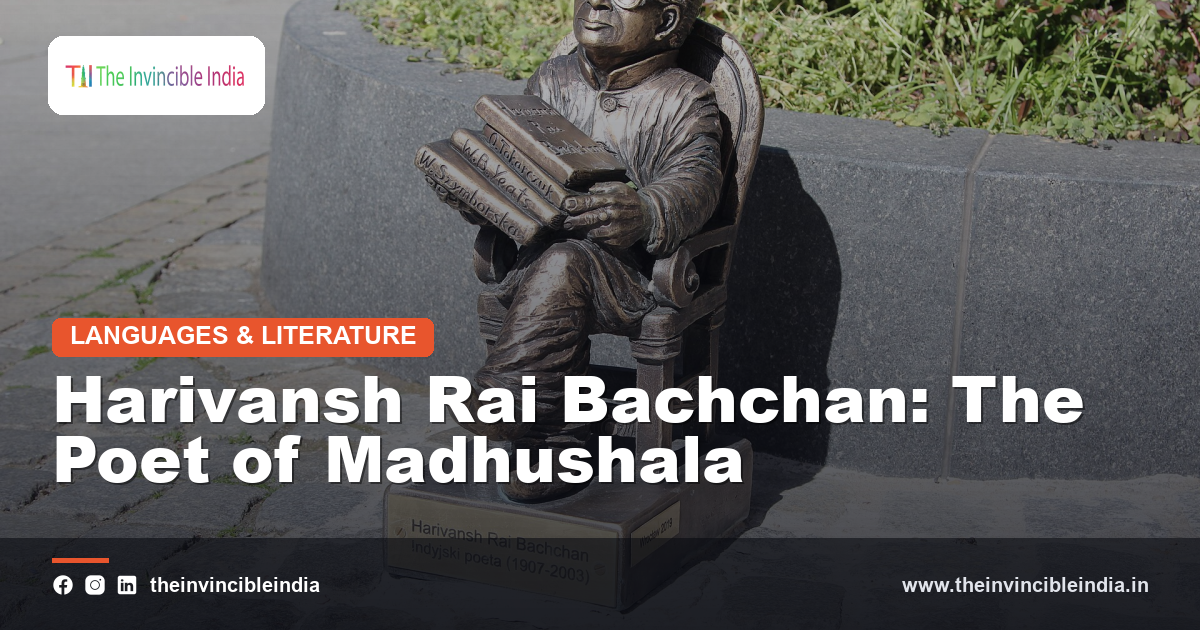
Harivansh Rai Bachchan is remembered as one of the most widely loved poets of modern Hindi literature, celebrated above all for Madhushala, a long sequence of verses built around the imagery of wine, the cup, and the tavern used as metaphors for life, longing, and spiritual seeking. Writing in accessible yet lyrically rich Khari Boli Hindi, Bachchan brought poetry to readers well beyond literary circles, and his reflective, emotionally direct style set him apart from some of his more ornate contemporaries. Alongside his poetry, he was known for autobiographical prose and for a long engagement with Hindi letters that spanned education, broadcasting, and public life. His legacy continues to shape how modern Hindi poetry is read and remembered.
Quick Facts
| Detail | Information |
|---|---|
| Language of Work | Hindi |
| Best Known For | Madhushala (The House of Wine) |
| Literary Form | Lyrical poetry and autobiographical prose |
| Literary Period | Twentieth-century modern Hindi literature |
| Notable Recognition | Widely honoured figure in modern Hindi letters |
| Family Legacy | Father of actor Amitabh Bachchan |
A Life Devoted to Hindi Letters
Harivansh Rai Bachchan is remembered as one of the central figures of modern Hindi poetry, a writer whose career spanned literary composition, teaching, broadcasting, and public service, all conducted with an evident devotion to the Hindi language and its literary possibilities.
His body of work, spanning poetry and prose, reflects a lifelong engagement with questions of meaning, memory, and human experience, expressed in language accessible enough to reach a broad readership while remaining artistically accomplished and emotionally resonant.
Early Life and Education
Bachchan grew up in the Allahabad region of what is now Uttar Pradesh, an area long recognised as an important centre of Hindi literary and intellectual life. His early education exposed him to both Hindi literary tradition and English literature.
This dual grounding in Hindi and English letters shaped his later career, informing both his original poetry and his interest in translation and literary study, and connecting him to the wider currents of modern Indian literary thought taking shape in the early twentieth century.
Entry into Hindi Poetry
Bachchan began composing poetry at a time when modern Hindi literature was undergoing considerable change, with poets exploring new emotional registers and moving away from purely classical or devotional conventions toward more personal and reflective modes of expression.
His early verses displayed a lyrical sensibility and emotional directness that would come to define his mature work, gradually earning him recognition among readers and fellow writers as a distinctive new voice within the modern Hindi poetic tradition.
This early period of experimentation gave Bachchan the confidence to pursue an ambitious extended poetic sequence built around a single sustained metaphor, an undertaking that would culminate in the composition of Madhushala.
Madhushala: The House of Wine
Madhushala, meaning the House of Wine, stands as Bachchan’s most celebrated work, a long sequence of short, rhythmically consistent verses built around a sustained metaphor of wine, the cup, the tavern, and the cupbearer. The work quickly became immensely popular with readers.
Rather than a literal celebration of drinking, Madhushala uses this imagery symbolically, exploring themes of life’s fleeting pleasures, spiritual longing, and the search for meaning, in a manner that resonated with a wide and varied audience across generations of Hindi readers.
The sequence’s consistent four-line verse form allows each stanza to stand largely on its own while still contributing to the cumulative philosophical meditation of the whole, a structural choice that has made individual verses easy to recall and quote independently.
The Symbolism of Wine and the Tavern
In Madhushala, the tavern represents the world itself, the wine stands for the essence of life or spiritual experience, and the cupbearer takes on the role of a guiding or divine presence offering this essence to seekers who gather in the poem’s imagined setting.
This extended metaphor allowed Bachchan to explore philosophical and even mystical themes through vivid, sensory imagery, giving the sequence a quality that could be read simultaneously as worldly celebration and as symbolic meditation on existence and transcendence.
Style and Language of Madhushala
Madhushala is composed in simple, rhythmic Khari Boli Hindi, using a consistent verse form that lends itself naturally to recitation and memorisation, qualities that greatly contributed to its widespread popularity among audiences who encountered it both in print and through public readings.
Bachchan’s choice of accessible language over more elaborate classical diction reflected a broader modern impulse in Hindi poetry to reach ordinary readers directly, without sacrificing lyrical craftsmanship or emotional depth in the process.
Reception and Popularity of Madhushala
Madhushala achieved a level of popular recognition unusual for a modern Hindi poetic work, becoming widely known even among readers who otherwise had limited engagement with formal literature, and it has been recited and performed publicly on numerous occasions over the decades.
This broad popularity helped cement Bachchan’s reputation as a poet capable of bridging literary sophistication and mass appeal, a combination that few of his contemporaries achieved to the same extent within modern Hindi poetry.
Public recitations of Madhushala, often performed with musical accompaniment, have introduced the work to audiences well beyond readers of printed poetry, and such performances continue to be a familiar feature of Hindi literary gatherings decades after the sequence was first composed.
Beyond Madhushala: Other Poetic Works
While Madhushala remains his best-known work, Bachchan produced a substantial body of poetry beyond this single sequence, exploring themes of love, loss, nostalgia, and reflection across numerous collections published throughout his literary career.
These works reveal a poet consistently attentive to personal emotion and lived experience, expressed through the same accessible yet carefully crafted style that characterised his most famous composition, and they continue to be studied as part of his broader poetic contribution.
Bachchan's Place Relative to Chhayavaad
Bachchan wrote during the period when Chhayavaad, the romantic and symbolist movement in Hindi poetry, held considerable influence, and while his work shares some of that movement’s lyrical sensibility, he is often discussed as occupying a somewhat independent position within modern Hindi poetry.
His more direct, personal, and accessible style distinguished him from some of the more overtly symbolic and ornate tendencies associated with core Chhayavaad poets, contributing to his distinct standing within the broader landscape of twentieth-century Hindi literature.
Prose and Autobiographical Writing
In addition to poetry, Bachchan wrote extended autobiographical prose, reflecting on his own life, times, and literary journey in a manner that has been valued both for its personal candour and for the historical and cultural insight it offers into the Hindi literary world of his era.
These autobiographical writings complement his poetic output, providing readers with a fuller picture of the experiences, relationships, and reflections that shaped his creative outlook over the course of a long literary life.
Spread across multiple volumes, his memoirs also document the broader social and literary changes he witnessed during his lifetime, giving later readers valuable insight into the evolving world of Hindi letters through the eyes of one of its central participants.
Bachchan as a Translator and Scholar
Bachchan’s grounding in English literature alongside Hindi supported his interest in literary translation and scholarship, connecting Hindi readers with wider literary traditions and reflecting his broader engagement with comparative literary study beyond his own poetic composition.
This scholarly dimension of his career situates him within a generation of Hindi writers who moved comfortably between creative writing and academic or literary study, enriching Hindi letters through this exchange between languages and traditions.
His years spent teaching English literature also sharpened his own critical sensibility as a poet, giving him a comparative vantage point from which to consider the possibilities and limits of Hindi poetic expression.
Association with Public Broadcasting and Institutions
Over the course of his career, Bachchan was associated with public institutions connected to broadcasting and cultural life, roles that placed him at the intersection of literature and public communication in independent India during a formative period for Hindi media.
These associations reflect the broader public role many leading Hindi writers of his generation played, extending their influence beyond the printed page into the wider cultural and institutional life of the country.
Recognition and Literary Honours
Bachchan received wide recognition during his lifetime as one of the foremost poets of modern Hindi literature, with his contributions acknowledged through various literary and public honours reflecting his stature within Indian letters.
This recognition extended beyond formal awards to the enduring popular affection in which his poetry, particularly Madhushala, continues to be held by generations of Hindi readers across India and among Hindi-speaking communities abroad.
Family and Enduring Legacy
Harivansh Rai Bachchan is also widely known as the father of actor Amitabh Bachchan, a connection that has introduced his poetry to audiences who might not otherwise encounter classical or modern Hindi literature directly.
This broader public awareness has helped keep Bachchan’s poetic legacy visible in contemporary Indian culture, even as his literary reputation rests firmly on the strength and popularity of his own substantial body of work.
Influence on Later Hindi Poetry
Bachchan’s accessible yet lyrically accomplished style influenced later generations of Hindi poets who sought to combine emotional directness with artistic craftsmanship, demonstrating that popular appeal and literary depth need not be at odds with one another.
His example of using extended metaphor, as in Madhushala, to explore philosophical themes in approachable language continues to be studied by students and writers of Hindi poetry interested in balancing accessibility with meaningful literary substance.
Later poets have also drawn on his willingness to write for public recitation and performance, recognising that verse composed with sound and rhythm in mind could reach audiences well beyond those who primarily encounter poetry through the printed page.
Bachchan's Place among Modern Hindi Poets
Within the broader landscape of twentieth-century Hindi poetry, Bachchan is often discussed alongside other major figures for his contribution to making modern verse emotionally resonant and accessible to a mass readership without sacrificing artistic craftsmanship.
His career illustrates how a poet could achieve both critical respect and enduring popular affection, a combination that continues to inform how literary historians and readers alike assess the broader achievements of modern Hindi poetry during his era.
Harivansh Rai Bachchan Today
Today, Bachchan is remembered as one of the most beloved poets in the modern Hindi tradition, with Madhushala continuing to be read, recited, and studied decades after its composition, a testament to its lasting emotional and artistic resonance.
His broader body of poetry and prose remains an important part of the modern Hindi literary canon, and his life continues to be seen as emblematic of a generation of writers who helped shape Hindi literature’s modern character.
Sources & Further Reading
- Ministry of Culture, Government of India (indiaculture.gov.in).
- Sahitya Akademi (sahitya-akademi.gov.in).
Frequently Asked Questions
What is Harivansh Rai Bachchan best known for?
He is best known for Madhushala, a celebrated sequence of Hindi poems that uses the imagery of wine and the tavern as a metaphor for life and spiritual seeking.
In which language did Bachchan write?
Bachchan wrote primarily in Hindi, using an accessible form of Khari Boli that helped his poetry reach a wide popular readership.
What is Madhushala about?
Madhushala uses the symbolism of wine, the cup, and the tavern to explore themes of life’s fleeting pleasures and the search for deeper meaning, rather than describing literal drinking.
Is Harivansh Rai Bachchan related to Amitabh Bachchan?
Yes, Harivansh Rai Bachchan was the father of actor Amitabh Bachchan, a connection widely known in India.
Did Bachchan write only poetry?
No, alongside poetry he wrote autobiographical prose and engaged in literary translation and scholarship, reflecting a broad literary career.


