

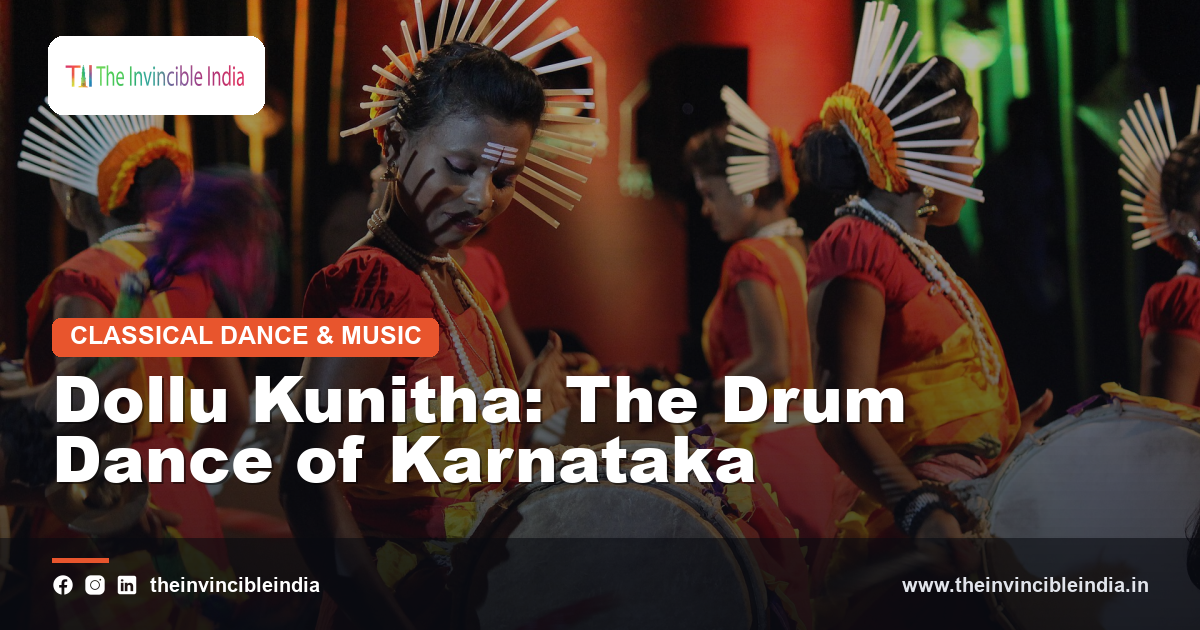
In the villages of northern Karnataka, a line of performers advances in disciplined formation, large drums slung from their shoulders, sticks striking taut hide in thunderous unison: this is Dollu Kunitha, one of Karnataka’s most physically demanding folk performance traditions. Combining vigorous dance movement with powerful percussion played on the performers’ own instruments, it stands among the most visually striking entries in the wider landscape of folk dances of India. Traditionally linked to shepherd communities and performed in devotion to regional deities, Dollu Kunitha combines rhythm, movement, and communal identity into a single powerful performance form.
Quick Facts
| Detail | Information |
|---|---|
| Dance Type | Drum-based folk dance |
| Region | Northern Karnataka |
| Associated Community | Pastoral and shepherd communities (Kuruba) |
| Main Instrument | Dollu (large drum worn on the body) |
| Traditional Context | Devotional festivals honouring regional deities |
| Performance Style | Coordinated group choreography with live drumming |
Origins and Etymology
The name Dollu Kunitha combines two Kannada words: ‘dollu’, referring to the large drum central to the performance, and ‘kunitha’, meaning dance, together describing a dance form built entirely around drumming. The tradition is generally understood to have developed among pastoral and agrarian communities in the northern districts of Karnataka, where communal performance played an important role in religious observance and seasonal celebration.
Historical accounts commonly associate Dollu Kunitha with devotion to regional deities, particularly forms of Shiva worshipped under local names, situating the dance within a broader pattern of Indian folk performance rooted in religious ritual. Over generations, the form evolved from a devotional practice into a widely recognised public performance tradition while retaining its religious associations.
The Dollu Drum
Central to the performance is the dollu itself, a large, cylindrical drum traditionally made from a wooden or metal frame covered with stretched animal hide on one or both playing surfaces. Performers wear the drum slung across the body using a strap, positioning it at waist or chest height so that both hands remain free to strike its surface with wooden sticks.
The drum’s considerable size and weight require significant physical stamina, since performers must carry and play it continuously while also executing energetic dance movements. Skilled drum makers carefully select and prepare the hide covering to achieve the deep, resonant tone associated with authentic Dollu Kunitha performance.
Community and Cultural Roots
Dollu Kunitha is historically associated with pastoral communities in Karnataka, particularly shepherd and herding groups whose traditional livelihoods and social organisation shaped the dance’s ritual context and communal character. Performance of the dance was traditionally tied to religious festivals and occasions of communal worship, reinforcing shared identity across generations.
As the dance gained wider recognition across Karnataka and beyond, its performance expanded beyond its original community context to include troupes and cultural groups that maintain and teach the tradition more broadly, while still retaining strong associations with its community origins.
Costume and Appearance
Performers of Dollu Kunitha typically wear vividly coloured traditional attire suited to vigorous physical movement, often including turbans, waist sashes, and simple but striking upper garments that allow freedom of motion while drumming and dancing. The large dollu drums themselves, often decorated or brightly painted, contribute significantly to the visual impact of a performance.
Group performances typically feature dancers dressed in coordinated or matching costumes, reinforcing the collective, ensemble-based character of the dance, while some troupes incorporate additional decorative elements such as anklets or headgear reflecting regional traditions.
Choreography and Formations
Dollu Kunitha choreography relies heavily on disciplined group formations, with performers moving in coordinated lines, circles, or other geometric patterns while maintaining a continuous, synchronised drumming rhythm. Movements typically combine vigorous stepping, turning, and bending with the physical demands of carrying and striking a large drum.
Formation changes are often choreographed to build visual and rhythmic intensity as a performance progresses, and this emphasis on collective precision reflects the dance’s communal origins, in which coordinated group performance served both practical and symbolic purposes.
Musical Accompaniment
Unlike many folk dances that rely on separate musicians, Dollu Kunitha performers generate their own percussion accompaniment directly through the drums they carry and play while dancing, making music and movement inseparable elements of the same performance. The dollu drums are sometimes joined by additional smaller percussion or wind instruments.
The rhythmic patterns played on the dollu are typically structured around repeating cycles that build in intensity, mirroring the increasing energy of the choreography, and the resulting soundscape is one of the most immediately recognisable features of Dollu Kunitha performance.
Religious and Ritual Significance
Dollu Kunitha’s origins are closely tied to religious devotion, particularly worship associated with regional forms of Shiva venerated within Karnataka’s rural communities, and the dance traditionally formed part of festival observances honouring these deities. Performances were historically understood not merely as entertainment but as an act of devotion.
Temple festivals and religious fairs in northern Karnataka have long served as primary occasions for Dollu Kunitha performance, and many troupes maintain awareness of and respect for these religious roots, sometimes incorporating invocatory elements dedicated to the deities historically associated with the tradition.
Occasions and Festivals
Beyond its original religious festival contexts, Dollu Kunitha today appears at a wide range of occasions, including state cultural festivals, national day celebrations, and events showcasing Karnataka’s folk heritage to wider domestic and international audiences. Its dramatic visual and auditory impact makes it a popular choice for public celebrations.
Village-level religious festivals, particularly those honouring regional deities historically associated with pastoral communities, continue to serve as important occasions for more traditional performances closely tied to the dance’s original devotional context.
Training and Transmission
Learning Dollu Kunitha requires sustained physical training, since performers must develop the strength and stamina needed to carry a heavy drum while executing vigorous, coordinated choreography over an extended performance. Traditionally, skills were passed down within communities through direct observation and practice.
As the dance form has gained wider recognition, more formal training structures have also emerged, including cultural troupes and educational programs, with training emphasising rhythmic precision and group coordination as much as individual drumming technique.
Regional Variations Within Karnataka
While Dollu Kunitha is recognised as a distinctive tradition across Karnataka, specific performance details, including drum size, rhythmic patterns, and choreographic style, can vary somewhat between different districts and communities within the state. Northern Karnataka is generally regarded as the tradition’s primary heartland.
Some regional variants place greater emphasis on acrobatic or highly athletic movement, while others prioritise slower, more measured formations that highlight rhythmic complexity, reflecting how a shared performance tradition can develop distinct regional character over generations.
The Role of the Lead Dancer or Caller
Many Dollu Kunitha performances feature a lead performer or caller responsible for guiding the group through choreographic transitions, formation changes, and shifts in rhythmic intensity as the performance unfolds. This role requires strong drumming and dancing ability alongside clear communication skills.
Experienced lead performers are typically drawn from among the most skilled and senior members of a troupe, and this leadership role also plays an important part in preserving and transmitting the tradition to newer members of the group.
Dollu Kunitha in State and National Platforms
Dollu Kunitha has gained recognition well beyond Karnataka’s rural festival circuit, appearing at major state and national cultural events, including celebrations organised around national holidays and government-sponsored cultural showcases. Its inclusion reflects a broader effort to represent India’s diverse regional folk traditions on prominent public stages.
Karnataka’s state cultural departments and tourism bodies have periodically featured Dollu Kunitha in promotional material, helping elevate the tradition’s status while providing performing troupes with valuable visibility and occasional financial support.
Costume Symbolism and Colors
The vivid colours and bold visual presentation associated with Dollu Kunitha costumes and drums are generally understood to reflect broader conventions within Karnataka’s folk performance culture, where bright, easily visible attire suits large, open-air festival settings. Turbans and sashes in vibrant hues help performers stand out clearly during outdoor daytime festivals.
Decorative elements applied to the dollu drums themselves further contribute to the performance’s overall visual impact, complementing the physical spectacle of synchronised drumming and movement for which the tradition is widely known.
Comparison with Other Drum Dances of India
India’s folk performance traditions include several other dance forms built around performer-produced percussion, and comparing Dollu Kunitha with these related traditions highlights both shared principles and distinctive regional character. Various regions of India have developed their own drum-centred folk dances shaped by local instruments and community histories.
Dollu Kunitha’s particular combination of large, chest-mounted drums, disciplined group formations, and close ties to pastoral community religious practice gives it a distinct identity within this broader category of Indian folk performance.
Preservation and Government Support
Recognising Dollu Kunitha as an important element of Karnataka’s intangible cultural heritage, various state cultural institutions and government departments have supported the tradition through funding for troupes, inclusion in official cultural programming, and promotion at tourism and heritage events.
Cultural documentation projects, including recorded performances and written accounts of the tradition’s history, contribute further to preserving detailed knowledge of Dollu Kunitha for future generations of performers and researchers within Karnataka’s cultural institutions.
Dollu Kunitha in Contemporary Culture
In recent years, Dollu Kunitha has found further visibility through inclusion in films, television programs, and staged cultural productions that seek to represent Karnataka’s folk heritage to broader domestic and international audiences. Choreographers have occasionally adapted elements of the dance for stage productions or fusion performances.
Educational outreach programs and cultural workshops have similarly expanded awareness of the dance among younger, urban audiences within Karnataka itself, helping bridge the gap between the tradition’s rural origins and contemporary audiences.
The Physical Demands of Performance
Performing Dollu Kunitha places considerable physical demands on dancers, who must sustain vigorous movement while continuously carrying and striking a heavy drum throughout an extended performance. This combination of endurance, strength, and precise timing distinguishes the dance from folk forms that separate musicians from dancers, since Dollu Kunitha performers must master both disciplines simultaneously.
Building the necessary stamina typically requires sustained practice over months or years, with experienced performers gradually increasing the length and intensity of routines they can sustain without losing rhythmic accuracy. This demanding physicality has become part of the dance’s appeal, since audiences often describe performances as visually and sonically overwhelming precisely because of the evident effort and coordination required from every performer in the group.
Dollu Kunitha in Educational and Cultural Programs
Educational institutions across Karnataka have increasingly incorporated Dollu Kunitha into cultural programs, workshops, and school events aimed at introducing students to the state’s folk performance heritage from an early age. Such programs often combine practical instruction in basic drumming and movement with historical context about the dance’s origins and religious significance.
Cultural academies and government-supported training centres have also periodically organised structured courses for interested learners beyond the communities historically associated with the tradition, broadening participation while fostering public appreciation for Karnataka’s rural folk heritage. These educational initiatives complement the informal community transmission that has traditionally sustained Dollu Kunitha across generations of rural performers.
Dollu Kunitha Today
Today, Dollu Kunitha remains an actively performed tradition in Karnataka, sustained both by continued religious festival practice within its originating pastoral communities and by broader recognition as a celebrated symbol of the state’s folk cultural heritage. Performing troupes continue to train new generations of drummers and dancers.
While modern adaptations and staged presentations have introduced Dollu Kunitha to new audiences, the tradition’s continued vitality ultimately depends on the communities and institutions that sustain its training, performance, and religious significance at the local level.
Sources & Further Reading
- Ministry of Culture, Government of India (indiaculture.gov.in).
- Sangeet Natak Akademi (sangeetnatak.gov.in).
Frequently Asked Questions
What is Dollu Kunitha?
Dollu Kunitha is a vigorous folk dance from Karnataka in which performers dance in coordinated group formations while simultaneously playing large drums, called dollu, slung across their bodies.
Who traditionally performs Dollu Kunitha?
The dance is traditionally associated with pastoral and shepherd communities of northern Karnataka, who historically performed it as part of religious festivals honouring regional deities.
What instrument is used in Dollu Kunitha?
Performers use the dollu, a large cylindrical drum with a hide-covered playing surface, worn on a strap and struck with wooden sticks while dancing.
Is Dollu Kunitha a religious tradition?
Yes, the dance originated as a devotional practice linked to festivals honouring regional forms of Shiva, and many performances still carry this religious significance today.
Where can Dollu Kunitha be seen today?
It is performed at village religious festivals in Karnataka as well as at state and national cultural events, competitions, and tourism showcases celebrating Karnataka’s folk heritage.


