

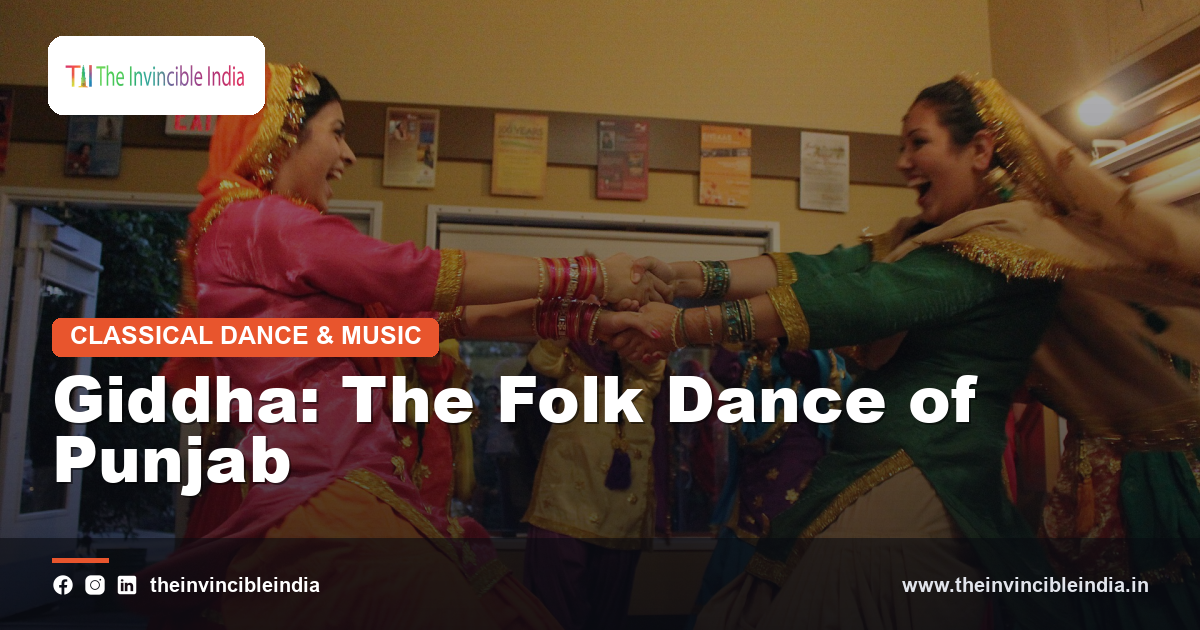
In villages and towns across Punjab, women gather in a circle, clapping in rhythm as one performer steps forward to sing a sharp, witty couplet before the group erupts into energetic movement: this is Giddha, one of Punjab’s most vibrant folk dance traditions. Performed traditionally by women at weddings, harvest celebrations, and festive gatherings, Giddha combines rhythmic clapping, call-and-response singing, and spirited group movement into a distinctly communal art form. Like Ghoomar in Rajasthan, Giddha represents a regional tradition of women’s folk dance built around circular formation and shared community celebration, though its sung couplets and energetic clapping give it a character entirely its own.
Quick Facts
| Detail | Information |
|---|---|
| Dance Type | Women’s folk dance |
| Region | Punjab |
| Formation | Circular, with rhythmic clapping |
| Key Feature | Sung couplets called boliyan |
| Common Occasions | Weddings, harvest festivals |
| Typical Attire | Salwar kameez with dupatta, traditional jewellery |
Origins and Etymology
Giddha is widely understood to have developed from Punjab’s rural folk culture, with some accounts tracing elements of its circular formation and rhythmic clapping to older regional dance and devotional practices, though its precise historical origins are difficult to establish with certainty. The name itself is generally associated with energetic, communal folk dancing in the Punjabi language tradition.
Traditionally performed exclusively by women, Giddha developed as an important outlet for social expression within rural Punjabi communities, providing an occasion for women to gather, sing, and dance together. Over generations, the dance became closely associated with specific celebratory occasions, particularly weddings and harvest festivals, cementing its place within Punjabi culture.
Formation and Basic Structure
A typical Giddha performance takes place within a circular formation, with participants standing or moving around a central space where individual performers step forward briefly to sing or dance before returning to the group. This circular structure encourages a highly participatory dynamic, in which no single performer dominates the entire performance.
Clapping performed by the surrounding group provides a steady rhythmic foundation throughout, uniting the various individual contributions into a cohesive overall performance and reflecting themes of community, inclusion, and shared celebration that run throughout Punjabi folk culture.
Boliyan: The Sung Couplets
Central to Giddha are boliyan, short sung couplets performed by individual women within the group, often addressing themes of daily rural life, family relationships, marriage, and humorous social observation with wit and directness. These couplets are typically delivered with confident, expressive delivery, sometimes drawing laughter or enthusiastic responses from the surrounding group.
Boliyan can be traditional, passed down through generations of performers, or improvised to suit a particular occasion, giving Giddha a strong verbal and narrative dimension alongside its physical performance elements and a window into rural Punjabi social life.
Costume and Adornment
Performers of Giddha traditionally wear vibrant Punjabi attire, most commonly the salwar kameez paired with a dupatta, in bright colours suited to festive occasions such as weddings and harvest celebrations. Jewellery, including traditional Punjabi ornaments for the head, ears, and wrists, often accompanies the costume, adding further visual richness.
Bright colours and flowing fabrics also serve a practical purpose, allowing freedom of movement during the dance’s energetic clapping and stepping sequences while enhancing visual impact for onlookers gathered at a wedding or festival celebration.
Clapping and Rhythm
Clapping forms the essential rhythmic backbone of Giddha, provided collectively by the surrounding group of women as individual performers take turns singing boliyan or executing brief solo movement within the circle. This rhythmic clapping requires no additional instrumentation, allowing Giddha to be performed spontaneously in almost any setting.
The tempo and intensity of clapping typically build as a performance progresses, mirroring the increasing energy of the singing and movement, reflecting Giddha’s identity as a genuinely communal, participatory folk tradition rather than one requiring specialised accompaniment.
Occasions for Performance
Giddha is traditionally performed at joyous social occasions within Punjabi rural and community life, most prominently weddings, where it forms an important part of pre-wedding and celebratory festivities among women of the families involved. Harvest festivals, particularly those associated with Punjab’s agricultural calendar, also serve as important occasions for performance.
Beyond these major occasions, informal gatherings of women during festive periods may also include spontaneous Giddha performance, reflecting the dance’s accessible, low-barrier nature as a form of communal enjoyment across generations of Punjabi families.
Giddha and Women's Social Expression
Historically, Giddha provided rural Punjabi women with a valued space for social expression, humour, and community bonding within a social context that often limited other public forms of female self-expression. The boliyan sung during performances frequently touch on the realities of women’s lives, including relationships with in-laws and married life.
The dance’s participatory, non-hierarchical structure, in which many women take turns contributing verses and movement, further reinforced its role as a shared communal activity, helping explain why Giddha has remained such a deeply valued tradition within Punjabi community life.
Regional Variations
While Giddha is recognised across Punjab as a shared cultural tradition, specific performance styles, boliyan themes, and clapping rhythms can vary somewhat between different districts and communities within the broader Punjabi region. Some areas maintain particular local variations in the pace or structure of the dance.
Punjabi communities beyond India’s borders, including diaspora populations, have also developed their own variations of Giddha, adapting the tradition to different social contexts while retaining its core structure of circular formation, sung couplets, and collective clapping.
Giddha vs Bhangra
Giddha is frequently discussed alongside Bhangra, Punjab’s well-known energetic folk dance traditionally performed by men, and comparing the two highlights both shared regional roots and important differences in structure and social context. Bhangra traditionally features vigorous, athletic movement accompanied by the dhol drum, while Giddha centres on sung boliyan and collective clapping.
In contemporary settings, both dances are increasingly performed and taught more broadly, sometimes appearing together at cultural events showcasing Punjabi folk heritage as complementary expressions of the same regional culture rather than a single dance form.
Instruments and Accompaniment
Although Giddha relies primarily on vocal singing and collective clapping for its rhythmic foundation, some performances incorporate additional instrumental accompaniment, most commonly the dholak, a two-headed hand drum widely used across Punjabi and North Indian folk music. When present, the dholak reinforces the rhythmic pulse established by clapping.
This flexibility regarding accompaniment reflects Giddha’s origins as a spontaneous, accessible community activity that could be performed in almost any setting without requiring specialised musicians or instruments to be present at every gathering.
Themes in Giddha Boliyan
The boliyan sung during Giddha performances cover a wide range of themes drawn from everyday rural Punjabi life, including marriage, family relationships, agricultural seasons, and affectionate or humorous teasing among friends and relatives. Many boliyan express emotions associated with major life events, particularly marriage and the transition to a new household.
Humour features prominently in many boliyan, with performers often drawing appreciative laughter through witty observations, demonstrating that Giddha functions not merely as physical dance but as a rich oral tradition preserving everyday experience through sung verse.
Training and Community Transmission
Traditionally, Giddha has been learned informally within family and community settings, with younger women observing and gradually participating in performances led by older, more experienced relatives and neighbours during weddings and festive gatherings. This informal transmission process meant skills were absorbed gradually through repeated participation.
As Giddha has gained recognition as a celebrated element of Punjabi cultural heritage, more formal training opportunities have also emerged, including dance schools and cultural organisations that teach the tradition to interested students beyond its original community setting.
Giddha in the Punjabi Diaspora
Punjabi communities settled outside India have played an important role in sustaining and promoting Giddha well beyond its original rural regional context. Cultural associations, community celebrations, and diaspora wedding traditions frequently feature Giddha performances, helping maintain a connection to Punjabi heritage among communities living far from Punjab itself.
Younger generations within the diaspora often learn Giddha through community cultural programs and family celebrations, ensuring the tradition continues to be passed down even outside its original geographic setting, contributing to its continued global visibility.
Giddha in Modern Media and Stage
In recent decades, Giddha has gained considerable visibility through its inclusion in Punjabi and broader Indian films, television programs, and staged cultural productions that showcase Punjab’s folk heritage to wide audiences. Choreographers have sometimes adapted traditional Giddha elements, blending them with other dance styles for formal performance venues.
Educational and cultural institutions have similarly incorporated Giddha into performance programs and competitions, with these modern presentations generally aiming to celebrate and preserve Giddha’s essential spirit while extending its reach to new and diverse audiences.
Preservation and Recognition
As an important element of Punjab’s intangible cultural heritage, Giddha has received attention and support from cultural institutions, educational programs, and government cultural bodies aimed at documenting and sustaining the tradition for future generations. Recorded performances and written accounts of boliyan contribute to preserving detailed knowledge of the dance.
Competitions and organised festivals celebrating Punjabi folk arts frequently include Giddha as a featured category, providing both recognition and incentive for continued practice and instruction among younger performers across Punjab and beyond.
Giddha in Festivals and Competitions
Giddha frequently appears as a featured performance category at cultural festivals across Punjab and in broader Indian folk dance competitions, providing structured opportunities for troupes and individual performers to showcase their skill in choreography, singing, and group coordination. School and college cultural events across Punjab frequently include Giddha performances.
National-level folk dance festivals and competitions have also provided Giddha performers with platforms to represent Punjabi culture alongside folk traditions from other Indian states, contributing to broader public awareness of the dance’s distinctive character.
Giddha and Seasonal Celebration
Beyond weddings, Giddha holds a special connection to Punjab’s agricultural calendar, particularly the harvest season, when communities traditionally gather to celebrate a successful crop cycle with music, food, and dance. During these seasonal festivities, Giddha performances often carry an especially joyous, communal energy, reflecting relief and gratitude after months of agricultural labour.
The seasonal association also shaped many traditional boliyan, which frequently reference themes of abundance, seasonal change, and the rhythms of rural agricultural life familiar to performers and audiences alike, illustrating how the dance functioned as an integral part of the broader cycle of community life in rural Punjab.
The Cultural Legacy of Giddha
Giddha’s enduring legacy lies in its role as a living record of rural Punjabi women’s social life, preserving through sung verse and movement a perspective on family, marriage, and community that might otherwise have gone undocumented. Generations of performers have contributed to an evolving repertoire of boliyan, keeping the tradition responsive to changing circumstances while retaining its core structure.
Cultural historians and folklorists studying Punjab’s performing arts often point to Giddha as a particularly rich source of insight into everyday rural experience, given the directness and honesty characteristic of its sung couplets, securing its place in the broader cultural memory of the region’s rural communities.
Giddha Today
Today, Giddha remains a vibrant and actively practised tradition, performed both in its traditional informal community settings, particularly weddings and festive gatherings, and in more structured contexts including cultural festivals, competitions, and staged productions. Its continued popularity reflects the enduring appeal of its accessible, participatory structure.
While modern media and staged adaptations have introduced Giddha to increasingly wide audiences, its essential character as a communal, women-centred celebration of Punjabi social life remains firmly intact, ensuring it stays among the most cherished folk dance traditions associated with the region.
Sources & Further Reading
- Ministry of Culture, Government of India (indiaculture.gov.in).
- Sangeet Natak Akademi (sangeetnatak.gov.in).
Frequently Asked Questions
What is Giddha?
Giddha is a traditional Punjabi folk dance performed by women in a circular formation, featuring rhythmic clapping and sung couplets known as boliyan, typically at weddings and festive occasions.
What are boliyan?
Boliyan are short sung couplets performed by individual women during Giddha, often touching on themes of family life, marriage, and humorous social observation with wit and directness.
How is Giddha different from Bhangra?
Giddha is traditionally performed by women and centres on sung couplets and collective clapping in a circle, while Bhangra is traditionally a men’s dance built around vigorous movement and drumming.
When is Giddha typically performed?
It is most commonly performed at weddings and harvest festivals within Punjabi communities, as well as at cultural festivals, competitions, and community celebrations worldwide.
Is Giddha still popular today?
Yes, Giddha remains widely performed both within Punjab and among Punjabi diaspora communities, and it continues to appear in films, stage productions, and cultural festivals.


