

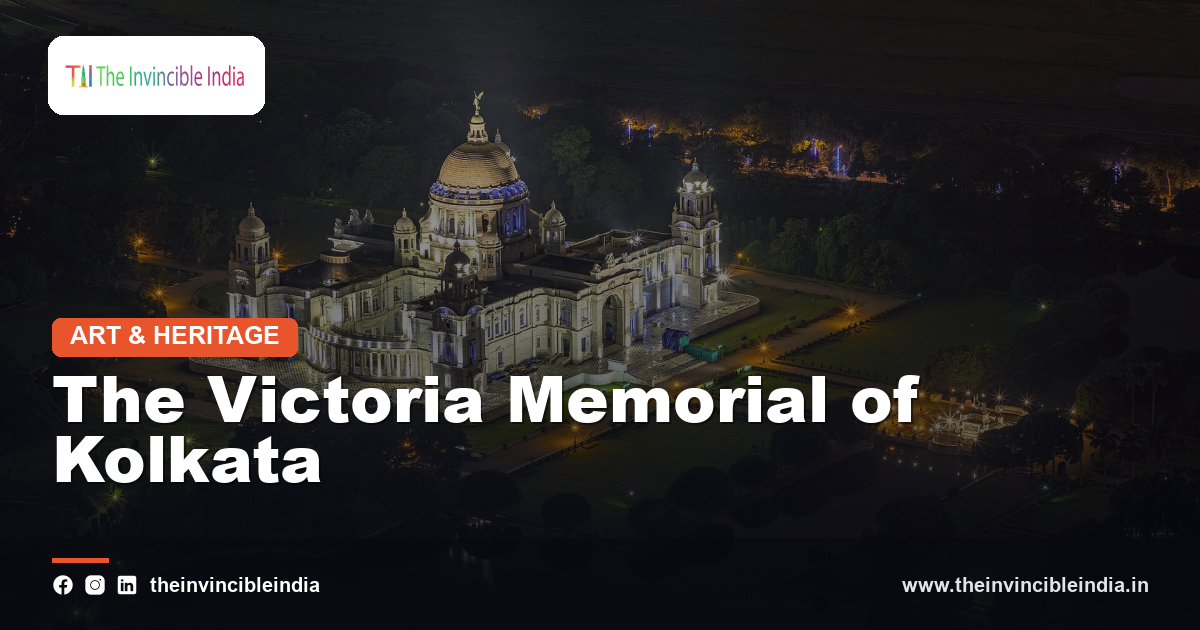
Rising in pale marble above the wide lawns of central Kolkata, a domed memorial hall commemorates a pivotal figure of the British colonial era while housing one of eastern India’s most significant museum collections. The Victoria Memorial, built in the early twentieth century, exemplifies the Indo-Saracenic style that blended European classical forms with motifs drawn from colonial architecture across India and earlier Mughal traditions. Set within landscaped gardens near the historic Maidan, the building has become one of the city’s most recognizable landmarks. This guide examines its history, architectural character, and continuing role as both memorial and museum.
Quick Facts
| Detail | Information |
|---|---|
| Location | Kolkata, West Bengal |
| Built For | Memorial to Queen Victoria |
| Style | Indo-Saracenic |
| Material | White marble |
| Function | Memorial hall and museum |
| Setting | Landscaped gardens near the Maidan |
Historical Background and Purpose
The Victoria Memorial was conceived in the early twentieth century as a grand commemorative hall dedicated to the memory of Queen Victoria, built in the city then serving as the capital of British India. Its construction was funded through public and private contributions gathered across the subcontinent, reflecting the scale of ceremony attached to marking the end of an era in colonial governance. Envisioned from the outset as both a memorial and a museum, the building was designed to house historical artifacts, paintings, and sculptures alongside its role as a monumental tribute. Its creation reflected the colonial administration’s broader interest in using grand public architecture to project authority and permanence. Set within extensive gardens near the heart of the city, the memorial was intended to serve as a lasting civic landmark rather than a purely private commemorative structure. This dual identity as memorial and museum continues to define its role today.
Colonial Kolkata Context
Kolkata, then known as Calcutta, held a central place in British colonial administration in India, serving for a considerable period as the seat of government before the capital was later shifted elsewhere. The city’s prominence attracted substantial investment in grand public buildings, wide boulevards, and expansive green spaces during the colonial period, of which the Victoria Memorial became one of the most ambitious examples. Its location near the Maidan, a large open ceremonial ground in the city center, placed the memorial within a landscape already associated with public gatherings and colonial civic life. The building’s scale and prominence reflected Calcutta’s status as a major administrative and commercial center of the era. Today, the memorial remains deeply embedded in the city’s identity, standing as one of its most recognizable landmarks. Its historical context within colonial Calcutta continues to shape how the building is understood and visited.
Architectural Style: Indo-Saracenic Fusion
Architecturally, the Victoria Memorial is a striking example of Indo-Saracenic style, a colonial-era design approach that combined elements of European classical architecture with motifs and forms drawn from Indian, particularly Mughal, building traditions. Domes, chhatris, and decorative details reminiscent of Mughal monuments appear alongside classical columns, pediments, and symmetrical massing more typical of European civic architecture. This deliberate fusion was intended to create a building that felt both authoritative in the European classical sense and visually connected to the Indian architectural context in which it stood. The result is a distinctive hybrid form that set it apart from purely European-style colonial buildings elsewhere in the city. This blending of traditions makes the memorial an important case study in Indo-Saracenic architecture, a style that became closely associated with major British colonial commissions across India during this period.
Design and Overall Layout
The memorial’s overall design follows a symmetrical plan centered on a large central hall beneath the main dome, flanked by wings and secondary chambers arranged in careful balance. Wide terraces and staircases lead visitors up to the main entrance, emphasizing the building’s monumental scale and ceremonial character. The layout was designed to accommodate both the movement of large numbers of visitors and the display of extensive collections within its galleries. Corner towers and secondary domes punctuate the building’s silhouette, adding visual rhythm to its long facades. Reflecting pools and formal pathways within the surrounding gardens extend the building’s symmetry outward into the landscape. This careful attention to balance and proportion throughout both the structure and its grounds reflects the ambitions of its designers to create a truly monumental civic and commemorative building.
The Central Dome
Rising above the central hall, the memorial’s large dome forms the building’s most prominent visual feature, visible from a considerable distance across the surrounding gardens and open ground. Constructed in white marble to match the rest of the exterior, the dome draws visually on domed forms found in earlier Mughal architecture while incorporating structural techniques associated with contemporary European engineering. Its scale and prominence were intended to give the memorial a commanding presence befitting its commemorative purpose. Beneath the dome, the central hall houses some of the building’s most significant statuary and historical displays, illuminated by natural light filtering through the structure above. The dome’s silhouette has become closely associated with the wider skyline of Kolkata, appearing in countless depictions of the city. As the visual centerpiece of the memorial, the dome anchors both the building’s architecture and its symbolic identity.
Materials: White Marble
The Victoria Memorial is built predominantly of white marble, a material choice intended to evoke both permanence and grandeur befitting its role as a royal memorial. Sourced and transported at considerable effort, the marble gives the building its distinctive pale exterior, which shifts in tone across the day as sunlight changes. The use of marble throughout, rather than more common colonial-era building materials such as brick or sandstone, reflects the elevated status accorded to the structure among British colonial commissions in India. Careful craftsmanship in cutting and fitting the marble panels contributed to the building’s smooth, monumental surfaces. Over time, the exterior marble has required ongoing cleaning and maintenance to counter the effects of pollution and weathering in an urban environment. The choice of material remains one of the most immediately striking aspects of the memorial’s appearance today.
The Angel of Victory
Atop the central dome stands a large bronze weathervane figure known as the Angel of Victory, designed to rotate with the wind and visible as a distinctive silhouette against the sky. This figure has become one of the most recognizable symbolic elements of the memorial, often reproduced in depictions of the building and used as an emblem of the monument as a whole. Positioned at the highest point of the structure, the angel reinforces the memorial’s commemorative and celebratory character. Its bronze construction has weathered over the decades, acquiring a distinctive patina consistent with long exposure to the elements. The figure’s dynamic pose, capturing a sense of movement, contrasts with the more static, classical forms found elsewhere on the building. As both a functional weathervane and a symbolic crowning feature, the Angel of Victory remains an iconic element of the memorial’s silhouette.
Gardens and Grounds
Surrounding the Victoria Memorial is an extensive formal garden, laid out with manicured lawns, tree-lined pathways, and reflecting pools that frame views of the building’s marble facade. These grounds were designed as an integral part of the overall composition, providing a landscaped setting appropriate to the memorial’s monumental scale. Statues and commemorative markers are placed at intervals throughout the gardens, adding further historical and artistic interest to the grounds. The gardens serve today as a popular public recreational space, drawing visitors and local residents alike beyond those specifically visiting the museum inside. Seasonal plantings and careful upkeep maintain the grounds’ formal character throughout the year. Together, the building and its gardens form a cohesive civic landscape that remains one of Kolkata’s most visited and cherished public spaces.
Sculptures and Statuary
Statuary plays a prominent role both inside and outside the Victoria Memorial, with sculptures depicting historical figures, allegorical themes, and decorative motifs distributed across its halls and grounds. A prominent statue associated with the memorial’s namesake occupies a central position within the surrounding gardens, reinforcing the building’s commemorative purpose. Interior halls display busts and figures of historical administrators and dignitaries associated with the colonial period, alongside allegorical sculptures representing abstract concepts common in memorial architecture of the era. These works, largely executed in marble and bronze, reflect the sculptural conventions of the period in which the memorial was built. Careful placement of statuary throughout the building and gardens reinforces the overall narrative purpose of the memorial as a space for commemoration and historical reflection. This extensive collection of statuary remains a significant part of the site’s cultural value.
Interior Halls and Galleries
Inside, the Victoria Memorial’s central hall and surrounding galleries house one of the more extensive collections of historical art and artifacts associated with the colonial period in eastern India. High ceilings and generous natural lighting within the main hall create a suitably grand setting for the display of large paintings, sculptures, and decorative objects. Adjoining galleries are organized thematically, guiding visitors through different aspects of the region’s colonial and pre-colonial history. The scale of the interior spaces reflects the building’s dual function as both memorial and museum, designed from the outset to accommodate large public collections. Circulation through the galleries has been arranged to allow a coherent visitor experience despite the considerable size of the building. These interior spaces remain central to the memorial’s ongoing role as a major cultural and historical institution in the city.
Museum Collections
The museum housed within the Victoria Memorial holds an extensive collection of paintings, manuscripts, weapons, and decorative artworks relating to the history of the region and the wider colonial period. Portraits and historical paintings depicting notable figures and events form a significant part of the collection, offering visitors insight into the visual culture of the era. Manuscripts, maps, and archival materials provide further historical context for the period surrounding the building’s construction. The collection has grown over time through acquisitions and donations, expanding the scope of the museum well beyond its original commemorative core. Rotating exhibitions and curated displays allow different aspects of the collection to be highlighted for visitors over time. This substantial museum collection secures the Victoria Memorial’s place as a major cultural institution alongside its architectural significance.
Role in Kolkata's Urban Landscape
Within Kolkata’s broader urban landscape, the Victoria Memorial occupies a prominent position near the Maidan, contributing significantly to the city’s skyline and civic identity. Its scale and visibility have made it a natural point of reference for orientation within the city, as well as a frequent backdrop for public events and celebrations. The surrounding area, including nearby colonial-era buildings and open ground, forms a historically cohesive precinct that reflects the city’s development during the colonial period. As one of the most photographed buildings in the city, the memorial features prominently in depictions of Kolkata in media, tourism promotion, and civic identity. Its continued prominence within the urban fabric illustrates how colonial-era monuments can become deeply integrated into a city’s modern identity. The memorial’s role extends well beyond its original commemorative function to that of a defining civic landmark.
Construction Process and Craftsmanship
Constructing the Victoria Memorial required coordinating skilled labor, imported materials, and considerable engineering expertise over an extended building period. Marble and other materials were sourced and transported to the site, while craftsmen skilled in both classical European detailing and Indian decorative traditions contributed to the building’s hybrid architectural character. The scale of the undertaking reflected the ambitions attached to the project as a major public monument, requiring sustained investment and coordination across multiple stages of construction. Attention to fine detail in stone carving, sculptural work, and interior finishing extended the building period considerably beyond that of more modest colonial structures. The completed building stood as a testament to the organizational and technical capacity available for major public works during the late colonial period. This construction process itself forms an important part of the memorial’s broader historical significance.
Symbolism of the Memorial
As a memorial, the building was intended to embody ideals of imperial permanence, order, and grandeur associated with the monarch it commemorates, expressed through its scale, materials, and symbolic ornamentation. The choice of a hybrid Indo-Saracenic style was itself a symbolic gesture, intended to present the memorial as connected to, rather than entirely separate from, the Indian context in which it was built. Statuary and decorative elements throughout the building reinforce themes of authority, continuity, and civic order characteristic of memorial architecture from this period. Today, the memorial is often approached less as a celebration of empire and more as a historical artifact reflecting the complexities of the colonial era. This layered symbolism gives the building continued relevance as a site for historical reflection rather than simple commemoration. Its meaning has evolved considerably since its original construction, shaped by changing perspectives on the period it represents.
Restoration and Maintenance
Maintaining a large marble structure in a humid, densely populated urban environment presents ongoing conservation challenges, requiring regular cleaning, structural monitoring, and careful restoration work. Pollution and weathering have periodically necessitated cleaning of the exterior marble to preserve its original pale appearance. Interior galleries require climate control and careful handling of sensitive paintings, manuscripts, and artifacts to prevent deterioration over time. Periodic restoration projects have addressed structural elements, decorative details, and the surrounding grounds to keep the memorial in good condition for public visitation. These ongoing efforts reflect the recognition of the Victoria Memorial as both an architectural landmark and a significant repository of historical material. Sustained investment in conservation ensures that the building remains accessible and well-preserved for future generations of visitors and researchers alike.
Victoria Memorial Today
The Victoria Memorial today functions as one of Kolkata’s most prominent museums and civic landmarks, drawing visitors interested in its architecture, its extensive historical collections, and its surrounding gardens. It continues to serve its original dual purpose as both a commemorative monument and a public museum, hosting exhibitions and educational programs alongside its permanent collection. The building’s Indo-Saracenic architecture remains a subject of scholarly and popular interest as an example of colonial-era architectural fusion. Its gardens continue to serve as a valued public space within the busy urban environment surrounding it. As both a historical monument and an active cultural institution, the Victoria Memorial remains deeply woven into the identity of Kolkata. Its enduring presence reflects the layered history of the city and the continuing relevance of its colonial-era architectural heritage.
Sources & Further Reading
- Ministry of Culture, Government of India (indiaculture.gov.in).
- Archaeological Survey of India (asi.nic.in).
Frequently Asked Questions
What is the Victoria Memorial?
The Victoria Memorial is a marble memorial hall and museum in Kolkata, built in the early twentieth century to commemorate Queen Victoria and to house historical art and artifacts.
What architectural style is the Victoria Memorial?
The building is designed in the Indo-Saracenic style, which combines European classical architectural elements with motifs drawn from Indian, particularly Mughal, building traditions.
What is the Angel of Victory?
The Angel of Victory is a bronze weathervane figure mounted atop the memorial’s central dome, one of the building’s most recognizable symbolic features.
What can visitors see inside the Victoria Memorial?
Visitors can view an extensive museum collection of paintings, sculptures, manuscripts, and historical artifacts relating to the colonial period and the wider history of the region.
Where is the Victoria Memorial located?
The Victoria Memorial is located near the Maidan in central Kolkata, set within extensive formal gardens that form part of its overall design.


