

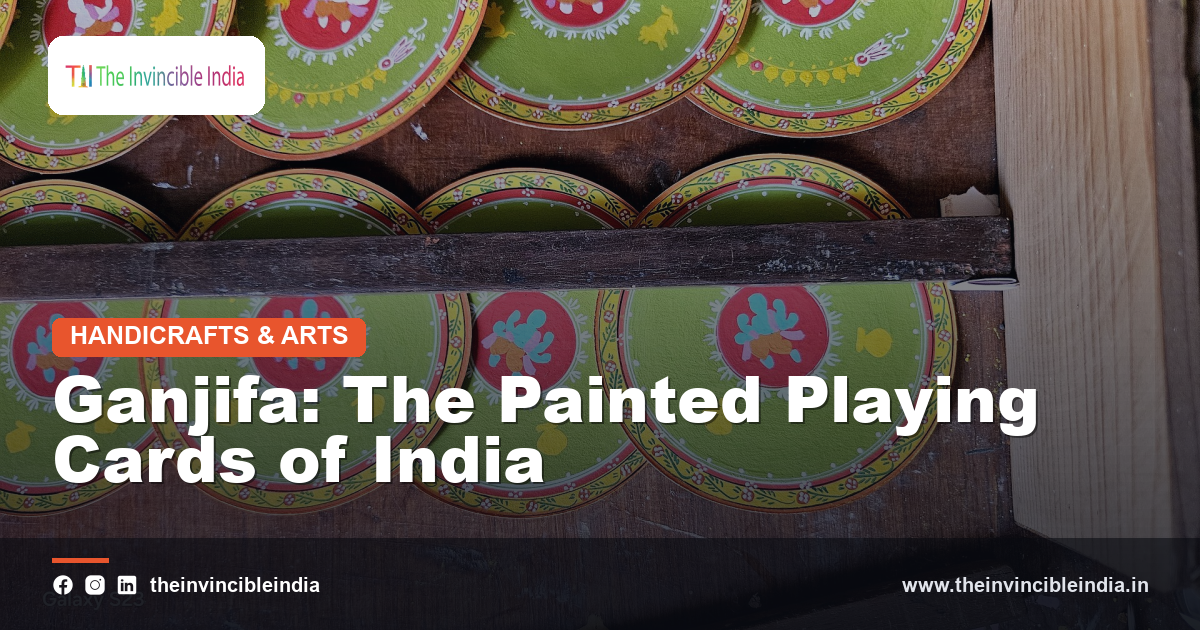
Ganjifa is one of India’s most visually distinctive craft traditions, a form of hand-painted playing cards that has been produced in circular and rectangular formats across several regions for many generations. Far removed from the printed cards of modern card games, Ganjifa sets are individually painted by hand, often depicting mythological figures, courtly scenes and elaborate decorative borders rendered with the same narrative sensibility found in Pattachitra painting. Once popular across royal courts and everyday households alike, Ganjifa gradually declined with the spread of Western-style playing cards, though pockets of the tradition survive through dedicated artisan families. This guide traces the history, materials, regional styles and continuing revival of Ganjifa card painting.
Quick Facts
| Detail | Information |
|---|---|
| Type | Hand-painted traditional playing cards |
| Common shapes | Circular and rectangular |
| Key regions | Sawantwadi, Odisha, Mysore, Nirmal |
| Common theme | Dashavatara, the ten avatars of Vishnu |
| Materials | Layered cloth or wood, lacquered and hand-painted |
| Recognition | Sawantwadi Ganjifa holds a Geographical Indication tag |
What Is Ganjifa
Ganjifa refers to a tradition of hand-painted playing cards produced across several regions of India, each card individually decorated rather than mass-printed as with modern packs. A complete Ganjifa set typically consists of a larger number of cards than a standard Western deck, divided into several suits with numbered and court cards distinguished by carefully rendered imagery. The cards themselves are usually circular or rectangular, made from layered cloth, wood or card stock coated with a smooth ground before painting. Ganjifa occupies an unusual place among Indian handicrafts, functioning simultaneously as a game object and a miniature work of narrative art, prized as much for its imagery as for its use in play.
Origins and Early History
The precise early history of Ganjifa is difficult to establish with certainty, but the tradition is understood to have developed and flourished in India over several centuries, absorbing influences from courtly culture as it spread across different regions. Ganjifa found favour in royal and noble households, where finely painted sets were commissioned as prestige objects as much as instruments of leisure. Over time, the craft took root in numerous towns and princely states, each developing its own preferred materials, suit structures and painting style. This long and layered history has left Ganjifa without a single fixed form, but rather a family of related regional traditions united by the shared idea of the hand-painted card.
The Meaning of the Name
The word Ganjifa is generally understood to derive from a term referring to playing cards, reflecting the game’s long history and its movement across cultural and linguistic boundaries before becoming firmly rooted in Indian courtly and popular life. As the game and its cards spread into different regions, local languages and artistic traditions reshaped both the terminology and the visual style associated with them. This linguistic journey mirrors the broader pattern of adaptation seen throughout the craft, in which a shared underlying concept, a deck of individually painted cards used for play, took on distinct regional identities. Understanding this etymological background helps explain why Ganjifa today refers to a diverse family of related traditions rather than one uniform product.
Materials and Card Construction
Traditional Ganjifa cards are built up from layers of cloth or paper bonded together with a natural paste, creating a firm, slightly flexible base capable of holding fine painted detail. Once dried, this layered base is coated with a smooth ground, often made from a chalk or clay-based preparation, which is polished to provide an even surface for painting. In some regional styles, thin sheets of wood or tortoiseshell have historically been used instead of layered cloth, giving certain sets additional durability and weight. This careful preparation of the card base, though largely hidden beneath the finished painting, is essential to producing a card that can be handled, shuffled and played with repeatedly without damaging its painted surface.
The Painting and Lacquering Process
Once the card base has been prepared, artisans hand-paint each card individually, working with fine brushes to render figures, symbols and decorative borders according to the established conventions of their particular regional style. After painting, many Ganjifa traditions apply a protective coat of natural lacquer or varnish, which seals the painted surface, enhances its colour and gives the finished card a smooth, slightly glossy feel. This lacquering step also improves the card’s durability for repeated handling during play. The combination of careful hand-painting and protective finishing reflects the dual purpose of Ganjifa cards, intended to be both functional playing pieces and small, enduring works of decorative art.
Traditional Pigments and Colours
Ganjifa artisans have traditionally relied on natural pigments derived from minerals, plants and other locally available materials, mixed with binding agents to create paints suited to the smooth surface of the prepared cards. This reliance on natural colour sources gives many older and traditionally made Ganjifa sets a distinctive palette, often built around warm earth tones set against contrasting bright accents used for figures and symbols. Colour in Ganjifa is not merely decorative but also functional, since different suits within a set are often distinguished partly through consistent colour coding alongside symbolic imagery. This thoughtful use of pigment helps a skilled player quickly identify suits and ranks even within visually dense, richly painted decks.
Circular Versus Rectangular Formats
Ganjifa cards are traditionally made in either circular or rectangular formats, with the choice of shape varying by region and by the particular version of the game being played. Circular cards, closely associated with certain courtly and classical forms of Ganjifa, present a distinctive visual challenge for painters, who must compose figures and borders to suit a round rather than rectangular frame. Rectangular Ganjifa cards, by contrast, allow for a layout closer to that of familiar Western playing cards while still following the traditional suit structure and painted ornamentation. This variation in shape adds another layer of regional distinctiveness to the craft, with certain towns and traditions strongly identified with one format over the other.
Suits and Set Structure
A traditional Ganjifa deck is typically organised into a number of suits considerably greater than the four found in standard Western playing cards, with historical sets recorded as containing as many as eight or ten suits depending on the regional version. Each suit generally includes a run of numbered cards alongside distinguished court cards representing higher ranks, often depicted with royal or divine figures appropriate to the suit’s symbolism. This expanded structure allows for more elaborate gameplay and greater scope for artistic variety across a single set. The precise number and naming of suits differs between regional Ganjifa traditions, reflecting the same diversity found in the craft’s materials, shapes and painting styles.
Dashavatara and Mythological Themes
Among the most celebrated thematic schemes in Ganjifa painting is the Dashavatara set, in which the suits and court cards are organised around the ten traditional avatars of the deity Vishnu, each rendered with its own distinctive iconography and colour associations. This mythological structure gives Dashavatara Ganjifa decks a strong narrative and devotional dimension, transforming a game of cards into a visual retelling of well-known religious themes. Artisans painting Dashavatara sets draw on established iconographic conventions for each avatar, ensuring that even a small, densely detailed card remains immediately recognisable. This blending of religious narrative with recreational play exemplifies the way Ganjifa merges entertainment with cultural and devotional meaning.
Courtly and Narrative Motifs
Beyond overtly religious themes, many Ganjifa traditions also depict courtly figures, rulers, attendants and scenes drawn from regional history or literature, reflecting the game’s long association with royal and noble patronage. Such courtly Ganjifa sets often feature richly dressed figures, ornate thrones and decorative borders that echo the visual language of miniature painting traditions found in the same regions. These narrative and courtly motifs allowed Ganjifa artisans to showcase considerable artistic skill within the constrained space of a single card, balancing intricate detail with legibility. The variety of possible themes, from mythological to courtly, underscores the flexibility of Ganjifa as an artistic format capable of carrying many different kinds of visual storytelling.
Sawantwadi Ganjifa of Maharashtra
The town of Sawantwadi in Maharashtra is among the most celebrated centres of Ganjifa production, historically supported by local princely patronage that helped the craft flourish alongside the town’s broader tradition of wood and lacquer work. Sawantwadi Ganjifa is typically circular, built on a layered cloth or paper base and finished with the same lacquering techniques used in the town’s decorative wooden crafts. Artisan families in Sawantwadi have continued to produce Ganjifa cards using established techniques, supplying both traditional players and a growing market of collectors and craft enthusiasts. This continuity has made Sawantwadi one of the most recognised names associated with the surviving Ganjifa tradition today.
Ganjifa Traditions of Odisha
In Odisha, a related tradition of hand-painted playing cards has developed alongside the state’s broader heritage of narrative painting, sharing stylistic sensibilities with forms such as Pattachitra in its use of bold outlines and vivid colour. Odisha’s Ganjifa sets often draw on mythological and religious themes consistent with the state’s strong devotional painting culture, rendered on cards prepared through locally established methods. Artisans working in this tradition have historically operated within close-knit painting communities, where card-making sits alongside other forms of religious and narrative art. This regional variation illustrates how Ganjifa often develops in close dialogue with a region’s wider painting traditions rather than existing as an entirely separate craft.
Ganjifa in Mysore and Nirmal
Further south and in parts of the Deccan, towns such as Mysore in Karnataka and Nirmal in Telangana have historically supported their own Ganjifa traditions, each shaped by local painting styles and courtly patronage. Mysore’s association with fine traditional painting lent its Ganjifa production a refined, detailed quality, while Nirmal’s broader reputation for decorative wooden and painted craft is reflected in its own approach to card-making. These regional centres, though less widely known today than Sawantwadi, contributed to the historical spread of Ganjifa across a wide swathe of the subcontinent. Their existence underscores how deeply the tradition of painted playing cards once penetrated diverse artistic and courtly cultures across India.
How the Traditional Game Is Played
Traditional Ganjifa games generally involve trick-taking or sequence-based play among several participants, with rules varying according to the regional version and the particular suit structure of the deck in use. Because Ganjifa decks typically contain more suits and cards than a standard Western pack, gameplay often demands a somewhat more elaborate set of rules and a greater capacity to track suit hierarchies and card ranks. Historically, Ganjifa was enjoyed both as a leisurely courtly pastime and as a popular pursuit among ordinary households, with regional variations in rules reflecting local social customs. Though far less commonly played today, knowledge of these traditional rules survives among some communities and enthusiasts dedicated to preserving the game alongside its visual craft.
Decline of the Tradition
The widespread adoption of mass-produced Western-style playing cards during the modern era gradually displaced Ganjifa from everyday use, as cheaper, faster-to-produce printed decks became far more accessible than individually hand-painted sets. This shift placed considerable economic pressure on Ganjifa artisan families, many of whom found it increasingly difficult to sustain a livelihood from a craft requiring extensive time and skill for each set produced. As practical demand for the cards as a game object declined, the tradition risked being remembered mainly as a historical curiosity rather than a living craft. This decline set the stage for later revival efforts aimed at preserving Ganjifa primarily as an artistic and cultural heritage rather than purely a functional card game.
Revival and Recognition
In recent decades, renewed interest in India’s traditional handicrafts has brought welcome attention back to Ganjifa, with cultural organisations, designers and collectors helping sustain remaining artisan communities. The Sawantwadi tradition in particular has received formal recognition through a Geographical Indication tag, helping protect its name and supporting the livelihoods of artisans who continue to produce authentic hand-painted sets. Exhibitions, craft fairs and museum collections have also introduced Ganjifa to new audiences who may never use the cards for play but value them as miniature paintings and historical artefacts. These combined efforts have helped move Ganjifa from the edge of disappearance toward a more secure, if modest, continued existence.
Ganjifa Today
Today Ganjifa survives chiefly through the dedication of a small number of artisan families, particularly in Sawantwadi, who continue to hand-paint circular cards using techniques passed down across generations even as the game itself is rarely played in its traditional form. Ganjifa cards are now valued largely as collectible art objects, sought after by museums, craft enthusiasts and travellers drawn to their intricate mythological and courtly imagery. Continued documentation, exhibition and formal recognition remain important to ensuring that this once-widespread tradition is not entirely lost. As both a historical game and a distinctive painting craft, Ganjifa remains a quietly remarkable thread within India’s broader handicraft heritage.
Sources & Further Reading
- Ministry of Textiles, Government of India, on regional Indian handicraft traditions (texmin.nic.in).
- Ministry of Culture, Government of India, on the folk and craft heritage of India (indiaculture.gov.in).
Frequently Asked Questions
What is Ganjifa?
Ganjifa is a traditional Indian form of hand-painted playing cards, made in circular or rectangular formats and decorated with mythological, courtly or narrative imagery according to regional style.
What is Dashavatara Ganjifa?
Dashavatara Ganjifa is a themed set of cards organised around the ten traditional avatars of the deity Vishnu, each suit and court card carrying its own distinctive iconography drawn from this mythology.
Which region is most associated with Ganjifa today?
Sawantwadi in Maharashtra is the region most closely associated with surviving Ganjifa production today, known for circular, lacquered cards and holding a Geographical Indication tag for its tradition.
Why did Ganjifa decline in popularity?
Ganjifa declined as mass-produced Western-style playing cards became cheaper and more widely available, making the time-intensive hand-painted decks impractical for everyday casual play.
Is Ganjifa still made today?
Yes, a small number of artisan families, especially in Sawantwadi, continue to hand-paint Ganjifa cards, now valued mainly as collectible art rather than for everyday gameplay.


