

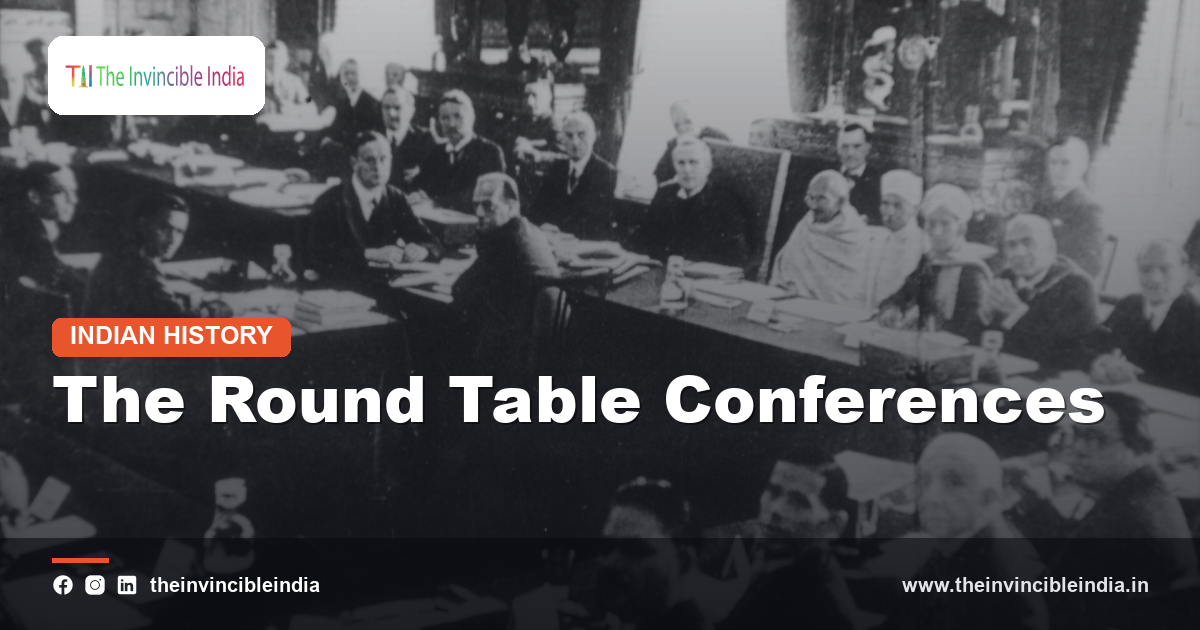
The Round Table Conferences were a series of constitutional discussions held in London in the early 1930s, bringing together British officials, Indian political leaders, representatives of princely states, and spokespersons for various communities to debate the future shape of Indian governance. They arose at a moment when the Indian independence movement had grown into a mass phenomenon that colonial authorities could no longer address through incremental measures alone. Held across three separate sessions, the conferences examined questions of provincial autonomy, federal structure, minority representation, and the place of princely states within any future constitutional arrangement. Although they did not resolve every disagreement, the conferences shaped the framework that would guide constitutional reform for the remainder of the decade.
Quick Facts
| Detail | Information |
|---|---|
| Held in | London, United Kingdom |
| Number of sessions | Three conferences |
| Period | Early 1930s |
| Convened by | British Government |
| Key theme | Constitutional reform and communal representation |
| Followed by | Government of India Act, 1935 |
Background to the Conferences
The Round Table Conferences emerged from a long period of British reassessment of how India should be governed as nationalist sentiment grew stronger through the early twentieth century. Constitutional reforms introduced in earlier decades had expanded limited representation for Indians in legislative councils, but they fell well short of the self-government that political leaders across the spectrum were demanding. Colonial administrators in London recognised that further changes to the structure of Indian governance were unavoidable, even as they sought to manage the pace of any transfer of authority. Reviews of existing arrangements pointed toward a need for a fresh framework addressing provincial autonomy, the role of princely states, and the representation of India’s many communities.
Rather than legislate unilaterally, the British government opted to convene a series of conferences in London that would bring together representatives of British India, the princely states, and various political and communal interests. This approach reflected both a genuine wish to consult a wide range of opinion and a strategic effort to manage rising demands through dialogue rather than confrontation.
The Simon Commission and Calls for Reform
Discontent with the pace of constitutional progress led the British government to appoint a commission tasked with reviewing the working of earlier reforms and recommending further changes. Because the commission included no Indian members, its formation was widely criticised across the political spectrum and became a rallying point for protest rather than a source of consensus. Boycotts and demonstrations greeted the commission during its visits to Indian cities, underscoring how central the question of Indian participation had become to any reform process.
In response to this criticism, and to competing proposals put forward by Indian political bodies for a constitution largely drafted by Indians themselves, British policymakers concluded that a conference format bringing Indian voices directly into discussion in London might prove more productive. This shift in approach set the stage for the Round Table Conferences, conceived as a way to involve a broad cross-section of Indian opinion before any legislation was drafted.
The First Round Table Conference
The first session opened in London with delegates representing princely states, various provinces, and a range of political and communal organisations, though it notably lacked participation from the Indian National Congress, then engaged in a civil disobedience campaign at home. Discussions ranged widely over the possible shape of a future Indian constitution, including proposals for a federation that would bring British Indian provinces and princely states into a single structure.
Princely representatives showed considerable interest in a federal arrangement that might allow them to retain internal autonomy while joining a wider constitutional framework. Delegates also explored questions of provincial self-government and the distribution of powers between a central authority and the provinces. While the absence of the Congress limited the session’s claim to represent mainstream nationalist opinion, it produced valuable groundwork on federalism that would influence later negotiations.
Absence of the Indian National Congress
The Indian National Congress, the leading vehicle of the independence movement, chose not to attend the first conference because its leadership was then engaged in a nationwide campaign of civil disobedience against colonial rule, and many senior figures were in prison. Congress leaders had also expressed reservations about a process that seemed to place British authorities in the position of arbiter over India’s constitutional future rather than acknowledging a clearer path to self-government.
This absence was widely seen as a significant gap, since no settlement could carry broad legitimacy without the participation of the organisation most identified with the national movement. British officials and moderate Indian leaders who had attended the first session recognised this problem and worked toward conditions that might allow the Congress to join subsequent talks, contributing to a shift in approach between the first and second conferences.
The Gandhi-Irwin Pact
Ahead of the second conference, negotiations between Mahatma Gandhi and the Viceroy resulted in an agreement that eased tensions and created conditions for the Congress to take part in the next round of talks. Under this understanding, the civil disobedience campaign was suspended and various restrictions imposed during the agitation were relaxed, while the government agreed to release political prisoners connected with the movement.
In return, the Congress agreed to attend the second Round Table Conference and to represent its position directly at the negotiating table in London. The pact represented a rare moment of direct accommodation between the colonial government and the nationalist movement’s most prominent leader. Although criticised by some nationalists as a compromise that yielded too little, the agreement opened the door for the Congress to engage formally with the constitutional discussions that followed.
The Second Round Table Conference
The second Round Table Conference marked the high point of the process in terms of the breadth of Indian participation, with the Congress now represented directly at the table alongside princely delegates and spokespersons for various communities and interests. Discussions again centred on the design of a federal constitution, the distribution of powers, and the safeguards that might be built into any new arrangement.
The session also exposed how difficult it would be to reconcile the differing visions held by various participants, particularly around how India’s diverse religious and social communities should be represented in future legislatures. Disagreements on this point proved difficult to resolve, and the session ultimately made only limited headway toward a comprehensive settlement, even though the presence of Congress representatives gave the talks a stronger claim to reflecting mainstream nationalist opinion.
Mahatma Gandhi's Role at the Talks
Mahatma Gandhi attended the second conference as the principal representative of the Indian National Congress, presenting the case for a constitution grounded in broad principles of self-government rather than a structure defined primarily by communal safeguards. He argued that the Congress spoke for the interests of the nation as a whole, including its minorities, and expressed concern that arrangements built around separate communal representation could deepen divisions rather than resolve them.
His position placed him at odds with other delegates who insisted on distinct representation for their communities as a condition for supporting any settlement. Despite lengthy engagement with fellow delegates and considerable public attention to his presence in London, Gandhi was unable to secure agreement on the communal question, though his participation gave the proceedings significant visibility before an international audience.
Debating a Federal Structure
A recurring theme across all three conferences was the attempt to design a federal system that could bind together the provinces of British India and the numerous princely states under a single constitutional umbrella. Such a federation promised princely rulers a degree of continued autonomy over their internal affairs while linking them to a common central government responsible for matters such as defence and external affairs.
For British Indian provinces, federation was often discussed alongside proposals for expanded provincial self-government, giving elected legislatures greater control over local administration. Delegates debated how representation in a federal legislature should be apportioned among provinces and states, and how the powers of the central government should be balanced against those of its constituent units, though these proposals proved intricate and difficult to finalise.
The Communal Question
Among the most contentious issues debated at the conferences was how India’s religious and social communities should be represented in future legislative bodies. Various groups pressed for separate electorates or reserved seats to ensure their voices would not be overwhelmed within a general electoral system, while others argued that such arrangements risked entrenching division rather than fostering a shared national identity.
The Congress delegation, led by Gandhi, generally opposed extending separate representation further, while several other delegations viewed guaranteed representation as essential protection for their communities. The inability to reach a consensus on this question was one of the clearest failures of the Round Table process, and it foreshadowed communal tensions that would continue to shape Indian politics through the following years.
Minority and Communal Representation
Beyond the broader communal debate, the conferences also gave attention to the specific concerns of smaller communities and marginalised groups seeking assured representation in future legislatures. Delegates representing these groups argued that without explicit safeguards, their interests could be overlooked within larger electoral constituencies dominated by more numerous communities.
Discussions considered various mechanisms, including reserved seats and special electorates, as ways of ensuring a voice for groups that might otherwise struggle to secure representation. The complexity of balancing these competing claims within a single constitutional framework contributed to the slow progress of the talks on this front, and many of the arrangements considered fed into the framework later adopted for elections under the reformed constitution.
Princely States and the Conferences
Princely states, which governed a substantial portion of the subcontinent under indirect British paramountcy, sent rulers and representatives to the conferences with a strong interest in shaping any federal arrangement that might affect their status. Many princely rulers were attracted to the idea of federation because it offered a route to greater involvement in an all-India political framework while preserving their internal administrative autonomy.
Their participation added a further layer of complexity to the negotiations, since integrating states of widely varying size, wealth and administrative practice into a common federal structure raised numerous practical questions. Although a federation incorporating the princely states was seriously discussed throughout the conferences, the necessary agreements were never fully completed, and the scheme remained largely on paper by the time the talks concluded.
Business, Labour and Other Interests
The conferences also included representatives of commercial and industrial interests, as well as delegates concerned with labour conditions, reflecting an intention to consult a broad cross-section of Indian society rather than political and communal leaders alone. Business representatives raised questions about how constitutional changes might affect trade, taxation and economic policy, seeking assurances that reform would not disrupt commercial stability.
Labour delegates, for their part, drew attention to working conditions and social welfare concerns that they felt deserved a place in discussions otherwise dominated by constitutional and communal questions. Including such a wide range of participants reflected an ambition, at least in principle, to design a constitution informed by the practical concerns of different sections of Indian society, even where the final settlement fell short of addressing every concern raised.
The Third Round Table Conference
The third and final Round Table Conference convened with a notably smaller and less representative gathering than the previous sessions, as several major parties, including the Indian National Congress, did not take part. By this stage, much of the substantive discussion had already occurred in earlier sessions and in the drafting work that followed them, so the final conference served largely to review and refine proposals rather than to open fresh debate.
Delegates who did attend continued to examine details of the federal scheme and provincial reforms under consideration, but the absence of key nationalist voices meant the session carried less political weight than its predecessors, and it is often remembered as a concluding formality rather than a decisive turning point in the process.
Limited Participation in the Final Session
Several factors contributed to the reduced participation in the final conference, chief among them a renewed period of tension between the Congress and the colonial government following the breakdown of the understanding reached earlier in the process. Civil disobedience activity had resumed in parts of India, and many Congress leaders were again facing restrictions, making full participation in a London conference politically and practically difficult.
Some delegates who had attended earlier sessions also felt that the essential positions of the major parties were already well known and that little would be gained from further general discussion. This combination of political strain and diminishing enthusiasm meant the third session functioned mainly as a mechanism for finalising technical details rather than as a forum for renewed negotiation.
The White Paper and Its Aftermath
Following the conclusion of the conferences, the British government issued a detailed statement setting out its proposals for a new Indian constitution, drawing heavily on the discussions held across the three sessions. This document laid out a framework combining provincial autonomy with a proposed all-India federation bringing together British Indian provinces and princely states, alongside provisions addressing minority representation along the lines debated at the conferences.
It was subsequently examined by a parliamentary committee in London, which took further evidence and refined the proposals before they were translated into formal legislation. Reactions in India to the published proposals were mixed, with some welcoming the extension of provincial self-government while others felt the safeguards retained for the central government left real power still concentrated in British hands.
Toward the Government of India Act, 1935
The recommendations developed through the Round Table Conferences and the subsequent white paper process fed directly into a major piece of legislation passed by the British Parliament later in the decade, which established a new constitutional framework for India. This law provided for greater autonomy in the provinces, with elected legislatures given substantially expanded authority over provincial administration, while plans for an all-India federation incorporating princely states were also outlined, though this element was never fully implemented in practice.
Elections held under the new provincial arrangements soon followed, giving Indian political parties direct experience of governing at the provincial level. Even though many nationalist leaders regarded the law as falling short of genuine self-government, it represented the most substantial devolution of authority to elected Indian representatives up to that point.
The Round Table Conferences Today
The Round Table Conferences today are remembered chiefly as a formative episode in the long process leading toward Indian self-government, illustrating both the possibilities and the limits of negotiated constitutional change under colonial rule. They demonstrated that the British government had accepted, in principle, that any future settlement would need to involve Indian voices directly, even as the conferences also revealed the depth of disagreement over communal representation and federal structure.
Historians and students of the independence movement continue to study the conferences as a case study in the challenges of reconciling competing political, religious and princely interests within a single constitutional framework, a legacy that fed directly into the reforms shaping Indian governance in the years before independence.
Sources & Further Reading
- Ministry of Culture, Government of India (indiaculture.gov.in).
- National Archives of India (nationalarchives.nic.in).
Frequently Asked Questions
What were the Round Table Conferences?
They were a series of three constitutional conferences held in London in the early 1930s, bringing together British officials and Indian representatives to discuss the future governance of India.
Why did the Indian National Congress miss the first conference?
Its leadership was engaged in a civil disobedience campaign and many senior leaders were in prison, so the party did not send delegates to the initial session.
What role did Mahatma Gandhi play?
Gandhi represented the Congress at the second conference, arguing for a constitution based on national unity rather than extensive separate communal representation.
What was the central unresolved issue at the conferences?
The question of how India’s different religious and social communities should be represented in future legislatures proved the most difficult to resolve.
What came out of the conferences?
The discussions informed a government white paper and ultimately shaped the Government of India Act of 1935, which expanded provincial self-government.


