

Rakhigarhi, located in the northern Indian state of Haryana, is recognised as one of the largest settlements associated with the Indus Valley Civilisation, one of the earliest urban cultures in the world. Long before empires such as the Maurya Empire rose to prominence in the subcontinent, communities at sites like Rakhigarhi were already building planned towns with organised streets, drainage systems and craft industries. Archaeological work at the site has revealed layers of occupation spanning the different phases of the Harappan civilisation, offering insight into how a mature urban centre developed, thrived and eventually declined. As one of several major Harappan sites identified within present-day India, Rakhigarhi holds particular importance for understanding the eastern extent of this ancient civilisation.
Quick Facts
| Detail | Information |
|---|---|
| Location | Haryana, India |
| Civilisation | Indus Valley (Harappan) |
| Site type | Ancient urban settlement |
| Known for | Planned streets, drainage, craft production |
| Excavated by | Archaeological Survey of India and university teams |
| Significance | One of the largest Harappan sites in India |
Location and Setting
Rakhigarhi is situated in the Ghaggar river plain of present-day Haryana, a region that lies within the broader zone once occupied by settlements of the Indus Valley Civilisation. The site sits near a now largely dry riverbed that is often associated with the ancient Saraswati river system described in early Indian tradition, though the precise identification of ancient watercourses remains a subject of ongoing scholarly discussion.
Its location on fertile alluvial plains would have supported agriculture and settled village life well before the site grew into a substantial town. Over time, Rakhigarhi expanded into a large cluster of connected mounds, reflecting successive phases of habitation and growth. This setting placed Rakhigarhi among the eastern reaches of the wider Harappan cultural zone.
Discovery and Early Investigation
Rakhigarhi first drew scholarly attention during archaeological surveys of the region in the twentieth century, when researchers began recording ancient mounds scattered across the plains of Haryana. Early observations noted surface pottery and other remains consistent with the Harappan cultural tradition already known from major sites further west.
Systematic excavation followed in subsequent decades, gradually revealing the true scale of the settlement hidden beneath the modern village and surrounding fields. As archaeologists exposed more of the site, it became clear that Rakhigarhi represented one of the largest Harappan settlements yet identified within Indian territory. Continued fieldwork by the Archaeological Survey of India and academic institutions has since built a more detailed picture of the site’s history.
Rakhigarhi within the Indus Valley Civilisation
Rakhigarhi belongs to the Indus Valley Civilisation, a Bronze Age urban culture that flourished across a vast area spanning parts of present-day Pakistan and northwestern India. This civilisation is known for its planned cities, standardised systems of weights and measures, distinctive pottery styles, and a still undeciphered script found on seals and other objects.
Rakhigarhi’s material culture, including its pottery, seals and architectural remains, closely mirrors patterns observed at other major Harappan sites, confirming its place within this shared cultural sphere. Comparing Rakhigarhi with sites further west helps researchers trace both the common threads that unified the civilisation and the local variations that developed in different parts of its territory.
Layout of the Ancient Settlement
The ancient settlement at Rakhigarhi developed across several distinct mounds, each representing a different part of the town as it grew over time. Archaeologists have identified areas that appear to have served residential, craft and possibly civic functions, suggesting a settlement organised along lines broadly comparable to other major Harappan towns.
Because much of the ancient town now lies beneath a living village, archaeologists have had to work within the constraints of a populated modern landscape, carefully selecting excavation areas to reveal as much of the ancient layout as possible without disturbing present-day residents. Even with these constraints, enough has been uncovered to confirm the site’s scale and complexity.
Town Planning and Street Grid
Like many major Harappan settlements, Rakhigarhi shows evidence of deliberate town planning, including streets laid out in an organised manner and structures arranged in a way that suggests coordinated construction rather than purely organic growth. Such planning is a hallmark of Indus Valley urbanism, reflecting a level of social organisation capable of directing construction across a large settlement.
The presence of this kind of planning at a site as far east as Rakhigarhi reinforces the impression that sophisticated urban design was not confined to the civilisation’s most famous western centres but extended across its full geographic range, pointing to shared cultural norms guiding how communities built their settlements.
Drainage and Water Management
Effective management of water was an important feature of Harappan urban life, and evidence from Rakhigarhi points to attention paid to drainage and water-related infrastructure within the settlement. Remains associated with water channels and carefully constructed surfaces suggest that residents took deliberate steps to manage runoff and maintain sanitary conditions within densely built areas.
Access to water, whether from wells, nearby water sources or stored supplies, would have been essential for a settlement of Rakhigarhi’s size, supporting both domestic needs and craft activities that required water as part of their processes, reflecting a broader Harappan emphasis on public health and orderly urban living.
Houses and Domestic Architecture
Excavations at Rakhigarhi have revealed the remains of houses built from mud brick and, in some cases, fired brick, arranged in clusters that suggest closely knit residential neighbourhoods. Rooms of varying sizes point to households of different scales, while courtyards and internal divisions within structures suggest attention to privacy and the practical organisation of domestic space.
The construction materials and techniques used at Rakhigarhi are broadly consistent with building practices seen elsewhere in the Indus Valley Civilisation. Continued excavation of residential areas at the site offers researchers a valuable window into how ordinary families lived, organised their homes and carried out daily routines within a large, well-established Harappan town.
Craft Production and Industry
Rakhigarhi has yielded substantial evidence of craft activity, including materials and workshop debris associated with the production of beads, bangles and other ornamental objects. Such finds indicate that the settlement supported specialised artisans who produced goods likely intended both for local use and for exchange with other communities.
The variety of raw materials recovered at the site, some of which would have originated from distant regions, points to a settlement engaged in networks that brought materials from beyond its immediate surroundings, an economic specialisation that situates Rakhigarhi among the significant manufacturing hubs of the civilisation rather than a large village alone.
Trade and Regional Connections
The presence of materials not locally available at Rakhigarhi points to participation in wider networks of trade and exchange that connected communities across the Indus Valley Civilisation and beyond. Items associated with craft production at the site suggest that raw materials moved across considerable distances before being worked into finished goods, implying organised systems of transport and exchange.
Such connections would have linked Rakhigarhi with other Harappan centres, allowing the flow of goods, materials and possibly ideas across the wider cultural zone, underscoring its status as more than an isolated settlement within a larger web of economic relationships.
Pottery and Everyday Artefacts
Pottery recovered from Rakhigarhi displays the characteristic styles associated with the Harappan tradition, including distinctive shapes, surface treatments and painted decoration found at other major sites of the civilisation. These ceramic remains help archaeologists date different layers of occupation and trace how styles changed gradually over time.
Alongside pottery, excavators have recovered a range of everyday objects, including tools, ornaments and items associated with household activities, that together build a picture of daily life at the site, reinforcing Rakhigarhi’s place within a shared material culture extending across a wide area of the ancient subcontinent.
Burial Practices and Cemeteries
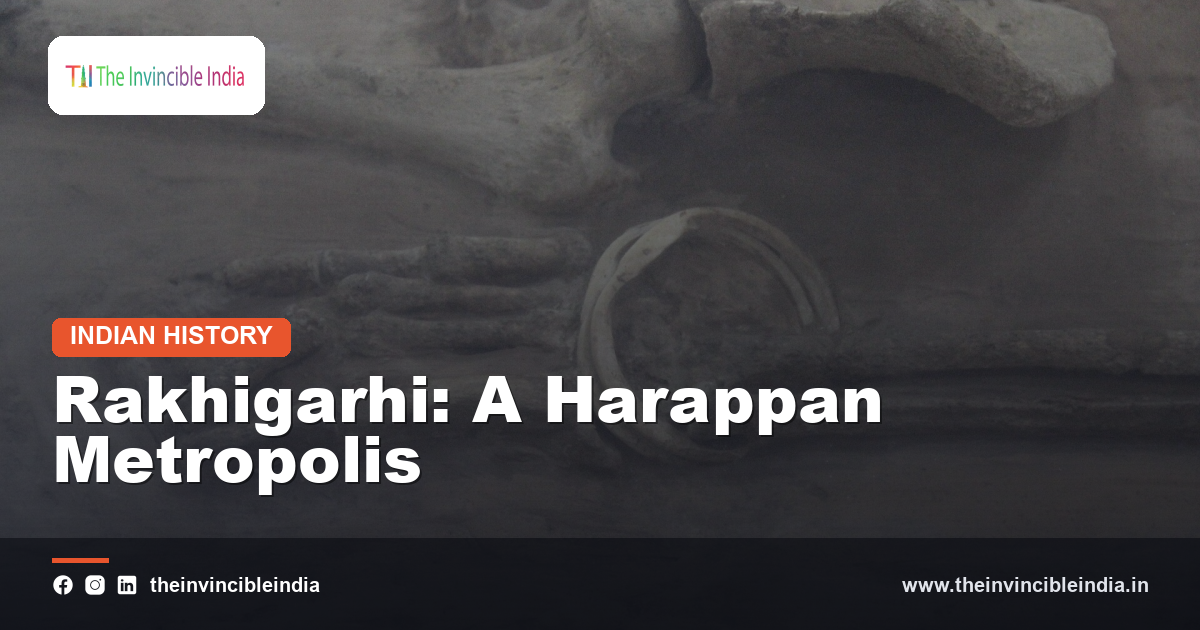
Excavations at Rakhigarhi have uncovered burial areas associated with the ancient settlement, providing valuable evidence about funerary customs practised by its Harappan inhabitants. Graves examined at the site follow patterns broadly similar to those documented at other Harappan cemeteries, including the placement of pottery and other objects alongside the deceased.
Study of skeletal remains from these burials has contributed to wider research on the population that inhabited Harappan settlements, including questions about health, diet and possible connections to later populations of the subcontinent, adding an important dimension to understanding of the site’s beliefs and practices around death and burial.
Seals and the Indus Script
Among the more intriguing discoveries at Rakhigarhi are seals bearing the symbols of the Indus script, a writing system that remains undeciphered despite considerable scholarly effort. These small seals, often carved with animal motifs alongside rows of script, are found across Harappan sites and are thought to have served purposes connected with trade, administration or identification.
Their presence at Rakhigarhi confirms that the settlement participated in the same symbolic and administrative traditions documented elsewhere in the civilisation, and such objects continue to be studied closely for clues that might eventually help specialists understand the script’s structure and meaning.
Decline of the Settlement
Like other major settlements of the Indus Valley Civilisation, Rakhigarhi eventually experienced a decline in its urban character, a process that researchers associate with the broader transformation that affected Harappan sites across the region toward the end of the Bronze Age. Possible contributing factors discussed by scholars include shifts in river courses and water availability, along with broader environmental and climatic changes affecting the wider region.
Rather than a sudden abandonment, evidence from sites like Rakhigarhi generally points to a gradual transition, with settlement patterns and material culture changing over an extended period rather than ending abruptly, aligning with the wider understanding of Harappan decline as a complex phenomenon.
Modern Excavations and Research
Modern archaeological work at Rakhigarhi has been conducted in phases over several decades, employing increasingly detailed excavation and scientific analysis techniques to study the site. Researchers from the Archaeological Survey of India, alongside university-based teams, have contributed to a growing body of published findings covering the site’s architecture, artefacts and human remains.
Advances in scientific methods have allowed researchers to ask more refined questions about the population and daily life at the site than earlier excavations could address, cementing Rakhigarhi’s reputation as one of the most significant Harappan sites in India.
Conservation Challenges
Preserving a site as extensive and significant as Rakhigarhi presents considerable challenges, particularly because a modern village occupies much of the area beneath which ancient remains lie buried. Balancing the needs of a living community with the protection of archaeological heritage requires careful planning and cooperation between residents, local authorities and heritage bodies responsible for the site.
Exposure to weather, agricultural activity and urban development in the surrounding area can all pose risks to unexcavated portions of the site if adequate protective measures are not maintained, making continued attention to conservation essential for future research.
Rakhigarhi Today
Rakhigarhi today stands as one of the most important known sites of the Indus Valley Civilisation within Indian territory, valued both for its scale and for the detailed evidence it offers about Harappan urban life. Ongoing excavation and research continue to refine understanding of the settlement’s history, from its early growth through its mature urban phase to its eventual decline.
The site attracts researchers, students and visitors interested in the deep roots of civilisation in the subcontinent, long before the empires and kingdoms that later shaped Indian history emerged, and each excavation season adds further detail to the picture of life at this remarkable ancient settlement.
Sources & Further Reading
- Archaeological Survey of India (asi.nic.in).
- Ministry of Culture, Government of India (indiaculture.gov.in).
Frequently Asked Questions
What is Rakhigarhi?
Rakhigarhi is an archaeological site in Haryana, India, recognised as one of the largest settlements of the ancient Indus Valley Civilisation.
What has been found at the site?
Excavations have uncovered planned streets, houses, drainage features, pottery, seals with Indus script, and burial areas, among other remains.
How does Rakhigarhi compare to other Harappan sites?
It ranks among the largest known Harappan settlements in India and shows planning and material culture consistent with major sites elsewhere in the civilisation.
Why is excavation at Rakhigarhi challenging?
A modern village sits above much of the ancient site, so archaeologists must carefully choose where to dig without disturbing the present-day community.
What happened to the settlement over time?
Like other Harappan sites, Rakhigarhi experienced a gradual decline associated with broader environmental and cultural changes at the end of the Bronze Age.


